
Theme: Waiting and Exile

CONCEPT NOTE:
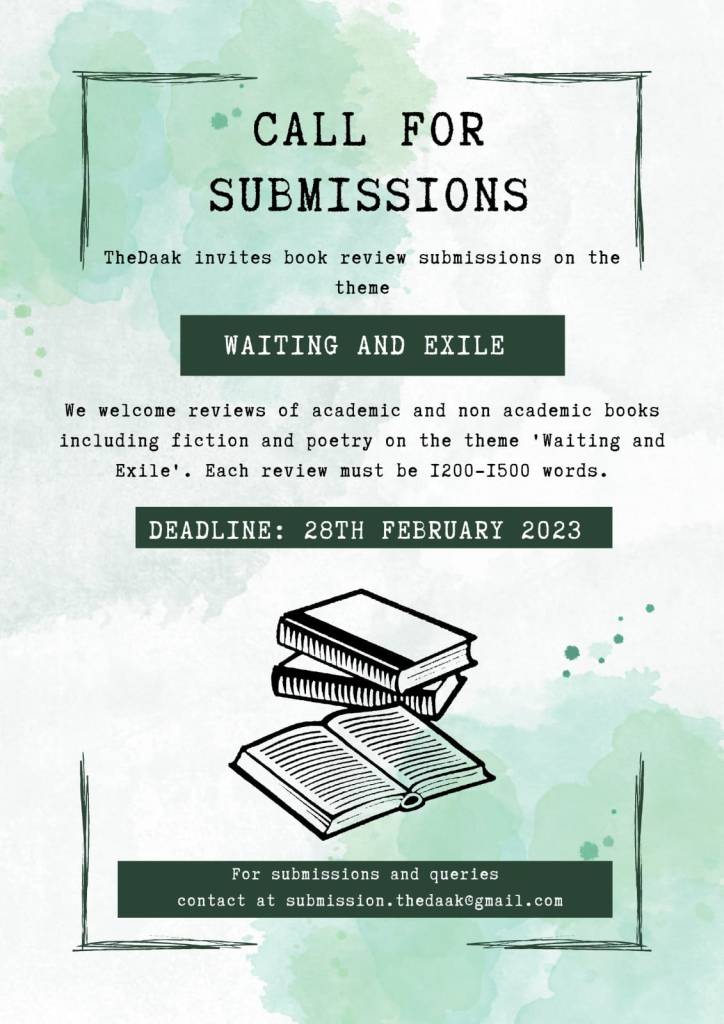
TheDaak invites book review submissions on the theme Waiting and Exile for its second issue.
The passage of time leading to the act of waiting or to be in a particular space without movement could be considered as waiting in both physical and mental space. Being in exile or feeling as if in exile is not just a political or social act but also an individual act. Those waiting or in exile go beyond an aspect of time- frame.
Human life in one way is a determinate act in waiting. We are all waiting to die. The cyclicity of life forms in one sense is an eternal wait to transform or move and change from one form of existence to another. Every night, we wait for the sun. Every sun waits for its fall. Waiting is a passive act of human life but there is in fact an active waiting. The nature of time and existence itself means that life is waiting to happen. But the passive-ness of the wait-act in the living is inherent to this existence. There are also other kinds of waiting. Women wait at home for their men and children to return. Some wait for their men to return from war. Some wait for the prodigal son (child) to return.
Exile can also be a ‘state of waiting’ for acceptance; for those rebels who once broke away from the norms upon which our society is based. In their exile, they hope this doomed world would change for good and they would be spotted as its flag-bearer. They hoped they would not be outcasts anymore. Their exile might not transcend into a physical, tangible entity i.e. they might not actually be distant from their homes like the migrants or the refugees. Their turmoil is internal.
They might not be the prisoners of war in a distant land but they definitely have been the offenders of norms: gender, caste, and class to name a few.They stand detached from their birth identities and have acquired identities to which they now conform. Their new-found conformities have driven them away from people they once called family; because they could never fit in. So they live in exile, sometimes in their ‘homes’ and at others, away from home; bearing hopes of change and acceptance. Acceptance, if not from all then at least, from their own people.
In the previous century, due to myriad reasons – wars, globalization, and urbanization to name but a few – the rates of migration and flight/exile have risen exponentially. The process of stepping outside the geopolitical confines of a homeland is, especially in times of distress, not an easy one. What the necessity of having to leave the comforts of a home entails is an engagement with an infinitely elaborate bureaucratic labyrinth. It is imperative that the subject becomes a helpless witness of the passage of time. The subject must wait till it feels the bittersweet pain of being in exile. The fortunate, privileged ones who are graced with the approval from the authorities carry with them their material possessions, but mostly the anguish of leaving their home. However, this home is not to be found on any number of returns, because now it only exists in memories and in the past. The 21st century human is a product of temporal and spatial displacement.
Discussions on books that speak to the theme of waiting and exile, including questions of migration, refuge and asylum but not limited to these are welcome.
Please send your book reviews to submission.thedaak@gmail.com. The deadline for the same is 28th February 2023. The issue is due for publication on 15th March 2023
Team TheDaak
For any queries write to us at submission.thedaak@gmail.com.
 TheDaak review
Leave a comment