
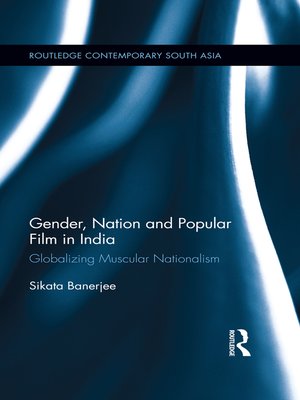
Book: Gender, Nation and Popular Film in India Globalizing Muscular Nationalism by Sikata Banerjee, Routledge, New York152 Pages, Published 2017, 24.10 × 20.32 cm, ISBN: 978-1-138-65399-3, $45.56
Banerjee is a political scientist whose work has focused on gender, masculinity and nationalism. Like her previous work, Banerjee in Gender, Nation and Popular Film in India: Globalizing Muscular Nationalism has sought to understand how manhood and nationalism have been portrayed in Bollywood movies by exploring what she called ‘muscular nationalism’. The 1990s saw the implementation of economic liberalisation and globalisation programs in India, which brought about significant socio-cultural and political changes and the ascendancy of Hindutva politics in India. Banerjee notes in her book that the ascendancy of Hindu nationalism and the triumphalism linked to post-1990s globalisation has constructed a context where “the male body” became “a signifier of India’s new self-confidence on a global stage” (p. 10). By applying the lens of ‘muscular nationalism’ to the popular commercial Bollywood cinema, the author analyses the social construction of manhood and nation in these movies. The author defines ‘muscular nationalism’ as “the idea of nation animated by an idea of manhood associated with martial prowess, muscular strength, and toughness” (p. 9).
The book has been divided into six chapters which examine the different aspects of this ‘muscular nationalism’ by examining different movies to understand –
- the evolution of muscular nationalism in Hindi commercial movies, which is represented by a Hindu male body that is either ready to sacrifice for the nation like in the case of Sarfarosh and Rang de Basanti;
- or defending against the Imperial British, like in Mangal Pandey and Lagaan. Banerjee (2017) analyses the movies like ‘Lagaan,’ ‘Mangal Pandey’ and ‘Rang de Basanti’, to note how these movies validate the contemporary forms of muscular nationalism as a nationalistic challenge to the imperial image of ‘effeminized Indian men’ (p.71). The white women created opposite to the Indian men in these movies have also been portrayed as ones who desire Indian manhood, which challenges the imperial masculinity of the British empire (p.71).
In this background of male muscular Hindu nationalism, Banerjee’s book has also sought to locate Muslim male bodies as represented in popular Hindi movies. There are four substantive chapters which trace the ‘fluctuations’ in the depiction of masculinity in film since independence (Chapter 2), validate muscular nationalism to counter the Imperial effeminized image of Indian men (Chapter 3), locate Male Muslim bodies in popular cinemas (Chapter 4), and the multifaceted muscular nationalism in the imagined Indian diaspora (Chapter 5).
The book is an academic read which allows the author to sit back and rethink all the movies through a gender lens. The book, through various chapters, has etched the idea of ‘muscular nationalism’ in Hindi movies. This idea of muscular nationalism, as portrayed in different films, is embodied through a Hindu male body in the backdrop of the globalizing world. In her analysis of the various sets of movies in separate chapters, Banerjee also paints the picture of a ‘subordinate’ female as opposed to the hegemonic muscular male portrayed in these popular commercial cinemas.
This muscular nationalism is ‘Hindu-tinged’ nationalism which is not necessarily aggressive or violent because “economic globalization has increased religiosity among the Hindu majority”, and ‘Indian’ culture is popularly being conflated with Hinduness (p. 35). In such a depiction of nationalism, the book also notes that Hindi movies do not mechanistically cast all Muslims as the “terrorists” or enemy of India. Rather, the filmic depictions of these men and women have attempted to contain them within the binary of “good Muslim/bad Muslim”, which is “defined by rejections of an aggressive Islamic identity and steadfast explicit patriotism” (p. 79). Islam in popular film, as Banerjee (2017) notes, is not depicted “as a question of private faith but as a public ideology,” i.e. for a Muslim man, Islam dictates his ideology, his identity and all aspects of his social actions (p. 77). As the book notes, Muslim women also occupy an ambiguous position in the Indian body politic. Often, movies portray a Hindu man marrying a Muslim woman to save her from an oppressive religion.
The author compares Indian movies like Pardes, Swades, Kabhi Khushi Kabhi Gham and Namastey London with films like Bend it Like Beckham, Nina’s Heavenly Delights and others written by diasporic Indians. The book notes how those Indian movies are often based on a romanticized idea of India. While diasporic movies often point out how second-generation youth define their spaces in the West while exploring their own cultural identities and spaces. The masculinity projected in the Indian film by the male hero is self-confident and assertive, but at the same time metrosexual in that he can interact with women in the family to take their ‘feminine’ concerns seriously. His proper manhood is articulated by the steadfast belief in protecting Indian women’s virtue. Femininity is again portrayed in terms of modesty, chastity and supporting roles to the male hero.
I remember watching the song Zara Sa Jhoom Loon Mein in Dilwale Dulhania Le Jayenge and thinking that the female actors do not feel cold. The female characters are often characterised in two extreme ways in popular Hindi films. From portraying an ‘abla nari’ or ‘supporting wife/girlfriend’ to independent working women who ‘drink alcohol’, smoke and are promiscuous, these are two extreme portrayals of women in mainstream Bollywood movies. Somehow women have to ‘drink alcohol and be sexually promiscuous’ in a typecasted idea of ‘modern independent women’.
The author highlights the plight of the representation of female characters as chaste, supporting the male character and often in need of the man’s support in the background of muscular nationalism portrayed in Bollywood movies. Masculinity, like femininity, is socially constructed, and hegemonic masculinity dominates other forms of subordinating masculinities and femininities. The book elaborates on how a notion of muscular Hindu nationalism has dominated the idea of ideal men in popular cinemas. The female lead has been constructed in a way which complies with such masculinity. Female (lead) characters in these movies are primarily created as an embodiment of ‘chastity’ and in a supporting role to their masculine counterpart. However, regardless of what form of femininity is embodied in muscular nationalism, purity has been a constant trait of the female body, symbolising national honour and providing a moral code for the lives of women in the nation. Muscular nationalism generally centres on a gendered binary: martial man/chaste woman (p.10). Like the plural nature of masculinities, there are multiple forms of femininities – one which conforms to hegemonic masculinity and one which challenges such norms.
As mentioned earlier, the book has aimed to locate the embodiment of the ‘Hindu Male Body’ in popular Bollywood cinema as a new idea of muscular nationalism in India. The book steers itself in this direction from the get-go. While curving its way through different movies, the book brings forth a new lens of – gender, masculinity and nationalism – in analysing the ‘popular’ Bollywood film. In doing so, Banerjee’s book does fall short in many aspects.
First, the conflation of popular cinemas with Bollywood Hindi movies personally does not suit the narrative of popular cinemas and muscular nationalism. Even though Bollywood Hindi movies can have more commercial value, in this current situation where regional cinemas dominate the theatres and are dubbed in Hindi, it is a severe limitation to conflate popular films with just Bollywood movies.
Secondly, the book has a long list of movies which Banerjee uses to convince the readers to agree with her arguments. Banerjee’s argument of the creation of subordinate female characters in Bollywood movies is very restrictive, whereby she has limited her analysis to look at the female lead in the movies. She has not expanded much on the ‘sacrificing mothers’ portrayed in the movies like Rang de Basanti and Lagaan in supporting these ‘masculine men’.
Thirdly, the choice of movies and the list of films is so expansive that the readers tend to get lost in the chapters. The book also locates the movies in a fifteen-year time frame- 1995-2010, without justifying why this particular period was chosen. Certain films were selected to set the tone of the author’s arguments throughout the book. The preferred movies are either critically acclaimed or have done great at the box office. Moreover, the movies selected by the author claim to be popular. However, the films have no parity in their performance or critical acclaim. For instance, Mangal Pandey was technically a ‘flop’ movie paired with Lagaan to understand the imperial history behind the new muscular nationalism in India. However, the author does not justify why a particular cluster of the film was chosen for specific contexts by the author has not been examined properly.
Similarly, the movie My Name is Khan (2010), which was a box office success, somehow did not make it to the list of the author even when she locates the portrayal of the Muslim male body in Hindi films. Movies like Gupt (1997), and Dil Chahta Hai (2001), which were commercial successes, should have been included in the discussion. It feels like the movies were chosen to fit a particular preconceived notion.
Moreover, although the author has examined several films against the backdrop of muscular nationalism, it remains unclear how this form of masculinity intersects with other identities – caste, race and colour in popular cinema. There cannot be a monolithic idea of gender – femininity or masculinity. The book does not go beyond the character portrayal of the male lead in different movies to understand the intersection of his masculinity with his other identities- caste, class, race, colour etc. A closer read of the societal positioning of the male ‘heroes and a deeper understanding of how the notion of muscular nationalism intersects with the different identities will give the much-needed nuance to the idea of muscular nationalism.

Sanjukta is a PhD scholar from the Centre of International Politics, Organisation and Disarmament, Jawaharlal Nehru University. She is passionate about research and currently pursuing different research engagements.
©TheDaak2023
 TheDaak review
Leave a comment