
Book: India’s Nuclear Titans: Biographical Tales
“This volume is not a validation of India’s stand on the nuclear regime. Nor is it about trying to understand this trajectory and help assess the future. It is simply the stories of people who toiled to make India the exceptional nuclear case that it is today”
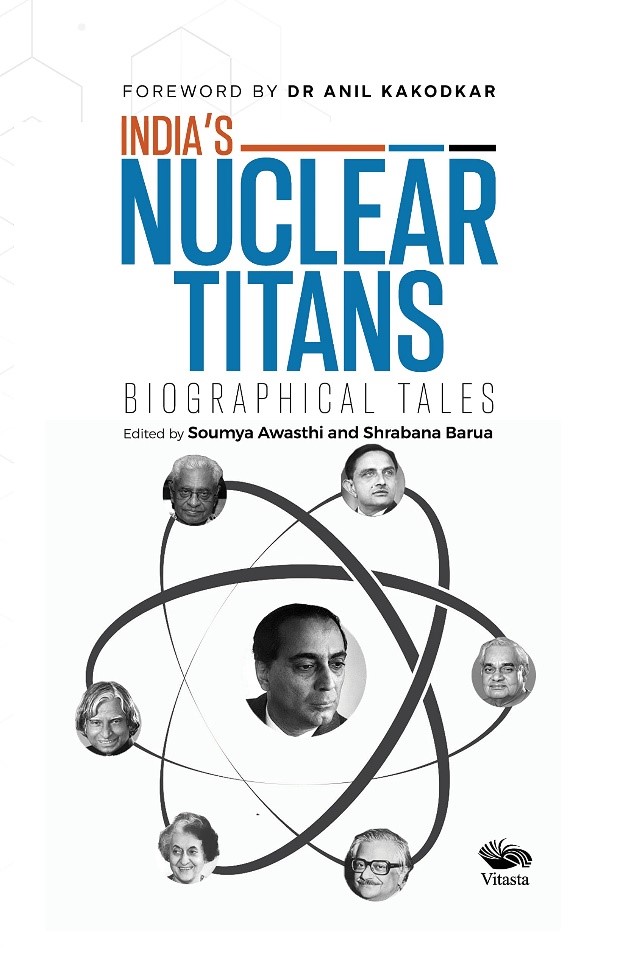
Book Excerpt
The monumental work of George Perkovich, India’s Nuclear Bomb: The Impact on Global Proliferation (1999) is one of the best works that gives the comprehensive story of how India became openly nuclear in 1998. But the timeline stops there. Raj Chengappa’s Weapons of Peace: The Secret Story of India’s Quest to be a Nuclear Power (2000) falls into the same genre of nuclear history and strategic studies. There are many others in India who have written exclusively on issues of nuclear matters, mostly from a security point of view. Experts such as Achin Vanaik, Brahma Chellaney, Itty Abraham, Bharat Karnad, Uday Bhaskar, Robert Anderson, C Raja Mohan, among many others, come to mind when we think of India’s nuclear program and nuclear policy related issues. Amitabh Mattoo and David Cortright’s work, India and the Bomb: Public Opinion and Nuclear Options (1999), is another meaningful addition that provides a pool of data on how the nuclear tests were perceived by people in India. The surveys, aimed at gauging public opinion (Cortright presents his data in a separate paper written in 1996 that gauges the elite opinion), were rendered useful for policy making on nuclear issues later. On the other hand, scientists have regularly guided policy pertaining to India’s nuclear technology and programme.
Having said that, the literature on the subject remains inadequate in its attempt at analysing the role of people – whether scientists, statesmen, diplomats or strategists – who have relentlessly contributed in catapulting India into the nuclear map of the world. When Homi Bhabha is celebrated as the father of India’s nuclear program, it is a tribute well deserved, but one that is limited in its understanding. The nuclear program is the making of many such fathers and sons, sisters and daughters of India who find sparse references in the field of nuclear study in India. Similarly, when the United Progressive Alliance (UPA-I) garners credit for furthering India’s positon in the use of nuclear power, it only provides a macro image of the progress India has made in the nuclear world. How that progress has been made, is scarcely documented. Who are the people that worked (and are still working) towards making this progress a reality, is even poorly so.
The point is, how many of us are aware of the life struggles and experiences of people who have made India’s achievements in the field of nuclear science possible? Of course, we know how Homi Bhabha and Vikram Sarabhai were among the pioneers, encouraged by statesmen like Nehru at the time. We learn about them through scattered sources and their biographies. We know how Indira Gandhi approved nuclear tests in 1974. We may stretch a bit more and include the names of Abdul Kalam or AB Vajpayee for instance, to the list of people whose names are familiar in the context of India’s nuclear policy and programme. They are among the more popular personalities. Yet, we lack a body of work that is focused on people as the ontological core of stories related to India’s nuclear history. Robert Anderson writes in his book Nucleus and the Nation: Scientists, International Networks and Power in India that the definition of who comprises nuclear “‘community” is stretched widely here, beyond physics, to include most of those people who considered themselves part of the scientific community. Thus, not just mathematicians and astronomers but also doctors, engineers, lab technicians, industrial and medical researchers, and technologists were included by definition in India’s scientific community’ (2010, p. 5).
More recently, under a joint project by the Atomic Heritage Foundation and Los Alamos Historical Society, a series of interviews have appeared, titled ‘Voices of the Manhattan Project’. It is a collection of oral histories, and shares the experiences of the people associated with the Manhattan Project that gave birth to US’s nuclear programme and the race for nuclear weapons in the 1940s. Similarly, in India, we have some biographies (of Homi Bhabha, AB Vajpayee and many others) as well as autobiographies (for example, Raja Ramanna’s, Years of Pilgrimage, 1991) that give us a peek into how people have achieved what they have in context of India’s nuclear story. But we are left wanting to know more, to get a more complete picture.
A new show, titled ‘Rocket Boys’ was streamed on Sony Liv in early 2022, while the second season is being streamed successfully in 2023. Directed by Abhay Pannu, it has managed to captivate the interests of a large audience, mostly the youth. It is a great attempt to deal with a topic, through a medium that resonates with the millennials and the Gen Zs, as a reviewer of the show put it. But there is a need to compliment these stories through the medium of books as well. As it is, the series faces the same problem that the book attempts to address, i.e. it eulogises the select few.
There is a need for reading the story of nuclear India under a new light, a light that helps us glimpse into the lives of the people who have toiled in its making and how they managed to do so. If scientists and physicists are the creators of nuclear devices and technology, and statesmen the executioners of the nuclear program; strategists are the planners and diplomats the negotiators in the world of nuclear politics. Further, there are the others who labour at various levels to provide manual support to the higher echelons in the field, the stories of whom remain unsung and efforts disregarded. In fact, even the lives and struggles of the popular personalities remain confined to narrations at annual celebratory events or in the works that are singularly biographical.
The nuclear history of the world is markedly different from that of India. It is not only an interesting journey to trace the making of nuclear India but also an endeavour open to debate since no law or act guides nuclear policies in India. Determining what and who shaped nuclear India is an exercise that enriches one’s experience as a scholar and reader.
The book is edited by Soumya Awasthi and Shrabana Barua
 TheDaak review
Leave a comment