

“Listen, and you will realize that we are made not from cells or from atoms. We are made from stories.”- Mia Couto
Some stories are told for everyone to hear and remember. They are retold until they become truths. Other stories are whispered, sometimes as prayers and at other times as rebellion- feeble, fading and afar. There are also stories that are never uttered, never heard. Stories that are silenced.
Stories and silences are at the heart of identities, culture and communities. They are how humans make sense of their sufferings and struggles, and of their hopes and aspirations. Both silences and stories are burdens of the self. They become ideas we have and give about ourselves, our history and destiny.
In this issue we have the pleasure to present to you both the stories and silences punctuated by each other. Stories that break the haunting silences of mainstream and popular narratives. We find that often silence itself is a story. These books have given voice to the experiences of people who have been silenced by power structures, and of those who have chosen to break free of it.
Issue 04 Narratives: Stories and Silences brings reviews from across genres to bring forth the narrator, the narration, and the narrative.
WIDE SARGASSO SEA

Book: Wide Sargasso Sea by Jean Rhys, W.W. Norton & Company, 2016, 176 pages, ISBN: 0393352560, ₹ 799
A key area of focus for feminist and post-colonial scholarship and praxis has been the project of (re)constructing narratives as spaces for revision, retelling and ‘creative intervention’ (Bhabha, 1994:3) in literary texts. Embedded within established narratives are hierarchies and asymmetries of power. Dismantling these hierarchies requires us to reconceptualize the narrative. As Virginia Woolf notes in her seminal essay A Room of One’s Own, for women (and the colonised) to find a voice of their own, ‘’breaking the sentence’ and ‘breaking the sequence’ of the (dominant) narrative is of great importance. Revisiting old texts– looking back at them from a new, critical perspective, dragging to the centre-stage characters that are at the margins- constitutes a crucial enterprise in all emancipatory social theories aiming to break the hold that the past has over us.
An interesting and noteworthy work in this regard is Dominican-born Jean Rhys’s Wide Sargasso Sea. Set initially in post-emancipation Jamaica and then in England, Rhys’s novel is a prequel to Charlotte Bronte’s classic Jane Eyre. The novel recasts Bertha, Mr Rochester’s first wife, as the tale’s protagonist. Though of utmost importance in driving Bronte’s story, the Creole-born character is, in the words of Spivak, ‘banished to the margins’ (Spivak, 1985), both literally– she is kept locked in the attic on the third floor– and figuratively– she suffers from madness and lunacy, thus morally condemned and pushed to the periphery. Rhys however yanks her from obscurity and re-imagines her in a story of her own.
Rhys’ retelling is divided into three parts, the first and third of which are narrated by Antoinette Cosway (as she was known before being made Bertha) and the second by Rochester. The first part spans Antoinette’s troubled childhood: born to ex-slave owners, she spends her day in isolation and poverty, distant as she is from her Martinican mother whose mental condition has been deteriorating following her husband’s death and ostracised by the natives who treat her with contempt for her class and race. Simmering discontent among the freed blacks manifests itself in the form of protests outside Antoinette’s residence. The house is accidentally set on fire, injuring Pierre, Antoinette’s younger brother, seriously, and forcing the family to flee. Upon recuperating from her six-week long malaise following the incident, Antoinette learns of her brother’s demise and her aggrieved mother’s descent into madness. At the end of the first part, Antoinette’s stepfather visits her in the convent, where she’s been living for several years among other Creole girls.
Antoinette’s English husband narrates the second part: his hastily done marriage for which he gets thirty thousand pounds, his misgivings about their marriage, his impatience with and dislike of the place and its people, their crumbling relationship as a consequence of a letter, infidelity on his part, Antoinette’s echoing of her mother’s frenzy and their ultimate departure for England. The third part is a recollection of Bertha’s (the name Rochester gives her) seclusion and emotional tumult in England, where she was locked in an attic and held captive under the supervision of Grace Poole, a servant. Violent and hysterical, she dreams of setting her husband’s mansion ablaze. Rhys ends the novel on an ominous note: Bertha walks down the stairs with a candle in her hand.
Jean Rhys’s story from the perspective of the subjectified colonial is an authentic and unfiltered reflection of women’s social and psychological realities. Notwithstanding the subversive elements of her re-told narrative (which we unpack in a minute), things are to be said about Rhys’s writing style: her way of telling her story has a Ferrante-like quality to it, urgent, unsettlingly candid, attentive to details and not a word in the wrong place. Her ingenious method of first-person narration provides insights into the minds of the characters, making the narrative a fertile ground for identity formation and interaction.
The relationship between Mr Rochester and Antoinette Cosway typifies the sexual and colonial encounter. In the lopsided power dynamics, it’s not solely the facticity (a wrong word perhaps) of Antoinette being a woman that her subordination is based on, her status as a Creole– neither a European nor an African– equally sustains this imbalance. The seemingly trivial act of Rochester refusing to call Antoinette by her original name and choosing instead to use the name Bertha constitutes what Spivak calls as epistemic violence: the denial of the coloniser to acknowledge the local cultures and identities and attempting to remould them. Making Antoinette Cosway into Bertha Mason Rochester not only deprives her of something as fundamental to her being as her name but also imposes upon her an alien identity, one that is divorced from who she really is, one that defines her entire self in relation to the men in her life: she is the stepsister of Richard Mason who sold her and wife of Mr Rochester who bought her. Nothing more, nothing less.
Rochester and Antoinette symbolise two different beings, two different cultures, two different subjectivities. This is fleshed out adeptly through the diametrically opposite ways the two frame their narratives in their respective parts: hers fragmented, muddled, unpredictably moving back and forth and vividly raw and his overly critical, evaluative, prejudice-laden and finicky. Interestingly, it’s this distinctly ‘incoherent’ and ‘senseless’ way of speaking that characterises Antoinette in the third part of the novel when she loses any awareness of time and place, which poses a resistance to the masculine rationality that Rochester embodies. By constantly resisting the identity Rochester imposes upon her and breaking, as in not adhering to, historical and spatial continuity and consistency in the story she narrates, the colonised resists rationality, certainty and fixity, lying at the core of the imperial project.
More importantly, Rhys’s narrative grounds female hysteria in systemic power dynamics: both Antoinette and her mother are driven to madness as a result of acute psychological trauma stemming from their experiences of isolation, abuse and ostracism. They mirror each other in this regard: in a patriarchal setting, both are forced to depend their sanity and well-being on (white) men, who exacerbate their suffering and push them to the brink of mental breakdown. Simultaneously their ‘in-betweenness’ engenders anxiety and uncertainty, their existence strung out between two incompatible cultures both of which are unwilling to accept them.
The last scene of the novel is full of ambiguity: Bertha dreams of herself being beckoned by her black childhood friend while a man’s, most probably Rochester’s, voice calls her; she screams her friend’s name and jumps. Does this visionary reunion with her childhood friend reflect her reconciliation with and acceptance of who she is? Or does her jumping represent her ultimately succumbing to the cage she’s been imprisoned in? We never know. But we do know that the ‘madwoman’ of Jane Eyre wasn’t always such, that it was the interlocking system of oppression that pushed her off the cliff. And that says a lot about what Rhys’s retelling has been able to achieve.
References
Bhabha, Homi. (1994). The Location of Culture. Routledge.
Spivak, Gayatri C. (1985). Three Women’s Texts and a Critique of Imperialism. Critical Inquiry, 12, 243-261.
Funck, Susana B. (2011). Of Mimicry and Woman: A Feminist Post-colonial Reading of Wide Sargasso Sea and the biggest modern woman of the world. Revista Estudos Anglo-Americanos, 36, 65-91.
Mardorossian, Carine M. (1999). Double [De]colonization and the Feminist Criticism of “Wide Sargasso Sea”. College Literature, 26(2), 79-95.
Pratham Gupta
I’m a first-year Pol Sc undergrad at Hindu College. When not swooning over Hozier or Gulzar, I’m found arguing vociferously why Rohinton Mistry is the best author while having DSE-ki chai & rusk.
He can be reached at dpsvn.prath11001@gmail.com
TO KILL A MOCKINGBIRD
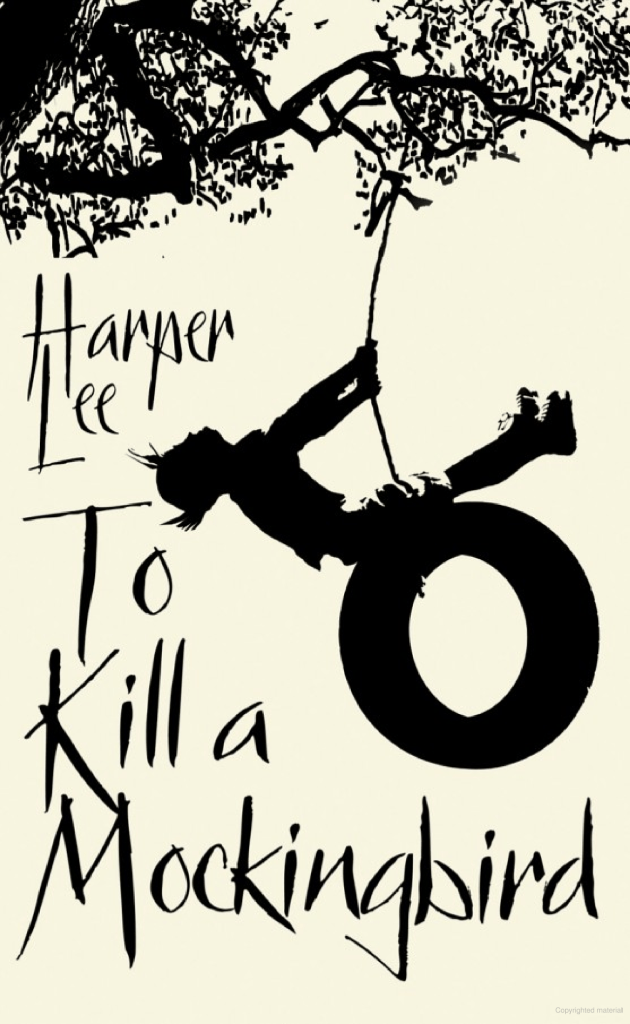
Book: To Kill a Mockingbird by Harper Lee, Arrow Books Ltd, 2015, paperback, 320 pages, ISBN: 978-1784752637, ₹279
Literature has long been a tool for authors to hold a mirror to society and bring forth conversations that happen in whispers, to the public consciousness. It forces us to challenge our assumptions, expose social injustices and awaken our conscience to take action. To Kill a Mockingbird by Harper Lee is one of the finest examples of how a piece of literature can prompt crucial conversations about prejudice in institutions and the crushing impact it has on systematically disadvantaged communities. Published in 1960, when the civil rights movement was gaining momentum, the novel’s visceral depiction of entrenched racism and how prejudice was weaponized through State has led it to become an important work in American literature.
The novel is written from the perspective of Scout and Jem Finch, children of Atticus Finch, a distinguished attorney. The book is set in the deep South of Alabama during the 1930s in a fictional town called Maycomb. Maycomb is an old, sleepy town. A town where everyone follows predictable daily activities. A close-knit community where everyone knows everyone, and most people are related to each other either by blood or marriage. The initial description of southern charm and idyllic lifestyle is slowly revealed to be a facade as the town’s long-held family histories and social hierarchies have ossified into distinct divisions between social classes. These distinctions are overtly visible in physical separation, with the African American community residing in a separate part of town known as ‘the Quarters’. This difference is extended even to places of worship where the not-so-subtle irony of equality is preached.
The insidious manifestations of racism are most impactful, not in the physical separation but in the psychological separation. Lee creates a vivid town, where all interactions among people begin with stereotypes based on their class. ‘‘It’s just goes to show you, all the Penfield women are flighty.’ Everybody in Maycomb, it seemed, had a Streak: a Drinking Streak, a Gambling Streak, a Mean Streak, a Funny Streak” (p. 142). In Maycomb County, class, not individual behaviour, is used as the yardstick to judge people. In essence, virtue is class-ridden, and morality is class-bound. The author seamlessly presents the interplay of these social narratives within the functioning of societal institutions like the education and the justice system.
The centrepiece of To Kill a Mockingbird is the trial of Tom Robinson, a black man falsely accused of raping a white woman. In the intricate world of the justice system, evidence serves as the cornerstone of the legal process. Evidence provides the factual foundation upon which decisions are made, guilt or innocence is determined, and justice is served. In cases like sexual assault, when concrete evidence is hard to come by, the trial often devolves into a battle of narratives. Each side presents a compelling account that weaves together facts, opinions, emotions, and perspectives to construct a coherent and convincing story. But what happens when emotions are biased, and perspectives are based on racist morality? Lady Justice is said to be blind, but is it truly ‘just’ to be blind to an unequal society?
These are the questions that are beautifully raised by the author through the trial. Atticus Finch, who is the father of the protagonist, valiantly strives to prove the innocence of Tom Robinson. Atticus is the moral compass in the story. A paragon of integrity, empathy, and morals, his presence resonates throughout the entire novel. He forges ahead with fortitude despite the racial prejudice and hostility he faces from the community.
The trial scene is one of the finest depictions of witness examination in literature. The prosecution’s approach is firmly based on manipulation of facts. They seek to dismiss the defendant’s credibility by appealing to racial bias in the jury and presenting the resulting narratives in the society as natural. The prevailing social dynamic is so overwhelming and overpowering that Tom is unable to accuse a white woman of lying; instead, preferring to say that she is “mistaken in her mind” (p. 218). The racial narratives are entrenched in the society to the extent that the oppressed cannot break them even when their own life is at stake. The prosecution perpetuates the dehumanisation and marginalisation of Tom Robinson based on preconceived notions of guilt due to his race. The utter disregard for truth is starkly contrasted by Atticus’s approach.
Atticus presents an unwavering dedication to providing Tom with a fair trial. He presents a compelling case that exposes the inconsistencies in the prosecution’s line of argument. His stoic demeanour is unaffected by the frequent innuendoes to prejudice the jury. He confronts the jury on their entrenched beliefs and urges them to pursue the truth rather than resorting to negative stereotypes associated with African Americans that perpetuate social injustice. The courtroom scene depicts the battle between the narratives employed by the oppressors and the unwavering commitment of those who have a belief in the power of truth and integrity. Through this, To Kill a Mockingbird poignantly showcases the devastating effect systemic racism has on the oppressed and the oppressors.
Harper Lee’s To Kill a Mockingbird is unique because despite its examination of important issues like prejudice, justice, and its setting within the American judicial system, it is essentially a Bildungsroman. A Bildungsroman is a genre of literature which deals with novels about the formative years of the protagonist and their psychological and moral growth from their youth into adulthood.
The seamless and effortless blending of the coming of age of the protagonists with discussions on the wider themes of education, justice and racism make the novel a pleasure to read. As with any coming-of-age book, we see the childlike innocence of the protagonists in dealing with everyday life. The attribution of the unknown to the supernatural, an inability to understand the adults’ way of thinking, and an idealistic concept of how the world works are all important facets of the story that make it charming to read. The novel beautifully presents situations where the deeper meaning is understood by the author and the reader, but the protagonist, due to her innocence, is unable to grasp the true meaning of the events she is witnessing. The writing style creates a deep connection between the readers and the story as they see the growth of the children, as if we are a member of the Finch household. The novel presents the growth of Scout, who grows to understand the injustices of the society they live in. This is where the central theme of the novel comes forward.
“Shoot all the bluejays you want, if you can hit ‘em, but remember it’s a sin to kill a mockingbird” (p. 99)
It is a sin to kill a mockingbird because they bring only beauty and do no harm. The Maycomb community would rather validate their deeply ingrained prejudices with closed eyes than pursue the truth and protect the innocent. The book encourages us to view the world with compassion and empathy. A just and inclusive society is one which challenges prejudice and stereotypes, protects marginalised individuals who are unfairly targeted and stands up for what is right, even in the face of adversity. It is a sin to harm the innocent and we must treat all individuals with dignity and respect, regardless of their race or social status.To Kill a Mockingbird by Harper Lee serves as a reminder of the power of literature in pushing society towards justice. The way it addresses social inequality through the eyes of children slowly realizing the evils of the society they live in, makes it a must read for anyone with an appreciation for the art of storytelling. Its impact will continue to reverberate with readers for generations to come.

Aditya is an avid reader of fictional novels and is currently serving a self-imposed exile from bookstores until he completes his reading list. He can be reached at adityatemail@gmail.com.
THE BOOK OF GOLD LEAVES

Book: The Book of Gold Leaves by Mirza Waheed, Penguin Books, Published: 2014, 280 Pages, ISBN: 9780143422839, Rs. 399.00
“In the dark times
Will there also be singing?
Yes, there will be singing.
About the dark times”
Bertolt Brecht
Svendborg Poems (1939), trans. John Willett
The epigram “Motto” by Bertolt Brecht encapsulates the vicissitudes of turbulence-ridden times. On one hand, it suggests that despite the harshest adversities, the art of expression has an unyielding resilience, but on the other, it suggests that conflict becomes the dominant leitmotif of dark times. Thus, the all-pervading nature of a conflict captures our imagination in a way that both our songs and silences narrate the tales of the same. Similarly, Mirza Waheed’s novel The Book of Gold Leaves takes us on a poignant journey where he unravels the nature of chaos that dark times entail. While normalcy is the first thing that is robbed in times of conflict, the hijacking of desires and dreams is perhaps conflict’s greatest collateral damage. Both the mundane and the extraordinary are shaped by the invisible hand of turmoil. Likewise, the world created by Mirza Waheed in his novel highlights how each character’s destiny is inseparable from the zeitgeist of political instability. The novel is set in the early 1990s in downtown Srinagar. The author narrates the story of the region’s rapidly changing political landscape and the effect it has had on the lives of different characters. The novel displays the love story of Faiz and Roohi against the backdrop of sprawling military presence. It goes on to outline changes in the daily activities of local residents following heavy militarisation of the city: from late-night outings to deafening silences on the roads at dusk. The tragic exodus of Kashmiri Pandits after the selective targeting of the community has also been narrated in the book. The spawning of army bunkers at every nook and cranny along with the conversion of hotels into torture cells creates a psyche of fear. Makeshift bunkers are set up in school “rooms that have for ages listened to the whispers of the older girls, the laughter of the younger ones”(p.64).
The novel is successful in exploring the complexity of human existence through the portrayal of love between Faiz and Roohi. Despite being set in a war-torn state, where basic survival takes precedence over catering to an elaborate array of human emotions, the spark of love ignites the protagonists. Faiz is a naqāsh ( papier-mâché artist) who earns a meagre income and supports his large household and Roohi is a spirited, headstrong and attractive woman who dreams of experiencing a love story.
The picturesque scene of the swirling breeze sweeping everything on its way conspires the lovers to meet. Waheed portrays the power of destiny writ large. The characters succumb to its force, mindless about consequences and oblivious to social realities. As in any quintessential love story, it is only when characters are all engrossed in love, the jolt of reality strikes, making the lovers see what seemed invisible at its inception. In the case of Faiz and Roohi, they each belong to different sects of Islam. So, they have to navigate not only through the political turmoil which is all-encompassing but also through deep social cleavages Waheed’s lyrical prose gives us a glimpse of the shared world that Roohi and Faiz create together while juxtaposing it with the vivid details of the grimness that engulfs the city. “They dream and dream. Together and alone. They meet and talk, the evening prayer their pretext and sanctuary” (p.71). But the rapidly deteriorating political climate results in the city being subjected to a round-the-clock curfew. Thus, “All movement proscribed. All meetings banned. All life besieged. A deathly calm has spread everywhere, as soldiers circle the area from sides”(p.89).
Faiz’s character takes a dramatic turn when there is an attack on a school minibus and his Godmother is killed in a crossfire. As a result, he swings to “the borderland between sanity and insanity, or, that, his mind is filled with the thoughts of escape, of flight, or running away and freeing himself. He cannot take it anymore”(p.106). The need to escape the state of helplessness pushes him to become a militant. His artistic brilliance at papier-mâché seems meaningless when he cannot contribute to a greater cause. Remaining true to his artistic sensibility— like his namesake Faiz Ahmed Faiz whose poetry is marked by defiance against the might of President Zia-ul-Haq— Faiz marches unwittingly towards the mission of bringing justice to his people. Waheed explores the notion of how conflict drags individuals out of their personal space, a sensitive artist transforms into an armed fighter. The luxury to remain“apolitical” is lost when immediate lives are at stake.
Mirza Waheed has also touched on the significant theme of unplanned development in Srinagar. Unregulated urbanisation has blocked the city’s natural drainage canals and the network of lakes has collapsed. The devastating flood of 2014 was a grim reminder of the need to reevaluate the parameters of development in an ecologically sensitive area. The nostalgia about the currently non-existent Nallah Mar canal invokes a sense of remorse in the novel. Environmentalists cite the filling up of the Nallah Mar navigational canal which connected Bari Nambal to the Khushal War lake and its conversion into the Nallah Mar Road as an ecological disaster. “This road, too, was built on water, filling yet another artery of the city”(p.86). Such issues of great significance become marginalised in conflict zones as people are forced to focus primarily on the concerns of life and death. Waheed suggests that there is a lot that goes on in the background of the conflict. However, the events from the background get lost into oblivion. Therefore, conflicts create selective memories of history. While the consequences of conflict usuallly focus on death, destruction and despair, a range of events and episodes from the history of a region are erased alongside. Waheed maintains that the presence of a canal in the place of Nallah Mar road will, in a similar way, become a legend to be forgotten by posterity.
The plight of the Kashmiri Pandits who were forced to leave their home during the upheaval is represented by a sense of loss to Kashmiri culture. Waheed depicts the heart-wrenching details of the departure of Faiz’s immediate neighbour, Dinanath’s family, who had been his neighbour for at least half a century. The mass exodus of Kashmiri Pandits shook the very foundation of the Valley’s composite society, as it witnessed a radical shift in the aftermath of their departure. Principal Shanta Koul’s transformation from being an assertive woman who speaks her mind to living as a forced recluse for survival captures the painful complexity of the shifting power dynamics. However, the novel gives scant attention to the fact that an element of insularity has a tendency to brew when communities grow in isolation.
Waheed justifies the narration of the story about Kashmir by a Kashmiri with his usage of colloquial expressions throughout the novel. One is reminded of Chinua Achebe’s “Things Fall Apart” where Achebe deliberately introduced Igbo words and metaphors into a novel written in English. While it is refreshing to know the sociopolitical landscape of Kashmir from the lens of a native, it is equally baffling how Waheed has glossed over the Shia-Sunni divide in the Valley. The phenomenon of inter-sectarian marriages doesn’t enjoy general social acceptability in the Valley. However, Roohi and Faiz’s relationship receives an easy acceptance from their respective families. Minor resistance from some insignificant characters doesn’t adequately reflect the magnitude of opposition such relationships/marriages face. Waheed wants to show that the sectarian divide retreats during times of adversity, yet, at no point can one ignore the fact that conflicts can often exacerbate parochialism.
Overall, The Book of Gold Leaves is a riveting story about love during a time of conflict. It captures the layered complexity of the Kashmir conflict by providing it with a human element. It explores the richness of tradition bequeathed to the region from the plurality of different cultures. Waheed’s melodious prose accentuates the beauty of the Valley’s geographical distinctiveness, which has earned it the sobriquet ‘Firdaus’. The outstanding element of the novel is the authenticity of its narration, as the writer gives the reader an insider’s view of a person living and loving amidst dark times.

Mehnaz Abdullah is a research scholar at MMAJ Academy of International Studies, JMI
WHO DO YOU THINK YOU ARE? THE SEARCH FOR ARGENTINA’S LOST CHILDREN

Book: Who Do You Think You Are? The Search for Argentina’s Lost Children by Andrew Graham-Yooll, Calcutta, Seagull Books, 2011, 104 pages, 18.5 x 11 x 1.5 cm, ISBN: 9781906497774, 395 INR
Rarely does a small book comprehensively encompass a heavy and layered account of history using multiple narrative forms, but Who Do You Think You Are manages exactly that. Grappling with past narratives and their present consequences, the book contextualises Argentina’s military dictatorship—and its use of targeted, tactical violence under General Videla—through a mix of official history, personal anecdotes and playwriting.
Between 1976 and 1983, 10,000-30,000 Argentines were kidnapped and killed, their whereabouts and fate often still unknown. These men and women had their lives and identities erased by the junta, while their children were seized and later raised by the same personnel. Those targeted were academics, activists, left-leaning thinkers and liberals who opposed the right-wing military regime.
At the time of these ‘disappearances,’ Argentina was considered among the most advanced societies in South America. The author emphasises this point to demonstrate that systematic violence is usually, by design, perpetuated by the pursuit of power and appealing to historical justification. The repressions were considered unnecessary, and although never directly admitted to, Videla is noted for stating: ‘the disappeared do not exist, they are neither alive nor dead, they simply do not exist’ (p. 6).
A generation of voices and thinkers were thus silenced — annihilated by a single regime. Graham-Yooll highlights that ‘it is not surprising that military regimes that seized power in what became one of the most highly literate countries in Latin America burned books, destroyed universities and demolished cultural centres in the name of combating foreign ideologies and strange religions to erase a section of society as an identity’ (pp. 49-50). He notes: ‘it is still open to debate whether the military came to government in Buenos Aires to eliminate the children of their captives’ (p. 34).
Who Do You Think You Are contextualises ‘the disappeared’ as part of the many lives lost and forgotten in what the author calls the twentieth-century catalogue of horrors. The book delves into the numerous examples and forms of state-sanctioned genocide in the 21st century: the Armenian genocide, the holocaust, South African apartheid, and ethnic cleansing in Russia, China, Rwanda and Eastern Europe. The devastating evidence of humanity’s cruelty in pursuing political power while destroying and disregarding people, history and identity is unavoidable. The author reminds us, with examples that span the beginning of the twentieth century, that organised mass slaughter of people of specific political, ethnic or religious groups is often planned by educated people using naturally devised strategies to annihilate ‘others’ (p. 13). The title of the book itself contains a much more difficult suggestion: how are we to face stories and truths about ourselves, and what happens when we consider that our identity might be different from the officially stated?
The book can be divided into two halves: non-fiction and fiction sections. The non-fiction section is further divided into five topical chapters. The first half of the book, if not more, sets out the historical context for how the experience of ‘the disappeared’ echoes the demands for people-led justice to this day. The second half of the book contrasts and punctuates this narrative with short plays— demonstrating how art can indirectly infer the past and evoke the seriousness and confusion of a violent, traumatic legacy. The interaction of fiction and non-fiction creates a valuable liminal space to consider what is known, what is reported and what is expressed. It also reflects the current reality of this historical topic: these children are still discovering their true identities around the world.
The book presents the reader with some fundamental broad questions about the social construction of public memory and the falsification of identity. Graham-Yooll explores Argentina’s Spanish colonial past, explaining how their colonial ideals and way of mythologising the past made way for the justification of future oppressions. The book then discusses official censorship and the memories of those whose identities were erased: the children of the desaparecidos or ‘the disappeared.’ The children adopted by their appropriators — the term given to describe the people who adopted the children of the disappeared— were often the same ones responsible for killing their parents. These children were sometimes raised as slaves and only discovered their identities later in their lives, if at all. This difficult subject is carefully treated through the craft of multiple narratives.
The book is one example of how the right-wing military violently targeted the left in South America, in the context of the Cold War, continuing the frightening inhumanity and legacies of ‘othering’ people. It highlights the important fact that narratives are built around questions asked and the desire to uncover truths that are often difficult to tell or to face. Particularly striking is the author’s mention of the plight of the Roma in Europe, noting that, as a group, they continue to face societal injustices (p. 23). In a parallel to ‘the disappeared’, children or subsequent generations often bear the difficulties of past realities and narratives of exclusion rooted in racism or other differences. The important point is that “attention span in children is one of the cornerstones of education because it helps to build memory which is a necessary part of identity; yet society in the 1970s was intent on developing a conditioned personality, a different identity, by altering memory through censorship” (p. 41-42).
Graham-Yooll’s book begins with “A Question of Identity”, and the simple facts surrounding the inhumanness of what was made possible by the right-wing military regime, the actions taken to silence ideological opposition and to continue a project of cleansing its subversive elements. The work in its entirety raises the issue of social constructions of the identity, of collective memory, and of the ways in which fiction and reality can engage through constructed narrative. One of the profound statements in the chapter suggests: ‘Sometimes, nostalgia takes the place of reality, and the longing for something remote becomes an exercise distorted by sentiment. Memory becomes shadowy, a cloudy reflection of the past. Recollection loses its power to hold real images, and certain aspects of identity are thrown into doubt’ (p. 3). He further notes that ‘the destruction of native cultures was never seen as a loss, only a necessary by-product of progress, a view that persists today’ (p. 15).
“Fabricating the Past”, considers the role of fiction to re-tell, reformulate and explore narratives about the past, referring to different types and roles of fictional history. “Argentina: A Suitable Case for Treatment” summarises the political transformations leading up to enacting a disappearance policy. Videla’s military regime had sought to quell its opposition following his ascent to power via a coup. To avoid negative publicity, the government maintained a secret policy — using a para-official terror group— to stifle political dissent through what can only be described as a form of ‘ideological cleansing’.
As a result, a generation of left-leaning activists, liberals and thinkers were erased from the continent. And a generation of their children had their identities erased and replaced after they were adopted by military or terror personnel. The very people often responsible for getting rid of their parents later raised and adopted the offspring. The trauma of this twisted legacy is something yet to be addressed, with children of ‘the disappeared’ still being located worldwide.
The book’s second half is structured around two awareness-raising plays (translated by the author), selected from the Theatre of Identity: A Propos of Doubt by Patricia Zangaro and In Labor by Marta Betoldi. Both use playwriting as a means of storytelling through theatrical dialogues, revealing the personal pain and confusion of not knowing one’s identity, and of the lasting connection between a mother and her child. The role of fiction is partially a necessity to cope: “Too much documentation has been lost… thousands will never know the whereabouts of the bones of their next of kin, friends and children. Argentina lost a considerable chunk of the story of a generation by the action of an archaic military establishment with its eyes on ‘ideological cleansing’ ” (p. 39). Yooll further notes that “it has been fiction that captured the public imagination” (p. 20).
Storytelling is a way of dealing with the discrepancies between sense-making and facts. The second half of the book presents two very moving theatrical dialogues, which offer different points of view and temporalities to the complex emotionality and experiences of the children of the disappeared. Using the negative space of suggestion and imagination rather than articulation shows how the power of arts can fill in for the gaps in memory and communicate difficult truths steeped in trauma and emotionality.
Grave atrocities may seem commonplace in history, and perhaps outnumber the loss of life recounted in the case of Argentina. Yet, the examples in the book seek to prove a bigger point: that facts can explain heaviness and complexity much less than when we attempt to understand history, its omissions and oppression through art. Whether as poetry, or as theatre, stories can reveal meaning without a betrayal of truth: “Though the full story of the policies and the victims or the military may never be known, the experience may help to set patterns of awareness and responsibility for the widest possible audience” (p. 29). It may never be known, but it can be inferred.
A Propos of Doubt offers a seemingly fictionalised dialogue between the Grandmothers of the Disappeared, the appropriators and the missing children who do not know their real identity. Using mise-en-scene and simple sentences, it repetitively poses a haunting question: Do you know who you are? “For as long as there is a single person with their identity stolen and forged, the identity of all is in doubt” (p. 59). The provocation and eeriness surrounding this question is a lasting one. The play, like the injustice of the disappearances, is a search for identity, justice and reconciliation that continues to this day.
In Labour presents a dialogue of private exchanges between a mother and her future child, marking her hopes and dreams for it. It concludes with the physical pre-labour pains that likely mimic her emotional state as the open-ended question of what a child may look like, suggesting that the mother may be the child of a disappeared. The dialogue does not directly state anything; it only implies and leaves the reader to infer the parallels between the mother’s identity and her daughter’s anticipated birth. It also reflects the strong love and ties between a mother and her child.
Storytelling methods such as personal narratives, local memory campaigns, and art empower people to pursue justice. In the case of the grandmothers of the disappeared, their demonstrations reflect courage and resistance while calling for accountability for the human rights violations inflicted by the military dictatorship. The book appears to challenge the idea of a cohesive national history as being of a fixed and unified concept— one that is rejected by a rejection of state terrorism and its surrounding opaque narratives. It does so by offering more voices, versions and questions.
What defines fiction and non-fiction? What is truth, and what is reality? The contrast in sections reveals that far too often, they are similar or tend to fill in for one another. The fictional half of the book is powerful, able to communicate aspects and emotionality of the time that the first part of the book could not directly articulate. Both plays bolster the facts raised in the book’s first half, supplementing people’s voices as they struggle with the past. These two parts of the book —fiction and non-fiction — speak to each other and the reader effectively, providing a glimpse into the traumatised psychologies of those affected and the murky terrain between knowing and not knowing.
Overall, Who Do You Think You Are shows that these difficult truths are often too traumatic to face. But, even more compelling is that it resonates deeply in an era where alternative facts challenge officially held national narratives. The author deftly combines history and art to balance official and creative narrative constructions while making space for questions about the forgotten. This helps to imagine spaces for alternative realities while showing us that, more often than not, history risks repeating itself. It raises questions about the legacies of violence, the forms of hidden violence that persist across generations as trauma, and how realities, histories and memories are constructed over time.
The official narratives extend from the past to the present through the lives of the children, stolen and appropriated in a form of trauma that cannot be fathomed. It is an example of what happens when systems and power become self-serving and obscuring—at all costs. These are the stories that cannot afford to be forgotten. They are not easily simplified, categorised or explained as black and white. And they are told, retold and revised because the questions surrounding the official narratives are often too disturbing for people to deal with. Memory, memorialising and forgetting are aspects of official history. Many societies are struggling with their consequential reality. Many of these are interconnected stories, but the main point about alternative and expressive narratives is this: they defy being censored, and they articulate alternative spaces for emotions to ensure that the atrocities people are capable of will never be forgotten or repeated. Nunca más: Never again.

Shriya is a graduate of McGill University and The New School—currently exploring the intersections of art and policy. Her research interests include Art, Policy, Development, Climate Change, and Population Health.
She can be reached at Shriyaisnot@gmail.com
ANTS AMONG ELEPHANTS: THE CONTINUITY OF DISCRIMINATION IN ERAS OF RADICAL CHANGES

Book: Ants Among Elephants – An untouchable family and the making of modern India by Sujatha Gidla, London: Daunt, 2018, 320 p., 13.8 x 2.6 x 19.6 cm, ISBN:1911547224, 10,99 £.
Sujatha Gidla’s book Ants Among Elephants describes the personal and political developments in and around the author’s family in the 1940s until the early 1960s. It provides insights into the life of a Dalit family during big shifts of power within Indian society. While the aim of the book is not intended to be a lesson on intersectional feminism, Gidla’s piece entails deep insights about the social position of a Dalit woman. A lot of social dynamics are displayed in the book, leading to tremendous changes within the social fabric, but discrimination against a Dalit woman is the “stable” theme of the book. This review will focus on a few sections of the book contextualising those fragments with ideas about intersectional discrimination.
Early Years and norms of Gender and Caste
Manjula (Sujatha Gidla’s mother), the protagonist in the book goes through different periods of her life, beginning with her childhood and the development of her social position during the 1930s. At that time, she profited from her brother’s intellect and a high social position owing to her father’s employment in the army. For a Dalit family like Manjula’s, social ascent by wealth was often connected to well-paid jobs like one in the army. In Manjula’s case, she was even regarded as “the master’s daughter” (p 113). Still, Manjula had to follow certain rules based on her gender and caste. For example, when Manjula started attending college, her family made her look as “unattractive as possible” (p 113) to keep her away from boys in general and boys from other castes in particular. To enforce rules, Manjula was slapped by her brother Carey. Her oldest brother Satyam tried more subtle methods like gossiping about girls who did not follow the social conventions. In this way, Manjula learnt the specific manner in which a young woman was expected to behave. In general, this shows how the role of women was mediated to her so that she internalised certain behaviour and thoughts for the rest of her life.
Internalising certain actions and her own social position is a key theme of the book. It also comes up in the context of class-related behaviours. For example, Manjula and her friends of lower castes who visited the school for the first time did not even notice that they were being ignored during the breaks and could never join conversations with the other students. Interestingly, caste-based discrimination played a bigger role in the early childhood of Sujatha (Manjula’s daughter). The family could not keep the high-army income, and the deterioration of their finances was reflected in their social status. While Manjula grew up in more protected neighbourhoods where she was somewhat regarded as an equal, it was different for Sujatha. The neighbours’ children harassed Sujatha and her siblings. They entered the family house while Manjula would be away for work and cut the sister’s hair with carpenter tools as they felt that Dalit children deserve such treatment (p 136). A backward economic position made it hard not only to protect the family from incidents like these, but also from ill health as doctors and medicine were hard to reach.
This reflects a form of exclusion specific to lower-caste (and poor) women that scholars like Sharmila Rege have pointed out specifically (2018; 1998). They underline that feminist movements and anti-caste movements did not address these kinds of intersections. Thereby they left many perspectives unacknowledged and ignored the possible solidarity between many more groups. Ants Among Elephants reflects exactly these dynamics, telling the specific stories of poor, Dalit women which can not be subsumed under either the story of a poor person, a Dalit or a woman.
Economic Discrimination and the double-burden of women in (Dalit) families
In the following section, I take on the economic dependency of women within Sujatha’s family. Starting with a scene of an injured Marthamma, the grandmother of Satyam, Carey, and Manjula. Carey was angry at Marthamma, who asked him for help in household chores. In his anger, he pushed his grandmother and she fell and broke her hip. At that time, Carey was unemployed and seeking to finish his degree and Satyam was the sole breadwinner. Due to her old age, Marthamma could not recover fully. After discovering this, the situation appeared clear for the family – as Gidla puts it in two sentences:
“[W]ho was going to cook and clean for the three of them [Carey, Satyam and Manjula]?
It was time for Satyam to get married.” (p 158)
During Satyam’s marriage, he made some demands which were equal to the tasks which Marthamma handled before. On the one hand, this showed how dependent the entire household was on one person. On the other hand it also revealed the degree of a woman’s dependency on the family which was produced through different means. It was maintained structurally in society by obstacles to access education and jobs. And it was upheld within homes through threat and fear of domestic violence. It was harder for women to get a job even with an equivalent degree of education as men. Further, the chance for the same education was also worse, women were to be much less likely to be sent to school.
Gidla further accounts the economic dependency of wives on their husbands against the backdrop of specific social dynamics. In this regard, Manjula’s economic dependency on her husband, Prabhakara Rao, could be observed in the early years of her marriage. She relied on Prabakhara’s money and had no big influence on how it was used. Instead of spending the money in a fair split, Manjula suffered severe medical problems while Prabhakara Rao consumed luxury products like tea. Due to major social changes, it was possible for Manjula to find a job and become independent financially. As a reaction to this, her husband started using violence to not feel subordinated and to protect his self-esteem:
“Prabhakara Rao only defended his mother’s “authority” against Manjula. Other than that, he never did anything for her. He never brought her things she liked to eat, never walked her to church, never even talked with her much. Yet he chased and beat up his wife to champion his mother.” (pp 260- 261)
In the end, Manjula had to work to earn money and ensure the health and comfort of her whole family. In general, economic dependency seemed to be a factor of suppression, as it helped the husband to control the spending. But further, the book reflects on the misguided male pride. Since the husband was not the sole breadwinner due to his wife’s economic position, violence became the new means of control.
Manjula did not want to marry but outside the institution of marriage there was no other way to ensure her safety. Her first marriage failed because of an exorbitant demand for dowry. Dowry demands are a unique way of ensuring caste and class endogamy. Being engaged once, Manjula’s social position had dropped. Gidla writes:
“After all, engagement is practically marriage. Something had gone wrong with a girl for her to be discarded at such a late stage.” (p 307)
This meant that she had to take any man to maintain her economic and physical security, which for her resulted in a situation of domestic violence. One major way out of this situation was Manjula helping her husband to get proper education and the resources to earn money. Ironically, by this she took the responsibility which her husband Prabakha Rao should have taken to overcome the injustice for which he was responsible in the first place. All these scenes of domestic dynamics connected the economic and social realm to the dependency of women on their male relatives. Gidla’s account shows that some of the demands of more (social) liberties and formal equalities did not transform into the domestic realm. Rather at times, the violence or the increased work of women formed part of the reaction to such changes.
Public Institutions as Places of Subordination
Further on, Gidla reflects the injustice faced by Dalit women in public institutions. Manjula was discriminated against in various situations and ways during her educational life. She was mistreated and she suffered more punishment than girls from other castes. Later, when Manjula was accepted in University, she was noticed by other men more than before. Sujatha Gidla describes a scene involving a “modern” female student, called Rajeswari:
“When Rajeswari walked by, the boys made fun of her strong talcum-powder scent and loose braid, while at the same time tripping over each other to catch a glimpse of her bra strap through her blouse.” (p 201)
The student was part of Manjula’s batch in the University of Andhra. She was devalued at first, only to give the men the power to objectify her as a sexual object later. This creates the classic pattern of simultaneous disempowerment and exploitation. Here, it is less connected to the necessary care-work but more to sexuality. Also, it leaves the domestic area, showing that the internalised norms are present in public institutions despite public sentiment and discourse which calls for formal equalities.
Conclusion
In Ants Among Elephants, we find vivid storytelling with sudden turns. Sometimes scenes are described in great detail while (e.g. scenes which contain images of domestic violence which where “burned in my [Gidla’s] memory” [p 233]) some major changes (especially the political ones) are regarded as a given.
This makes it seem like an authentic display of Gidla’s very personal memory about her family. Also, the sentences are neither boring nor do they entail many frills. This authenticity is what makes the book a real page-turner. Through my recommendation, I want to add to this reception that the book manages to display many specific characteristics of suppression of Dalit women with immense clarity and especially the persistence of discrimination against the backdrop of radical political change. Gidla’s piece conveys to a broad audience how Dalit women were marginalised in a Hindu-majoritarian, patriarchal society which was supported and stabilised by the British Rule. Still, after the independence of India, many internalised behaviours, language and power resources did not change dramatically or persisted through new ways. Ants Among Elephants does not raise bigger ethical questions explicitly, but rather shows the overwhelming injustice faced by Dalit women in the past, giving a clear picture of the lack of political measures until the present. The vivid story of her family and the specific choice of scenes is helpful to understand why Dalit women continue to strive for justice today and how political change must be looked at closely.
Further References
Rege, S. (2018, originally 1998): A dalit feminist standpoint, in: Seminar, Vol. 710
Vishwanath, R. (2015): Caste and Untouchability. B. Hatcher (ed.) Hinduism in the Modern World. Routledge, pp. 257-274.

Konstantin Mallach holds a Master in Development Students (SOAS, University of London) and has previously studied in Göttingen (Germany) and at the JNU. Currently, he works for a German MP in the field of development policy to support the just designing of development partnerships.
He can be reached at konstimallach@gmail.com
ACCUMULATION BY SEGREGATION
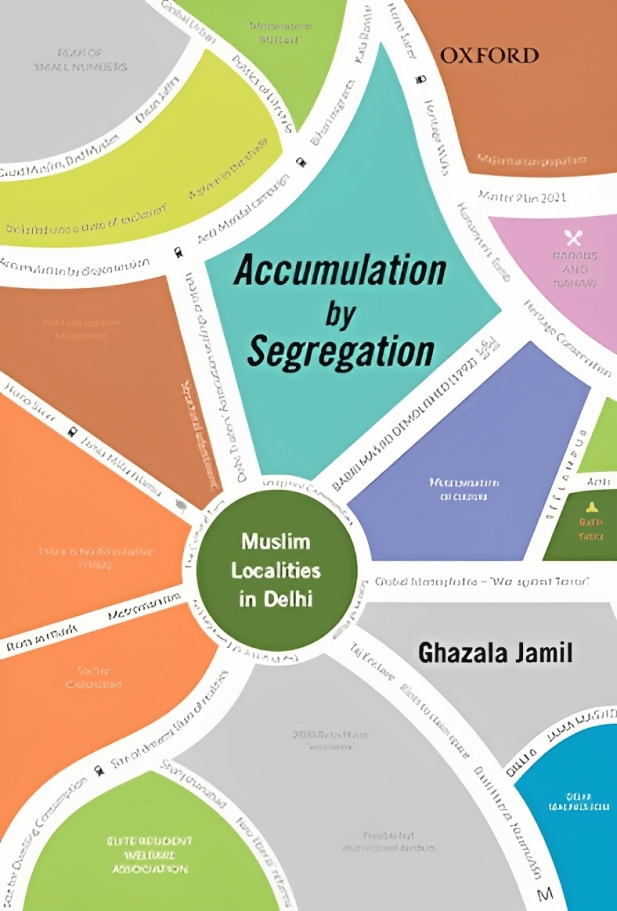
Book: Accumulation by Segregation by Ghazala Jamil, India, OUP India, 2017, 244 pages, ISBN: 9780199470655, 750 INR.
by Rizwan Hamid
Muslims in India continue to live in precarious conditions. Being classified as a minority implies more than just their small numbers; historically, it has implied a completely varied identity, negatively affecting their political, social, or cultural lives. With complete disregard for the geographical and cultural diversity within the Muslim community, postcolonial Muslims in India are differentiated by their aspersed identity. Within this overall restriction, which frequently took violent turns and formed the circumstances for surviving, Muslims had to negotiate their citizenship. Muslims’ circumstances were affected by their humiliating, dehumanising, and stereotypical identity.
Seen in this light, this book by Ghazala Jamil is an intervention into the conditions of Muslims in Delhi, studied as a part of the globalisation process. It provides readers with a systematic way of looking at the segregation of Muslims in Delhi. It looks at segregation in the context of the 1857 mutiny, the partition of 1947, Emergency and communal violence, and examines the relationship between globalization and segregation. It also examines the discursive practices perpetuating and strengthening the Muslim identity as anti-modern, backward, and unchangeable, thereby hindering the developmental potential among Muslims.
The author argues that comparing the historical ghettos of the Jewish population in Europe to the concentration of Muslims is misleading. The situation of Muslims is not primarily caused by coercion, violence, and oppression but rather by the limited options they face. This makes their situation historically specific and functionally distinct, warranting critical examination.
The book largely focuses on areas in Delhi, including parts of the walled city and localities outside Shahjahanabad; Seelampur and other trans-Yamuna Muslim areas in North Eastern Delhi. It also includes Jamia Nagar in South Delhi; Nizamuddin and Nizamuddin West, and the Taj Enclave. Through ethnographic explorations, Jamil explores the city’s inhabitants’ memories, living experiences, dreams, and discontent.
Violence, displacement, discrimination, migration and hope remain common in making these settlements. Various events, such as post-partition violence, the beautification drive during the emergency, and subsequent violence associated with growing Hindu nationalism, particularly in Gujarat, have contributed to the establishment of these settlements. As a result, a large influx of people migrated to settle in Delhi. By the late 1980s, segregation in Delhi on religious identity lines became almost final and complete (p. 5). These settlements faced various forms of discrimination, including being labelled as centres of terrorism, poverty, backwardness, and fanaticism associated with Muslims.
These places are identified as Muslim settlements and are subsequently termed ‘mini-Pakistan’, as with Seelampur. These conditions further determine the relationship of Muslim settlers beyond the segregated areas.
In the context of economic liberalisation, Delhi provided a sense of security in segregation but also better educational and economic opportunities to Muslims. Capitalism is found in Muslims as an ‘incarcerated resource’. For example, in Jamia Nagar, students with the requisite skills are making their place in the global economy. In Seelampur, the small manufacturers, both semi-skilled and unskilled labourers have ‘benefited’ from manufacturing jobs brought to India by globalization. But what is making them functionally distinct and incarcerated resources from other beneficiaries is that their involvement with globalization is restricted by their location in the segregated areas, which limits their movement and confines them to these areas only. Globalization, in this case, is not promoting progress but rather enforcing separation and discrimination, creating barriers that are challenging for Muslims to overcome.
Muslims are incorporated into the capitalist objective of maximizing profits. However, their situation is distinct due to several limitations. Firstly, they receive less financial help from banks and lack capital, both socially and financially. Additionally, they face a disproving work and business environment. Moreover, they are often viewed as enemies, backward, stagnant, and traitors. These factors ultimately determine their terms of incorporation with the outside world. Hence, making the point that aspersed identity has a distinctly exploitative and material function.
Despite segregation, the real estate business thrives within these settlements while keeping the segregated topography of Delhi undisturbed. Within these processes Muslim neighbourhoods have become complex and diverse in economic classes. Zakir Nagar Extension, Jogabai Extension, Johri Farm and Taj enclaves have emerged as affluent enclaves, areas of the neighbourhood where the wealthy citizens are clustered. Despite being wealthy, the residents are unable to leave their neighbourhood because Hindu property owners in other sections of the city refuse to sell or rent their homes to Muslims or because they see a threat of violence or claim to have had already experienced it. They try to enclose themselves and try to become less like the popular stereotypes about Muslims.
The author argues further that old Delhi, Jama Masjid with adjoining areas and that of Nizamuddin fell prey to commodification from the 1990s. The less significant structures, the Partition’s history and legacy, the clothing, the eateries, and the fragrances all serve as living artefacts and installations for tourists in addition to the historical monuments and religious sites in the region. The taboo topics of Muslims and “Muslimness” have evolved into odd, even weird, spectacles for the adventurous.
People flock to the streets of old Delhi to explore the exotic and the antique, reducing the inhabitants to spectacular displays for the consumer while rendering political contestation and mobilization difficult (p. 91). Through accumulation, it functions as a means of constructing the identity of individuals, connecting them to a particular place and creating an impression of an inherent and unchanging nature.
Jamil notes that in this effort of commodification, the state, civil society, and media are all involved, promoting history tours and good exotic Muslim foods to tourists. Keeping these things in mind, marketable Muslims in segregated areas has to remain as it is for the consumption of others.
Ghazala Jamil, drawing from Althusser, argues on the same lines that ideological state apparatus is reflected in cinema and media representation. She argues that Muslims and Muslimness are always shown and understood as homogenous entities, with utter disregard for their variation in political interest and in cultural practices. This notion is sustained and perpetuated in popular media films. Where the lines between reality and the stage are blurred. The author here analyses various Hindi movies during the period between 2008 to 2010, where the popular image of Muslims depicted as fundamentalist, parochial and backwards was given a space and subsequently uncritically consumed by viewers. When examining print media descriptions, it is evident that irrational attitudes, dangerous behaviour, volatility, and backwardness continue to be prominently used to portray incidents involving Muslims, often generalising the entire community.
Further, framing her case through fake encounters, extra-judicial killing, and differential treatment, she claims the Indian Muslim is fashioned as homines sacri. They are being made to “feel guilty for the partition of the country, represented as irrational fundamentalist fiends, loathsome and polluted, disloyal normative non-citizens, and potentially dangerous terrorists”(p. 99).
Homines sacri, according to Trevor Parfitt (2009), are individuals who have been placed outside the boundaries of the law, rendering them outlaws. They can be harmed or even killed without any legal repercussions. Their lives are meticulously planned, controlled, and regulated in every possible aspect.
When employing the concept of ‘homo sacer’ for Muslims in India, akin to its application to Jews in concentration camps, it raises the question of how to interpret the legal constitutional rights granted to Muslims in comparison to the rights that Jews were deprived of. This brings to light the inquiry as to how the treatment of the Muslim case, which Jamil considers “historically specific and functionally distinct,” falls short in addressing this issue.
The author puts forth a convincing viewpoint concerning the Muslim community’s struggle with a deficit in citizenship and a feeling of alienation within the political sphere. This argument carries logical weight as it emphasizes the obstacles faced by Muslims in fully exercising their rights as citizens and achieving a sense of inclusion within the larger political framework.
Particularly since the rise of right-wing governments, hatred against Muslims has become more crude and naked; where everything associated with Muslims is being politicized and then criminalized. Every activity in the eyes of sponsored vigilantes has become some or other kind of jihad against the government and the people. Responses from the government include intimidation, demolitions, and arrests of victims guised as perpetrators. With the unfolding of these events, experts are even raising concerns over the situation and its striking similarity with past historical atrocities.
However, this violence is not absolute. The Muslim remains an equal citizen theoretically capable of posing counter-hegemonic discourse, which the author does acknowledge. Therefore, it is crucial to approach the situation of Muslims with an understanding that their experiences, though marked by violence, do not reduce them to the status of ‘homo sacer’, as they retain the capacity for political agency and the ability to contest dominant narratives.
The author in the end puts her hope in education and the growing enthusiasm around it among Muslims. Muslims themselves are expected to make interventions in their own circumstances and discourses around them. For instance, measures to combat epistemic Islamophobia would also require adjustments in other areas. This can be found in the ‘Discursive-Political’, which encompasses manifestations of daily life, culture, and behaviour and are primarily considered non-political. These activities, as she claims, involve transformative political practices that reveal the ‘contingent and socially constructed’ nature of what is portrayed as ‘necessary and natural’. The effective resistance for her is to claim and assert citizenship and be able to represent and define rather than getting defined.
References
Parfitt, Trevor. (2009). Are the Third World Poor Homines Sacri? Biopolitics, Sovereignty, and Development. Alternatives: Global, Local, Political, Vol. 34, No. 1 (Jan.-Mar. 2009), pp. 41-58.

Masters student at the Department of Political Science, Jamia Milia Islamia, New Delhi.
He can be reached at rizwanhamid689@gmail.com
COURTING HINDUSTAN: THE CONSUMING PASSIONS OF ICONIC WOMEN PERFORMERS OF INDIA
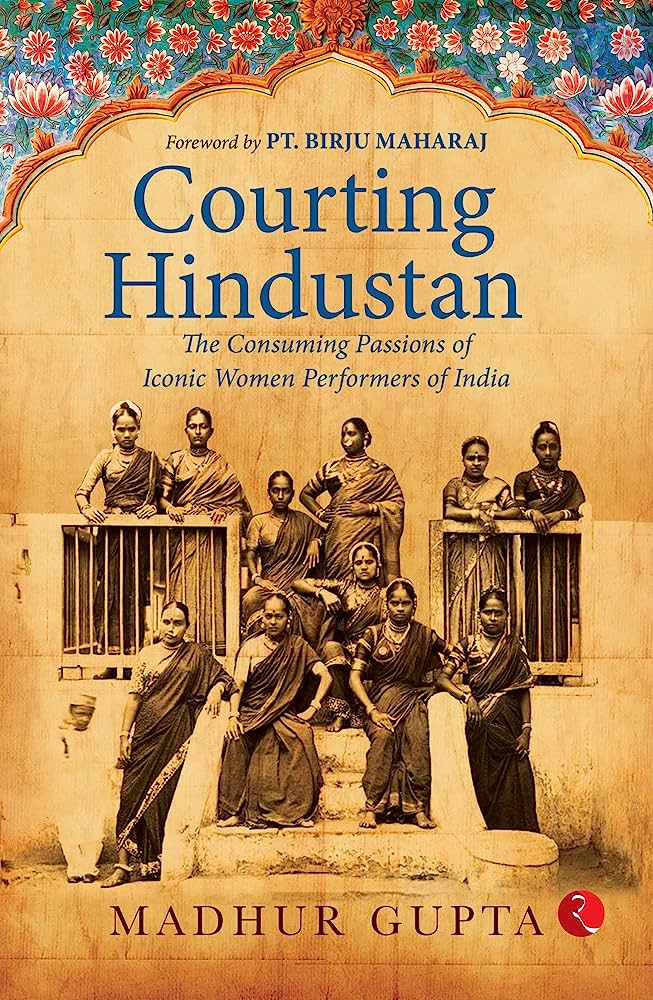
Book: Courting Hindustan: The Consuming Passions of Iconic Women Performers of India by Madhur Gupta, New Delhi: Rupa Publications, Paperback, Published: 5 May 2023, 208 Pages, 19.8 x 12.9 x 1.18 cm, ISBN: 978-93-5702-103-6, ₹ 228
If one were to analyze the socio-political placement of women in the cultural project of modernity in India, they would come across as a very complex tale of both empowerment and subversion. On one hand, there were movements in support of women’s rights, while on the other hand, a section of women was vilified, silenced and criminalized on charges of moral pollution. The women of the latter group stayed outside the conventional norms of marriage, spent life with suitors of their choice, and lived and worked under the public eye. Their ‘non-marital sexuality’ and association as ‘women who were in the public gaze.. accessible to all’ made them socially repulsive – ‘fallen and dangerous’ (Dewan,2019, p.2-4). Their ways of living could not fit into the cultural imaginations of a monogamous-patriarchal structure of the newly emerging middle-class. The nexus of the colonial state and a group of Western-educated reformists started to look at these practices as exploitative and any female sexual activity outside marriage as prostitution and illegal. They sparked off the anti-nautch movements from the 1890s and finally on the ninth of October, 1947, the Devadasi Abolition Bill was passed (Subramanian, 2006, p.125-127; Gupta, 2023, p.172). By tampering the image and silencing the voices of these women from the cultural memory, these episodes turned into a history of violence when the artistry and knowledge of these women was squeezed out from them without even a fleeting mention of their acknowledgement. These processes marred them not only of their reputation but also economically by snatching away their livelihood. This community of women who were pushed into obscurity were the female performers and courtesans. They were chronicled by several names like nagarvadhu, tawaif, baiji, devadasi, nautch-girls et cetera in different parts of the country and at various points of time.
The courtesans carried strong matrilineal lines of performing tradition and underwent rigorous training in music, dance, and literature. In the pre-colonial times, they were regarded as ‘cultured women’ of high status in the society, expected not just to entertain the royalties but also to participate in the temple rituals (like in the case of the temple dancers or Devadasis of South India) and, serve as the guardians of art and culture. Titles such as ‘jan’ or ‘bai’, argues Gupta, were markers of such social standing (Gupta, 2023, p.5). In the North, young male members of the aristocracy (princes, nawabs-to-be) were sent to many tawaifs to learn good behaviour and social etiquette (tameez and tehzeeb) along with various male musicians and artists who also accompanied and trained with them. (2019, p.2). They were also quite active in the political spheres, some of them acted as important advisors of the monarchy running their day-to-day governing business and commanding the military in times of need. Since the nineteenth century, all that their persona got reduced to was a figure of prostitute – luring, swaying and trapping noblemen away from their households. Their free will and agency on matters of their sexual partnership and terms of living did not go well in the eyes of the Western colonizers and the newly-English educated native intellectuals who were guided by the Western ideals of Victorian morality. In their place, a new set of upper-caste women of ’respectable’, middle-class backgrounds were substituted as necessary steps taken to ‘reform’ and ‘purify’ the space of performing arts (Bakhle, 2005, p.5; Subramanian, 2006, p.115).
Active processes to invisibilize these women from the cultural memory started happening in many ways. To rise above the social stigma, the moral guardians gave them the forceful alternative of marriage and an honourable domesticated life. In reality, however, like the author has observed in the case of Begum Akhtar, this meant choosing between the art-form or the domestic life. In most cases, the upper-class man would show the broad-mindedness to marry a tawaif/devadasi but after the marriage, rarely did he approve of her performing in public, putting into place the subtle practice of purdah. The newly independent state and its apparatuses, brought stringent laws to deprive them of their patrons and opportunities for public performances. While the commercial ventures of the gramophone and film industry enabled them to survive after the first few years of independence, state-run cultural entities, like the All India Radio, openly made attempts to dehumanize them in order to curtail their traditional ways of living. In this context, the author has cited the interesting example of Jaddan Bai who was the mother of the famous cinema actress, Nargis and the first female filmmaker, producer and music-director of the Hindi film industry.
“Jaddan ensured that her daughter grew up respectable. That may be the reason why Nargis was not taught how to sing. Those who remained gaanewalis had to suffer discrimination when the All India Radio put out a preference for married female vocalists over them. The gaanewalis were even required to use a different entrance so that their presence at recordings would not annoy ‘normal’, well-born employees (2023, p.136).”
Saba Dewan’s work has further made another interesting observation of the usage of nomenclatures at this time to distinguish women performers of the two different worlds. The colloquial term “gaanewalis” used for the tawaifs were often pitted against “gayika”, the Sanskritized term preferred for the married women from respectable household (p.5).
The cultural memory about these women entertainers have existed in two ways.Some solely chose to remember their skills, artistry, poetry and compositions, separated from their private lives. For others, the latter aspect of scandal and gossip about these women held more importance. The famous tawaif, Gauhar Jaan has been remembered for her feisty and extravagant character. She was the first to use the gramophone device in India at a time when the male ustads dreaded using the microphone, fearing the loss of their voice. Besides boasting her vocal prowess, Gauhar Jaan was known for her smart, bargaining skills of striking the perfect business deal with the foreign record companies. Janki Bai on the other hand, is remembered in the music fraternity by the acronym of “chappan-churi”- after she survived fifty-six stabbings by one of her lovers. Both these singers saw the epitome of their social status, glory and wealth when they were invited to perform for King George V at the Delhi Durbar in 1911. However, the results of their spendthrift habits did not go down well in history. They died with extreme penury, betrayed and robbed by their lovers and today lay in unknown graves in slum areas, forgotten in time. This was all that the moral policing eye chose to remember and document. It is only recently that the archivists and private music collectors have been finding a large corpus of unknown traditional bandish (Hindustani compositions) from their sound records, and cherishing their memory for their vocal expertise and understanding.
Of late, scholars, some of the performing artists, and archivists have taken a renewed interest in and around the lives and times of these women performers. Their efforts have discovered traces of these women through scattered memoirs, songbooks, sound (gramophone) records, and popular oral retellings among the artist fraternity. They have suggested an alternative narrative which does not just reduce them to promiscuous figures as the reformists posited, but rather tells stories about their skills, pioneering artistic inventions, combat and survival. The book “Courting Hindustan” by Madhur Gupta is another such attempt to revisit the world of this country’s traditional female performers and entertainers, and the lesser-known narratives about their survival and little moments of victory. Within the sad episodes, the author chose to write in a celebratory tone to hint at a crucial fact that despite hardships the courtesans managed to survive, especially in the early decades of the post-independence period when the state was legally trying to erase them. Though their matrilineal tradition disappeared after the mid-twentieth century, their existence in the cultural memory is afresh among practitioners, artists and connoisseurs even today. Much of this has been made possible due to their sound records for the gramophone industry.
Tales of their absence and erasure cannot be considered absolutely fictional for many women have completely gone into oblivion. The case of Chandrabhaga Bai is one such stark example whose memory now lives only in a few anecdotal references. Chandrabhaga Bai was the courtesan and mistress of Jayarao Scindia (1834-1886) of Gwalior, with whom she had a son, Bhaiyya Rao Ganpat (1852-1920). Bhaiyya Rao received his musical legacy from his mother and became one of the famous harmonium maestros from the Gwalior Gharana. There is ample evidence about Bhaiyya Rao and his paternal roots but rarely any affirmative information about his mother, mainly because of the social stigma that started getting associated in the modern period. This was a common phenomenon that many ethnomusicologists have observed –
“The male offspring of tawaifs are said to be acknowledged and cared for by their fathers..typically of wealthy classes… Some of the sons have risen to important positions…although I was told such musicians exist, I never met one who identified himself as such. (Neuman, 1980, p.100)”.
The reason for the celebratory tone adopted by the author partially lies in the successful attempts of some of these artists (Begum Aktar, Balasaraswati as some crucial examples) to leave their indelible mark irrespective of their marginal status. By exploring ten different lives in ten chapters, he has attempted to segregate them based on historical timeframes. They chronologically navigate from the ancient Buddhist period to the Medieval to the modern and early years of the post-independence era. The triumphs for some women were about fighting for one’s dignity and principle (found in the chapters of Amrapali, Vasantasena and Roopmati). For few others, it was about rising to the ranks of a queen and exhibiting one’s leadership qualities in a place highly dominated by men and sometimes at a time when they even lost the support of their patrons/spouses (Begum Samru, Begum Hazrat Mahal and Begum Akhtar). Yet for some others, it was about foreseeing the changing times, grabbing the opportunities they brought in, and eventually becoming pioneers in bringing revolution within the art form and their ways of consumption (Gauhar Jaan and Jaddan Bai). In other words, the author has portrayed these women singers and dancers as loyal lovers, diplomats and advisors, leaders, survivors, philanthropists as well as entrepreneurs.
Madhur Gupta’s Courting Hindustan meanders through accounts of oral history, mythology and empirical sources. His lucid language and story-telling manner of writing can even grab the attention of such readers who might not be from the world of the performing arts but have an interest in it. The book thematically builds on the history and historiography of women entertainers of the Indian subcontinent, bringing forth issues of women independence, individuality, morality, marriage, resistance and survival within. Gupta’s analysis of the traditional women performers stops at the case of Balasaraswati (1918-1984) whom he has stated as the last-living courtesan of India. However, the story of resistance and survival serves as a point of provocation and relevance to further analyze some of the post-colonial cases like the that of the bar dancers. Many journalistic and academic studies have thrown light on how some young girls and women from non-famous tawaif families ended up in the bar-dancing profession in search of employment. Thus, the vantage point of Victorian morality has often intertwined the business of women-entertainment with prostitution, but in reality, when the entertainment was stopped and they lost their means of livelihood, it was then these women entertainers who were forced into prostitution.
Works Cited :
- Bakhle, Janaki (2005). Two Men and Music: Nationalism in the Making of an Indian Classical Tradition. Oxford University Press.
- Daniel M. Neuman 1980). The Life of Music in North India: The Organization of an Artistic Tradition. The University of Chicago Press.
- Dewan, Saba (2019). Tawaifnama. Westland Publications Private Limited.
- Gopinath, Vishnu (2019, January 2019). Everything You Need To Know About India’s Ban On Dance Bars.The Quint.
- Morcom, Anna (2013). Illicit Worlds of Indian Dance: Cultures of Exclusion. Oxford University Press.
- Subramanian, Lakshmi (2006). From the Tanjore Court to the Madras Music Academy: A Social History of Music in South India. Oxford University Press.
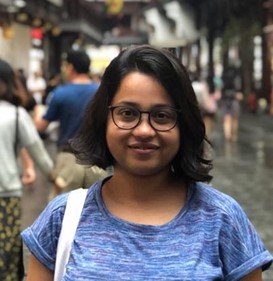
Pushpita is a doctoral candidate in the Department of Theatre & Performance Studies, School of Arts & Aesthetics, Jawaharlal Nehru University. She is an enthusiast of performance cultures, history and politics. Her research interests include Music History, Ethnomusicology, Modern South-Asian History, Gender & Identity Politics, Cultural Nationalism and Cultural Media.
She can be reached at mpushpita42@yahoo.com
बेगम्स ऑफ अवध

पुस्तक : बेगम्स ऑफ अवध , लेखिका के.एस. सांथा, भारती प्रकाशन, संस्करण सन १९८० , स्थान वाराणसी , उत्तर प्रदेश , कुल पृष्ठ ३७७, एस. बी. एन. 9380550030, दाम ७५०
के. एस. सांथा द्वारा लिखित पुस्तक ‘बेगम्स ऑफ अवध (Begums of Awadh)’ 1980 ईस्वी में प्रकाशित हुई थी | इस पुस्तक के माध्यम से लेखिका, हमें अवध की स्थापना से लेकर उसके ब्रिटिश साम्राज्य में विलय और तदुपरांत 1857 ईस्वी के विद्रोह तक की ऐतिहासिक यात्रा में, बेगमों की राजनीतिक भूमिका पर पाठक का ध्यान आकर्षित करने का एक सफल प्रयास करती हैं | यह किताब किसी इतिहासकार के द्वारा अवध की बेगमों और उनके क्रियाकलापों के आलोचनात्मक विश्लेषण को समर्पित प्रथम प्रयास है | सांथा लेख में इस तथ्य पर अधिक बल देती हैं कि जब-जब किन्ही परिस्थितियों के फलस्वरुप आवश्यकता प्रतीत हुई, तब-तब बेगमों नें राज्य की आंतरिक और बाहरी राजनीतिक गतिविधियों में हस्तक्षेप किया | हालांकि इस पुस्तक का सूक्ष्मता पूर्वक अध्ययन करने पर यह भी साबित होता है कि कई बार राजनीति में हस्तक्षेप करना बेगमों के लिए आर्थिक, सामाजिक तथा राजनीतिक रूप से हानिकारक सिद्ध हुआ | इसका एक बहुचर्चित उदाहरण ‘बहु बेगम’ का अपने पुत्र नवाब आसफ-उद-दौला के साथ अवध के शाही खजाने के ऊपर अधिकार को लेकर हुआ संघर्ष है| लेखिका बड़ी चतुराई से यह स्थापित करने में सफल हो जाती हैं कि अवध की सबसे प्रभावशाली बेगम और नवाब के बीच के संघर्षों का फायदा ब्रिटिश ईस्ट इंडिया कंपनी उठाती है| यह उदाहरण हमारे समाज में प्रचलित एक प्रसिद्ध लोकोक्ति ‘दो बिल्लियों की लड़ाई में पूरी रोटी बंदर खा गया’ को पूरी तरह चरितार्थ करती है | बेगम और नवाब दोनों ही अपने राज्य के आंतरिक मामलों में कंपनी को मध्यस्थता के लिए आमंत्रित करते हैं और कंपनी अपनी सुविधानुसार अपने पक्ष का चुनाव करती है | अनेक अवसरों पर लेखिका हमें नवाब, बेगमों और ब्रिटिश ईस्ट इंडिया कंपनी के बीच के महत्वपूर्ण परन्तु कम चर्चित संबंधों से अवगत कराने का काम करती है | उदाहरणार्थ बहु बेगम ने कंपनी के समक्ष अपना पक्ष रखने के लिए एक हिजड़े(ख्वाजासराय) बहार अली खान को अपना प्रतिनिधि बनाकर कलकत्ता भेजा था और लेखिका बेगम, नवाब, तथा कंपनी के प्रतिनिधियों के मध्य बातचीत का अत्यंत रोचक विवरण प्रस्तुत करती हैं |
यह ऐतिहासिक कृति सदर-ए-जहाँ बेगम, बहु बेगम, बादशाह बेगम,बेगम हज़रत महल इत्यादि बेगमों के साथ ही अन्य कम महत्वपूर्ण बेगमों का भी उल्लेख करती है | अगर ईमानदारी पूर्वक बात की जाए तो मुझे ऐसी कई सारी जानकारियाँ मिली, जिसके विषय में इतिहास का विद्यार्थी होने के पश्चात भी मैं उनसे अनभिज्ञ था | मिसाल के तौर पर हममें से कितने लोगों को यह पता होगा कि 1837 ईस्वी में बादशाह बेगम ने एक तख्तापलट की कोशिश की थी | यदि इस पुस्तक में सबसे उल्लेखनीय प्रसंगों की बात की जाए तो लेखिका, हमें बेगम हजरत महल का उदाहरण देते हुए बताती हैं कि किस प्रकार 19 वीं शताब्दी की राजनीतिक अस्थिरता ने एक तलाकशुदा बेगम को 1857 के विद्रोह के दौरान लखनऊ का सर्वेसर्वा बना दिया | यह शोधकार्य हमें एक ऐसे विषय से रूबरू कराता है जो कि शायद अपने समसामयिक दौर में अवध के इतिहास-लेखन में एक ‘वैकल्पिक इतिहास-लेखन’ की अवधारणा प्रस्तुत करता है| इसके अतिरिक्त लेखिका अपने इस ग्रंथ में अवध साम्राज्य में हिजड़ों(ख्वाजासरायों) की भूमिका का संक्षिप्त परंतु अत्यंत रोचक और ज्ञानवर्धक वर्णन करती हैं |
20 वीं शताब्दी का उत्तरार्द्ध ऐतिहासिक लेखन की अनेक अवधारणाओं पर आधारित नयी बहसों जैसे सामन्तवाद, राज्य-निर्माण की प्रक्रिया, सबाल्टर्न (उपाश्रित वर्ग) का अध्ययन आदि के अभ्युदय का साक्षी बना | ये सभी नयी ऐतिहासिक लेखन प्रवृत्तियां इस बात का उद्घोषणा करती थीं कि वो इतिहास के उन पहलूओं पर चर्चा करना चाहती हैं जिनके बारे में प्रचलित इतिहास चर्चा नहीं करता। यहाँ एक विचारणीय संदर्भ यह भी है जब कभी भी किसी वैकल्पिक इतिहास की ओर इंगित किया जाता है तो उसमें महिलाओं के योगदान(यदि प्रमुखता से कहें तो किसी महिला द्वारा महिला प्रधान इतिहास लेखन) की तरफ जरूर इशारा किया जाता है। इस बात की प्रबल संभावना है कि कई सारे पाठक/विद्वान मेरी इस बात से सहमत ना हों, परंतु इस वास्तविकता से कोई इंकार नहीं कर सकता है कि बिना महिलाओं के इतिहास के ‘वैकल्पिक इतिहास’ की बात बेमानी है। इसी दौर में सांथा की यह किताब प्रकाशित होती है | उस समय जब आवागमन इतना सुलभ और सुरक्षित नहीं था, ऐसे समय में जिस उत्कृष्टता के साथ देश के विभिन्न अभिलेखागारों में उपलब्घ स्रोतों की पहचान करना और ब्रिटिश राज के दौरान के उपलब्ध पत्राचारों के आधार पर महिला केंद्रित इतिहास लिखना एक अत्यंत ही सराहनीय प्रयास था | यद्यपि ये ग्रंथ किसी भी प्रकार से खुद को किसी वैकल्पिक या महिला केंद्रित इतिहास लेखन से प्रभावित होने का दावा नहीं करता, परंतु इसके अध्ययन के समय एक पाठक/विद्यार्थी के रूप में आपके समक्ष ये सारी बातें स्पष्ट हो जाती हैं |
उपरोक्त वर्णित सारी खूबियों के बावजूद भी ऐसा नहीं है कि यह कृति पूर्णतया त्रुटि विहीन है | इसको पढ़ते समय ऐसा अनुभव होता है कि कहीं ना कहीं ये किताब एक प्रकार बेगमों की राजनीतिक जीवनी बन कर रह जाती है | यद्यपि कुछेक अवसरों पर उनके व्यक्तिगत जीवन और हरम में विद्यमान आपसी द्वंद को दिखाया गया है | इस किताब के अध्ययन से मन में ऐसा भाव उत्पन्न होता है कि काश! इसमे अवध की आम महिलाओं की स्थिति अथवा हरम में घटित होने वाले सामाजिक और आर्थिक कारकों की थोड़ी सी और विस्तृत चर्चा की गई होती | इसके अतिरिक्त लेखिका पुस्तक की प्रस्तावना में अपने पाठकों से जिस ‘आलोचनात्मक विश्लेषण’ की बात कहती हैं, वो हमें ज्यादातर समय इस चर्चा में उपलब्ध नहीं होता है | इस किताब को पढ़ते समय मुझे ब्रिटिशों की भूमिका के बारे में लेखिका के विचारों से असहमति और आश्चर्य दोनों की अनुभूति हुई | यदि कुछेक घटनाओं जैसे बादशाह बेगम द्वारा तख्तापलट की कोशिश और 1857 के विद्रोह आदि को अपवादस्वरूप छोड़ दिया जाए, तो सांथा ने इस पूरी पुस्तक में ब्रिटिश कंपनी और उसके नुमाइंदों के प्रति तटस्थता की नीति अपनायी है, जबकि उनके द्वारा प्रस्तुत घटनाक्रम उन्हें तटस्थ रहने की अनुमति नहीं प्रदान करते |
व्यक्तिगत तौर पर मुझे ऐसा अनुभव होता है कि विगत वर्षों में ‘मुगल हरम’ के उपर अनेक प्रामाणिक और शैक्षणिक जगत में प्रचलित मानदण्डों को तोड़ने वाले लेखन कार्य किए गए हैं | उसकी तुलना में उसके उत्तरी भारत में ‘उत्तराधिकारी राज्य’ अवध की ‘जनाना राजनीति’ पर आधारित शोध कार्यों की कमी है | ऐसी परिस्थिति में यह किताब अवध की बेगमों के ऊपर भविष्य में होने वाले शोध कार्यों के एक पथ-प्रदर्शक की भूमिका का निर्वहन कर सकती है | निष्कर्षतः यह कहा जा सकता है कि उपरोक्त पुस्तक हमें अवध की शाही परिवार की महिलाओं के अनेक अनछुए पहलुओं से हमें अवगत कराती है| आखिरी में पाठकों को हमारा यही सुझाव है कि अपनी कुछ सीमितता के बावजूद यह एक ऐसी किताब है जिसको पढ़ा जाना चाहिए |
Footnotes:
1 सांथा, पृष्ठ. viii.
2 ऐसे इतिहासकारों में रूबी लाल, रेखा मिश्रा, इरा मुखोटी, रुखसाना इफ्तिखार के नाम प्रमुख हैं |

Sameer Mani Tripathi is a research scholar of medieval history at the Centre of Historical Studies, Jawaharlal Nehru University, Delhi. His particular area of academic interest is the transition phase of the early medieval era and the transition from the medieval to the early modern period from the perspective of state formation, gender history and military history.
VICTORY CITY

Book: Victory City by Salman Rushdie, Penguin Random House, Published: 2023, 342 Pages, ISBN: 9780670098460, Rs. 699.00
by Dr. Amir Ali
My rishta with Rushdie (relationship) is an old one. In a word, I can describe him as my alter ego. As a child I remember watching with my father the Booker Awards ceremony when Salman Rushdie won the award for his 1981 book Midnight’s Children. This would be one of my most formative literary and political memories. I was mesmerized by the title. There was an unmistakable hint of pride in my father’s voice as he explained to me who Rushdie was, an Indian Muslim, who could write better English than the English.
I will never forget Rushdie being interviewed during the awards ceremony. His droopy khwabeeda خوابیدہ neem-kash نیم کش (dreamy and half-closed) eyes gave him the look of what I thought a genuine intellectual and writer should be like. It was only later that I came to know that the droopiness of his eyelids had to do with a medical condition called ptosis, which was corrected by surgical intervention. What a tragedy that Rushdie has now lost one eye in the shocking and despicable attack on him in the US in August 2022.
Until the Rushdie Affair exploded onto the international political stage with the publication of Rushdie’s controversial Satanic Verses, I had not actually read any of Salman Rushdie’s books as I wasn’t old enough to read them. With the passage of time, that matter was resolved. I picked up Midnight’s Children and right from the very first page, the lines from Rushdie jumped off the page, punched me in the nose and made my head dance with delight. My appetite for Rushdie was whetted. In my early years at JNU someone gave me Rushdie’s Shame to read. I read it almost ravenously but could not find the joy of Midnight’s Children. I went on to read The Satanic Verses.
I suppose that the trilogy that is constituted by Midnight’s Children (on independent India), Shame (on Pakistan) and The Satanic Verses (on Thatcherite Britain) exhausted me. When Rushdie published The Moor’s Last Sigh, I read it a little indifferently, yet at the same time I was fascinated by the evocatively derived title which comes from the Spanish El Ultimo Suspiro del Moro, the name of a rock just outside the famous Alhambra Palace in Andalusia, Spain. By the time Rushdie published The Enchantress of Florence, my immersion into teaching as a newly appointed faculty member at the Centre for Political Studies, JNU prevented too many divergences in my reading. Rushdie and I kept growing apart. Yet I cannot say that I forgot Rushdie. It is best captured in that wonderful line from the Urdu poet Firaq Gorakhpuri: Ek muddat se teri yaad bhi ayi na hamein/Aur hum bhool gaye hon aysa bhi nahin (It seems like an eternity since I last remembered you/But to say that I haven’t thought of you would be a lie).
When I wrote my first book, South Asian Islam and British Multiculturalism, a substantial chapter on ‘Revisiting Rushdie’ meant that I read, multiple times, The Satanic Verses, grimacing each time at the tastelessness of Rushdie’s criticism. Around this time Rushdie’s memoirs Joseph Anton came out, with the title taken from two of Rushdie’s favourite writers Joseph Conrad and Anton Chekhov. I enjoyed reading Rushdie’s memoirs, perturbed only by what I felt was a habit of referring to himself very often in the narcissistic third person. The funniest part of it though was when Rushdie recounted how he was involved in a road accident as he drove with his family across Australia. The police officer was able to recognize Rushdie and said in an inimitably Australian way, that Rushdie was the guy who had that ‘thing’ issued against him, and as he was not quite able to recall the word fatwa, ended up calling it a ‘fatso’!
And this long introduction brings me to the book that I have been asked to review which is Rushdie’s latest offering, Victory City. I thought that Rushdie had lost his mojo, that he was now bereft of the enchanting touch of his magic realism. I was pleasantly proved wrong. I also realized that Rushdie was attacked by Hadi Matar in New York state in August 2022, very soon after he completed his book. After the attack, life-changing in its consequences, Rushdie announced in his characteristically impish manner that he was back, missing an eye. Rushdie’s status as one of the greats of modern literature is securely established. There will almost inevitably be a Nobel Prize for literature announced for him in the not-too-distant future. Until then one can speculate on the contents of his acceptance speech.
Victory City is vintage Rushdie. It is a story of epic proportions as Rushdie keeps returning to the land of his creative genius, India. In Victory City the rise and fall of the kingdom of Vijaynagar in Southern India is recounted with that typical Rushdie-esque combining of history and myth. There is the central character of Pampa Kampana whose semi-divine status ensures a longevity of 247 years that allows her to establish the city of Bisnaga through the magical scattering and sprouting of seeds. She is witness to, partakes of and contributes to the kingdom’s creation, triumphs, tribulations and travails that culminate in the ultimate demise of the empire in 1565. With this Pampa Kampana herself dies, having outlived many generations of her own lineage. The witnessing of Bisnaga’s history is extensively chronicled by her in the magisterial poem Jayaparajaya. Victory City is itself an abridged version of that extensive chronicle, captured and condensed by a lesser storyteller of far humbler means, a mere ‘spinner of yarns’, whose identity is not revealed. The narrative and story line of Victory City marches along at a brisk and lively pace, capturing and arresting the attention of the reader until the very end. This tighter plot sets Victory City apart from other works of Rushdie where there are often multiple and parallel plots and dream sequences within dream sequences.
Victory City revels in its ability to evoke and explain the originary stories of political entities, in its own case Bisnaga. These originary stories necessarily have the element of the imaginative in them, which serve the function of presenting the polity as special and convinced of the exceptionality of its imperatives. Even though the kingdom and people of Bisnaga emerge almost ex nihilo from its magically sprouting seeds, Pampa Kampana whispers stories into them to give them the necessary historical and mythical depth and perspective that any polity aspires for and acquires. Such imaginatively told stories also serve the function of concealing the unseemlier side that exists and taints like an original sin, every polity. One of the first acts of sovereignty for any polity then is to drape that original taint with a cover of concealment that no one can then dare approach, as hinted by the 18th century parliamentarian and political theorist Edmund Burke.
An important element of Victory City is the contemporaneity that it both captures and about which it wonders aloud. Bisnaga is colourfully portrayed as a cosmopolitan, tolerant and gender just polity that through the efforts of Pampa Kampana allows women to play an outsized role in a context of 14th century medievalism in which it begins. Yet threats to this openness, tolerance and cosmopolitanism are forever bubbling and brewing. Victory City seems to suggest that the ice on which tolerance and cosmopolitanism gracefully skate is always wafer-thin; tenuous, temporary and threatened by forces inimical to them. Rushdie almost seems to be thinking aloud if in today’s grand epochal struggle between democracy and autocracy, where battle lines have hardened, democracy’s triumph can be guaranteed. The answer seems to be a sensible rejection of any naive Whig interpretation of history that in its complacent confidence views the victory of progress as underwritten and guaranteed by the forward movement of history. Rushdie seems to be hinting at the US of our times which braces itself for a bruising electoral contest in 2024 where almost inevitably the Republican Presidential candidate is likely to be Donald Trump.
Will democratic dissent in the US and for that matter many other parts of world be drowned out by the disciplinary drum beat of autocracy? We await that historical verdict with bated breath. On a more pessimistic note, the principle of free speech today stands even more precariously perched than it was 35 years ago when the Rushdie Affair broke out. Rushdie and his supporters with their grandstanding defences of free speech have not been able to make the principle safer in the dangerous world of the early 21st century. On a further pessimistic note, the precariousness of free speech could mean that democracy may have already lost half the battle against autocracy. But no battle is finally over. Sometimes the greatest victories are those snatched from the jaws of defeat or victory follows defeat in quick historical succession. Recall the title of Pampa Kampana’s epic historical account, Jayaparajay, meaning victory and defeat.

Dr Amir Ali is Assistant Professor at the Centre of Political Studies at Jawaharlal Nehru University. An avid reader and writer himself, he has recently published his book Brexit and Liberal Democracy. He combines his love for literature and poetry by teaching political theory, multiculturalism and group rights while quoting Faiz and Iqbal.
This piece was authored on request.
 TheDaak review
Leave a comment