
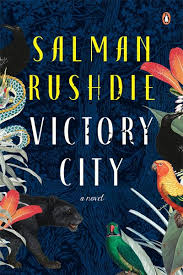
Book: Victory City by Salman Rushdie, Penguin Random House, Published: 2023, 342 Pages, ISBN: 9780670098460, Rs. 699.00
by Dr Amir Ali
My rishta with Rushdie (relationship) is an old one. In a word, I can describe him as my alter ego. As a child I remember watching with my father the Booker Awards ceremony when Salman Rushdie won the award for his 1981 book Midnight’s Children. This would be one of my most formative literary and political memories. I was mesmerized by the title. There was an unmistakable hint of pride in my father’s voice as he explained to me who Rushdie was, an Indian Muslim, who could write better English than the English.
I will never forget Rushdie being interviewed during the awards ceremony. His droopy khwabeeda خوابیدہ neem-kash نیم کش (dreamy and half-closed) eyes gave him the look of what I thought a genuine intellectual and writer should be like. It was only later that I came to know that the droopiness of his eyelids had to do with a medical condition called ptosis, which was corrected by surgical intervention. What a tragedy that Rushdie has now lost one eye in the shocking and despicable attack on him in the US in August 2022.
Until the Rushdie Affair exploded onto the international political stage with the publication of Rushdie’s controversial Satanic Verses, I had not actually read any of Salman Rushdie’s books as I wasn’t old enough to read them. With the passage of time, that matter was resolved. I picked up Midnight’s Children and right from the very first page, the lines from Rushdie jumped off the page, punched me in the nose and made my head dance with delight. My appetite for Rushdie was whetted. In my early years at JNU someone gave me Rushdie’s Shame to read. I read it almost ravenously but could not find the joy of Midnight’s Children. I went on to read The Satanic Verses.
I suppose that the trilogy that is constituted by Midnight’s Children (on independent India), Shame (on Pakistan) and The Satanic Verses (on Thatcherite Britain) exhausted me. When Rushdie published The Moor’s Last Sigh, I read it a little indifferently, yet at the same time I was fascinated by the evocatively derived title which comes from the Spanish El Ultimo Suspiro del Moro, the name of a rock just outside the famous Alhambra Palace in Andalusia, Spain. By the time Rushdie published The Enchantress of Florence, my immersion into teaching as a newly appointed faculty member at the Centre for Political Studies, JNU prevented too many divergences in my reading. Rushdie and I kept growing apart. Yet I cannot say that I forgot Rushdie. It is best captured in that wonderful line from the Urdu poet Firaq Gorakhpuri: Ek muddat se teri yaad bhi ayi na hamein/Aur hum bhool gaye hon aysa bhi nahin (It seems like an eternity since I last remembered you/But to say that I haven’t thought of you would be a lie).
When I wrote my first book, South Asian Islam and British Multiculturalism, a substantial chapter on ‘Revisiting Rushdie’ meant that I read, multiple times, The Satanic Verses, grimacing each time at the tastelessness of Rushdie’s criticism. Around this time Rushdie’s memoirs Joseph Anton came out, with the title taken from two of Rushdie’s favourite writers Joseph Conrad and Anton Chekhov. I enjoyed reading Rushdie’s memoirs, perturbed only by what I felt was a habit of referring to himself very often in the narcissistic third person. The funniest part of it though was when Rushdie recounted how he was involved in a road accident as he drove with his family across Australia. The police officer was able to recognize Rushdie and said in an inimitably Australian way, that Rushdie was the guy who had that ‘thing’ issued against him, and as he was not quite able to recall the word fatwa, ended up calling it a ‘fatso’!
And this long introduction brings me to the book that I have been asked to review which is Rushdie’s latest offering, Victory City. I thought that Rushdie had lost his mojo, that he was now bereft of the enchanting touch of his magic realism. I was pleasantly proved wrong. I also realized that Rushdie was attacked by Hadi Matar in New York state in August 2022, very soon after he completed his book. After the attack, life-changing in its consequences, Rushdie announced in his characteristically impish manner that he was back, missing an eye. Rushdie’s status as one of the greats of modern literature is securely established. There will almost inevitably be a Nobel Prize for literature announced for him in the not-too-distant future. Until then one can speculate on the contents of his acceptance speech.
Victory City is vintage Rushdie. It is a story of epic proportions as Rushdie keeps returning to the land of his creative genius, India. In Victory City the rise and fall of the kingdom of Vijaynagar in Southern India is recounted with that typical Rushdie-esque combining of history and myth. There is the central character of Pampa Kampana whose semi-divine status ensures a longevity of 247 years that allows her to establish the city of Bisnaga through the magical scattering and sprouting of seeds. She is witness to, partakes of and contributes to the kingdom’s creation, triumphs, tribulations and travails that culminate in the ultimate demise of the empire in 1565. With this Pampa Kampana herself dies, having outlived many generations of her own lineage. The witnessing of Bisnaga’s history is extensively chronicled by her in the magisterial poem Jayaparajaya. Victory City is itself an abridged version of that extensive chronicle, captured and condensed by a lesser storyteller of far humbler means, a mere ‘spinner of yarns’, whose identity is not revealed. The narrative and story line of Victory City marches along at a brisk and lively pace, capturing and arresting the attention of the reader until the very end. This tighter plot sets Victory City apart from other works of Rushdie where there are often multiple and parallel plots and dream sequences within dream sequences.
Victory City revels in its ability to evoke and explain the originary stories of political entities, in its own case Bisnaga. These originary stories necessarily have the element of the imaginative in them, which serve the function of presenting the polity as special and convinced of the exceptionality of its imperatives. Even though the kingdom and people of Bisnaga emerge almost ex nihilo from its magically sprouting seeds, Pampa Kampana whispers stories into them to give them the necessary historical and mythical depth and perspective that any polity aspires for and acquires. Such imaginatively told stories also serve the function of concealing the unseemlier side that exists and taints like an original sin, every polity. One of the first acts of sovereignty for any polity then is to drape that original taint with a cover of concealment that no one can then dare approach, as hinted by the 18th century parliamentarian and political theorist Edmund Burke.
An important element of Victory City is the contemporaneity that it both captures and about which it wonders aloud. Bisnaga is colourfully portrayed as a cosmopolitan, tolerant and gender just polity that through the efforts of Pampa Kampana allows women to play an outsized role in a context of 14th century medievalism in which it begins. Yet threats to this openness, tolerance and cosmopolitanism are forever bubbling and brewing. Victory City seems to suggest that the ice on which tolerance and cosmopolitanism gracefully skate is always wafer-thin; tenuous, temporary and threatened by forces inimical to them. Rushdie almost seems to be thinking aloud if in today’s grand epochal struggle between democracy and autocracy, where battle lines have hardened, democracy’s triumph can be guaranteed. The answer seems to be a sensible rejection of any naive Whig interpretation of history that in its complacent confidence views the victory of progress as underwritten and guaranteed by the forward movement of history. Rushdie seems to be hinting at the US of our times which braces itself for a bruising electoral contest in 2024 where almost inevitably the Republican Presidential candidate is likely to be Donald Trump.
Will democratic dissent in the US and for that matter many other parts of the world be drowned out by the disciplinary drum beat of autocracy? We await that historical verdict with bated breath. On a more pessimistic note, the principle of free speech today stands even more precariously perched than it was 35 years ago when the Rushdie Affair broke out. Rushdie and his supporters with their grandstanding defences of free speech have not been able to make the principle safer in the dangerous world of the early 21st century. On a further pessimistic note, the precariousness of free speech could mean that democracy may have already lost half the battle against autocracy. But no battle is finally over. Sometimes the greatest victories are those snatched from the jaws of defeat or victory follows defeat in quick historical succession. Recall the title of Pampa Kampana’s epic historical account, Jayaparajay, meaning victory and defeat.
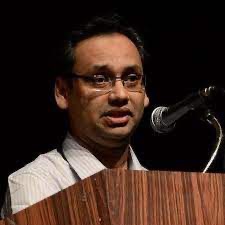
Dr Amir Ali is Assistant Professor at the Centre of Political Studies at Jawaharlal Nehru University. An avid reader and writer himself, he has recently published his book Brexit and Liberal Democracy. He combines his love for literature and poetry by teaching political theory, multiculturalism and group rights while quoting Faiz and Iqbal.
This piece was authored on request.
 TheDaak review
Leave a comment