
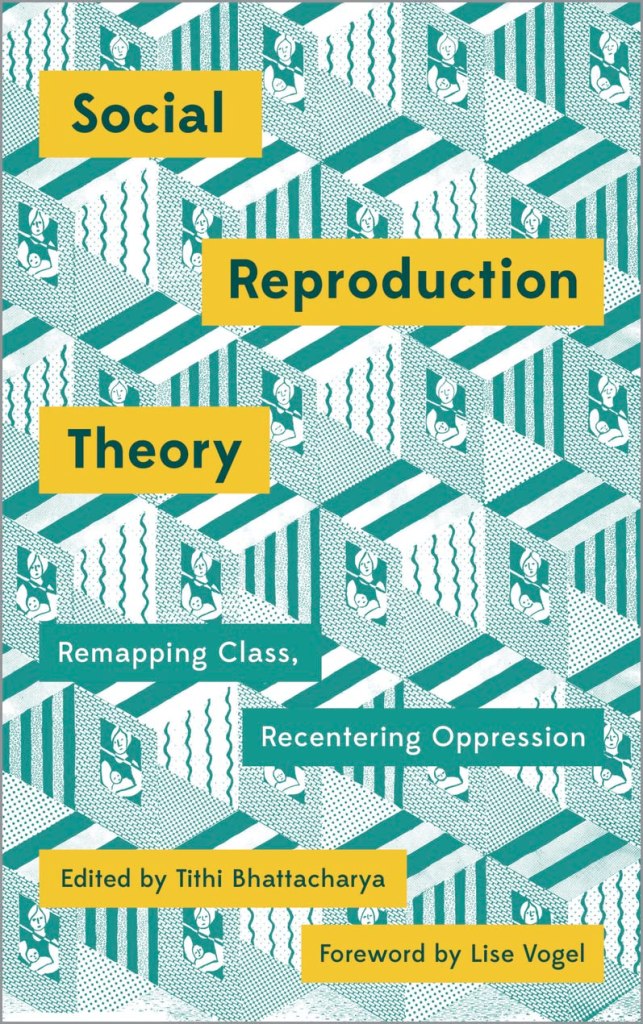
Social Reproduction Theory: Remapping Class, Recentering Oppression, ed. Tithi Bhattacharya, Forward by Lise Vogel, 2017, Pluto Press, 250 Pages, ISBN 9781786801579
Tithi Bhattacharya’s edited volume titled Social Reproduction Theory: Remapping Class, Recentering Oppression is an array of different developments on the idea of ‘social reproduction’ in different realms of conflicts and struggles of the subjugated ones against the exploitative expropriation by the dominating sect. Bhattacharya draws upon the trajectories of SRT (Social Reproduction Theory) theorization and poses it as a methodological framework to understand the process of exploitation and expropriation of bodies outside the materialistic sites of production. Through an honest attempt, it recontextualizes Marxist political economy based on class relations and maps its intersection to other social identities such as gender and race. By doing so, it rearranges the debate around the centrism of oppression from economic class to an idea of class as a site of oppression. The volume carries forward what Marx left under-theorized, i.e.; reproduction of capitalism as a systematic whole where social reproduction and material production are conjoined, yet separate spheres with social relations regulating them.
The different essays point to the negligence of capitalism towards the sphere of social reproduction and the unseeing totality of the use value of labour-power. SRT emphasises on labour and its labour-power in the larger portrait of the ‘social whole’ through ‘capitalist social relations’. Fraser’s essay “Crisis of Care? On the Social-Reproductive Contradictions of Contemporary Capitalism” questions the capitalist devalorization of extra-market resources like household labour-power, governance assistance, and nature itself, taking these as given. This historical alienation of ‘social reproduction’ from the sphere of value production is further detailed in Mohandesi & Teitelman’s essay “Without Reserves”. It argues against the gradual devaluation and externalization of social reproduction as women’s social responsibility, then under financialized capitalism renegotiated as an inferior work. The essays establish how capitalism is far from allowing reconstruction of gender roles, rather, allows class privilege to buy what is otherwise the conventional responsibility of women belonging to the upper-class. The male bread-winner model has led to the procreation of a new form of patriarchy – Capitalist Patriarchy – symbolizing the symbiotic coexistence of the two oppressive systems. Capitalism, thus, holds an ulterior motive to exteriorize social reproduction from the material world as a separate sphere of love and affection.
Hopkins’ essay “Mostly Work, Little Play: Social Reproduction, Migration, and Paid Domestic Work in Montreal” on the same line criticizes the devalorization of domestic work as something outside ‘productive work’ and hence, unpaid. She draws upon Tronti’s (1962) idea of ‘Social Factory’ that develops on the social relations and their reproduction at home. The historical devaluation of domestic work has created a racist and sexist other than classist narrative, where care work is commodified and marketed to absorb proletariat women of colour mostly. The immigrants from Global South, especially women, are encouraged in Global North to absorb them as low-paid domestic workers.
In a capitalist society, every sphere of life is commodified for market purposes. Fraser identifies that under financialized capitalism a duality in social reproduction is produced – care as a commodity who can afford it, and as a private matter for those who can’t, hence, externalized on the family and the community. What goes unseen is that under this partial commodification of care, the exploitation of labour continues with extended working hours for both who can and cannot afford paid care work. In Oran’s essay “Pensions and Social Reproduction”, the capitalist move towards informalization reveals to threaten access to pension, which is a worker’s right and means to generational reproduction of the labour force for capitalism. Bhattacharya also highlights how marketization of every sphere makes the proletariats more dependent on capital to sustain, alienates them from their resources – both physical and social. Ferguson’s essay “Children, Childhood and Capitalism: A Social Reproduction Perspective”, exposes the indirect subjugation of childhood to capitalist relations of value production. She further notes how the engineering of childhood through capitalist interventions alienates and transforms their non-materialistic playful state to a more materialistic orientation needed in a future labourer. To sustain and expand, financialized capitalism needs the state to roll back, where capitalism consumes everything under its market commodification.
SRT framework in the essays reveals the superficiality of the division between the production and reproduction realms into the public and private spheres, and brings up their connections in different aspects. Bhattacharya’s essay “How Not to Skip Class: Social Reproduction of Labor and the Global Working Class”, draws upon Vogel, broadens the sphere of social reproduction out of domesticity to include education and health, leisure facilities, pension and other social benefits that reproduce labour-power on a regular basis. Similarly, David McNally’s essay “Intersections and Dialectics: Critical Reconstructions in Social Reproduction Theory” connects the spheres of value production and social reproduction through the purpose of the former to be the latter’s means. In these dynamics, the importance of the multiplicity of oppression needs focus in intersectionality, which creates differences in working-class experiences’ narratives. Hence, one can derive that capital production and surplus accumulation is directed to an intended creation of inequalities in social reproduction of the working and capitalist classes respectively.
Sears’ “Body Politics: The Social Reproduction of Sexualities” theorizes body politics as a medium for capitalism to reproduce its social order. The reserve army of labour enables capitalism to sustain the hegemonic power relation between the employer and the employees, threatening the latter with competition where they end up as wage-takers. To maintain its generational procreation of the labour force, capitalism upholds the heterosexual nuclear family model where women are ‘unpaid caretaker’ and the men are ‘paid workers’. The ideas of ‘free labour’ and ‘freedom of sexuality’ in the capitalist system are paradoxical, as what seems ‘free’ on surface is bound with the compulsion to protect wealth and inheritance along with purity. Apparently, this is biologically possible through heterosexual marriage.
Ultimately, Arruzza’s end note concludes for the need for unionization of all forms of struggles against different social oppressions under organized wings of resistance. Arruzza’s “From Social Reproduction to Feminism to the Women’s Strike” suggests not to see different social movements such as Feminist Movement, ‘#Black Lives Matter’, Immigrants’ movements, movements against ‘Muslim Ban’ – as something that are alternatives to class struggle, rather, they need an integration under the larger comprehension of class resistance to the multiplicity of oppression under capitalism.
The volume stresses upon the coexistence of value production and social reproduction as united spaces in terms of operationalization and theorization, although, in absolute sense they can be spatially divided. But the readings push the reader to conclude that these two spheres are not even separated in terms of their physical absolute spaces. At a workplace, socialization happens that forms the social relations between colleagues, employers and employees. These relations are determinants of the workplace experiences that differ across these relations. The value production site is, as one can perceive as, a space embedded within the larger space of social reproduction, hence alienating the former from the latter only narrows the economic understanding of superficial market relations and fails Marx’s attempt to deepen the ‘economic’ narratives into political and social structures. Hence, Bhattacharya was right to see production relations as reflection of social relations historically specific in context. But not just time, these social relations are space specific as well. This volume efficiently captures diverse aspects but they reflect less the complexities of the spatial variations such. The forms of oppression and the resultant process of capitalist expropriation of extra-market resources differ in the Global South than in the North. Larger informal background creates a different story for the wage workers in the North and in the South (see Mies’ 1981). The labour narratives of piece workers in an Asian village, whose “unpaid” domestic and “paid” piece work go simultaneously, would definitely differ from an American factory worker.
Amidst the wave of postmodernism where de-differentiation and de-centralization is celebrated with every unique identity as a possibility for new forms of resistance, this volume attempts to revitalize and redefine “class” and class struggle as inclusive of all forms of oppression. SRT is reclaiming its relevance in addressing proletariat class struggle against capitalism by identifying the cunning approach the vicious system has taken to narrow the class identity to an economic issue, thus, playing the politics of ‘divide and rule’. But doubts remain in the understanding of which form of oppression predates and dominates the others. Will solidarity through SRT be able to overcome the male ego that historically has already failed the Medieval Anti-feudal struggle (Federici, 2004); will the racist antagonism subside which gave the whites, irrespective of class and gender, a sense of superiority over people of colours – these remain as questions.
The efforts in mapping social reproduction into different frameworks such as the site of capitalist reproduction, locus of class formation, site of oppression and resistance, a space of inequality creation and consolidation of all forms of struggle, other than reproducing labour-power, is indeed a rational and subjective approach that reaches the readers well. The reproduction of social relations across space and time provides the grounding for different experiences in the labour market which enables capitalism with a competitive environment where the capitalists can play the price-maker role. Intersectionalities in understanding oppression, thus, strengthen the SRT framework.
References
- Bhattacharya, T. (2017). Social reproduction theory: Remapping class, recentering oppression. Pluto Press
- Federici, S. (2004). Caliban and the Witch. Chap-2. Autonomedia.
- Mies, M. (1981). Dynamics of sexual division of labour and capital accumulation: Women lace workers of Narsapur. Economic and Political Weekly, 487-500.
- Tronti, M. (1962). Factory and society.
- Walby, S. (1999). Theorizing Patriarchy. Modernity: Critical Concepts, 2, 153-174.

Aditi Bardhan is a PhD Scholar at CSRD in JNU. She is currently working on gender and labour issues in spatial contexts. Feminist epistemology has been an inspiration for her to re-read the dominant theories under the light of the power dynamics in knowledge creation. This book by Tithi Bhattacharya was one such engagement that helped her me redevelop the understanding of capitalism on a larger social portrait and its rootedness in the social constructs such that it appropriates the existing hegemonic hierarchies to reproduce, appropriate, and sustain itself.


 TheDaak review
Leave a comment