
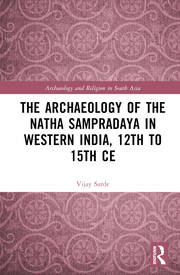
The Archaeology of the Nātha Sampradāya in Western India, 12th to 15th Century By Vijay Sarde, Routledge, 2023, 228 pages, Hardback, £120.00 GBP, ISBN: 978-1-032-21564-8
Nath Sampradaya as a distinct religious tradition might not be popularly unheard of, particularly after the rise of Yogi Adityanath as the chief minister of Uttar Pradesh in India. However, when one goes into details, the tradition remains as elusive as ever, given the incredible amount of diversity and variations that it encompasses together with continuous and often contradictory transformations throughout its history.
Nevertheless, to begin with, the Nath Sampradaya broadly represents a mediaeval Shaiva ascetic order, with its roots in Tantrism and a distinct type of yoga tradition possibly known as Hathyoga. Philosophically and religiously the Nath tradition can be said to be linked to various cult-like traditions, namely Tantric, Yogic, Rasayana, Bhakti or Sufi religious currents.
The uniqueness of the Nath tradition lies in the fact that unlike the popularly held assumption, which links spiritual quests in the Indian religious landscape with the attainment of liberation (moksha/nirvana), the Naths strived for the attainment of siddhi. Siddhi in a layman’s understanding can be thought of as the attainment of control over both the ‘natural’ and the ‘supernatural’. This is the picture that emerges from the legends associated with the Naths, where they’re shown as having control over rain, floods, diseases, epidemics and even death and the Gods. For the attainment of such siddhi, the Naths engaged in practices ranging from tantric, yogic to alchemical. It won’t be wrong to say that it was this supposed mastery over nature that separated Naths from the domain of the ‘natural’, and hence, made them the object of both fear and admiration, sought after by both kings and peasants alike.
Modern academic engagement with the Nath Sampradaya has been long, though not sustained. Nonetheless, we do have considerable work on the Naths. Most of the present study on the Nath Sampradaya has been either ethnographic or literary-historical (for a detailed literature review on Nath Sampradaya see Bouillier, 2013 and 2017; Mallinson, 2018). Archaeological studies regarding the Naths have been limited. Whatever studies we get are rather fragmentary and documentary in nature, concerned with collecting archaeological and epigraphical discoveries. Though some works such as that of M. N. Deshpande (1986) does exist. In his study, Deshpande tried to build a narrative by largely situating his study within the domain of archaeological material. However, his work exclusively focuses on the Western Indian archaeological site of Panehal Kaji.
In this background the current book under review, The Archaeology of the Nātha Sampradāya in Western India, 12th to 15th Century Vijay Sarde, is of particular importance, given it happens to be among the first comprehensive study of the Nath Sampradaya through the use of archaeological data collated from more than 500 sites spread across Western India, though mostly situated in Maharashtra and Gujarat (p. 3). The book is divided into six chapters, with the first being the introduction on the history and tradition of the Nath Sampradaya, along with the methodological approach of the work and the existing literature on the topic. Sarde’s intent is to revisit and re-examine various ethnographic and text-based assumptions regarding the Nath Sampradaya through the use of diverse archaeological data ranging from architectural remains, sculptures to epigraphical material, in addition to early Marathi literature (pp. 2-3). The methodological approach within which Sarde situates his chapters, is the ‘Cultural Landscape’ model, which aims to understand temples and icons not through the prism of political affiliation or patronage but rather by seeing them as part of a larger cultural landscape (p. 3).
The second chapter is titled “Early Marathi Literature: Beginnings of the Nātha Tradition”. The prime aim of this chapter is to not only argue for an early institutionalisation of the Nath Sampradaya but to also situate Western India as a region that facilitated the emergence of the Nath Sampradaya along with its transmission to areas such as Eastern India and Nepal.
The argument for early institutionalisation of the Nath Sampradaya in Western India is based on the analysis of Lilacharita and other early Marathi texts, as reflected in the usage of terms like ‘panthi’ in the early Marathi texts for Nath ascetics. Moreover, prominent identity markers, which are said to be characteristic of the Naths such as sringi, mudra, khapari and a distinctive style of salutation, are shown to be already present in Nath ascetics found in early Marathi literature. These, as per Sarde, demonstrate the early institutionalisation of the Naths.
The third chapter titled, “The Archaeological Evidence: Sacred Landscapes in Western India”, bases its analysis on the archaeological and architectural remains of Western India, including temple remains, sculptural depictions and cave engravings. This chapter aims to trace the geographical spread of the Nath Sampradaya in Western India, by situating it within the evolutionary archaeological terrain, in a bid to showcase the ways through which earlier diverse religious traditions which existed and operated within the same cultural landscape such as that of the Pasupata-Kalmukhas, Kapalikas, Tantric and Yogic traditions contributed towards the formation of a distinctive Nath tradition.
The next chapter titled, “The Iconography of Devotion: Images of Nātha Yogis in Context”, presents a detailed iconographical study of sculptures of Nath ascetics engraved on various architectural structures ranging from temples of Maharashtra to the step-wells of Gujarat. Apart from iconographical markers of individual Nath ascetics such as that of Matsyendranatha, Gorakhnath and others, the chapter also summarises the common identity markers associated with the Naths as drawn from the visual representations of the ascetics.
The fifth chapter, “Haṭhayoga: The Visual Record”, explores the visual representation of complex yoga posture depictions engraved on temples and other structures associated with the Naths, and hence, argues for the early linkages between the emergence of the Nath Sampradaya and Hathyoga traditions, as these depictions are possibly the earliest material evidence of Hathyoga. Hathyoga, involves the control and manipulation of prana (ether) and bindu (semen) in the body through the performance of complex bodily asanas (postures). Earlier this control and manipulation was attempted primarily through the mechanism of the mind such as through meditation. Hence, this development made possible the depiction of yogic techniques in the form of complex body postures on temple walls and other such structures. This archaeological study is complemented by the findings of Hathyoga techniques and ideas from the early Marathi texts.
In conclusion, the author gives an overview of the presence of the Nath Sampradaya across the Indian subcontinent, and concludes by highlighting the research gaps which need further investigation.
The work under review is a significant addition to the studies on the Nath Sampradaya. Through an extensive use of archaeological data complemented by vernacular Marathi texts, the work has contested many previously held assumptions about the Nath Sampradaya which were primarily based on textual or ethnographic studies, such as highlighting the early institutionalisation of the Nath Sampradaya, along with its link with Hathyoga. The most admirable aspect of the research lies in its primary data collection and analysis, as many unexplored sites have been studied for the first time in relation to the Nath Sampradaya.
What is possibly lacking in this work are fresh new questions that could shed light on less explored areas of Nath history, such as the social base and social location of Nath ascetic order, this is significant given the supposedly unorthodox nature of the sect under study. The author does promise to explore such aspects, particularly with reference to patronage, but does not appear to work in that direction, instead engaging with the already much-debated questions of origin, spread, cultic markers, and practices. Although the author proposes to base his work on the ‘Cultural Landscape’ model, its actual application in the work is somewhat faint, as he continues to view temples by associating them with successive political monarchies in Chapter 3.
Moreover, what could have added to the research, is an exploration into Hathyoga depictions on various structures in relation to the surrounding natural landscape, as one of the supposed outcomes of such practices was a mastery over nature and the natural. This mastery was primarily manifested in the form of control over one’s own as well as on other’s body and bodily functions, accompanied by claims of immortality. And secondly, it was reflected in the control over various natural phenomenons such as rain, pest attacks etc. Briggs (1938) has collated various legends associated with the Naths, where we find Gorakhnath and other accomplished Naths, exercising control over rains, transforming themselves into frogs and flies, and performing a host of other such fantastical miracles.
This would have contributed to the growing interest in understanding the Nath claim to power and its relation with the much-purported claims of yogic charisma. As D. G. White proposes that the Nath claims to political and economic power were a ‘logical extension’ of their supernaturally powerful bodies, which they achieved through various yogic practices (see Stuparich & Bevilacqua 2022, p. 15 , cited White).
Nonetheless, the work is a much-needed intervention in Nath studies which have been dominated by ethnographic and text-based studies. It’s bound to inspire future research on various aspects of the Nath Sampradaya through archaeological methodological approaches.
Bibliography
Bouillier, Véronique. “Religion Compass: A Survey of Current Researches on India’s Nāth Yogīs.” Religion Compass 7, no. 5 (2013): 157-168.
Bouillier, Véronique. Monastic wanderers: Nāth yogī ascetics in modern South Asia. Routledge, 2017.
Briggs, George Weston. “Gorakhnath and the Kanphata yogis.” (1938).
Deshpande, M. N. The Caves of Panhale Kaji. Memoirs of the Archaeological Survey of India No. 84. New Delhi: Archaeological Survey of India, 1986.
Mallinson, James. “Nāth Sampradāya.” Brill’s Encyclopedia of Hinduism, 2018.
Stuparich, Eloisa, and Daniela Bevilacqua. “The Power of the Nath Yogis: Yogic Charisma, Political Influence and Social Authority.” The Power of the Nath Yogis (2022): 1-722.

Mihir is a doctoral student at Centre for Historical Studies, at Jawaharlal Nehru University. His Interest lies in History, archaeology, and anthropology of religious traditions of South Asia.



 TheDaak review
Leave a comment