
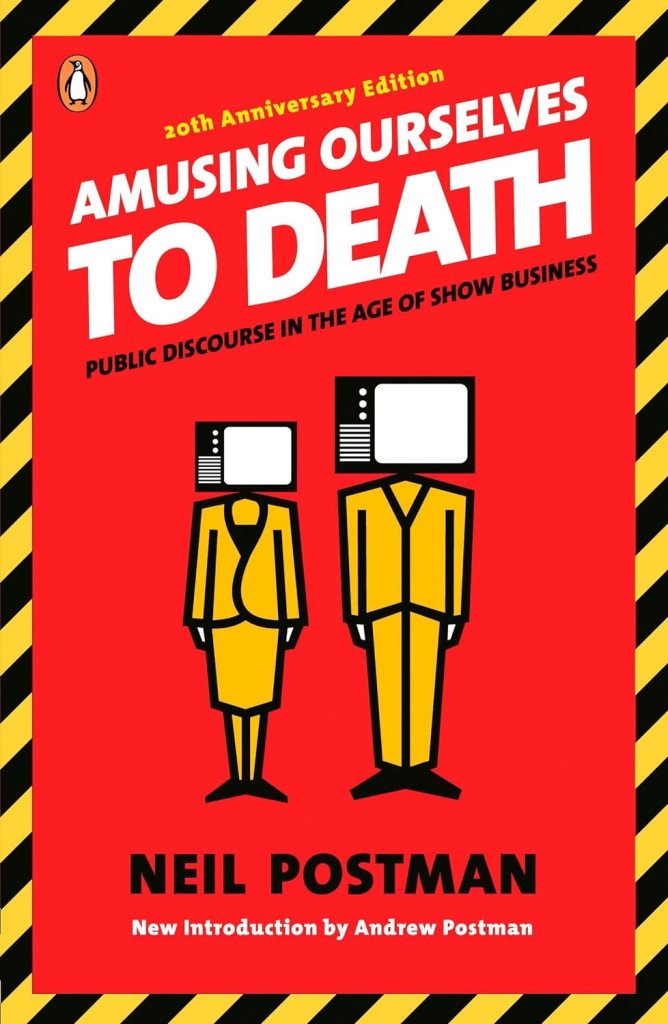
Amusing Ourselves to Death Public Discourse in the Age of Show Business by Neil Postman, Penguin USA, Anniversary edition (1990), Paperback, 208 pages, Dimensions: 1.52*12.95*19.56, ISBN 014303653X, Price: 845 INR
It’s been more than three decades since Neil Postman’s magnum opus Amusing Ourselves to Death has been published, but its ideas and arguments remain more relevant than ever. The book is not a dystopian novel per se, but it works as a grave reminder that we don’t have to prepare for a dystopian future; we might as well be living in one. All we need to do is look inward and around us.
Postman’s work was written keeping the television medium in mind but the prescience of his arguments makes it possible to be extrapolated and applied to any medium that has taken the audio-visual tool forward.
Postman makes it clear very early on that he doesn’t have an issue with Television as a source of entertainment, it’s only when it tries to be taken seriously as a cultural medium that it becomes a problem. Its tendency to co-opt almost every serious mode of discourse such as news, politics, science, education, commerce, religion among others, and turn them into entertainment packages. The problem, therefore, won’t solve itself if we start watching better content on television because it’s not the content which is the contention here but the form. In his own words, it’s not what we watch is the problem but the fact that we watch is. Unlike the panglossian view that accompanies whenever a new technology is introduced to the world, Postman questions this unconditional surrender and naive belief in technology’s neutrality. The faith in technology’s capacity to advance culture and the teleological understanding of progress has blindsided us to its ideological onslaught. It has a hegemonic impact on us in a way that we unquestionably surrender ourselves to it.
Postman weighs in on both George Orwell’s 1984 and Aldous Huxley’s Brave New World (both dystopias). He argues that rather than an Orwellian world, there is more possibility of us living in a Huxleyan world. In liberal democracies, rather than being deprived of information, citizens will be bombarded with information, so much that every piece of information loses its impact and becomes just a source of entertainment. In times like these, people will come to love their oppression. In Postman’s own words “while Orwell feared that the truth would be concealed from us, Huxley feared that truth would be drowned in a sea of irrelevance” (p. xix) . The Trump era saw the worst manifestation of this prophecy where there was an increasing use of phrases like ‘post-truth’ and ‘alternative realities’. Facts and truth have lost their sanctity and perceptions and beliefs have acquired an equal or higher pedestal in influencing people.
The inherent orientation of Television toward entertainment has created the phenomena of show business. In this context, the sole job of journalists, politicians, or even teachers is to entertain their audiences/voters/students wherein every role is reduced to the binary of entertainer and audience. Though Postman wrote his ideas in the context of Television, social media has taken up the job of disseminating information as infotainment very well and has metastasized the problem further. He summarizes by saying that the ‘clearest way to see through a culture is to attend to its tools for communication’ (p. 8).
Canadian Communication theorist Marshall McLuhan once quipped “Medium is the message” (p. 8); Postman took this idea further in his book and argued that medium is just a metaphor, as no medium is innocent and without any agenda, just like language and writing changed humanity as we know it, television will also have irreversible impact on human society. His idea was not to animate mediums such as television or writing with their own brains and thoughts but to convey the idea that the medium that we use to convey our message has a deep ‘implication to enforce their special definition of reality’. To elaborate on his point, he compared ‘technology’ to ‘brain’ and ‘medium’ to ‘mind’. While the television can be seen as just a piece of technology, a mere machine, it also works as a medium that furthers certain ways of knowing and thinking. There is an inherent tension between the ‘form’ and the ‘content’. In fact, the form shares a parasitic, rather than a symbiotic, relationship with the content, where the former decides the direction in which the latter goes.
In Amusing Ourselves to Death, Postman analyzes the phenomena of 24*7 news channels and how they have influenced the way we see, think about, and connect to the world. Here he puts forward his idea of ‘media as epistemology’, as a form of ‘truth-telling’. He questions the role of television, not as a trivial entertainer, but as a claimant to a provider of higher knowledge.
The problem now is not the censorship of information but too much information or an “information glut” (p. 68). We are constantly bombarded with information from around the world in back-to-back fashion. In the context of news channels, this information is interrupted by the catchy leitmotif of the channels followed by a random ad break. For instance, a serious piece of news on rape is followed by news of celebrities breaking up. This haphazardness and incoherence take a toll on the cognition of the person consuming the news regardless of their choice. It not only dissociates the information from its context but it also takes away the seriousness that the information requires. In other words, it increases the triviality and incoherence in discourse and takes the necessary exercise of reflection and imagination.
Suppose one extrapolates Postman’s thesis into a world of social media where every piece of information has to be reduced to a 2-minute capsule video with a catchy background score or a 140-word tweet. In that case, the conclusion won’t be too different. The contrasting images of people sharing videos of migrants walking miles to reach their homes and them making Dalgona coffee and banana bread in the very next story is not lost on most of us. This bizarre juxtaposition plays with the minds of people in more ways than one. While as passive consumers of television we consume it, as a participant in social media we propagate it as well. Postman further makes the point that in this world “there is no reflection time anymore” (Postman ix). The time to pause and think is a rare habit because we are too busy sharing reels, memes, and news bites and reacting to them.
Postman further points out the importance of ‘looks’ in a visual medium and how it’s not people who are the most intellectual but who are the most attractive that get to be the influencers in our visual culture. If one looks at all the news channels, most of the news anchors have catapulted to celebrity status with their own followers based on how they look and how loud they speak.
The nature of debates on news channels contributes very little to the knowledge and comprehension of its audience; their main goal is to entertain the audience and lock their attention. If one shifts the gaze to social media, the importance of “looks economy” is quite visible. The Kardashianification of people’s lives and faces is too rampant to be ignored. Postman argued in the context of the ad industry that “economics is less about science than a performing art” (p. 5); the growing “influencer economy” proves his point correct.
To understand the new media by extrapolating Postman’s thesis on Television would be what Marshall McLuhan called “rear-view mirror” thinking: “the assumption that a new medium is merely an extension or amplification of an older one” (p. 83). In fact, Postman showed how television is not just an extension of the print medium that came before it but redefines the public discourse entirely. It means the social media epistemology is completely different from the epistemology of Television and to understand how it creates a different way of knowing requires one to look at it differently from the television medium. Social media allows the collapsing of every medium into one. It is print, telegraph, photography, radio, television, and telephone all rolled into one. It allows one to interact, watch, write, listen, and speak, but while facilitating all this at once it also takes away the sincerity from all these actions. It amplifies the incoherence and triviality in discourse once started by the television medium. While television increases passivity, social media gives a false sense of activity. Its physical form decides its predisposition to be used in a certain way and not others and thus pushes for a particular form of intellectual tendencies over others.
Postman’s work has given a major insight into looking at technology as a medium and how it influences the episteme of a particular period. Social media has created a new weltanschauung and has amplified the trivial culture. This is where we should pay heed to Postman’s warnings. Though the work is not dystopian literature, it still stands the test of time as a prescient work that reminds us of the dystopian realities lurking within our society as it exists.

Rishija Singh is an Assistant Professor at GITAM University. Email: rishijasingh24@gmail.com
 TheDaak review
Leave a comment