
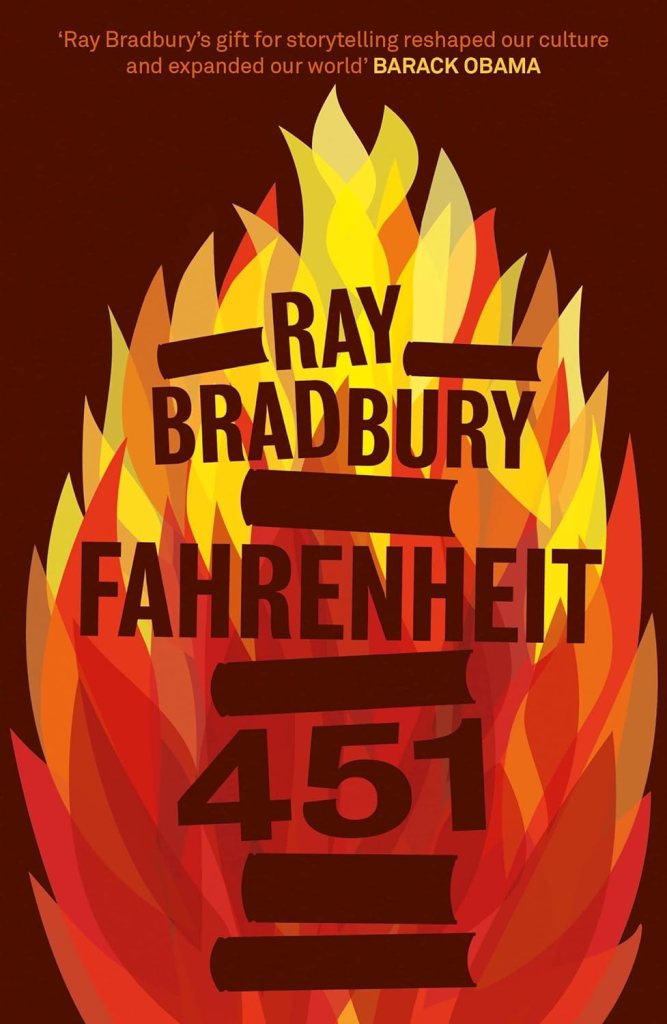
Fahrenheit 451 by Ray Bradbury, HarperVoyager, 2008, paperback, 227 pages, ISBN: 978-0-00-654606-1, ₹499
“A book is a loaded gun in the house next door. Burn it. Take the shot from the weapon. Breach man’s mind.” (p. 77)
Literature is often a target in authoritarian and dystopian societies because it possesses the power to inspire critical thinking and question authority. Book burnings have been historically associated with authoritarian regimes as a means of controlling information and imposing ideological conformity. Why and what is it about literature that frightens authoritarian governments and compels them to control it? This question and the search for its answer forms the backbone of the classic dystopian novel Fahrenheit 451. Written by Ray Bradbury at a time of great social upheaval in American society, the novel explores the impact literature has on human nature and how ignoring it will inevitably lead humanity to a dystopian world.
The world of ‘Fahrenheit 451’ is a bleak and oppressive vision of a future society where books are banned and intellectualism is suppressed. The title ‘Fahrenheit 451’ is a reference to the temperature at which book-paper catches fire and burns. It is used metonymically to represent the book-burning and censorship that are central to the story. The story takes place in an unspecified city in the United States sometime in the future. This is used to drive home the fact that no culture can claim immunity to such a society, and it can happen to any society at any point in time. The protagonist of the novel is ‘Guy Montag’. He is a loyal member of the fire department. Books are considered dangerous to the stability of the society, and as a fireman, Montag’s job is to burn books and the buildings they are found in. The ironic naming of firemen is reminiscent of the name of the government ministries in George Orwell’s 1984. The totalitarian government of 1984 had four ministries – The Ministry of Truth, which was responsible for disseminating propaganda; the Ministry of Peace, which was responsible for military activities; the Ministry of Love, which utilised torture for reeducation; and The Ministry of Plenty which kept the populace in a state of perpetual poverty as a means of control. ‘Fahrenheit 451’ follows the same pattern with fire departments and firemen who are responsible for burning things. Conversations with a new friend and a tragedy during one of his raids make him question the purpose of his existence and he becomes curious about the forbidden world of books. Eventually, he becomes disillusioned by the society around him as he repeatedly tries and fails to make other people, including his wife, realise that media is being used to enslave them and how literature offers an avenue to break those mental shackles.
In the novel, characters use small, portable radios called seashell radios or thimble radios, which are inserted into the ears. Large, interactive televisions called Parlor walls are a central feature in many homes and claim to provide an immersive entertainment experience. Devices like these constantly feed people with information and entertainment, preventing them from reflecting on deeper issues or engaging in meaningful conversations. Bradbury saw the power of the media in achieving both enlightenment and manipulation. He warned against a future where people are so bombarded by mindless entertainment and superficial information that they become passive and apathetic. This bombardment of sensations and emotions, in turn, serves as a substitute for thinking. Bradbury takes a loving view towards literature. His appreciation of the role the written word plays in the development of humans, both at a societal level and at an individual level borders on reverence. The protagonist of the novel seems lost at his own inability to understand why literature moves him so deeply. His journey of realisation is one which all book readers, who struggle to choose between a book or a Netflix show can empathise with.
“Books were only one type of receptacle where we stored a lot of things we were afraid we might forget. There is nothing magical in them, at all. The magic is only in what books say, how they stitched the patches of the universe together into one garment for us” (p. 107)
In classical democratic systems, the state is often likened to a multifaceted edifice upheld by three fundamental pillars: the executive, the legislature, and the judiciary. These three pillars work in tandem to create a functioning society while simultaneously creating checks and balances on each other. In the modern world, Media has emerged as a fourth pillar. It is a potent force that shapes public opinion, holds power to account, and acts as a crucial check on the functioning of the other three pillars. By serving as a bridge between the state and the public and providing citizens with essential information about government actions, the media indirectly influences the decision-making process. The emergence of social media and entertainment as integral components of media has significantly transformed the landscape of information dissemination, public discourse, and accountability. Entertainment, often as infotainment, has become intertwined and indistinguishable from news and information on social media. This power of the media as a propagandist tool can be clearly seen in today’s world where even justifications for war are primarily consumed by the public via Instagram posts and TikTok.
It is important to understand the political and social climate of 1950s America when this novel is written to fully appreciate the dynamics of literature and entertainment on societal freedom. All modern retellings of WWII and the Cold War cover how propaganda was utilised by the Nazis and Communists to brainwash the public and stifle free speech. However, the political paranoia, censorship, and the suppression of dissenting voices employed by the US government are less frequently brought up and discussed. Senator Joseph McCarthy led the Red Scare campaign to root out suspected communists and sympathisers in various aspects of American society. The House Un-American Activities Committee (HUAC) held hearings in the 1950s to investigate alleged communist influence in Hollywood and the entertainment industry. Through this book, Bradbury warns of the dystopian society that will be created when intellectual freedom is limited and independent thought is suppressed for ideological objectives.
“So now you see why books are hated and feared? They show the pores of the face of life.”
(p. 108)
Fahrenheit 451 is not limited to a critique of society and institutions. Most of the public in the novel is depicted as being apathetic, passive, and conformist. They do not question the government’s decisions to ban books and suppress intellectualism. “Remember, the firemen are rarely necessary. The public itself stopped reading of its own accord.” (p. 113). Rather than fighting for their freedom, the public is itself complicit in their own oppression. They prefer to engage in shallow and mindless forms of entertainment and this lack of resistance, in turn, allows the government to control and manipulate their beliefs and values.
“It didn’t come from the Government down. There was no dictum, no declaration, no censorship, to start with, no! Technology, mass exploitation, and minority pressure carried the trick… Today, thanks to them, you can stay happy all the time, you are allowed to read comics.” (p. 76)
The novel also touches upon how relationships in such a superficial society are often devoid of genuine connections. The public’s inability to form deep emotional bonds contributes to the isolation and alienation prevalent in the society. There are strong parallels between the worldviews of the fire chief Captain Beatty and Mustapha Mond, the Resident World Controller from Aldous Huxley’s Brave New World. Like Captain Beatty, Mond also believes in restricting access to literature, philosophy, and scientific knowledge that might lead to individual contemplation and dissatisfaction. He believes that limiting intellectual and artistic pursuits helps prevent disruptions to societal harmony. Seen in this light, the novel serves as a cautionary tale on the dangers of complacency, apathy, and the willingness to sacrifice intellectual freedom in exchange for a false sense of security and comfort. A critical citizenry and an engaging media landscape are necessary to safeguard individual liberties and preserve an open and free society.
The denouement of the book is a breath of fresh air. After evading his pursuers, the protagonist stumbles upon a group of nomadic intellectuals who are aware of the workings of the dystopian society they live in and consequently live in hiding. They live a simple life on the fringes of society and help those who are persecuted by the government. Despite being aware of the evil that pervades their society, these ‘Book People’ don’t seek revenge. They are not planning for an uprising or creating secret groups to make people aware of disinformation within them. They disregard violence to attain goals, preferring to engage in passive and positive resistance. Their approach is completely opposite to the hyper masculine media of today, where all conflicts are solved with bullets and bombs. The Book People’s actions are driven by a long-term vision. They do not shy away from the culpability people hold in the direction the society takes. Rather, they place the blame squarely on the shoulders of people who erode their own freedoms bit by bit. They believe that by preserving literature and knowledge, they are preparing for a future in which a more enlightened and open society may emerge. By sharing books through an oral tradition, they are engaging in a form of resistance that can help plant the seeds of change in the minds of people using the power of literature.
“Don’t ask for guarantees. And don’t look to be saved in any one thing, person, machine, or library. Do your own bit of saving, and if you drown, at least die knowing you were heading for shore.” (p. 112)
The term ‘classic’ in literature generally denotes a book whose themes reverberate through time and culture. Some people use it to signify books from a certain time period, and some use it for books that have reached a certain level of critical acclaim or popularity. For me, there is one more criterion. A book that affects the fundamental way the reader examines their own life and society. Bradbury’s dystopia will horrify you with its forces of censorship and conformity. At the same time, it will make you realise the essence of what makes literature so vital to humanity. This classic is an essential reading for anyone who seeks to understand the forces that create a dystopia and better understand where our world stands.

Aditya is an avid reader of fictional novels and is currently serving a self-imposed exile from bookstores until he completes his reading list. He can be reached at adityatemail@gmail.com
 TheDaak review
Leave a comment