
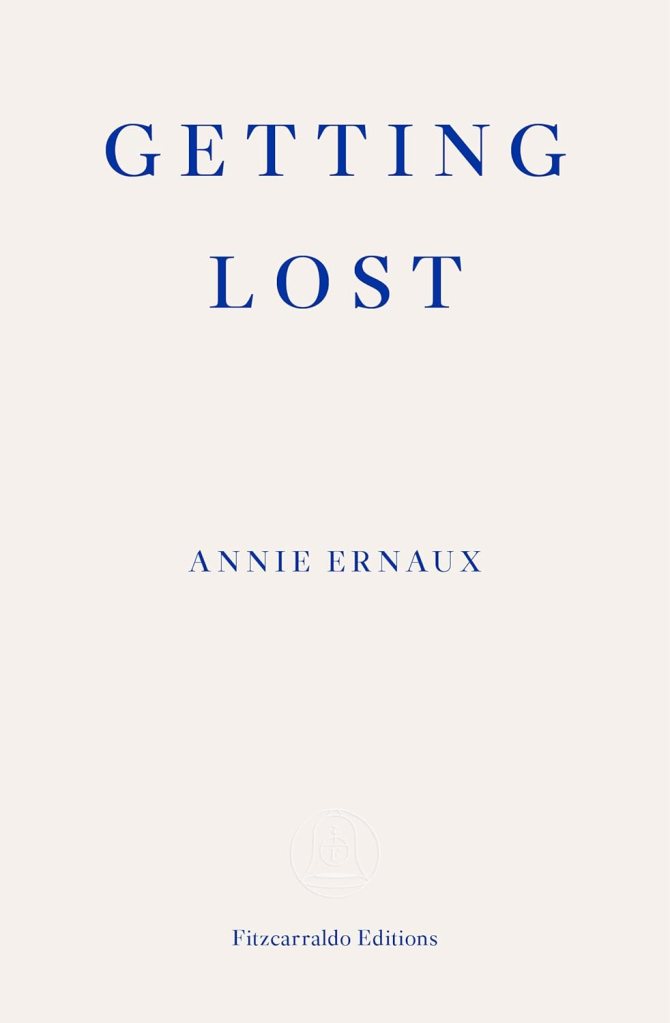
Getting Lost by Annie Ernaux, New York, Seven Stories Press, 2001, 239 pages, 8.5 x 5.5 inches, ISBN 978-1-64421-350-6
In 2022, Annie Ernaux received the Nobel Prize in Literature for: “the courage and clinical acuity with which she uncovers the roots, estrangements and collective restraints of personal memory”(Nobel Prize Facts). Getting Lost is her beautifully translated and intimate memoir, which reveals the author’s private struggles with angst, lust, and desire.
Memoirs are a complicated literary genre. Authors have to contend with balancing details that are interesting to the reader, while making mundane aspects of life visible, in addition to interesting. People read them in order to escape their own lived realities, often willing to step into other more fantastic, complicated and even disturbing lives.
What makes for a compelling memoir is difficult to deduce; perhaps because there is no formula to life or the ways in which it is remembered. Patti Smith’s Just Kids (2010, Ecco) recounts her wild days in New York in the company of other artists. Anne Boyer’s The Undying (2019, Picador) documents firsthand the struggles to survive in the face of cancer, and the horrific-ness of a lived experience at the helm of death.
In Getting Lost, French feminist writer Annie Ernaux chronicles in great detail the fraught subtexts of her two-year affair in Paris in the form of short diary entries. Reading it feels like taking a front seat to her deepest vulnerabilities. Yet, these seemingly uncensored notes do not just describe her sexual encounters. They are interwoven with her dreams, and reflections about her life as a writer. In this case, the author’s profoundly honest voice emerges from the written annotations of an impossibly complex context: her illegitimate love affair with a younger Soviet diplomat, dramatically set against the fall of the Berlin Wall and the collapse of the USSR.
The memoir reads like an unsettling archive of one woman’s personal life— a live account of a reckless, lust-driven romance. The writing is a transcription of Ernaux’s handwritten diary (written in French) from a time when she was in a relationship with a married Soviet cultural attaché. Their relationship and her lack of interest in his personality vs. his physical body seem to echo the ways in which Europe looked at and treated the USSR – replete with similar disbelief, suspicion and mistrust.
Ernaux unabatedly invites the reader directly into her subconscious through this log-book of personal desire and despair. Getting Lost chronicles her pain and vulnerability as she experiences the addictions of obsession and passion. The meticulous documentation of her thoughts reveal how her feelings transform overtime. Her voice is unique because it is permeable to the point that while reading, one wonders if these could be one’s own thoughts.
The level of personal detail in this archive of private thoughts is sometimes uncomfortable, leading you to wonder with the author if S would have approved of her writing this without permission. The vignettes of prose read like flurries of memories: the perils of intimate relationships recounted in such detail that the reader is left wondering whether she seeks affirmation in the ways she invites us to remember with her.
She shares everything, from tender moments: “I gave him the newspaper for the day of his birth” (p. 155) to fears about his attention roving. These are very human and relatable anxieties: the seduction of a lover, the waiting games, the passion, and of course the pain. Even the repetitive angst of waiting for a phone call from her lover: “he hasn’t called yet… (pp. 14), or “last night he called. I was sleeping,”(pp. 15) to: “I’m afraid of seeming clingy and old (clingy because old)” (p. 19).
Although Ernaux’s vulnerability stems from being a single woman and a mistress, her anxieties sound familiar to anyone that has experienced intense emotional attachment: “this waiting for the phone to ring, in addition to his total inscrutability — what do I mean to him?” (p. 21), “when will he call?” (p. 41). Her confessions are sincere, and with it she has also chronicled the effect of oxytocin many of us experience when we first fall in love.
Annie Ernaux’s entries are individually labeled with the month, day and date, and she notes the calls from her lover with a bureaucratic exactitude reminiscent of the Soviet-era. Given this level of detail, the reader gets easily caught up in her drama, punctuated by the passing of time across pages: “it will be six days since the last time S called… “(p. 67). There is also an admirable degree of awareness in Ernaux’s writing, particularly when she confesses: “writing fills me with waiting and with longing for him” (p. 76), as well as denial rooted in contradiction, “…I am overwhelmed with pain (p. 218).”
Ernaux has a particular penchant for mundane yet funny observations, like her lover’s Russian underpants, which construct the serious backdrop of the affair. She notes, for instance: “I had lost a contact lens. I found it on his penis” (p. 33). Although the diary entries do not directly describe the fall of the Berlin Wall or collapse of the USSR, she alludes to events as the articles she doesn’t feel like writing, through her travels to Poland or as discussion from events she attends. This is the specter holding her book together, along with the distant mistrust of her lover.
Ernaux’s short sentences are poetic for their emotional intensity, the pain and loneliness which she tenderly articulates: “I love him with all of my emptiness” (p. 62), something that she experiences as both a writer and a mistress. The book is bound by a constant undercurrent— her fears of rejection: “this morning’s drama: he will call tonight or tomorrow and say it’s over” (p.p. 59). Reconciling her own emotions and the passing of time with pain seems to fuel her writing. The brutal honesty with which she expresses herself is perhaps a way of coping with the realities of her affair: “meeting his wife is a horrifying prospect. I have to be the most beautiful of all, the one who sparkles most, desperately” (p. 29).
Sometimes, she writes in incomplete sentences, which makes it easier to disengage from one’s own thoughts and dive headfirst into her anxieties. She says, for instance, that she makes love not to write about it later, but as if it were here last time— a metaphor for feeling alive. She recounts the familiar devastation of wanting to die when your lover doesn’t call or acknowledge: “perhaps all that attracts him is my status as a writer” (p. 23), to the profound: “truth works in writing, not in life” (p. 27), highlighting the fact that her traumatic passion may be less of a way of coping with the man she calls S, and more with the pain of her lonely life.
The reader gets a sense of her yearning through the things she notices; small things, like their love making: “I almost always take the lead, but in accordance with his desires,” to exoticizing his Russian accent: “the guttural accent which palatalizes and emphasizes the first syllable, making the second one very short” (p. 19). Their relationship feels superficial at best, an enamorment with the exotic.
Throughout the book, she recounts and justifies her affair as one driven by lust and sexual prowess. She does not attempt to analyze her lover and his psyche apart from the reasons he is cheating on his wife, and barely alludes to the past relationships whose failures have likely resulted in the situation she finds herself in. Unlike memoirs that try to infer a contemporary political situation, Getting Lost is just a series of articulations of her inner life and feelings — a mirror to one woman’s angst-ridden and deepest thoughts.
The book is woven together with the worries of retelling and reliving her sordid affair. As the diary progresses, she reveals: “this pain which I am tolerating a little bit better today is caused by the conjunction of two things: the necessity of writing and lucidity about the fact that S doesn’t love me” (p. 135). These descriptions of her painful reality, dreams, erotic experiences, of waiting, wanting and fearing their inevitable break up like his country of citizenship; the jealousy towards his wife and the fragile nature of their affair, which is set to break at any moment: “I live in a state of anesthetized pain” (p. 119). Ironically, at one point she notes: “I should not reread this journal, it is sheer horror” (p. 205).
One does not consider the emotional trauma of re-living the depths of one’s own thoughts. However, in context: “my suffering, like my happiness, is linked to my condition of being a single woman” (p. 87). Mentions of her lover start to fade towards the end of the book, when she concludes: “for the first time since November 6 – the last time I saw S – I waken with an inexplicable feeling of happiness” (p. 239). And yet, we know from her earlier entries, that she writes to remember, to memorialize and perhaps justify their encounters. In her own words: “to lock him in” (p. 62).
By publishing this diary, Ernaux has not only forever memorialized her relationship with S, but has made space for women to freely narrate their lives as stories. And with it, she has raised critical questions about memorialization: what and how do we choose to immortalize, to conflate fact and fiction, private and public? How does power mediate between truth and the domain of privacy? And when we liberate ourselves through our stories, what do we compromise for others involved? Her book, in spite of these concerns, is an example of how our voices are not simply expressions of memories, but that they make space to tackle the injustices of the untold.
Reference:
Nobel Prize Facts, The prize motivation described on the website for the Nobel Prize:
https://www.nobelprize.org/prizes/literature/2022/ernaux/facts/

Shriya is a graduate of McGill University and The New School—currently exploring the intersections of art and policy. Her research interests include Art, Policy, Development, Climate Change, and Population Health.
She can be reached at Shriyaisnot@gmail.com
 TheDaak review
Leave a comment