
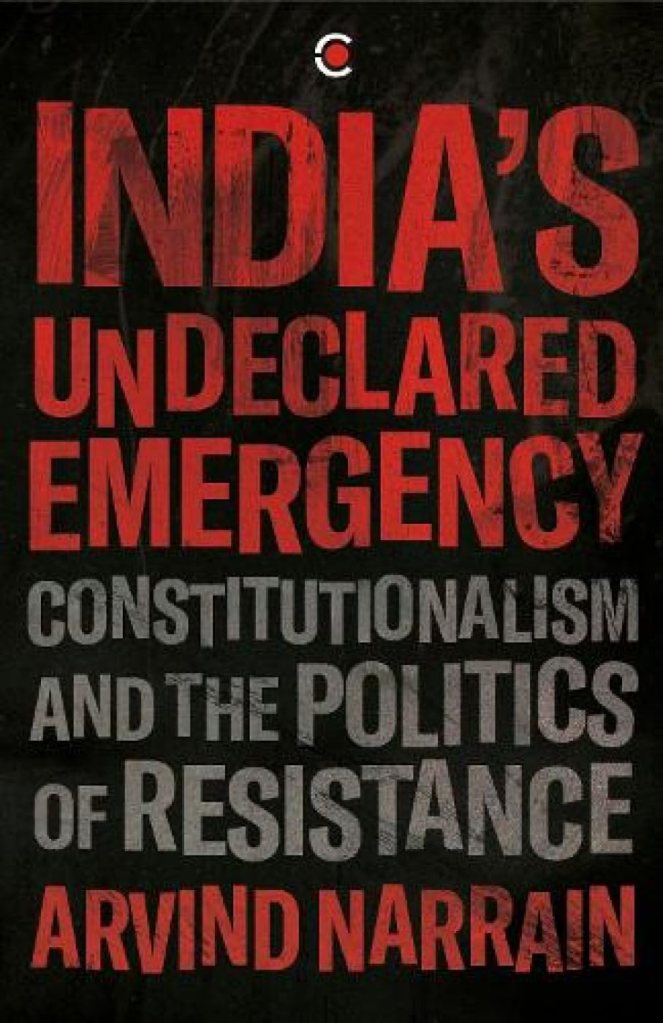
India’s Undeclared Emergency: Constitutionalism and the Politics of Resistance by Arvind Narrain, Westland Publications Private Limited, Paperback, Published: January 2022, 342 Pages, ISBN: 9789395073042,Price 799 INR
The history of nations identified as a part of the ‘third world’ has been a testimony to the struggle waged by the people against European colonialism and a bid to reclaim the right to freedom and self-governance. But what happens in these post-colonial societies when the promise of freedom comes to be marred by the exercise of absolute power? Arvind Narrain’s book India’s Undeclared Emergency is a quest for understanding two watershed moments in the political history of India: The Emergency of 1975-77 and the rise of National Democratic Alliance under Prime Minister Modi post-2014. Tracing the rise of authoritarianism in India since the dawn of Indira Gandhi’s regime, he delves into the transformation of the ‘nature of Emergency’ in India. Under the auspices of the Modi government, what has emerged is an Emergency which is ‘undeclared’ in character, but manifests itself both through the mandates of the state as well as popular mobilization. The legacy of centralized control of the state continues to live in old forms and new.
The book begins with a short introduction and comprises five chapters. The first two chapters provide an insight into the Emergency era of 1975 and the governance and legislative measures it was rooted in. The third and the fourth chapters are an elucidation on the Modi Era and the nature of Emergency it has catalyzed. The final chapter concludes the book on a hopeful note, initiating a discussion on the future course of action to tackle the current day totalitarianism that exists in the garb of a mass political culture.
The beginning of the era of Emergency
The book begins by familiarizing the readership with the conditions that existed within the ‘overt’ Emergency which was declared by Indira Gandhi in 1975. The author views it as the beginning of a regime that enabled centralization of power and routinization of state excesses. In the first chapter titled “Authoritarian Rule: The Emergency of 1975-77”, he provides a detailed description of the instruments deployed by the state under the declaration of Emergency. These ranged from Constitutional provisions like Article 352 (declaration of Emergency), Article 353, 358, 359 (the executive powers that the government acquires under Emergency); to laws like Maintenance of Internal Security Act (MISA), 1971. Such legislative measures were accompanied by censorship of the media, demolitions and forced family planning. The author provides a detailed analysis of the same through multiple examples and case laws that formed the backbone of the Emergency. However, it is in Chapter 2 titled “Roots of the Emergency: Preventive Detention” that he goes on to locate the most effective tool of quelling dissent in Article 22 of the Indian Constitution. The mapping of the Emergency 1975-77 is extremely comprehensive and expansive, giving the reader an insight into the ground zero of the institutionalization of extraordinary measures, both through a coverage of de facto incidences as well as judicial reasoning in the cases challenging the imposition of Emergency.
The Dawn of the ‘Undeclared Emergency’
The author proceeds further with an in-depth description of the sequence of events as it has unfolded under the Modi regime. It also constitutes the longest portion of the book. He begins with the argument that even post-Emergency, India functioned only as a 50-50 democracy (p. 57). Post-2014, an ‘undeclared’ emergency has been promulgated in the country through repression of dissent, creation of a climate of fear and a continued use of laws of exceptional nature. In the third chapter titled “The Modi Era: The Undeclared Emergency”, the author focuses on the role of the state in creation and maintenance of the conditions of Emergency. The utilization of laws such as the Unlawful Activities Prevention Act (UAPA) enabled a widening ambit of criminalization, role of agencies like National Investigation Agency (NIA) and judicial failure to perform the function of a counter majoritarian institution has been the highlight of the current era of emergency. This is demonstrated through the documentation of the Bhima Koregaon case, anti-CAA protests and the role of the media. The author goes on to assert that the point where this ‘undeclared Emergency’ makes a departure from the Emergency of 1975 is the manner in which it has paved the way for a complete control of social and political life. This symbolizes a shift from the ‘authoritarian state’ of 1975 to a ‘totalitarian state’ of the current age. A detailed analysis of the same is provided in the fourth chapter titled “Slouching towards a Totalitarian Future”. The book further notes that the Modi regime has successfully created an Emergency of unprecedented and magnanimous proportions. It has achieved this through the creation of a vast civil society network of the Hindu Right, enabling mob violence and hate speech as well as imbuing the law with a Hindutva sensibility.
The Way Forward
In the final chapter of the book titled “What is to be Done?”, the author has tried to delineate a silver lining by endeavoring to chart out a path for the future. Instead of creating a blue-print, he draws on examples of past resistance and instances of dissent that provide us with glimpses of a hopeful future. He emphasizes on reassertion of the “normative state” (p. 199) and constitutional values. Further, he underlines the importance of humor as dissent, bureaucratic dissent and dissent rooted in cultural contexts to bring home the argument that creation of an inclusive nationalism and a unity rooted in diversity is the key to meting out the challenges that lie ahead.
Comprehensive yet Disjointed
The book is empirically rich and is extensively researched. It is illustrative of a good qualitative study as the author took recourse to secondary literature to utilize suitable theoretical ideas as well as citation of case laws and media reports to give the reader a glimpse into the string of cases that form a part of the ‘undeclared emergency’. The book would have enriched had the author provided some instances of judicial reasoning in cases that he talks about in the greatest detail, like, the Bhima Koregaon case as well as the Anti-CAA protests. This would have exposed the reader to the skewed judicial logic that becomes instrumental in denying the most fundamental relief to the under-trials in the form of bail.
However, where the book falters is the disjointed perspective with which it sees Indian political history. While the Emergency of 1975 and the rise of Narendra Modi are indeed significant events that have shaped the political landscape, it is difficult to see them as divorced from or towering above a tradition of politics of excess that has existed in India since Independence. The legal inheritance of India is burdened by a British baggage that viewed dissent as a threat. The framers of the Indian Constitution borrowed heavily from the Government of India Act, 1935. This is exemplified by the provision of President’s Rule (Section 93 of the Government of India Act which became Article 356 in the Indian Constitution). Its first usage in independent India could be traced to as far back as 1951 in Punjab. The British legacy of this kind further found its place on the outlook of the various organs of the government. The judiciary continued to see the constitution as a continuation of British traditions (Kannabiran, 2004: 60). This was observed in A K Gopalan v Union of India, where the detenu continued to languish in jail for offenses invoked by the British even after independence. The executive acquired powers to issue directives in an “unfiltered and unfettered manner” through Article 73 and Article 152 of the Constitution (residuary powers) (Narsappa, 2018: 133). All of this was accompanied by a proliferation of laws like Armed Forces Special Powers Act (AFSPA), Terrorist and Disruptive Activities (Prevention) Act (TADA) and Prevention of Terrorism Act (POTA). It represented the creation of a culture where the state equated violence with power and reduced socio- economic problems to law and order issues (Kannabiran, 2004:4). Hence, it is perhaps better to visualize the two events as a crescendo to the continuum of state excesses that has been a part of India even under home rule and which entails a ‘crisis of legitimation’ for the state (Baxi, 1982). One starts to see a glimpse of the acknowledgement of this fact by the author in the second chapter when he traces the history of preventive detention in India. But this is a trajectory that the author abstains from adopting in further chapters. What probably needs to be recognized is that Emergency, whether overt or covert, is not an aberration. It is the product of a long flawed political, social and legal structure that needs repair.
Nevertheless, the author has sought to produce an extremely comprehensive analysis of the centralized rule of two eras, charting out their similarities and departures quite succinctly. Further, the book is fairly well-rounded, not only in terms of the corpus of laws, executive decisions and judicial reasoning that it covers, but also in terms of the interdisciplinary character that it embodies. The author, while being a lawyer by training, has made efforts to include arguments of political scientists like Hannah Arendt, Christophe Jaffrelot and Juan Linz as well as economists like Thomas Pikettty. The widespread documentation of cases and judgments that the book has undertaken, is a delight to read for a seasoned academic as well as for a reader who is not familiar with the intricate details of the political history of India. Such profound documentation becomes instrumental in holding truth to power by sketching out the devil from the intricacies of legal technicalities as well as popular culture. What makes this book a truly academic read is the way in which it goes beyond a purely doctrinal analysis and tries to give an insight into the diverse aspects (social, political and economic) of how the ‘undeclared emergency’ has unfolded in India.
References
Baxi, Upendra. 1982. The Crisis of the Indian Legal System. Vikas Publishing House Private Limited.
Kannabiran, Kandala Gopalaswamy. 2004. The Wages of Impunity:Power, Justice and Human Rights. Orient Longman Private Limited.
Narsappa, Harish. 2018. Rule of Law in India: A Quest for Reason. Oxford university Press.

Anjali Mathur is a PhD scholar at Jawaharlal Nehru University, Delhi. Her current thesis concerns itself with analysing the selective and curated application of laws in service of the logic of populism and how that can impact and shape long standing constitutional values. She has presented at the workshop under the project ‘Geographies of Populism’ organized by Aalborg University, Denmark. She has also made a presentation at Ulster University, Northern Ireland titled ‘Honour and Chivalry: Investigating the Ingredients of Anti-Terror Laws in India’ as well as at Aligarh Muslim University titled ‘India as Aid Donor and Significance of Aid in International Politics’. Her fields of interest include Political Philosophy and Constitutional Law.
 TheDaak review
Leave a comment