
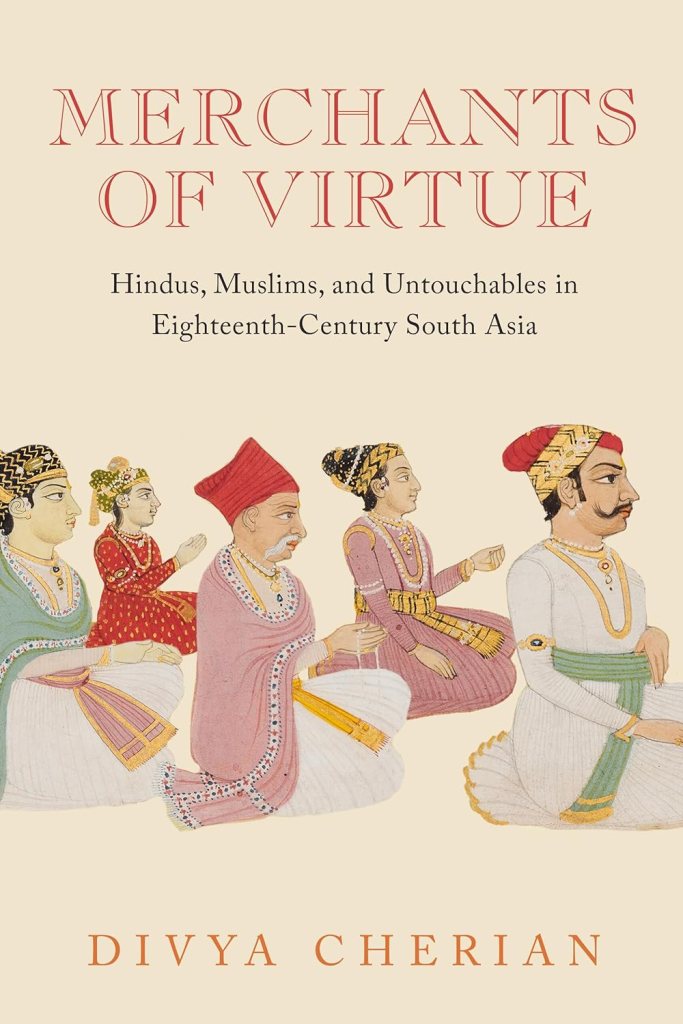
Merchants Of Virtue: Hindu, Muslims, Untouchables In Eighteenth-Century South Asia by Divya Cherian, Navayana Publication, New Delhi, Paperback, Published: 2023, 272 pages, 6 x 9″, ISBN: 9788195539277, ₹599.
“The everyday social is the domain where the first experiences of social are formed.”
– Gopal Guru, Sundar Sarukkai (2019)
Understanding caste in its quotidian forms unveils the construction of the ‘everyday social.’ When exploring the histories of caste, the consideration of ‘everyday lives’ and ‘everyday practice’ becomes crucial. Going beyond textual analysis, caste-related events, and movements, it is essential to scrutinize the operations of caste within the fabric of daily life (Jawaare, 2019). Divya Cherian’s Merchants of Virtue is part of this quotidian caste history.
One of the book’s central concerns is probing the role of merchant castes in the histories of caste. By focusing on the Kingdom of Marwar, particularly Maharaj Vijay Singh’s reign (1752-93), Cherian illustrates how merchant castes enforced their caste ideals and influenced the development of the Rathore State. She asserts that the ‘Hindu’ self within the region emerged in opposition to ‘achhep’ or untouchables. The ideals of vegetarianism and bodily austerity as markers of Hindu identity, are again products of the very same process.
Hindu ‘self’ in the pre-colonial period developed as a reaction to Muslim presence. While reacting to the Muslim ‘other,’ the Hindu ‘self’ gets expressed and solidified (Thapar, 1989). Countering this claim, some scholars have denied the strict categorization as ‘Hindu,’ ‘Muslim,’ and argue for hybrid and sectarian identities (Talbot, 1995). In both these arguments, religion or faith assumes the central position. Instead of this, Cherian argues that, to comprehend the precolonial Hindu ‘self’ and Hindu-Muslim relations, the central role of caste, particularly Untouchable castes, must be considered. This requires a focus on the bodily ethics associated with caste in its quotidian forms.
For any kind of historical inquiry, the question of ‘sources’ is important. The book relies on an examination of more than seventy volumes of the Jodhpur Sanad Parwāna Bahīs (JSPB). The JSPB depicts the quotidian relation between the state and its constituents in the form of – orders, petitions, demands, etc. The Bahis, which bear the imprints of merchants’ administration, are embodiments of Rathore Documentary Culture. Her engagement with vernacular literature, particularly in the early modern period, undoubtedly offers a distinct understanding of South Asian history.
The book is divided into two parts. The first part, titled “Other”, delves into how the Rathore state’s orders aimed to express distinction from perceived untouchables, covering topics in three chapters: ‘Purity’, ‘Hierarchy’, and ‘Discipline’. In the second part, “Self”, the book explores the recasting of elite identity through the elevation of merchant ethics. It examines how the state, led by Merchants and Brahmin administrators, enforces mercantile values and endeavors to shape a ‘Hindu caste body’ through bodily discipline. It contains three chapters- “Nonharm”, “Austerity”, and “Chastity” The initial chapter, “Power”, provides background insights into these changes, while the ‘Epilogue’ discusses their afterlives of those changes and the symbiotic association between Marwari merchants and Sanatani Dharma in colonial and post-colonial period.
While investigating the role of merchants in South Asian history, the author argues that in the eighteenth century, merchants made the leap from ‘participants in state machinery to leaders of political change’. Their roles as courtiers, administrators, and scribes, coupled with dominance over income-generating positions, facilitated this transformative shift. Scholars have widely acknowledged the rise of merchants as a ‘political class’ in the Mughal period itself. Post-Mughal Rajput State formations have also shown similar kinds of patterns.
The first chapter of the book delves into the social, political, and economic transformations in the Marwar region post the fifteenth century. It primarily focuses on the reign of Vijay Singh (1752-93) and the subsequent changes in the Rathore state. Cherian explores Vijay Singh’s initiation into the Vallabha sect in 1765 and his deliberate efforts to present himself as a devotee of Krishna, which leads to the creation of a shared bond with Jain and Vaishnava traders. The reference to merchants and certain brahmin castes being grouped under the common term ‘Mahajan‘ was a consequence of their active participation in the administration. Key positions within the state organization, such as Diwan, Bakshi, Hakim, Kotwal, and Sayar, were primarily occupied by those Jain and Vaishnava merchants. In essence, Cherian demonstrates that Krishna-centered devotion and economic debt conditions allowed merchants to translate their economic success into social and political status. This transformation ultimately brought the king into a closer alliance with merchants.
“Living next to a leatherworker violates my dharma” (p.46)
“If they drink water there, my dharma will remain intact” (p.47)
Mahajans strategically employed state authority to uphold social distance from the ‘achhep’ or untouchables. The above quoted petitions underscore the Mahajan’s endeavors to establish a distinct, autonomous, and untainted sphere for the Hindu ‘self,’ invoking dharma to justify social segregation. The individuals labeled as ‘achhep’ in these records encompass various groups such as Turuk, Chamars, Dhed, Thori, Bavari, Bhangi, Bhambi, Meghwal, and Halalkhor. Despite evolving definition of who precisely falls under the category of ‘untouchable’, for the elites as Cherian observes, the ‘Bhangi body’ remains at the core of untouchability. The stigmatization of the bhangi body is essentially associated with the nature of their labor. Those ‘achhep’ are not regarded as full human beings, as implied by terms like ‘kamin‘ (lowly) and ‘pun jat‘ in archives, and even Muslims are also categorized under ‘achhep’.
Chapter 3, titled “Hierarchy”, delves into state intervention in religious traditions and practices, exploring the consequent formation of the ‘Muslim Other’. The chapter examines the shaping of the imagination of Muslims in Rajput courts, through the lens of state-sponsored Rajput narratives, with a specific focus on Prithviraj Chauhan. These narratives defined Muslims as ‘others’ and ‘political enemies.’ The chapter highlights the significance of depictions in Udaipur and Sisodia courts in creating categories, a scenario where Muslims are collectively portrayed as a unified entity. For the Rathore state, the concept of ‘Hindu’ is realized by excluding Muslims and ‘achhep’, reflecting an attempt to carve out an independent and autonomous space within Hindu society.
Chapter 4, titled ‘Discipline’ delves into how the designation of ‘achhep’ in Marwar is shaped by referencing the practices and moral values of the elite. ‘Nonharm’ is depicted as the moral conduct anticipated from the elites, with the killing of animals essentially linked to untouchables and deemed an immoral and criminal activity. The state’s insistence on vegetarianism led to the establishment of strict surveillance regimes. Groups associated with the dead or the meat were labeled as ‘low’ and ‘other,’ with such acts were considered both immoral and criminal. Cherian provides detailed insights into these dynamics, particularly in the cases of the Thorī and Bāvrī castes. This historical context can be viewed as a precursor to the concept of the ‘criminal caste’ during the colonial period. The State’s adoption of a policy of public surveillance is emphasized, turning every individual in the State into an informer essentially, the ears and eyes of the State. Cherian emphasizes that the vegetarian policy played a crucial role in shaping Hindu identity in Marwar. This underscores the notion that, when it comes to food, the dietary choices of upper castes are accepted as the universal norm.
The three chapters in Part Two extensively explore the regulation and control of the body within the higher castes, elucidating how the Hindu ‘self’ became the exclusive domain of the upper castes through the imposition of bodily discipline. The Rathore state, advocating extreme non-violence, enforced a complete ban on killing animals. In this context, a historical review of non-harm and vegetarianism is also undertaken. Prior to earlier attempts by the State to impose these values, they were limited to the kingly class, as seen in the cases of Ashoka or Akbar; however, in the Marwar region, it was equally applied to subjects as well. The state exhibits an extraordinary sensitivity towards the killing of animals, evident in detailed orders, such as directives against using cow dung in rainy days, covering oil lamps, and refraining from killing ants. However, in stark contrast, these documents only make three references to female foeticide!
The body is regarded as an ethical space in the pursuit of ‘virtue’. State-sanctioned bans on activities such as betting, drinking, and abortion are also a part of creating the ‘Ideal Caste Body,’ heavily influenced by the ethics of merchant castes. Interestingly, these bans appear to be more specific to the ‘Mahajan‘ caste rather than being universal, as observed in the case of animal killing. This can also be observed in the regulation of the sexual lives of the Mahajan castes. The ‘Caste’ and ‘State’ act as a regulating entity to prevent cases like lagvad and chamchori (illicit affairs), which contributes to the definition of ‘immoral sex’ and underlines the attempt to control the body as a means of shaping the Hindu ‘self.’ In summary, body control is an endeavor to actively influence the formation of elite Hindu identity with rituals, spatial practices, dietary choices, and sexuality emerging as symbolic representations of this identity. Notably, these processes unfolded within a legal framework, adding a distinctive dimension to the formation of elite Hindu identity.
In the ‘Epilogue’, Cherian briefly explores the role played by Marwari merchants in the Sanatan Dharma Movement, emphasizing their response to colonial modernity by adopting the sanatani way. The significant involvement of Marwari merchants in supporting the revival of Sanatan Dharma is evident through financial contributions to organizations and printing houses that publish literature associated with Sanatan Dharma. Notable institutions benefiting from Marwari investments include Venkateswara Press in Mumbai, Kalyan Magazine, Geeta Press in Uttar Pradesh.
In the final stretch, Cherian argues that in the contemporary period, caste differences are rooted in ‘somatic and sensory engagements’, perpetuating themselves at an everyday level. Here, the affective responses to caste differences need to be taken into consideration. To understand this, it is essential to focus on what Joel Lee has termed the ‘affective theory of caste’ (Lee, 2021). Cherian discussed this argument in the context of disgust and caste ethics.
Overall, Merchants of Virtue highlights the merchant castes’ capacity to reshape caste ideology based on the principles of non-violence and vegetarianism. It emphasizes the role of non-brahmin castes and concurrently calls for a “recognition of caste in its everyday forms, the centrality of touchability/untouchability.. and bodily ethics” as a crucial step towards annihilating caste.
References
Guru, G., & Sarukkai, S. (2019). Experience, caste, and the everyday social. Oxford University Press.
Jaaware, A. (2018). Practicing caste: On touching and not touching. Fordham Univ Press.
Lee, J. (2021). Disgust and untouchability: towards an affective theory of caste. South Asian History and Culture, 12(2-3), 310-327.
Talbot, C. (1995). Inscribing the other, inscribing the self: Hindu-Muslim identities in pre-colonial India. Comparative studies in society and history, 37(4), 692-722.
Thapar, R. (1989). Imagined religious communities? Ancient history and the modern search for a Hindu identity. Modern Asian Studies, 23(2), 209-231.

I have completed my Masters in Political Science from IGNOU in 2023 and am also eligible for Junior Research Fellowship(JRF). My scholarly pursuits primarily revolve around exploring the intersections of Caste, Gender, Body, and Sensory Studies, with a particular focus on Dalit writings in Marathi. Additionally, I have a keen interest in reading fiction and I passionately follow the world of cinema.
 TheDaak review
Leave a comment