
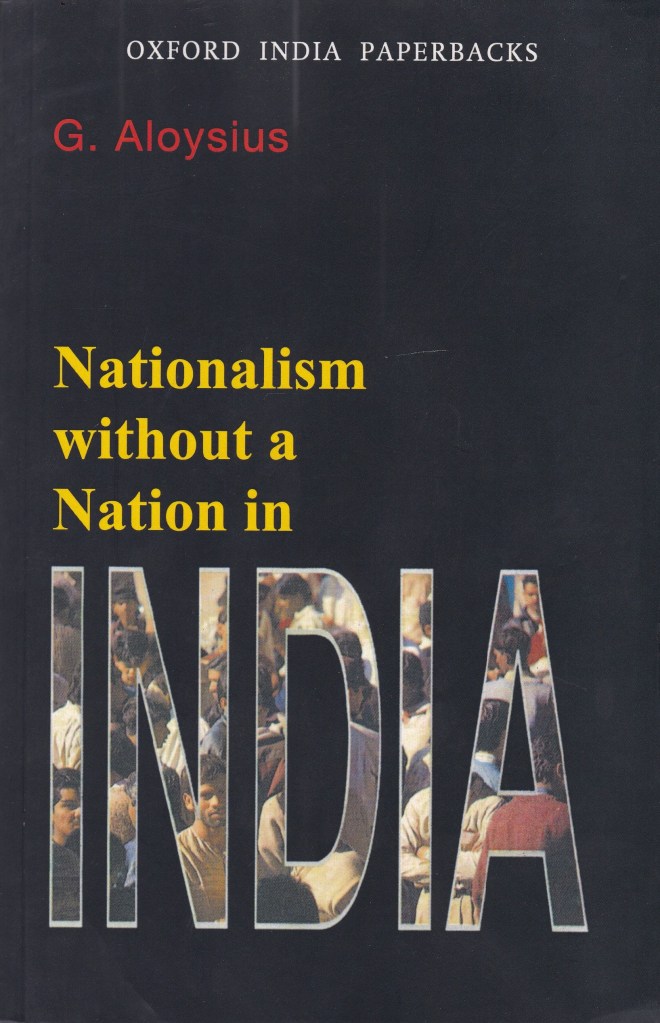
Nationalism without a Nation in India, by G. Aloysius, Oxford University Press, Pages. 283 pages, 216*138 mm, ISBN: 9780195646535, Price: 399 INR
By Amir Raza
In today’s India where majoritarian nationalism has gained prominence and is being actively pursued by the BJP and RSS, it becomes crucial to explore alternative perspectives on nationalism. In the ecosystem of hyper Nationalism which promotes the exclusion of marginal communities, G. Aloysius’s Nationalism without Nation presents an alternative discourse to understand nationalism and also challenges conventional definitions of nationalism that are often tied to specific ethnocultural identities or territorial boundaries. His work encourages us to consider nationalism a multifaceted concept transcending traditional boundaries and encompassing diverse identities and affiliations. It allows a more nuanced exploration of how people construct and express their national identities.
G. Aloysius the author of this book is a distinguished academic whose writings delve extensively into the realms of caste, nationalism, modernity, and the marginalized subaltern communities within the Indian subcontinent.
At the heart of G. Aloysius’s Nationalism without Nation lies the fundamental assertion that traditional notions of nationalism are inherently exclusionary and limiting. The dominant discourse often associates nationalism with a fixed territorial boundary and a homogenous group of people who share common characteristics, such as language, ethnicity, or religion. The author draws upon a wide range of interdisciplinary perspectives to support this argument. From postcolonial theory to cultural studies, sociology, and anthropology, the author presents a compelling case for reevaluating the traditional parameters of nationalism. Through meticulous analysis of historical and contemporary examples, the book demonstrates how the conventional emphasis on a singular exclusive identity suppresses diversity and perpetuates exclusion.
Aloysius begins by scrutinizing the Eurocentric model of nationalism that has been applied to India, highlighting its inherent limitations in capturing the multifaceted nature of Indian society. He contends that this model fails to adequately address the intricate interplay between various socio-cultural, religious, and regional identities that were pivotal to the Indian nationalist movement. By critically examining the works of prominent historians who have perpetuated this dominant discourse, Aloysius exposes the oversimplifications and omissions that have obscured the nuanced realities of Indian nationalism.
One of the prominent contrasts explored is between the dominant mainstream nationalism and the aspirations of subaltern groups. The book illustrates how mainstream nationalism, often championed by the ruling elite, seeks to project a singular narrative that may disregard or marginalize the diverse identities within the nation. This is juxtaposed against the subaltern voices of Dalits, Adivasis, and other marginalized communities who challenge the dominant narrative and demand recognition of their own distinct experiences and contributions.
Aloysius emphasizes how the struggle for cultural and linguistic recognition also reflects competing ideologies within nationalism. The example of language movements, such as the Dravidian movement in South India, highlights how linguistic identity can be a driving force for asserting autonomy and cultural distinctiveness within the larger national framework. These movements demonstrate the clash between the desire for linguistic self-determination and the state’s efforts to maintain a unified linguistic identity.
The concept of the “Homogenizations of Power” within culture (p. 57) serves as a critical lens through which G. Aloysius examines the dynamics of nationalism in India. This phenomenon often marginalizes or suppresses diverse cultural practices and viewpoints that do not align with the dominant group’s values or interests. Aloysius argues that this homogenization of power within culture has been employed by those in positions of authority to reinforce their control and influence over the nation’s identity. By promoting a standardized cultural identity, these power structures can legitimize their rule and maintain social order. This can lead to the suppression of marginalized groups, whose voices and cultural practices are often excluded or overshadowed.
On the other hand, ‘Appropriation of Power’ alludes to external influences shaping nationalist discourse. Aloysius suggests that dominant narratives often borrow Eurocentric models, neglecting the intricate socio-cultural realities of India. By scrutinizing historical and contemporary examples, Aloysius exposes how these twin processes contribute to the exclusion of marginalized voices and cultural practices.
However, Aloysius also highlights the resistance of subaltern or marginalized groups to this homogenization process. These groups challenge the dominance of a singular cultural narrative and seek to assert their own identities and histories. This resistance takes the form of cultural expressions, art, literature, and social movements that defy the attempts to impose homogeneity. By foregrounding previously marginalized voices, Aloysius challenges the hegemonic narrative that has often relegated them to the periphery of historical discourse.
The book also scrutinizes the conventional narrative of the Indian freedom movement, challenging the idea of a singular united nation rallying against British colonial rule. Aloysius argues that India’s social and cultural diversity has led to the existence of multiple “nationalisms,” often tied to regional, linguistic, and communal identities. The author contends that these diverse forms of nationalism coexisted and sometimes clashed within the broader struggle for freedom, thereby questioning the notion of a monolithic nationalistic movement.
However India, with its diverse tapestry of language, region, religion, caste, and tribe, strategically addresses subnational aspirations post-independence. Notably, the Indian Constitution, as elucidated by scholars like Granville Austin in The Indian Constitution: Cornerstone of a Nation, serves as the bedrock for accommodating these aspirations. The constitutional framework reflects the nation’s commitment to pluralism, effectively recognizing and safeguarding the interests of various identities. Through the reorganization and creation of states, the state has adeptly addressed surging subnational aspirations, fostering integrity and cohesiveness. However, it is imperative to acknowledge that while strides have been made in accommodating diverse aspirations, there remains a need for continued attention to the aspirations of marginalized groups, particularly tribes in mainland India, ensuring a comprehensive and inclusive approach to national identity.
The book also offers a thought-provoking critique of Mahatma Gandhi’s role and impact within the Indian nationalist movement. Aloysius argues that Gandhi’s vision of nationalism often overshadowed the diversity of voices and perspectives within the movement. He critiques Gandhi’s emphasis on ahimsa (non-violence) and satyagraha (civil disobedience), asserting that these principles, while important, did not always resonate with or adequately address the concerns of all segments of Indian society. Aloysius contends that Gandhi’s approach marginalized more radical and militant expressions of resistance that were adopted by other groups and individuals, particularly those from marginalized and oppressed communities.
Furthermore,the author challenges Gandhi’s stance on issues such as caste and untouchability. He points out instances where Gandhi’s efforts to address these social injustices were insufficient or even perpetuated existing hierarchies. Aloysius argues that Gandhi’s views on caste and his interactions with Dalit leaders like B.R. Ambedkar fell short of creating meaningful and lasting change.
Aloysius’s critique also extends to Gandhi’s focus on Hindu-Muslim unity. He argues that while Gandhi’s intentions were noble, his approach did not adequately address the complex religious and communal dynamics present in India. Aloysius suggests that Gandhi’s vision of unity often privileged Hindu perspectives and overlooked the diverse religious identities and aspirations within the nationalist movement.
While G. Aloysius provides a thought-provoking critique of Mahatma Gandhi’s role in the Indian nationalist movement, scholars like D.R. Nagaraj and Mushirul Hasan have highlighted instances where Gandhi advocated for the rights and upliftment of marginalized communities. Scholars like Rajmohan Gandhi and Sudarshan Iyengar offer insights on how Gandhi utilized religious principles for utilitarian purposes, emphasizing unity and communal harmony rather than fostering division.
While the book offers a valuable critique of the conventional narrative of a unified nationalist discourse, this seminal work has its own limitations as it strictly focuses on specific regions and movements within India. The book primarily examines South India and certain linguistic and caste-based movements, potentially leaving out important aspects of the broader national freedom movement that took place in other parts of the country. This narrow geographic scope may lead to an incomplete understanding of the complexities and dynamics of the entire Indian nationalist struggle.
In the broader context of Indian historiography, this book prompts a reexamination of conventional narratives. Aloysius’ work disrupts the prevailing tendency to homogenize and simplify the complexities of nationalist discourse. By acknowledging the existence of multiple nationalisms, the author encourages readers to appreciate the intricate tapestry of identities, ideologies and aspirations that characterized the pursuit of independence. The book challenges historians and scholars to adopt a more nuanced and inclusive approach to understanding India’s past.
Aloysius’ analysis also holds relevance beyond the realm of academia. The book’s exploration of diverse nationalistic expressions carries implications for contemporary debates surrounding nationalism and identity in India. As the country continues to grapple with questions of cultural pluralism, social justice, and communal harmony, Aloysius’ insights serve as a valuable resource for fostering a deeper and more nuanced understanding of challenges and opportunities presented by India’s rich diversity. As a result, the book stands as a significant contribution to both Indian historiography and the broader discourse on nationalism and identity.

Aamir Raza is an Independent Researcher based in New Delhi, India. He holds a Master’s degree in Political Science from Jamia Millia Islamia University, New Delhi. He has been previously associated with Lokniti-CSDS and the Institute of Perception Studies as a Researcher. His areas of research interest include Electoral politics, representation, minority studies, ethnic politics and democratisation.


 TheDaak review
Leave a comment