
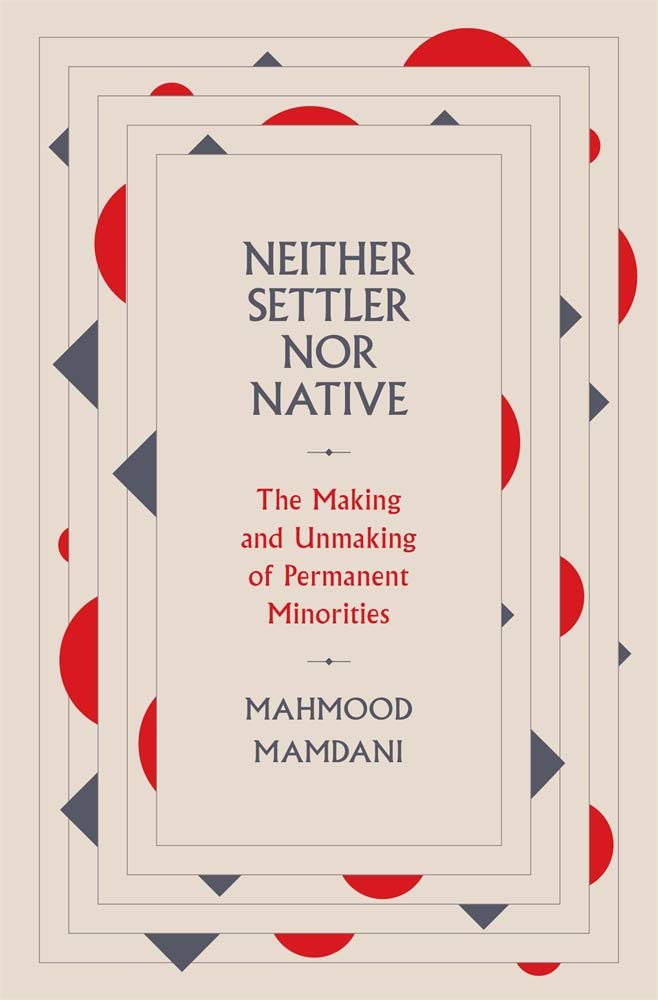
Neither Settler nor Native: The Making and Unmaking of Permanent Minorities by Mahmood Mamdani, Cambridge, Massachusetts: The Belknap Press of Harvard University Press, 30 November 2020, 451 pages, ISBN: 9780674987326, £26.95
As the situation unfolds in West Asia (October 7, 2023), the world witnesses’ atrocities unthinkable for a sane mind. What makes these crimes thinkable is the question one must ask before dealing with the dilemma of whom to support or whom not to. ‘How do I perceive the non-state armed actor – a terrorist or a resistance group?’ ‘Is it a state acting in defence, or is it state terrorism?’ Is becoming a state a solution, or is it a problem? Mamdani’s work might help us navigate through these questions.
When does a settler become a native or a native, a native? asks Mamdani. Never. Answers the book, published by him in 2020, entitled Neither Settler nor Native: The Making and Unmaking of Permanent Minorities. In this seminal work, deeply explained and proactively argued, Mamdani is against the prevailing idea taught in university courses that the project of the modern nation-state began following the Treaty of Westphalia in 1648. The book traces the founding moment of the modern nation-state instead to two developments in Iberia in 1492. One was the ethnic cleansing of Muslims and Jews by the Castilian monarchy to establish a national homeland for Christian Spaniards. The other was the taking of overseas colonies in the Americas by the same Castilian monarchy again through ethnic cleansing.
What had begun after Westphalia was a particular form of nation-state: the liberal nation-state, which introduced the idea of tolerance towards minorities, which had to be imposed on the nation-state long after its birth to stop the bloodshed it was causing. By situating the birth of modern nation-states amid ethnic cleansing and overseas domination, Mamdani claims that the nation-state has been less an engine of tolerance than of conquest (p. 2).
Since the beginning, the ‘nation’ for Europeans has been a culturally homogeneous polity, for civilisation and tolerance was introduced to secure civil peace at home. Minorities were tolerated in exchange for their political loyalty to the state. Tolerance was a characteristic of the post-Westphalian nation, as without it, the nation-state collapsed (Sowerby 2013: 256). But this was the political modernity of Europe. In the overseas settler colonies, where there was no clear distinction between nations and non-nations, political modernity meant conquest, not tolerance, as only those deemed civilised had to be tolerated. Others, owing to their cultural differences from Christian Europeans, had to be first made civilised before earning the right to be tolerated. The term ‘Native’ was introduced to describe those deemed uncivilised. (pp. 2-4). For Mamdani, modern colonialism and the modern state were born together with the creation of the nation-state; thus, nationalism and colonialism were co-constituted.
Divided into six chapters spanning across 355 pages, the book has been heavily based on primary sources. It follows a case study model, and the five case studies are carefully chosen to address the central idea of the book in unison. It could be clearly felt that the work of the author would have been incomplete if any of the five cases had been skipped. The citations of literary works and quoting sources like court judgments and newspaper headlines help build a strong base for the arguments original to the author, some of them are noted below.
The first case study that Mamdani takes explains the “making of permanent minorities” in the Americans (p. 37). He questions the settler-native narrative of the Americans. The Indians, whom the European settlers ethnically cleansed in their nation-building exercise, were referred to as ‘native Americans’ or the original inhabitants of the United States. On the contrary, the author reminds his readers that the Indians were the original inhabitants of the land, not the polity (p. 339). Since the creation of the US, Indians have been denied equal rights and citizenship even if they were born in their native territory under the pretext of ‘reservations’, a fallacy used as a smokescreen to deny ‘native Indian rights equal to those of Americans. The Indians follow their own “Customary laws” instead of “Congressional laws” (Civil Law), both of which Mamdani highlights were colonial constructs (Newton 1984: 233). The Indians, therefore, do not enjoy equal rights because they were not part of the United States, formed after the European settlers arrived, and are ruled by the decree of the Congress, a body in which they have no representation as people. Historically, they have been treated as wards of the white settlers as a marker of colonisation, not sovereignty (pp. 77–85). Colonialism, thus, as Mamdani proves, is a legal process in the US, not just cultural, and is very much ongoing.
In Germany, Mamdani argues that the settler-native narrative of the Americans, spearheaded by ethnic cleansing, inspired Hitler’s project of extreme nationalism (p. 101). Hitler realised that the creation of a homogenised nation-state was possible and that ethnic cleansing could be one of the options for achieving it. However, by criminalizing Nazi crimes at Nuremberg, the Allies avoided shifting the narrative towards the political system that enabled genocide. Mamdani argues that genocide is not solely a racist act; it is also a productive one, the outcome of which is the creation of a nation-state. By depoliticizing genocide and framing Nazism as a criminal act committed by Germans, rather than an expression of nationalism, shielded the Allied states from scrutiny.
Mamdani shows us that political identities are not permanent and could change in the same way they were constructed, as they did in South Africa. The Truth and Reconciliation Commission (TRC) sought to pin blame on individual perpetrators and provide restitution to individual victims, delinking the association of criminal acts from any political affiliation. But unlike Germany, it did not leave the political system that made violence possible unaddressed; it tried to renegotiate and reconcile possible solutions through dialogue. Despite its shortcomings, the commission did succeed in dismantling one of the two pillars of the settler-versus-native distinction in their country: race as a political identity. The other pillar of distinction that remained was that of tribe, and with it the existence of customary laws, which are discriminatory and preserve the distinction of us versus them. The case of South Africa is the only model in the book for the ‘unmaking of political identities’ and forms the basis of the argument that Mamdani further proposes that decolonising the political is practically possible.
Through the case of Sudan, Mamdani explains that the settlers’ colonialism requires no actual settlers, just a group defined as a settler and another group defined as a native. In Sudan, there were no actual settlers, but the Arabs were defined as settlers by the British. The British used census enumeration to identify people and divide them into tribes and races. The practice of taking censuses also gave more importance to race than culture. In some cases, one could be speaking Arabic at home but not be counted as Arab because of their racial identity as African. Colonialism made ethnic violence thinkable because it made ethnicity an important contour of public life and politicised it, which has often resulted in extreme political violence (p. 196).
“Zionism is the most perfected expression of European political modernity in a colonial context”, argues Mamdani in the case of Palestine (p. 250). At the core of political Zionism is the effort to build not just a Jewish religious community in the Holy Lands but a Jewish state (p. 256). The author asks readers to keep the settler-immigrant distinction in mind. Immigrants are unarmed; settlers come armed with both weapons and a nationalist agenda. Immigrants come in search of a homeland, not the state; for settlers, there can be no homeland without a state. For immigrants, the homeland can be shared; for the settlers, the state must be a nation-state where all ‘others’ are tolerated guests. Failure to understand this distinction perpetuates two serious intellectual errors. The first error is to claim that religion is irrelevant to Zionism; the other error, the flipside of the first, essentialises Zionists as Jews, thus, making any opposition to their project antisemitic. Mamdani explains how the first error makes Zionism and Zionisation incoherent; the second makes it seem that the conflict is between Israel and those who hate them, rather than between settlers and the community they dispossessed (p. 254).
The book has provided new frameworks for study. Mamdani, while conveying more in fewer words, has successfully explained the central argument of the book: that the existence of the modern nation-states continue to sustain the boundaries of who belongs and who doesn’t. The existence of minorities and majorities with clear cut differences makes the very structure inherent to conflicts, as in the nation-state, one can only be the oppressor or the oppressed, the majority or the minority, the nation or the other. And that the decolonisation of political identities is yet to be accomplished. Any scholarly investigation pertaining to the historical, political, legal, or ethnic dimensions of the five mentioned case studies would be deficient without a thorough examination of the perspectives and arguments so adeptly presented by Mamdani. The book could therefore be of great help, especially for students and scholars from the disciplines of legal and political history, peace and conflict studies, postcolonial studies, identity politics, international politics, and other related areas. Furthermore, the writing style of the author makes the book easily accessible for people with non-academic backgrounds as well.
References
Newton, NJ (1984), “Federal Power over Indians: It’s Sources,Scope and Limitations”, Online:https://scholarship.law.upenn.edu/cgi/viewcontent.cgi?referer=https://www.google.com/&httpsredir=1&article=4625&context=penn_law_review
Sowerby, Scott (2013), Making Toleration: The Repealers and the Glorious Revolution, Cambridge, MA: Harvard University Press.

Syed Rubeel Haider Zaidi has completed his bachelor in Political Science from Jamia Millia Islamia in 2021 and his Masters from Conflict Analysis and Peace Building again from Jamia Millia Islamia this July. Presently he is preparing to get enrolled into PhD program.
 TheDaak review
Leave a comment