
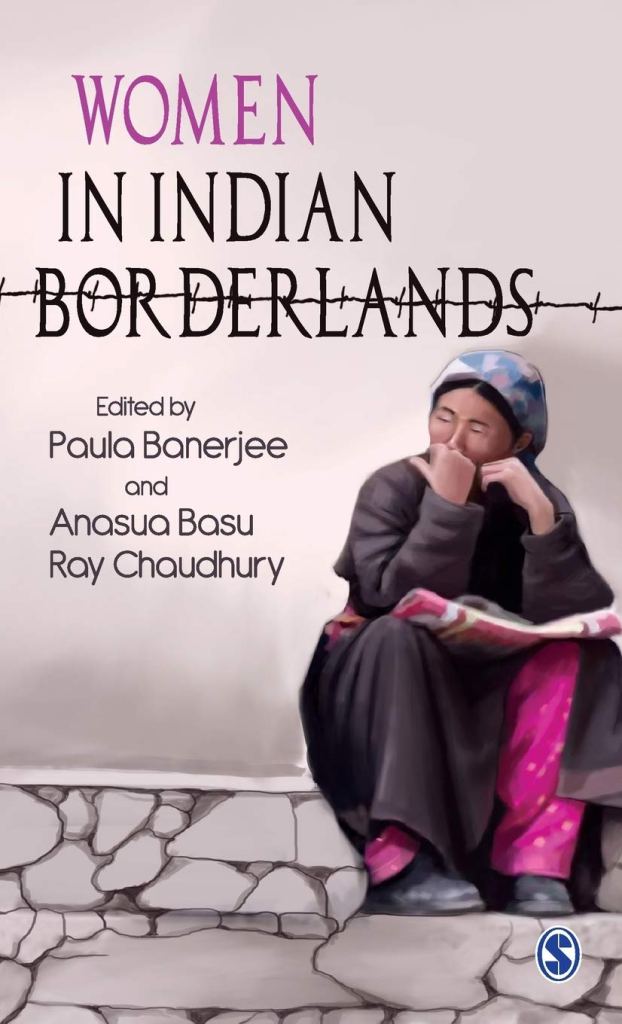
Women in Indian Borderlands by Paula Banerjee and Anasua Basu Roy Choudhury (eds), New Delhi: Sage Publications, 2011, pp. xxv + 234, `595, ISBN: 978-81-321-0650-0 (HB), Price: 953 INR.
The literature on border studies has primarily examined borderlands as spaces of exclusion and has expounded on how the state performs its sovereignty through policing. Border studies scholars have moved beyond the state-centric geography and primary theorization of border vis-a-vis security to explore the multifaceted processes of border-making in diverse socio-spatial contexts and geographical scales. Border studies present an effective way of incorporating the missing narrative of people into the sanitized discourses on national security.
Academic attention has been dedicated to issues such as smuggling and civilian deprivation in the borderlands, yet a noticeable gap remains in the exploration of gender perspectives. This void continues to be effectively addressed through the application of a gendered lens, initiated by Gloria Anzaldúa in 1987 through her study of the U.S. and Mexico border. Paula Banerjee and Anasua Basu Ray Chaudhari’s edited volume, Women in Indian Borderlands, makes a substantial contribution to filling this gap by delving into the lives of women along the Indian borders. The book is a collection of ethnographic studies, employing a gender lens in examining the contours of the borders drawn on the landscape and the mindscape of people living on the borderland. While each chapter could be treated as a stand-alone, what ties them together is a rich tapestry of the borderland produced using ethnography as the research methodology. Ethnography involves the in-depth study and observation of people and cultures in their natural settings. It provides a nuanced understanding of the social dynamics and lived realities within the border regions. The chapters succeed in conversing with each other through the depiction of a shared narrative on the borderland, revealing commonalities such as material disadvantages resulting from marginalized positions, persistent violence or the possibility of violence, complex relations with surveillance and security and gender-specific realities.
Enabling the visibility of minorities among minorities, the essays closely trace the experience of women living on the borders and attempt to portray the complex relations between gender and borders. Borders are gendered spaces, reflecting and perpetuating gender roles and identities, thus shaping the individual’s experience of the borderland. Borders are presented as grey zones characterized by endemic violence due to their distance from the centre, disconnect from the mainland and active contestations of inclusion and exclusion. Women bear a disproportionate burden of patriarchal structures, facing heightened vulnerability due to marginalization, systemic violence and the security challenges inherent in the borderland environment. The chapters prioritize the exploration of women’s daily experiences in private and public spaces, aiming to broaden the discourse beyond the predominant and sometimes singular focus on sex trafficking as the representation of gendered issues in the borderland.
The book can be seen as a follow-up to Paula Banerjee’s Borders, Histories, Existence: Gender and Beyond (2009). Adding an ethnographic account to the historical perspective adopted by Banerjee in her earlier work, this book demonstrates the ability of borders to unite the differences and divide the similarities by shifting the lens from the macro level to micro-practices along the borders, with gender at the centre of analysis.
The authors capture the unique gendered experiences of living on the South Asian borders through an examination of three distinct borders: Bengal-Bangladesh, Kashmir-Pakistan, and Northeast-Myanmar-Bangladesh. The ‘borders’ examined include the international boundaries, Line of Control (LOC), Line of Actual Control (LAC), and Actual Ground Position Line (AGPL). The book is split into four sections- West Bengal, Jammu and Kashmir, Northeast, and Voices- with two chapters each. The first chapter by Paula Banerjee addresses two of the most contentious issues surrounding the borders- migration and sex trafficking. Through an intense demographic study of three districts located on the Indo-Bangladesh border in West Bengal, Nadia, Murshidabad, and Malda, Banerjee demonstrates the historical nature of east-west migration and how the overbearing emphasis on sex trafficking renders all other offenses against women insignificant.
Anasua Chaudhary’s chapter highlights both the spatial and metaphorical aspects of the borders by delving into Partition as a living present and its gendered impacts. She picks up the case of ‘double displaced’ Muslim women of Hooghly district, who had migrated to Bangladesh during the Partition following the communal riots only to migrate back to Hooghly as the Bangla speakers across the border did not accept the Urdu-speaking Shia Muslims. The interviews demonstrate how women had to negotiate multiple borders of the sect, community, patriarchy, and conflicts to find a dignified life that continues to betray them. The section titled Jammu and Kashmir brings to the attention the invisibilized suffering of the ‘displaced and disposable’ borderlanders in the J&K.
The chapter by Anuradha Jamwal and Suchismita points to the contradiction in how military operations like the Kargil War and Operation Parakram are perceived in the borders and the mainland. While the mainland celebrated the victory and moved on, border villages like Kerni were converted into minefields, fields and habited lands were fenced out, and self-sufficient villagers became displaced, poor, and destitute overnight. Women became more susceptible to landmines since they were responsible for grazing cattle and collecting firewood. Physical and psychological deprivation meted out to women underlines the impact of structural violence. Sexual violence also persists at the hands of the military, the militants, and often, their own family members.
Adding to this narrative, Sumona DasGupta, in her chapter, looks into the psychiatric distress and suicidal tendencies that ail the women in these regions, exacerbated by insecurity, the constant threat to life and lack of access to medications. With the men being maimed, missing, or dead, women are left with no choice but to shatter the public-private divide and seek employment, making them the sole wage earners and, inevitably, the heads of the household. The competition amongst the women due to limited resources, “politics and economics of firewood” (p. 103) has further disrupted communitarian life and alienated them from the material and emotional safety net that a close-knit community offered.
The fifth and sixth chapters, by Sahana Basavapatna and Anshuman Ara Begum, are located in the Northeast. The former points to the instability of the Other created by the borders and the overlap in the meanings of terms like ‘economic migrants,’ ‘refugees,’ and ‘stateless’ (p.127) by examining the case of Chin ‘refugees’ in Mizoram. Unlike other states, Mizoram has exhibited a benevolent attitude towards the Chin refugees from Myanmar due to the historic migration and common lineage traced to the Luhasi mountains. The Chin women recognised both as kin and a dangerous presence, eke out their lives at the doorsteps of violent abuse. The creative ways in which the system accounts for the rights of ‘illegal’ women migrants become the centre of the narrative of the fifth chapter. The use of the law against domestic violence by Chin women to protect themselves despite not being legal citizens of the country sheds light on the maneuvering space that impersonal laws present to those who implement them. Organizations like the Ferrando Integrated Women’s Development Centre that assisted the Chin women domestic workers and judges who consciously looked away from their illegal status during trials are the agents of the system that enable this.
The sixth chapter focuses on the arbitrary nature of fences and the deprivations they cost the lives of the women of West Garo Hills, mainly in the form of loss of agricultural lands, disruption of cross-border trade and feeling of entrapment in one’s land. The final section, titled the “Voices” consists of chapters by Aditi Bhaduri and Chitra Ahanthem and is in narrative format, with the women of the borderland recounting their experiences of negotiating the multiple disadvantages arising from being on the fringes of both the nation-state and the society. The multiplicity in the experiences of women is highlighted as the Border Security Force becomes the protector and the intruder, boundaries become porous and rigid, and the ‘other side’ a haven and hell.
The diversity in the accounts presented by women highlights that women do not experience the world identically despite sharing a gender identity. Their experiences are also mediated by other identities like religion and ethnicity, calling attention to intersectionality. For instance, Sabranti Karmakar, who is serving as a constable with the BSF, perceives her work as a service to ensure security and peace. In contrast, the perception of BSF in several other accounts is marked by unrelenting anxiety and resentment. The common thread joining these multiple narratives is endemic violence and poverty, which have contributed to both affinity and estrangement among women.
The book successfully presents an impactful analysis of the complex association between gender and border. The work confronts the bird’s eye view adopted by the state in its foreign policy head-on. It demands the relocation of the narrative to the micro-practices of the people negotiating with the lived realities of being in the proximity of the ‘foreign’ who, especially in the South Asian context, were intimate before the boundaries were drawn by the forces distant to them. Employing a gender lens in understanding the actuality of borders not only gives voice to the silenced suffering of women but also enables bringing to attention the non-traditional security concerns, the relational identities of people, and the inadequacy of theoretical abstraction in perceiving the nuances of borders.
However, the book lacks a wholesome account of the borderland since the ethnographic study is not complemented by an account of the evolution of bordering practices adopted by the state. The state is invisible in the narrative, and a gendered account of policies adopted by the state and their impacts could have added to the richness of the accounts. The diversity, or the lack thereof, in the border practices of the state pertaining to distinct borders is hence missed out in an otherwise comprehensive account.
The book tends to portray women predominantly as passive victims, offering scant instances of women’s acts of resistance—exceptions being figures like Parveena Ahangar, founder of APDP, and NGOs for domestic workers in Mizoram. Yet, the counterargument lies in the book’s commitment to eschewing an isolated celebratory history, instead embracing a broader array of narratives originating from the ordinary. The book also misses significant aspects of the narrative, particularly those from the other side of the border and the Indo-China border. These omissions highlight opportunities for additional research and exploration. The essays serve as the inaugural phase in a broader initiative to integrate a gender perspective and incorporate the human element into the field of International Relations and governance studies. This collection is strongly recommended for those intrigued by the application of a gender lens, border studies, ethnographic research, and gaining insights into India’s position within South Asia.

Manjima Anjana is a PhD scholar at the Department of International Relations and Governance Studies, Shiv Nadar Institution of Eminence, Delhi NCR.
 TheDaak review
Leave a comment