
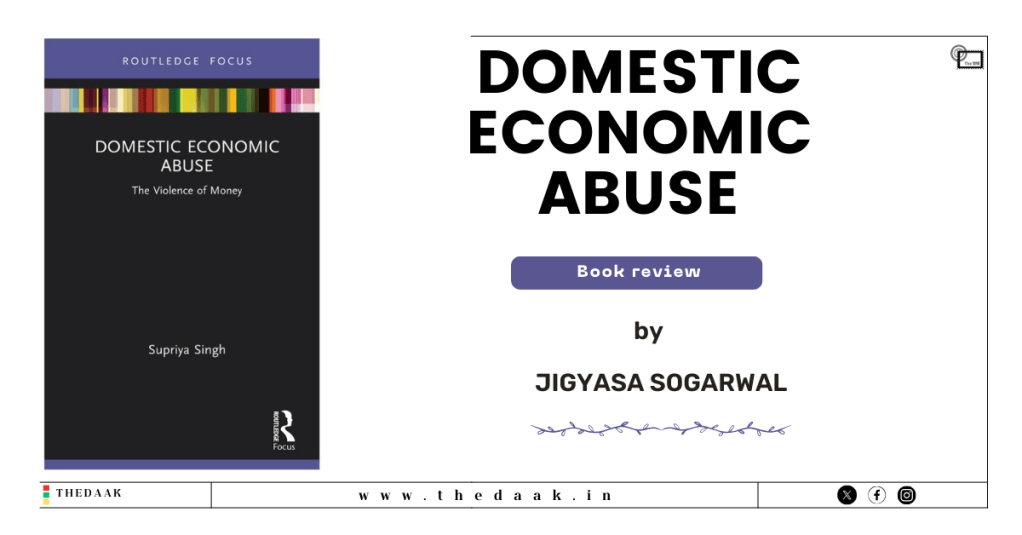
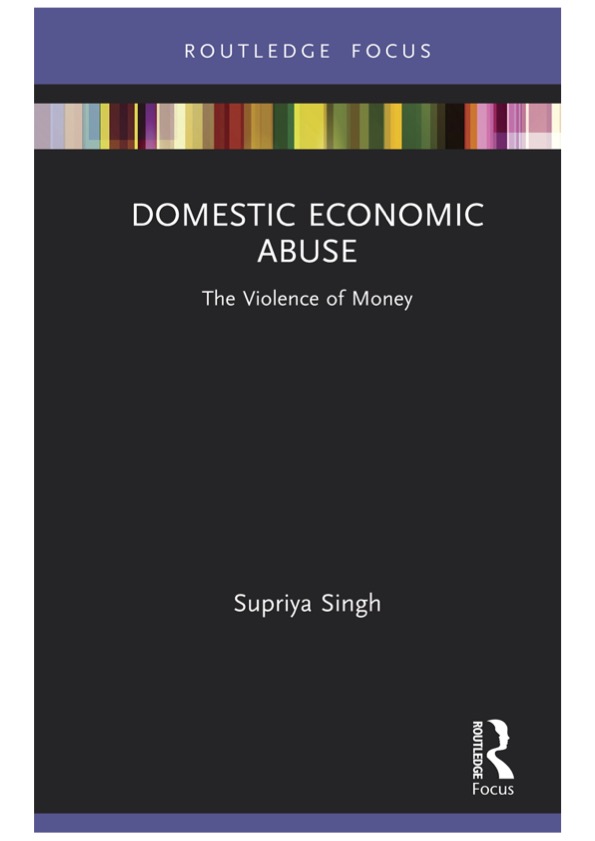
Published July 26, 2021 by Routledge, Hardback, ISBN 9781032014319, 128 pages. GBP £39.19
Economic abuse in itself is an intriguing topic. Growing up, I had a difficult relationship with money, primarily rooted in my fear of debt. Very recently, I have also realised that higher education in public institutions, especially the ones I attended have remained conspicuously silent on the question of money. I must clarify that financial literacy is not what I have in mind. I am more concerned about the general apathy of arts and social sciences towards the idea that ‘art and ideas’ have value which can be measured, translated; transacted in currency. This, I found, had created a huge gulf between how I looked at money and how, say for instance, my family thought of money. I picked this book, therefore with a personal interest. From page one, I had invested an expectation of self- help in this book. That I wanted this book to explain to me, my experience with money and how families could use it potentially as a tool of control.
Supriya Singh’s book, as the title suggests, is a study of domestic economic abuse. The argument made here is this, there seems to be a preponderance of the view that family violence is essentially physical. That sociologists of money have long never paid attention to the dimension of economic abuse. That domestic economic abuse may be widespread and more difficult to detect or even articulate. To key out the argument, economic abuse is described in three forms: “economic control, economic exploitation and employment sabotage” (p.3). The author also clarifies economic abuse to be a much broader concept which may include dimensions such as access to property, financial decisions, assets, stocks etc
The book takes us through the lives of 12 women, all of them are located in Australia, some of whom come from the Celtic-Australian context and others from the Indian. Their stories are anchored in economic abuse in one form or another. Most times such abuse is accompanied by physical and emotional abuse, but in some cases it is only as an afterthought that women could articulate that their deep seated anguish and trauma was caused by the difficulties they faced with money, a consequence of intimate partner economic abuse.
In bringing about these stories, the author makes a compelling case for interrogating non physical dimensions of family violence. It is being argued here that ‘Coercive Control’ is a recent conceptual category which has gained currency in 2020-21. This category is more appropriate and useful in defining experiences of abuse other than physical violence. Coercive control is different from the incidental violence where the injury to the victim is easily identifiable, noted and rooted in the evidence. Coercive control is an all pervasive-everyday phenomenon that uses various techniques including shaming, inducing fear, withholding communication and cordiality.
Broadly, the book makes the following arguments about money. One, that the sociology of money can and needs to bring in greater insights to understand the gender and morality of money. That gender and morality of money are the pivots around which the economic abuse across generations and cultures are tied. For instance, the author argues that the culture of money in Asian contexts, especially in countries like India, is different from say for people brought up in Australia. Money is both an acceptable and expected form of gift in India, which may not be the case elsewhere. It is usually expected that the money flows from the older generation to the younger and vice versa as maintenance, where adult children are found to be sending money home or providing for their elderly parents. Hence it is crucial, as this book proves, to understand money in its social and cultural context. What is the social value of money in relations? How does it create patterns of dependence and interdependence? What is owed, to whom, how long?
The author also suggests that the gender and morality of money is also changing across generations. The way for example money earned by a daughter was treated a couple of decades ago, is decidedly different from how parents are less hesitant in eating at, or taking from the daughters’ salary, or assets. In some cases, women also support their maternal families which was not an accepted norm in previous generations. These transitions of money practices along with traditional cultures of money create different ways in which the coercive control is maintained and strengthened.
In fact, some types of money is considered more in tune with the cultural ethos of the people. Taking gifts in money or financial or economic care is considered two ways in the Indian culture where there is no public safety grid as opposed to places like Australia where there seems to be a protective grid and adult children are not expected to put in the economic care of their parents.
The second argument of this book is that “Money traditionally has been Male in India.”(p. 12). It has been such that men have either been the primary earners in the family, or have been the primary resource holders in the Indian social system. (p. 14) Money, therefore, has remained predominantly in the hands of men. Even where women have spent, it has remained within the confines of the domestic, such that selfless spending by women on household and children compared to men becomes the hallmark virtue. So when a woman spends, she keeps herself last. This virtuous relation with money is celebrated in women, creating a coercively controlled environment where deviant economic behaviour is reprimanded with shame and guilt.
Increasingly, educated women, and there are many here in Supriya Singh’s sample, were raised to be independent. They described themselves as free-spirited sculpting their own destiny. In such cases it was found that the ‘moralities from a previous era coexisting with present moralities’ caused for a ‘clash of morality of money’ (p. 102). Women put in their trust with their husbands or partners not only with respect to their emotions but also with regard to their financial resources, savings, assets, and money inherited from their maternal family, their job earnings et cetera. The women willfully put their earnings in joint accounts or in places where men had access because they were expecting to build a sphere of ‘jointness’ with ‘same autonomy’ they probably had before marriage (p. 102). They were found to be cheated in the end. Men either did not provide and lived off the resources brought by women or they gambled. They sabotaged women’s work spaces and opportunities and controlled how and when the money was spent. They jeopardised women’s and children’s economic security by effectively controlling the codes and passwords to bank accounts, by remitting money back to their parents in India, but not extending the same liberty to their wives for supporting her maternal family. Through these stories one finds that a clear discussion on finances and spending was no surety of avoiding economic abuse after marriage. In one of the cases discussed here, the woman in question did speak of her rights and finances, all of which were blatantly disregarded right into her marriage.
What could be the remedy for the violence of money? How to change the circumstances leading up to domestic economic abuse?
This book is making a case for ‘relational literacy of money’.(p. 104) What the author means by this is two things, first is an open dialogue detailing an intimate history of money for each individual getting into marriage. The author believes that it requires a profound sense of confidence to talk about how each partner in the association grew up with money. What that essentially means is that spending habits, who controlled money in their parental home growing up, what they think about debt, where and how they spend the most, et cetera are conversations that must happen not only at the beginning of any relationship but also at regular intervals through the relationship. I think the book rightly points at the fact that not only are such conversations entirely absent, there is also a lack of awareness around these. This acts as the greatest impediment to ensuring freedom from economic abuse. Adjusting to new ways of money can be difficult for individuals especially when such roles are unfamiliar. Relational literacy also includes talking to and teaching your children about money in an open manner so that they do not learn practices and repeat patterns which will lead to their economic abuse or economic abuse of their partners. The most interesting point is that often, men have learnt patterns of spending that sabotage the lives of those around them. They may not seemingly be abusive or even have that intention. They may be loving spouses and yet, economic abuse may be prevalent and unbearable.
At the policy level, this book makes a case for criminalising control, so that economic abuse is seen as a crime. Many women have no legal vocabulary to articulate their abuse. The economic control of resources and money create power dynamics that keep children and women in abusive spaces and marriages for years without recognising the violence because no ‘obvious’ injury has taken place. That the man has never hit her, is not a sufficient condition to ascertain the absence of abuse. An entire jurisprudence language will build itself around the concept of criminalising control which would then help define the economic abuse and help remedy it.
This is not an easy book to read. But it is an important one. Question of economic abuse needs to be interrogated further to include dimensions that this book alludes to.The case studies here are situated in the backdrop of migration. These themes need further investigation. Apart from the lesser researched title, this work also raises questions around methods of research. The preface reads like a troubled rumination of a scholar reporting on trauma and abuse. It left me thinking about some of my own research work and how best to handle questions that are sensitive, triggering and even hurtful. At one point Supriya Singh speaks of being hurt when one of her respondents withdrew her story. I zeroed on the word ‘hurt’. How much emotional investment is a researcher allowed here? Can we researchers collect information without ever being impacted by it? How much hurt is acceptable? In her introduction, the author remarks “I am a sociologist of money, but it was only through my research on economic abuse that I recognised I too am a survivor.” (p. 1) Perhaps, research like this will help us recognise some of our own hurt, reflected in the hurt of others; and our own empowerment, reflected in empowerment of others. But more so because in the question of marriage equality and family justice, a question of economic resources has to be settled in the favour of financial equality and autonomy.
Co-ordinating Editor
 TheDaak review
Leave a comment