

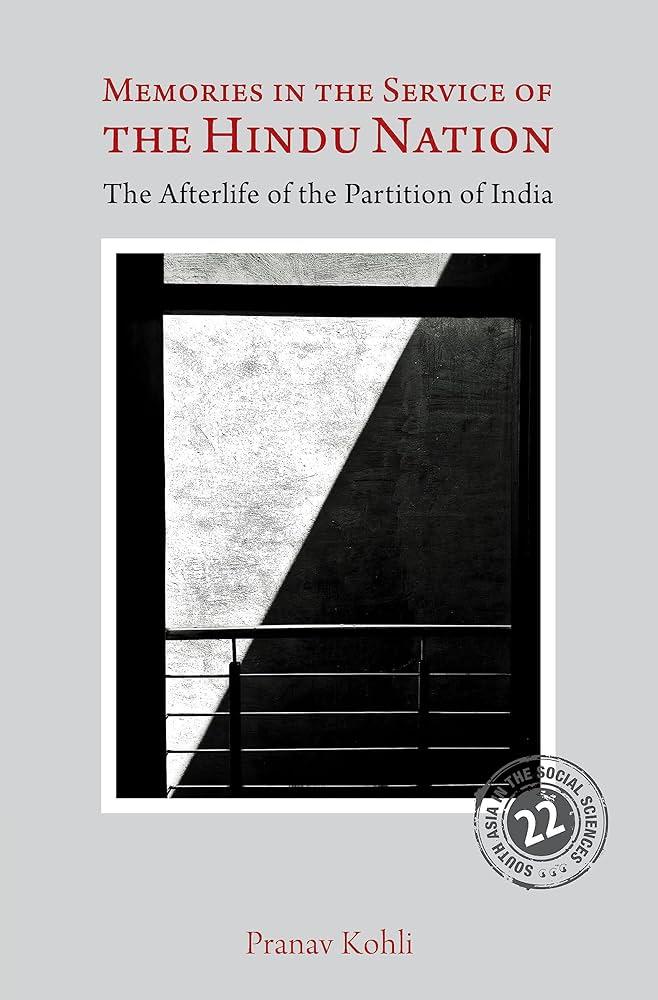
Book: Memories in the Service of the Hindu Nation: The Afterlife of the Partition of India, Pranav Kohli, Cambridge University Press, November 2023, Hardback, ISBN: 9781009318686, 300 pages.
The 1947 partition of India and the genocide that followed has been studied across various disciplines either to ascertain political blame or to understand the experiences of the people. In the pool of literature on Partition, Pranav Kohli’s book endeavours to put a fresh lens to understanding the aftermath of the Partition. It is a book that takes Partition as a point of reference to systematically link it to the rise of Hindu Nationalism in India.
Hindu nationalism is based on the notion of historical victimhood of the Hindus as an ancient nation plundered by the sectarian aggression of the Muslim invaders and the British colonisers. In this background, Partition and its trauma is often invoked as a “proof of the untrustworthiness of the Muslims”, thus sustaining the ideas fostering Hindu nationalism (p. 35). By using the lens of theodicy, memory and sacrifice, Pranav Kohli’s Memories in the Service of the Hindu Nation has carried an ethnographic study among the last generation of surviving refugees in the regions of Delhi and surrounding National Capital. The book seeks to understand how they remember the afterlife of partition and how they try to make sense of the deaths and sufferings, rationalising therefore their post partition life – the theodicies they subscribe to (p. 24). ‘Theodicy’ refers to the explanation trying to bestow meaning of the human experiences of sufferings and evils. In this context, the central question that the book revolves around is to understand “what does it mean to remember partition in the face of fascism?” (p. 30) Fascism is invoked here in the context of the growing Hindu nationalism and the spurring incidents of violence against the minorities in the country.
The book is an ethnographic study of the memory of Partition where memory is based on the postmodern understanding to “characterise the interventions of nationalism” as a theodicy (p. 30). ‘Memory’ has been seen here as a social construction which acknowledges the intertwining of the past and present in an individual’s experience of daily life (p. 30). The quality of memory is the object of study where it is recognised to be animated from the past with the spirit of the present; the book pays attention to the “interventions of the majoritarian mobilisations in the memories of the informants” (p. 30). The nine chapters of the book have been divided accordingly into three parts which chronologically progress from the “immediate memory of the suffering of partition”, to the “hard work and recovery of the refugees” to the persisting “resentiment” among them due to the experience (p. 50).
The book begins by giving an extensive literature review of the variables involved in the study. Chapter 2- 5 builds up the second part of the book dealing with hindu nationalism as a theodicy and the discourse of Purusharth. These chapters seek to understand how hindu nationalism as a form of theodicy along with the discourse of Purusharth have been used by the different informants to rationalise their sufferings and hard work in the aftermath of partition.
Purusharth is a key concept in Hinduism which is “linked to the Brahmanical order of the Varnashrama Dharma” (B. Singh 2020, cited in Kohli p. 24). Purusharth refers to the four goals of human life – Dharma, Artha, Kama and Moksha. The canonical meaning of the term is ‘objective of human purpose’. The reference to Purusharth in Kohli’s book is different from its canonical meaning and is seen to sanctify “physical labour, cleverness, hardship and suffering” by the respondents of the study (p. 24). Kohli also makes a note of how the idea itself has evolved from being just ‘labour of men’ to Purusharth as ‘sacrifice’. There is a self identification in the respondents of the study. Survivors primarily on the Punjabi side differentiated themselves from the ‘Bangladeshi and Rohingya Refugees’; there seems to be a firm belief that the hard work and sacrificial labour of men in the community differentiated them from the refugees or Sharanarthis. Another thing that has come up in different interviews with the survivors is the constant need to distinguish the survivors of the Partition to the influx of refugees from Bangladesh and the Rohingyas. This directs the readers to the casteist and sectarian nature of the idea of Purusharth itself. By not seeing the latter’s hard work as Purusharth and conflating them with Assamese immigrants also adds to the hysteria about the large-scale mass infiltration at the Eastern border of India. Kohli notes that the informants’ remembrance of hardwork and sufferings as ‘Pususharth’ and ‘sacrifice’; viewing the victims as ‘martyrs’ and erasing the memory of the honour killings of women constitutes the articulation of the Hindu nation (p. 51).
Purusharth as invoked by the various informants can be seen as a celebration of Hindu patriarchal masculinity. Chapter 5 argues “how this masculine discourse of sacrifice eulogises the lives of women and erases their actual lives” (p. 51). Purusharth is gendered and an essentially masculine in nature, as it is based on preferring hard labour of men and erasing the active labour of women under the guise of domestic work. Rather women’s role is “romantically constructed as self sacrificing martyrs and passive victims” (p. 160). The continuation of the domestic work by the women, or their active role as caregivers or earning through sewing machines is seen as a normal part of their domestic life. This erasure of women’s labour and normalisation of unpaid women’s care work can also be found in “the state’s musealisation”(p.158) and in general how the state remembers partition. Women are largely confined to “sacrificial commemoration as ‘martyrs’, their wounds and suffering symbolising the suffering, wounded nation” (p. 160).
Chapters 6-9 comprise the final part that collectively confront the central question that the book addresses -” what is it to remember partition in the face of partition?” (p. 52). Chapter 6 examines the idea of silence, trauma and narrative agency by examining the idea of ‘speaking out’ as ‘healing’ (p. 52). Chapter 7 examines how “violence and its remembrance” can act as a narrativising lens. Kohli uses the ‘hermeneutics of suspicion’ to critique the various ways in which the informants “other the violence of the Partition” (p. 52). The expression “hermeneutic of suspicion” is a tautological way of saying what thoughtful people have always known, that words may not always mean what they seem (Bryan 2013). This is visible in the ways the honour killings of the women are seen as martyrdom and sacrifice and not an act of violence. Moreover, the violence committed on them have been seen as excesses and their violence have been seen as acts of violence as an act of self defence. Chapter 8 particularly talks about two informants and raises the questions of nostalgia and reconciliation in the post partition context, although they question the partition, they had full support for the current regime and the violent nationalist policies under him. Chapter 9 looks at the notion of victimhood to discuss how it “imbues their Islamophobia with the moralistic aura of justice” (p. 53). In this context, the informants of the study draw on the knowledge of Hindu nationalism to give meaning to their “useless sufferings” as martydom and sacrifice but also to draw on historically conceived victimhood to demand a Hindu fascist state and “retributive genocide as ‘justice’ or reparations for the suffering of the Partition” (p. 30). The book thus breaks with the established convention of ‘believing victims’ to examine the kinds of violence that narratives of victimhood license in the context of the Partition (p. 26). The book wonders if it is actually healing to remember partition when everyone idolises and supports a fresh cycle of violence.
In the concluding chapter, the author expands on his ideas on ressentiment to understand the global wave of authoritarianism and the “democracy fatigue” (Appadurai 2017; cited in Kohli 2023: 53) which is taking over the world. Ressentiment, in this background disguises the violence of Hindu nationalism as ‘self-defence’, ‘retribution’ and ultimately justice (p. 298). The book in its final section has built on the resentment and the need for retributive justice to link it to global authoritarianism, particularly Hindu nationalism, the violence and the narrative that the government builds on the case for the CAA: law linking citizenship with religion.
The book ends on a cautious and hopeful note to remember Partition in the time of fascism;“means recognising the sufferings of the ancestors is what the minorities are suffering today” (p. 291) and it is the need of the hour to not ignore the fascism that thrives on the politics of victimhood of partition but to use these memories to express solidarity towards those being oppressed today in similar fashion (P. 291). In this regard, it notes the need to have a persistent dialogue with the racial and ethnic borders of the Post-Partition nation state.
However, one wonders whether just focusing on a small group of refugees and their memories is enough to make such conclusions by the author. There is no denial that Kohli has indeed sought to have a fresh take to understand why hindu nationalism survives on such a skewed understanding of ethno-nationalist and cultural notions of a nation.
Pranav Kohli’s Memories in the Service of the Hindu Nation: The Afterlife of Partition is an academic endeavour. To reiterate again, it is not a book on Partition. Rather, it seeks to understand the contemporary rise of ethno-nationalist tendencies based on ideas of Hindu nationalism. The differing lens of theodicy, memory and sacrifice that the book applies through the different chapters, have been structurally and systematically tied up to understand the interventions of Hindu nationalism in the memories of the informants. It is a vicious circle, in the sense that justifies violence as a retribution for past wrongs. Kohli has tried to deal with the difficult yet important conversations on Hindu nationalism and has tried to critically understand how the notion of victimhood itself can be political. Who is a victim and who is not is based on the significant otherisation of certain categories of victims based on their ethno-religious and cultural identities. The book also cautions the readers on the sectarian, skewed perspective of nationalism and the growing tendencies towards having a category of documented citizens based on these above-mentioned identities.
References:
Bryan, Christopher, ‘The Hermeneutic of Suspicion’, Listening to the Bible: The Art of Faithful Biblical Interpretation (New York, 2013; online edn, Oxford Academic, 23 Jan. 2014), https://doi.org/10.1093/acprof:oso/9780199336593.003.0004, accessed 25 Dec. 2023.
Sanjukta is a PhD scholar from the Centre of International Politics, Organisation and Disarmament, Jawaharlal Nehru University. She is passionate about research and currently pursuing different research engagements.
 TheDaak review
Leave a comment