

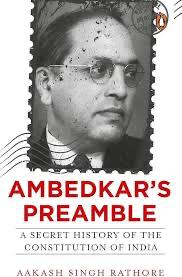
Ambedkar’s Preamble: A Secret History of the Constitution of India by Aakash Singh Rathore, Vintage, Penguin Random House, 2020, 236 Pages, Paperback, ISBN: 9780143457183, Rs. 399
In 2020, when India experienced a nationwide outcry for the protection of citizenship rights against the CAA and NRC, Ambedkar’s Preamble: A Secret History of the Constitution of India authored by Aakash Singh Rathore arrived on the shelves of bookstores. As the country was swept by protests, rallies and public meetings, the people of India read and re-read the Preamble as a reminder to the state of the rights and power of the people as sovereign. In Shaheen Bagh, which emerged as the epicentre of the movement, women, young students, journalists, and activists harked back to the principles of the Preamble for reinstating the idea of Indian secularism in the public space and building a strong front against state power.
Notwithstanding the power of the Preamble, the question of its authorship has been shrouded in mystery. From the low attendance of members of the Drafting Committee to the sparse references about the origin of the Preamble in the Constituent Assembly debates, has generated a host of speculation among scholars and thinkers. Nonetheless, the common understanding traces the Preamble to the famous Objectives Resolutions of January 1947 moved by Jawaharlal Nehru in the Constituent Assembly, which laid out the ideals and principles to be adopted by the constitution-in-making of India. A deeper historical analysis, however, would take a student of history back to Salt Satyagraha of 1930, the Poorna Swaraj Declaration of 1929, the Nehru Report of 1928, the Non-Cooperation of 1920 and Dadabhai Naorji’s and P.C. Ray’s economic critique of British rule (1901 and 1904 respectively) as landmark events, inspiring the ideals of the great nationalist leaders. However, revising this commonsensical and linear, but deficient narrative dominated by the Congress and its leaders, Rathore draws attention to Dr Ambedkar as the Chairman of the Drafting Committee and author of the Preamble.
Similar to Rathore’s earlier works B.R. Ambedkar: The Quest for Justice and Dr Ambedkar’s biography, Becoming Baba Saheb, this book also reflects the former’s peculiar understanding of the latter’s mind and intellectual moorings. A philosopher by training, unlike other scholars of Ambedkar, Rathore has an unmatched grip on his subject as an academician, a student, ‘forever engaged in study, discussion, and debate’ and forefronts the ideological and philosophical influences on Dr Ambedkar’s thinking, which other recent works by Shashi Tharoor and Anrudhati Roy have kept on the backburner in favour of the studying the more political, radical and anti-casteist Ambedkar (p. xxxvii). Consequently, Rathore reflects on his subject as a dynamic and evolving personality who was “firm on his principles…’ and yet, ‘pragmatic about the means and strategies used to secure them”(p. xxxvii).
Till recently, the history of the Constitution was limited to what has been criticised as an excessive emphasis on the great men of the Indian national movement and the deification of the text as a repository of liberal values and citizenship rights. As reflected by one of the early historians of the Constitution, Granville Austin, who credits the liberalism of the Indian Constitution to those he sees as semi-divine oligarchs leading the Congress – Nehru, Prasad, Patel and Azad. However, signalling a departure from this elitist narrative, the newer works look at the Constitution as a site of ‘political negotiations’ wherein a host of social actors have come together on issues of representation and power-sharing (Elangovan, 2022). ‘Ambedkar’s Preamble’ is a new addition to the budding histories of the making of the Constitution such as Kanika Gauba’s essay, “Forgetting the Partition: Constitutional Amnesia and Nationalism”, which underlines the memories of Partition violence as a definitive force behind the question of citizenship and minority rights and Rohit De and Ornit Shani’s articles on people’s role in the shaping of the constitution through judicial activism and letters sent to the Constituent Assembly, respectively – among other scholars. Rathore embarks on a similar path of broadening the scope of historical analysis beyond the great men of the Congress and gives space to Dr. Ambedkar, his ideas, his anxieties and the debates that he was a part of during the 1940s and 1950s.
Rathore tries to argue that the Preamble – far from being the progeny of the Congress – was the manifestation of Ambedkar’s genius and political thought. He dissects the six central ideas of the Preamble – justice, liberty, equality, fraternity, dignity and nation to spell out the imprint of Dr Ambekar’s intellectual thoughts and life experiences on the Preamble. By doing so, he attempts to ‘uncover little-known aspects of modern Indian intellectual and constitutional history, and spotlight moment of Dr Ambedkar’s revolutionary social, political and jurisprudential thought, hitherto hidden from conventional accounts’ (p. xlviii.). In other words, as a philosopher, he attempts to enter Dr Ambedkar’s mind to understand these six crucial ideas, their meanings, intellectual origins, and the vision of Ambedkar behind adding these to the Constitution.
The book is divided into six chapters, each discussing one idea. Rathore paints a vivid picture of the past, populated with contemporary debates between the Socialists, the Marxists, the Hindu-nationalists and the Anti-caste leaders to spell out the thought process and inspiration motivating Dr Ambedkar. In doing so, Rathore also spells out the ‘secret’ meanings that some of these ideals meant for Ambedkar. Furthermore, he does not shy away from broadening the narrative to include the role of global intellectual trends based on the French and Russian Revolutions in understanding the influences on Dr Ambedkar and his Preamble.
For instance, Dr Ambedkar held that true independence and democracy in India required nothing short of a social revolution brought by an egalitarian constitution that safeguards the minorities. In this context, Rathore tells us that Dr Ambedkar’s conception of ‘Revolution and Counter-Revolution in Ancient India’, provides the basis of the ‘secret’ meaning attached to his idea of equality. He points out that by taking inspiration from the Marxist notion of revolutions and counter-revolutions, Ambedkar imagined the rise of Buddhism as a revolution against the corrupt, superstitious, degraded and exploitative Vedic society. In Ambedkar’s perception, the Constitution of India marked the climax of the long revolution against caste. Therefore, a simple idea of equality in the Preamble is unpacked by Rathore to bring out the strong meaning attached by Dr Ambedkar.
Rathore sidesteps the perilous pitfall of anachronism that scholars of historical figures too often find themselves stuck in. He refuses to freeze his subject in time as static monoliths with rigid perspectives. His own acknowledgement best states the richness of Rathore’s analytical prowess:
…we need to understand Dr Ambedkar’s thoughts as not a static or constant viewpoint, but as a dynamic flow instead. I believe that his ideas evolved in accordance with new information that came in: new facts, momentous events, discovery of new literature (p.100).
In a similar vein, in one of the chapters, Rathore points out that the idea of ‘fraternity’ that Dr Ambedkar never clearly defined, in reality, held profound meaning in his writings. For him, it was the glue that held equality and liberty together and stopped them from devouring the Indian society and democracy. Yet, he never stuck with a particular usage or meaning, evolving his ideas over decades. Furthermore, in the wake of the bloody reality of Partition, unanimous acceptance of the clause may seem a no-brainer to contemporary history readers. However, for Ambedkar, ‘Fraternity’ addressed another ‘underlying concord’ in his mind: ‘the contentious and divisive omnipresence of caste’ (p. 96). The system of graded hierarchy and violence that was being shaken to the very core by the Constitution and Hindu Code Bill created an urgent ‘need for fraternal concord and goodwill in India [that] was never greater…’ (p. 97).
Even though Rathore extensively cites from archives and Dr Ambedkar’s writings, at times, he depends on conjecture rather than concrete primary material. For instance, the minutes of the meetings of the Drafting Committee are choppy at best, especially around the time when the Committee adopted the draft preamble which supposedly came out of the pocket of Dr.Ambedkar. Consequently, Rathore relies on indirect shreds of evidence to support his thesis.
Ambedkar’s Preamble is a powerful intervention in the project of revising our deified understanding of the Constitution as a liberal, nationalist and utopian text only concerned with rights and justice, and underpins the debates, anxieties and power struggles that still continue to transform the document. It is an important book to understand the story of the Preamble and the values and vision of its writer(s). This book not only revises the old linear and Congress-centric historiographical approach to the making of the Constitution but also foregrounds Dr Ambedkar and his struggles for justice as a force to be reckoned with.
References
Elangovan, A. 2022. A political turn? New developments in Indian constitutional histories. History Compass, 20(8), e12746. https://doi.org/10.1111/hic3.12746Rathore, Aakash. 2020. Ambedkar’s Preamble: A Secret History of the Constitution of India. New Delhi: Vintage, Penguin Random House.

Shubh Sihaniya is a final year BA (Honours) History student at Hansraj College, University of Delhi. He is the editor of the Hansraj Undergraduate History Journal. He is interested in studying modern India history, Imperialism and Environmental History.
 TheDaak review
Leave a comment