
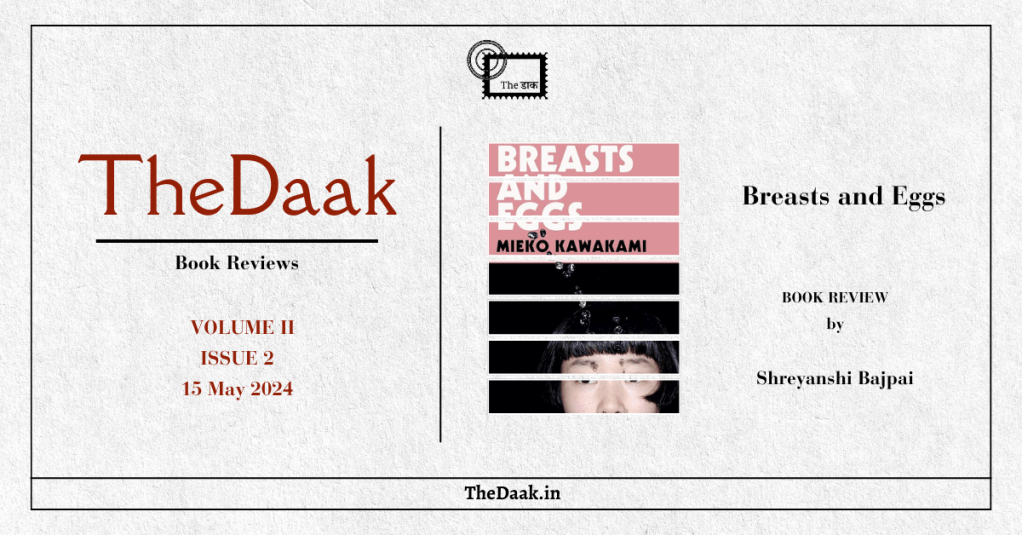
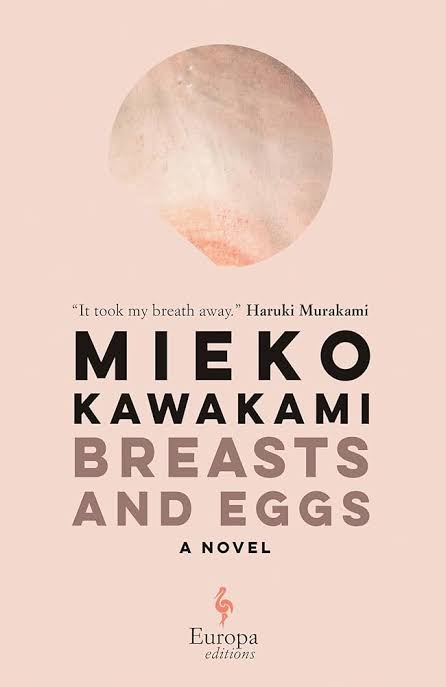
Book: Breasts and Eggs by Mieko Kawakami, Translated by Sam Bett and David Boyd, New York, Europa Editions, 2020, 393 pages, ISBN: 9781609455880, Rs. 625
‘Mother says there are locked rooms inside all women; kitchen of lust,
bedroom of grief, bathroom of apathy.
Sometimes the men – they come with keys,
and sometimes, the men – they come with hammers’
–Shire, Warsan “The House”, in Her Blue Body, Flipped Eye Publication, 2015
Mieko Kawakami is a Japanese writer-poet from Osaka. Her novel Breasts and Eggs (Natsu Monogatari (夏物語)), published in 2020, features characters from her short novel Chich to Ran (2008), which was awarded the 138th Akutagawa Prize.
Breasts and Eggs emerges from a nuanced exploration of a woman’s identity as it exists within societal constructs. Delving into the complexities of societal expectations and the iterative process of redefining womanhood, Kawakami weaves narratives of women from different class positions with great insight and sensitivity. She illuminates how societal norms govern and influence the expression of women’s bodies and sexualities within Japanese culture.
The title Breasts and Eggs is an act of radical reclamation, encapsulating the paradoxes embedded within the imagination of the female body. It juxtaposes the nurturing aspects associated with ‘breasts’ alongside the objectification they endure. On the other hand, the ‘eggs’ serve as a symbol for communicating the beginning of life and creation. In addition, they denote the unpredictability of existence through their properties of fragility and resilience of existence—the themes discussed in the book’s second part.
The first half introduces us to Natsuko, a writer in Tokyo, being visited by her sister Makiko, along with her 12-year-old daughter, Midoriko, from Osaka. It provides a glimpse into the poverty-stricken early childhood of the two sisters. With a father who abandoned them, leaving behind only debt, the sisters lived with their grandmother and mother till their passing. Forced to provide for themselves, they had to lie to employers to find odd jobs at hostess bars. While Natsuko’s ambition of becoming a writer led her towards the capital, Makiko’s responsibilities towards her daughter led her to continue the same job.
Makiko is hyper-fixated on the subject of breasts and the procedural details of breast enlargement surgeries. Midoriko disapproves of her mother seeking consultations for the same. Her journal entries reveal the ambivalent nature of her relationship with Makiko. Though Midoriko wants to protect and provide for her mother, she is also angry with her for creating another life and dooming them both to an existence filled with only suffering.
The second half, set ten years later, is longer and evidently more introspective and raw. It is focused on ‘eggs’ —Natsuko’s desperate desire to have a child of her own, which finds manifestation in her obsessive readings related to fertility treatments. The author brings in critical discourses around the right to have a family and who has a say in determining the same. The reader is compelled to consider the selfishness of each parent who decides to bring life into the world despite knowing the risks of living and still choosing to subject their child to pain and suffering that is interlinked within life. Ultimately, Natsuko weeds herself out of these apprehensions, doubts, and debates to realise that she would rather fail than not try at all to be a mother.
What does it mean to be a woman?
In answer to this question, Natsuko’s dream about women crying out, “There is no such thing as women” comes to mind (p. 56). Lacan (1972) famously said (and is often misunderstood for doing so), ‘The woman does not exist.’ He wished to convey that it was impossible to conceptualise women as a singular entity with a universal definition; that womankind exists in its own right. It is not subsumed under ‘mankind’. The prevailing definitions of what a woman should be are mere constructions and inventions of men’s desires and do not encompass ‘women’.
Prevalent ideas and beliefs around women have long been oppressive, which is illustrated by Makiko’s dissatisfaction with her body and Natsuko’s commentary on how beauty holds significant societal clout, ‘Beauty meant that you were good. And being good meant being happy’ (p. 48). This subjugation is apparent in Midoriko’s disillusionment about her changing body. ‘…the body I’m in keeps on changing, more and more and more and more, in ways I don’t even know…. Everything gets dark, and that darkness fills my eyes more and more’ (p. 57). Natsuko’s friend puts this systematic exploitation of women succinctly, ‘my mom was free labour—free labour with a pussy’ (p. 227).
In that light, the absence of men in the novel is an intentional attempt to centralise women’s narratives alone. Natsuko even stresses that it was in her father’s absence that she finally found agency and new meaning in her surroundings. ‘I saw these things every day, but now they gleamed as if sprinkled with magic dust’ (p. 12). Though one cannot remove the ‘men’ in menarche1 Kawakami has slyly removed the need for them in narrating women’s accounts. However, one is left to question what happens when men translate such accounts. To make it palatable, Brett and Boyd may have tamed Kawakami’s unbridled writing.2
Motherhood, the Idea of Family and ‘Knowing your child’
Midoriko questions the assumptions and expectations imposed upon women. Why was her body constructed in a way that even before she was born into the world, she had the biological materials required to create a baby? This prescribed trajectory of female existence that necessitates childbirth meets Midoriko’s discontent. It finds expression in her cathartic outburst of cracking eggs on her head. Midoriko is highly critical of the idea of women, which essentialises and idealises motherhood.
I wish I could rip out all those parts of me, the parts already rushing to give birth. (p. 99) / It’s not our fault that we have eggs and sperm, but we can definitely try harder to keep them from meeting. (p. 101)
On the other hand, Natsuko grapples with the complexities of navigating parenthood outside the conventional parameters of the heterosexual partnership. She desperately wishes to ‘meet her child’. This desire itself is a subversion of the traditional imagination of a family where only two opposite-sex partners are thought to be acceptable to raise a child. Till this point, the novel attempts to dismantle maternal essentialism, challenging the convention to assert women’s freedom and autonomy. The attitude is also reflective of the plummeting birth rates in Japan, where feminist stirrings have highlighted the illusory nature of the rewards of motherhood. Thus, the shift in tone makes one inquisitive about the author’s intentions with respect to childbirth.
Midoriko and Natsuko represent the two opposite ends of the spectrum of women’s identities in patriarchal societies. The contrasting perception of motherhood that Natsuko and Midoriko have can be traced back to their relationship with their respective mothers. Midoriko’s decision to not have children emerges from anger and pity for her mother’s life. ‘It’s your fault for having me. I realised something after that, though. It’s not her fault she was born’ (p. 67)
In Natsuko’s recollection of “When Mom was my age, she had two kids, fourteen and five”, we find a possible basis for her need to be a mother as an echo of the mothering received by her mother (p. 150). This is substantiated by Nancy Chodorow in her book The Reproduction of Mothering. She suggested that it is not, in fact, the biological drive of a woman that drives a woman’s maternal instinct but the quality of the relationship of a woman with her own mother.
In pursuit of motherhood, Natsuko considers donor conception but is greatly troubled by the ethical considerations of this process and of parenthood itself. The argument that considerably shakes her is an anti-natalist one. The readers also find themselves convinced by the argument, mainly due to another character, Yuriko. Her experiences of assault and abuse at the hands of her adopted father make the reader averse towards the idea of childbirth as well. One leans towards the ideas of this philosophy, as propounded by many anti-natalists such as David Benatar, who insist on abstention from the gamble of procreation because life’s pleasures do not balance out the sufferings.
Upon my initial engagement with the novel, Natsuko’s choice to proceed with the conception, regardless of her dilemma, leaves the reader with a disconcerting feeling. It is far too easy to give in to such pessimism than to believe that hope in itself is an act of resistance. Natsuko’s courage to accept the possibility of failure, rather than sacrifice her wants, warrants commendation. In Freud’s On Transience, he writes about how it is through the transient nature of things in existence that one can identify beauty in them. It is through destruction that we can value creation. It is through loss that we remind ourselves of an object’s worth. And, it is through pain that one can experience pleasures. Natsuko’s resolution is an attestation for the same.
- “I was wondering about the “men” in “menarche.” Turns out it’s the same as the “men” in “menstruation.” It means “month,” which comes from “moon,” and has to do with women and their monthly cycle. Moon has all kinds of meanings. In addition to being the thing orbiting the earth, it can involve time, or tides, like the ebb and flow of the ocean. So, “menarche” has absolutely nothing to do with “men.” So why spell it that way? What happened to the “o”?” (from Midoriko’s Journal entry, pg. 17)
↩︎ - “Midoriko writes about her mother’s desire to get breast augmentation surgery, in the Brett and Boyd version as: “It’s gross, I really don’t understand. It’s so, so, so, so, so, so gross … She’s being an idiot, the biggest idiot.” Here is Kawai: “I don’t get it. PUKE PUKE PUKE PUKE PUKE! … She’s off her trolley, my Mum, daft, barmy, bonkers, thick as two short planks.”” — Madeleine Thien (11 Sep 2020), Breasts and Eggs by Mieko Kawakami review – an interrogation of the female condition, The Guardian
↩︎
Bibliography
Cimino, Cristiana. 2022. From Freud’s Woman to Lacan’s Women: Implications in Clinical Practice, European Journal of Psychoanalysis. -, . https://www.journal-psychoanalysis.eu/articles/from-freuds-woman-to-lacans-women-implications-in-clinical-practice/
Freud, Sigmund. 1957. Essay. In The Standard Edition of the Complete Psychological Works of Sigmund Freud XIV, XIV:305–7. London: The Hogarth Press and the Institute of Psychoanalysis.
Kawakami, Mieko. 2020. Breasts and eggs. New York, NY: Europa Editions.
Kelland, Mark D. 2022. 7.4: Nancy Chodorow’s Psychoanalytic Feminism and the Role of Mothering, Social Sci LibreTexts, https://socialsci.libretexts.org/Bookshelves/Psychology/Culture_and_Community/Personality_Theory_in_a_Cultural_Context_(Kelland)/07%3A_Psychology_of_Women/7.04%3A_Nancy_Chodorow’s_Psychoanalytic_Feminism_and_the_Role_of_Mothering.
Lacan, Jacques. 1972-1973. The Seminar of Jacques Lacan, Book XX: Encore, On Feminine Sexuality, The Limits of Love and Knowledge. Translated by Bruce Fink. W. W. Norton & Company.
Lougheed, Kirk. 2024. Anti-Natalism. Internet Encyclopedia of philosophy. Accessed April 15, 2024. https://iep.utm.edu/anti-natalism/
Mamola, Claire Zebroski. 2000. Japan: The Childless Society?, And: From My Grandmother’s Bedside: Sketches of Postwar Tokyo, and: Broken Silence: Voices of Japanese Feminism (Review). NWSA Journal 12( 1) 198–203. https://doi.org/10.1353/nwsa.2000.0011
Thien, Madeleine. 2020. Breasts and Eggs by Mieko Kawakami Review – an Interrogation of the Female Condition. The Guardian, September 11, 2020. https://www.theguardian.com/books/2020/sep/11/breasts-and-eggs-by-mieko-kawakami-review-an-interrogation-of-the-female-condition
Williams, Holly. 2020. Breasts and Eggs by Mieko Kawakami Review – Strange and Ruthlessly Honest. The Guardian, October 5, 2020. https://www.theguardian.com/books/2020/oct/05/breasts-and-eggs-by-mieko-kawakami-review-strange-and-ruthlessly-honest

Shreyanshi is currently serving as the founding member of Qafila: Psychosocial Support and Research. She has finished her Master’s in Psychology (Psychosocial Clinical Studies) from Ambedkar University, Delhi
 TheDaak review
Leave a comment