

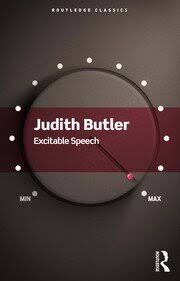
Excitable Speech: A Politics of the Performative by Judith Butler, New York, Routledge, 1997, 212 pages, ISBN: 0415915880, Rupees 2234 (Paperback)
By Aditi Gupta
A reading of Butler’s Excitable Speech: A Politics of the Performative allows thinking through the questions relating to speech acts, more specifically around hate speech – a speech that injures, words that wound. Questions such as: is the injury aspect of a speech located in what is uttered, and how it communicates, threatens, or performs violence? Or is it located in the utterer of the speech who injures those who are addressed in the speech? Both of these aspects can be found to be linked to language’s propensity to act. To be vulnerable to injurious language is to rely on one’s linguistic ontological condition of ‘being’ in language. Notably, according to Section 3 of the Slum Areas (Improvement and Clearance) Act, 1956, ‘slum areas’ are defined as mainly “those residential areas where dwellings are unfit for human habitation due to […] or any combination of these factors which are detrimental to safety, health and morals”. It is because of such characterisations of urban informal settlements – that carry negative and unwarranted connotations with them extending to their inhabitants, making them into something requiring a correction, a solution – that Gilbert (2007) argues against the use of the term ‘slum’. The concern with the vocabulary around urban informal settlements has to do with how such representations of slums as problems become the precursor for policy narratives and campaigns for ‘slum-free cities’. At the same time, the vulnerability of informal settlements in being called ‘slums’ lies in how the framing of slums in terms of their identifiable existing conditions in official statutes uses what is already known about slums as the end of what can be known about slums.
Then, if the injury aspect of hate speech is located in how language constitutes us, is it possible to regulate hate speech without disrupting what we derive from language? The location of injury with the content of the speech creates a call for a legal discourse on what is speakable/unspeakable, and the location of injury with a speaking subject creates a call for who can and cannot transgress the demarcation of the speakable/unspeakable. Butler puts in perspective how both calls are calls to the state and the law to regulate not only what is injurious, but also what is speech. Butler instead argues for non-state-centered forms of thinking about speech, for if it is in language that we are constituted and threatened, then it is in language that we survive. It is in language that we constitute our agency precisely because of our primary vulnerability to language.
The location of injury in terms of what is uttered, and who uttered it against whom, has been part of the larger emphasis on interpreting the context of the speech act – that Austin (1962: 52) considers a ‘total speech situation’. It is to argue that the sufferable effects of problematically injurious utterances are fully contextual. According to Butler, however, the line of argument that calls for contextualisation of speech acts fails to account for the ways in which injurious utterances are recontextualised – problematised, exposed, countered, and resignified. Butler’s argument for resignification is an argument for ‘breaking with prior contexts of utterances and acquiring new contexts for which it was not intended’ which both loosens and tightens the link between act and injury, between speech and conduct for it posits an unfixed transference (p.13). It is an argument about the possibility of a ‘politically consequential renegotiation of language’ (p. 92). This renegotiation is also of the trauma of being injured by language – from juridical to non-juridical, from state-regulated to non-state-regulated.
Another question that concerns this discussion is: if, with hate speech, an injury is inflicted against those who are already subordinated, would it affect the ‘resubordination’ of the one who is addressed? Butler introduces to this consideration of utterance, utterer, and referent, the complication of ‘the body of the addressee’ – arguing ‘body of the speaker exceeds the words that are spoken, exposing the addressed body as no longer in its own control’ (p. 12). But to think that the one who is injured by speech is deprived of their power would mean to take a limited approach to understanding the relationship of words and language, of language and bodies, and of bodies and power. This, however, is not to take a non-performativity view of speech – that speech is not a performance of harm by the utterer inflicted on the addressed.
Rather, to think of hate speech as hateful conduct embodied by the speaker has the possibility of allocating the liability, and therefore, prosecutability, to a singular subject even though the injury may have its origins elsewhere. The utterer does not originate an injurious speech but is ‘responsible’ for the performativity of its ‘repetition’. Butler muddles the authorship of an injury to argue that hate speech ‘neither begins nor ends with the [singular] subject who speaks’ , and that in many ways repetition of injury through speech is inevitable (p. 34). However, this is not to say that the subject is not responsible for such speech, it is to say that the subject is not the originator of hate speech.
This is also not to argue that certain words with the propensity to injure be either forbidden from use and, therefore, locked in their places as traumas in themselves, or never be prosecuted for the lack of their absolute prosecutability. Rather, it is to argue against a juridical discourse that inflicts violence of its own and constructs the domains of the speakable and the unspeakable (p.77). It is an argument for an agentive approach to use, reuse, and defuse language in a way that repeats, iterates, and recites “those injuries without precisely reenacting them” (p.40). In this sense, Butler preserves the possibility of a speech act “as an insurrectionary act” (p.159).
The introductory sentences that appear on the foremost pages of each chapter of Butler’s book find themselves at an oblique angle as if written as visual poetry. What that seems to do coincides with what Butler intends to do with the corpus of her texts – articulating a politics of performativity. In the slant aligned to the right, words become a performance on the page, giving visuality to textuality. However, in introducing a sense of ‘body’ to her sentences, Butler passes over the politics of spaces that this body-language visuality inherits.
Spaces punctuate bodies, as much as bodies punctuate language. And if language constitutes, threatens, and sustains bodies as subjects, there is an interrelatedness that language shares with spaces and spaces share with bodies (Vuolteenaho, et al. 2012).
Butler, in some ways, allows for a consideration of temporality in resignification of speech act, but not spatiality. The possibility for making a break with prior contexts, and for an offensive utterance to lose its power to injure, is attributed to ‘the gap between the originating context or intention… and the effects it produces”, and the “interval between instances of utterance’ (p. 14). However, resignification of the utterance, diffusion of injury, and autonomy in speech are made possible not only through time but also through space. This can be evidenced in how graffiti and street art become a renegotiation of spaces with linguistic art, a deterritorialisation of bodies that resignify a linguistic space.
The argument for space being constituted by language is substantiated by the vocabulary of interpellation. Being called a name is to be given an ‘address’, to be constituted in language but at a certain distance from one’s subjectivity, and what one comes to occupy is a relation of subjectivation. Spaces then become instituted with morsels of power with their own narratives, translations, and fictions – a series of intertextual significations. The linguistic constitution of a subject, thus, is not limited to the interpellation of the body, but also an interpellation that exceeds the body.
Butler’s Excitable Speech posits the body as the venue of power of language, however, the venue of the body and language is not construed as space that folds within itself a performative politics to be considered. This is addressed somewhat differently and relatedly in her Notes Toward a Performative Theory of Assembly, specifically in Bodies in Alliance and the Politics of the Street where the relation between congregating bodies, free speech, and the public square as a space of politics is theorised to understand ‘assembly’ as ‘performativity’ – how a body ‘speaks’ in occupying a space (Butler, 2015).
Conclusively, it serves us to consider how Excitable Speech is a conversation that takes almost entirely within questions. It is a text written dominantly in terms of what the question is and what the question is not. Butler’s quadripartite consideration of speech acts that are in some ways out of control is not just a critique of state regulation. Rather, it folds within itself a hope for radical acts of decontextualising and recontextualising the relation between word and wound.
References
Austin, J. L. 1962. How to Do Things With Words. Cambridge, Mass.: Harvard University Press.
Butler, Judith. 2015. “Bodies in Alliance and the Politics of the Street.” In Toward a Performative Theory of Assembly, 66-98. London: Harvard University Press.
Gilbert, Alan. 2007. “The Return of the Slum: Does Language Matter?” International Journal of Urban and Regional Research 31 (4): 697-713.
Ministry of Law and Justice. 1956. “The Slum Areas (Improvement and Clearance) Act, 1956.” Legislative Department.
Vuolteenaho, Jani, Lievan Ameel, Andrew Newby, and Maggie Scott. 2012. “Language, Space, Power: Reflections on Linguistic and Spatial Turns in Urban Research.” Collegium Studies across Disciplines in the Humanities and Social Sciences 13: 1-27.

Aditi Gupta is an Assistant Professor at the Department of Political Science of Lakshmibai College, University of Delhi. She has completed her M. Phil. from the Centre for Political Studies, School of Social Sciences, Jawaharlal Nehru University. Her research interests include Urban Political Sociology, Gender and the City, Socially-engaged Public Art Practices, and Discourses around the city of Delhi.
 TheDaak review
Leave a comment