
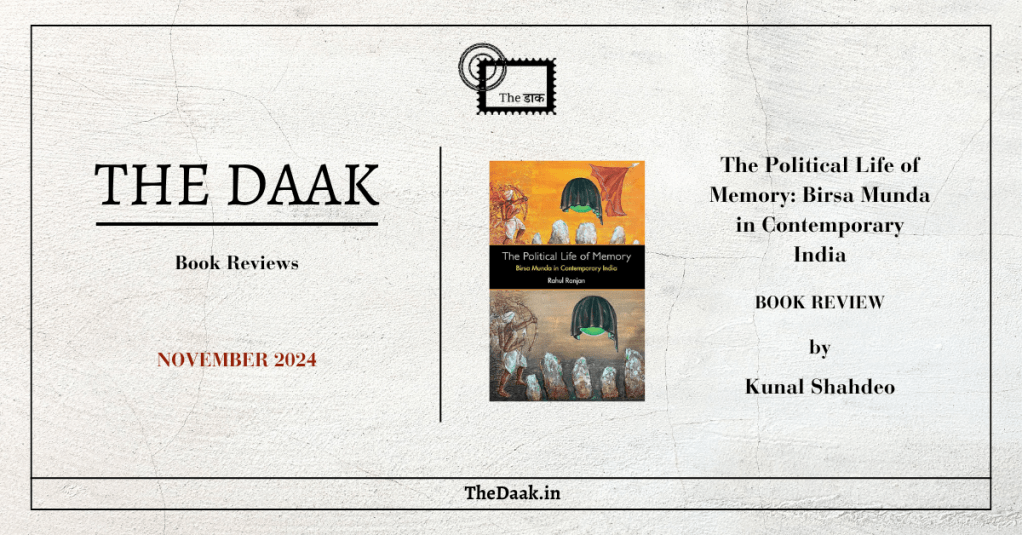
The Political Life of Memory: Birsa Munda in Contemporary India by Rahul Ranjan, Cambridge University Press, Hardback, 2022, 320 pages, Rs. 1095.
On a hot summer afternoon during my fieldwork, just after the second wave of COVID-19, hundreds of Adivasis travelled from Khunti district to Birsa Chowk in Ranchi, a symbolic space featuring the city’s most prominent statue of Birsa Munda. They were there to protest against land surveys being conducted in Khunti for a six-lane highway project. One of the protesters passionately declared, “We need to get the spirit of Birsa out of these statues (pointing at the Birsa statue at the circle) and fight like he did during his time for our people, land, and our country. Otherwise, there is no point in garlanding his statues if we don’t respect his teachings and his actions.” This speech encapsulates the essence of Rahul Ranjan’s book, Political Life of Memory: Birsa Munda in Contemporary India. The book delves into the afterlife of Birsa’s ulgulan (great tumult) and the politics of memory, examining how Birsa and his ulgulan are memorialized and remembered through material objects such as statues, Samadhi sthals (mausoleums), and Pathalgadi (stone slabs). These practices of memory and memorialization highlight the tensions between the official and popular, dominant and subaltern. The focus on memory allows the author to make two central moves: first, it enables him to move beyond the scholarship on reconstructing the history of Birsa’s ulgulan to the continuing relevance and ubiquitous invocation of Birsa in contemporary Jharkhandi politics. Secondly, a methodological focus on memory facilitates a non-linear reading of history and uncovers the discord and tension between Adivasi practices of remembering and the official narratives of Birsa, as embodied in statues and memorials.
Ranjan’s work offers an important exploration of how the history of the iconic Adivasi leader Birsa Munda (1875-1900) and his revolt are remembered. Birsa Munda led the ulgulan in the Chotanagpur region—present-day Jharkhand—between 1895 and 1900, challenging the British Raj and their collaborators, including Christian missionaries and Hindu zamindars. His ulgulan aimed to rejuvenate the demoralized Adivasi community under colonial rule, resist the Dikus (both British and indigenous exploiters), and strive for Munda Disum (Munda rule/country). Though captured by British forces in February 1900 and died in Ranchi jail on June 9, 1900, Birsa’s rebellion had a profound impact on Adivasi political consciousness and prompted administrative changes in the region.
Birsa’s resistance held great significance and inspired subsequent generations of Adivasi leaders to campaign for the separate statehood of Jharkhand. It continues to animate Adivasi resistance against regimes of extraction led by the state-capital nexus. This is captured in the book when the author quotes Adivasi activist Dayamani Barla asserting, “The angst of Adivasis, the ulgulan and the hul is still the same” (p.114). However, dominant forces, including the state, have attempted to assimilate and paint Birsa essentially in nationalist colours, invisibilizing the continuing forms of dominance and negation of Adivasi lifeworlds against which he was fighting.
The author underscores the framing of Birsa’s rebellion in official narratives primarily as a nationalistic and anti-colonial struggle, positioning him alongside other nationalist heroes who opposed the British Raj. This state-driven remembrance, evident in material representations such as statues and samadhi sthals, intentionally neglects the crucial issues of identity, autonomy, and agrarian distress that were central to Birsa’s mission to transform the Adivasi predicament. By focusing on the enduring relevance of these issues, the author challenges the official anti-colonial depiction of Birsa’s movement, arguing that colonialism represented a dynamic milieu of domination and subordination extending beyond the British Raj and persisting under post-colonial regimes that exploit Adivasi land and life. Ranjan provides a comprehensive exploration of how Birsa Munda’s legacy continues to shape contemporary Adivasi struggles and identity politics (chapter 5).
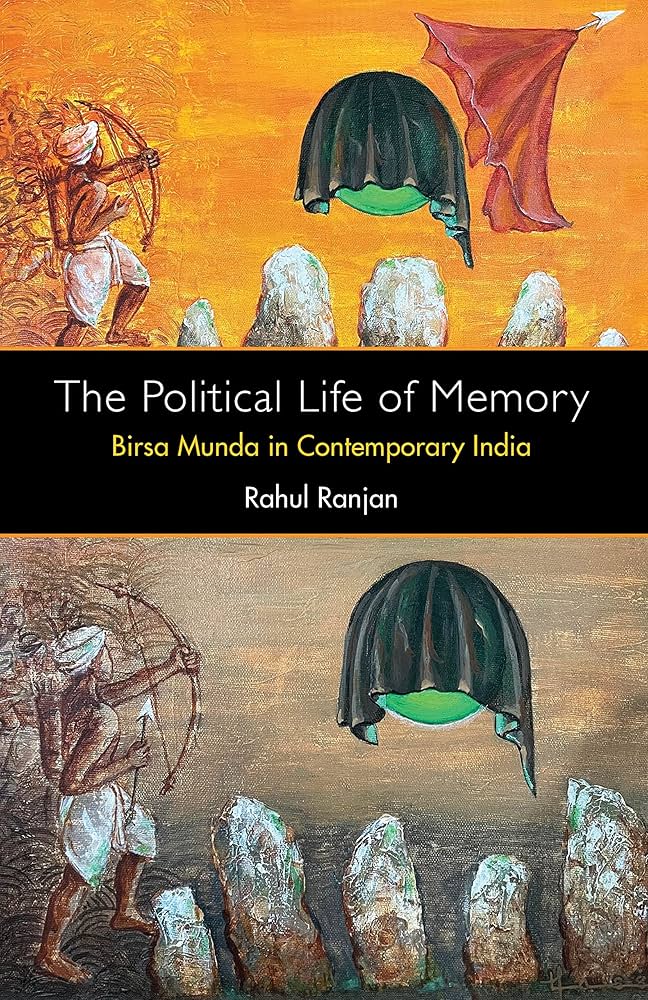
Before delving into the structure and content of the book, it is important to note that few book covers capture their essence as effectively as this one. Designed by Adivasi artist Lakhinder Hassa, the cover art vividly portrays the historical and ongoing struggle of Adivasis to secure their rights, deeply rooted in the potent field of memory.
The book is structured in six chapters divided into three thematic parts. The first part, ‘Context and Theory’, sets the foundation for the study. Chapter 1 offers a review of theoretical literature and contemporary debates on the historiography of Birsa Munda, emphasizing the role of memory in both historical and contemporary Adivasi struggles. Chapter 2 examines ‘historical memory,’ employing a rich trove of archival material from sources such as the India Office Records at the British Library, the Christian Missionary Society at the Cadbury Library, and the State Archive of Jharkhand. Ranjan elucidates how micro-histories are impacted by the limitations of records and the nature of memory, setting the stage for understanding the historical background of Birsa Munda’s rebellion and its subsequent commemoration.
The third part, ‘Ethnography of Memory, Objects, and Resistance,’ consists of four chapters presenting an ethnographic exploration of how Birsa Munda is remembered and commemorated in present-day Jharkhand. Chapter 3 examines the practice of statue-making, particularly of Birsa Munda’s, within the political and cultural context of Ranchi and Khunti districts. Ranjan traces the identity politics involving both Adivasi and non-Adivasi leaders and their engagement with memorialization amidst rising tensions around land rights. This chapter reveals how statues become sites of political contestation and identity formation. Chapter 4 explores the commemoration practices surrounding Birsa Munda, focusing on the Samadhi sthal in Ranchi and the memorial pillar at Dombari Buru in Sail Rakab village. These memorials, frequented by both politicians and Adivasis, illustrate the exclusion of Adivasi voices in state-sponsored commemorations. Ranjan’s fieldwork highlights the tension between the state’s official narratives and the Adivasi methods of remembrance, which intricately weave together human, natural, and spiritual elements. Chapter 5 investigates the 2018 Pathalgadi movement, which emerged in several Jharkhand villages. This movement revived the ancient practice of erecting stone slabs, repurposing them to inscribe constitutional provisions as resistance. The movement aimed to assert local democracy and resource management rights, inspired by the historical Sasandiri burial practice. Ranjan connects these contemporary struggles to archival records, showing the Pathalgadi movement in continuity of Birsa Munda’s legacy. This chapter highlights the transformative and subversive potential of memory politics. The concluding chapter examines the limitations of memory politics. Ranjan proposes new political imperatives arising from solidarity and identity-based mobilization. He stresses the importance of addressing material inequalities rooted in entrenched class and caste structures, advocating for a rethinking of memory politics to encompass these broader social and economic issues.
Ranjan’s work is significant for three main reasons. Firstly, it is crucial for understanding Jharkhand’s political landscape, where Birsa Munda’s image and memory are highly contested. Various groups, from the Hindu right to regional political parties, seek to reinterpret and use Birsa’s legacy for their agendas. Ranjan’s study reveals how these factions manipulate his legacy, demystifying the political use of memory in regional politics. Secondly, Ranjan’s methodological approach enriches his study by combining archival research with ethnographic fieldwork. This dual approach captures the everyday aspects of memory politics in Jharkhand, showing how memory is constructed, contested, and maintained. By integrating these methodologies, Ranjan provides a comprehensive view of the dynamics of memory and its impact on Adivasi identity and resistance. Thirdly, Ranjan’s attention to ethical considerations adds another layer of significance. He addresses research ethics and positionality, responding to criticisms from Adivasi scholars and activists about the often patronizing tendencies of non-Adivasi researchers. His commitment to ethical scholarship, reflecting an ethics of listening and respect, allows Adivasi voices to emerge through his work, underscoring the importance of amplifying marginalized voices in Adivasi studies.
While the book significantly contributes to the study of memory and politics, it has its limitations. Firstly, Ranjan’s focus on ‘material memory’ offers valuable insights into the political life of memory in Jharkhand but limits exploration of other ways in which Birsa Munda is remembered in the region. For instance, emergent Adivasi hip-hop innovatively engages with memories of the ulgulan, addressing issues of land, identity, autonomy, modernity, aspirations, and urbanization. By not including these aspects, the book misses a fuller picture of Birsa’s legacy in everyday Adivasi culture. Secondly, although Ranjan engages with the Birsaits and the Pathalgadi movement to move beyond the official and activist-centric dichotomy of memory politics, he does not fully illuminate how Birsa’s memory permeates the lives of ordinary Adivasis through stories and Jatras (religious fairs), which are collective remembrance practices. Lastly, the book could have benefitted from a deeper examination of how the Hindu right has reimagined Birsa Munda as a Hindu nationalist hero who opposed Christian missionaries and the British Raj, significantly influencing the Jharkhandi political landscape. A more thorough analysis of this nationalist framework, now the accepted lens through which Birsa’s legacy is viewed, would offer additional insight into the political and cultural dynamics at play, especially as the Hindu right struggles for political dominance amidst Adivasi resistance in the region.
Despite its limitations, Ranjan’s book stands out as a crucial study of both Birsa Munda and the broader political context of Jharkhand. It offers profound insights for anyone interested in Adivasi studies, Jharkhand’s political landscape, and the politics of memory.
Kunal Shahdeo is a PhD scholar in sociology at IIT Bombay and an academic fellow at the National Law School of India University, Bengaluru. His doctoral research explores the dynamics of socio-political change in the Chotanagpur region of Jharkhand.
He can be reached at his Twitter (X) handle: @kunalshahdeo1
 TheDaak review
Leave a comment