

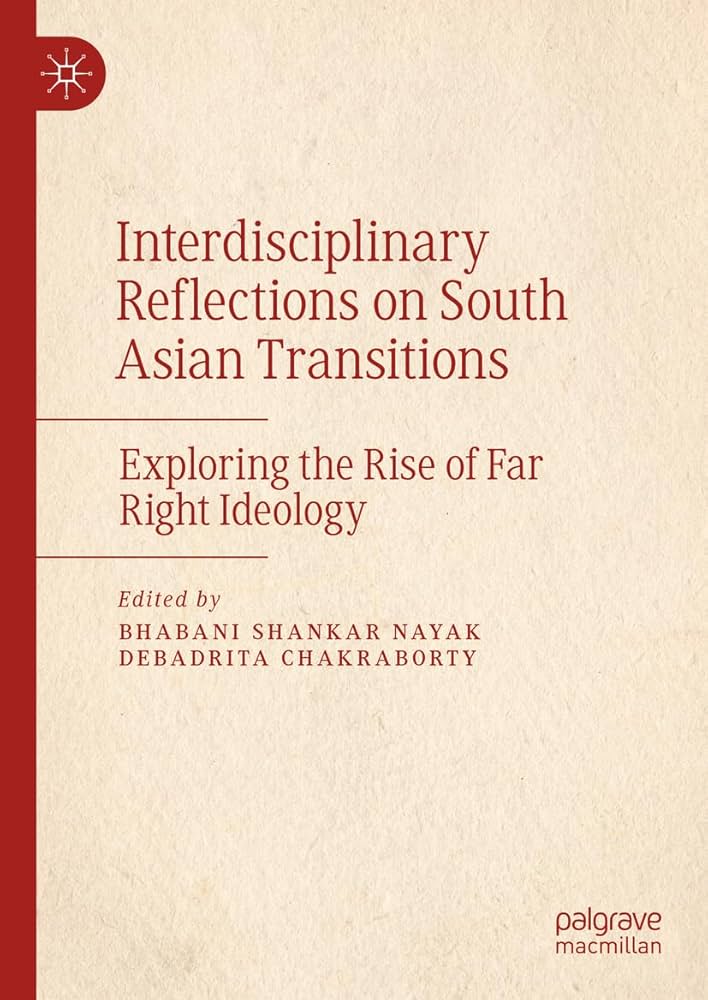
Interdisciplinary Reflections on South Asian Transitions: Exploring the Rise of Far Right Ideology edited by Bhabani Shankar Nayak and Debadrita Chakraborty, Switzerland, Palgrave Macmillan, 2023, 218 pages, ISBN 978-3-031-36685-7, ₹11,576
Over the past few decades, the right-wing has emerged as a significant electoral force in the global North (Rydgren 2007, 242). A similar trend is evident in South Asia, highlighting an unabashed attempt to revitalize the hierarchical and antagonistic socio-economic relationships that were seemingly disrupted after the post-colonial attempts to create a social equilibrium. While the now-dominant right-wing enacts its façade through an anti-minority approach, the backstage reveals the real objective, i.e. expanding the scope of neoliberal policies.
Neoliberalism is essentially a prescriptive concept that shapes “the proper relationship between the state, capital, property, and individuals” (Ganti 2014, 93 ). In this relationship, “serving the market becomes paramount, the state is recast as its enabler” (Phelan & Dawes 2018, 13). The right-wing, entrenched in anti-minority values, provides fertile political ground for the actualization of these policies through the symbiotic relationship with neoliberalism. For instance, in the case of India, liberalization created a middle class that only cares about growth and not the means. It “wants to grow in status by being recognized as Hindu through a kind of sanskritisation process and balance its growing materialism by some religiosity” (p.xix).
The volume, Interdisciplinary Reflections on South Asian Transitions: Exploring the Rise of Far Right Ideology is a collection of eleven pertinent essays addressing various dimensions of South Asian far-right politics. Traditionally, research has focused on specific national contexts but the volume attempts to offer a transnational approach interconnecting various nation-states. It demystifies the ideology’s real-world manifestations for those familiar with the historical, socio-political and cultural dynamics of South Asia.
The volume, edited by Bhabani Shankar Nayak and Debadrita Chakraborty, opens with the former’s erudite introduction that sets the stage for the rich conversations within. The book tackles the concerning rise of right-wing ideology across South Asia, marked by the marginalization of minorities, promotion of neoliberal economic policies, and the entrenchment of majoritarian dominance. The first chapter further establishes the premise of the volume delineating the right-wing ideology in practice and its implications for the minorities. Aligning with capitalism, the state becomes a “corporate stakeholder” (p. 7) and sidelines its social responsibility towards minorities. Economic development via foreign investment establishes a narrative of nationalist competence, revitalizing the faith in the right-wing and ossifying the anti-minority fervor.
Chapters 2-4 discuss how the historical development of the right-wing is not a linear or uniform process across the region. It is ridden with tensions based on local contexts. The manifestation of the ideology in one nation-state may not coincide with another, but it is also not an isolated process. Andrea Malji’s analysis of Sri Lanka exemplifies this. Here, ethno-linguistic Sinhalese right-wing politics dominates. Interestingly, the strategy to cater to the majority is not the imperative of explicitly right-wing parties. For instance, the United National Party (UNP), despite not being overtly communal, passed an Act denying citizenship to the linguistic minority, the Indian Tamils (p. 26). In contrast, Jayanth Deshmukh and Muhammed Favaz explore how India’s Bharatiya Janata Party (BJP) leveraged religious divisions, not linguistic ones, to propel Narendra Modi to power. These divisions already existed as created by the British which were weaponised by the BJP to further exacerbate the polarization.
A prime example of how right-wing ideology transcends borders is Prime Minister Narendra Modi’s emphasis on India’s shared Hindu history with Nepal. As Manish Jung Pulami notes, “the Hindu nationalists in Nepal have found an ally in the BJP. The Hindu nationalists on both sides of the border have united in this matter despite the Nepalese propensity to express their own identity by frequently ‘othering’ India” (p. 42). Therefore, despite differing in their modus operandi of furthering the communal divide, these transnational networks provide mutual support and validation, accelerating the spread of right-wing ideology across South Asia.
Moving beyond specific national contexts, chapters 6-10 explore the concept of right-wing ideology through wider conceptual categories using specific intersectionalities. Enrico Beltramini analyzes the transplantation of the western concept “secularism”, understanding its implication in India along with its ambiguity and fragility. Hindutva frames its opposition to secularism in ideas of decolonisation and self-preservation while others defend it by addressing the concept’s idiosyncratic evolution in India. Other critical thinkers have critiqued the Indian model for it lacks the historical journey that it witnessed in the West, remaining a “phantom concept” (p. 98).
Bhabani Shankar Nayak, the editor, in Chapter 7 outlines the roots of right-wing ideology. In India, Nayak notes that Hindutva has permeated into every aspect of our lives to establish a “Hindtuva social contract”. This results in “restructuring Indian society… to harmonise the primacy of corporates in the everyday lives of people” (p. 109). Overall, the capitalist class fosters the fascism of Hindutva through ignorance, arrogance and irrationality permeating all aspects of people’s everyday realities. Farooque Chowdhury in Chapter 9 complements the idea by demonstrating how right-wing ideology operates to sustain exploitative relationships, extending beyond narrow party politics. Factions of the dominant sections have specific parties that offer no real challenge to the property relations.
Dyotana Banerjee and Abhijit Dasgupta (Chapter 8) offer a gendered perspective by elaborating on the construction of the idealized Hindu woman and the “otherised” Muslim counterpart, often victimizing the latter. The Uniform Civil Code (UCC) is hailed as a pro-women endeavor to ‘protect’ the Muslim women from the control of their religion while obscuring the possibility of it being used as a tool to implement majoritarian values.
Furthermore, the editor, Debadrita Chakraborty, in the 10th chapter, focuses on the impact of biopolitical and necropolitical technologies on marginalized groups. She analyzes how inequalities embedded in race, citizenship and gender relations were reproduced during the Covid-19 pandemic through the apathetic state machinery and necrocapitalist market forces.
Methodologically, the volume has primarily relied on secondary sources making it lack the depth and detail often associated with primary fieldwork. The reliance on secondary material cannot articulate the subjectivities of people and their interpersonal negotiation strategies. However, Jessy K. Philip’s chapter, “Peasant Populism and Hindu Imagery: A Case Study from Gadwal, Telangana State of South India” marks an exception as it includes rich data gathered through fieldwork in Desharajupalli village, Telangana (conducted in 2009 and 2015), adding a crucial layer of nuance to his analysis. It is assumed that the right-wing is acceptable to the peasants based on the statistical calculation of profit as they appear to accept the conditions of the rural elite. However, his fieldwork allowed him to record the “stringent critique among OBC peasants of dominant sections perceived as exploiters of peasants as money lenders, merchant and commission agents” (p. 77).
The volume ends with a refreshing change in writing style, a compilation of Abdullah Malik’s diary entries, translated and contextualized by Raza Naeem. It offers a firsthand perspective on his Hajj pilgrimage, a break from the book’s reliance on secondary sources. Malik’s critical observations analyze the relationship between religion and politics. Noting the comparable human worship in both realms, he also raised concerns about the politicization of religious duties such as Hajj. While the chapter is an interesting end to the conversation, positing Malik’s personal archives alongside public records or oral histories from the region would have revealed possible silences and included relevant details to further conceptualize and concretize his arguments.
Nayak and Chakraborty’s skillful curation brings together diverse voices, creating a nuanced understanding of right-wing ideology. The operationalisation of this ideology must be understood in tandem with capitalism. The rise of the right-wing is, therefore, entrenched in the dynamics of a capitalist mode of production. This essentially reiterates the famous Marxist proposition that religion is the opium of the masses. By extension, the contemporary opium can morph into linguistic, ethnic and/or gender based forms. Equalizing the minority to a threatening Other, accords credibility to the ideological violence.
Although it makes a commendable effort to transcend borders by including various South-Asian nations, the chapter-by-chapter analysis inadvertently reifies artificial boundaries. Moreover, there is a predominant emphasis on the Indian context, further restricting the spatial fluidity. The impact of the right-wing narrative building strategies on the spatial peripheries may not be congruent with the mainland even within a nation-state. It would have been interesting if such deviations were accounted for.
Conceptually, the volume tackles the rise of the far-right but does not explicitly define the term. Although the text allows us to glean the meaning of “right-wing” through its contextual usage, the distinction between the far right and its probable variant, the “non-radical right” is hard to decipher. While the two concepts fall under the realm of right-wing, how does one explain the use of far-right in the title against simply right when the majority chapters, including the introduction, do not use the term? Moreover, Chowdhury critiques the mainstream scholars and analysts who often mistakenly equate the Right solely with the far-Right, ignoring the broader influence of right-wing politics, which is possibly a blunder committed by the volume (p.166).
In conclusion, it is an important source elucidating the socio-political dynamics in South Asia. It includes chapters with novel and creative arguments while others synthesize a diverse set of secondary literature. It would be interesting to develop the arguments by placing a greater stress on an upside-down perspective wherein the subjectivities and firsthand accounts of the marginalized form the dominant voice. Their lived experiences can shatter many academic armchair conceptions of reality.
References:
Ganti, Tejaswini. “Neoliberalism.” Annual Review of Anthropology 43 (2014):89-104. https://doi.org/10.1146/annurev-anthro-092412-155528.
Phelan, Sean, and Simon Dawes. “Liberalism and Neoliberalism.” Oxford Research Encyclopedias (2018). https://doi.org/10.1093/acrefore/9780190228613.013.176.
Rydgren, Jens. “The Sociology of the Radical Right.” Annual Review of Sociology 33 (2007): 241–62. http://www.jstor.org/stable/29737762.

Vanshika Yadav is pursuing her M.A. in Sociology from the Delhi School of Economics, University of Delhi.
She can be reached at vaanshika06@gmail.com
 TheDaak review
Leave a comment