

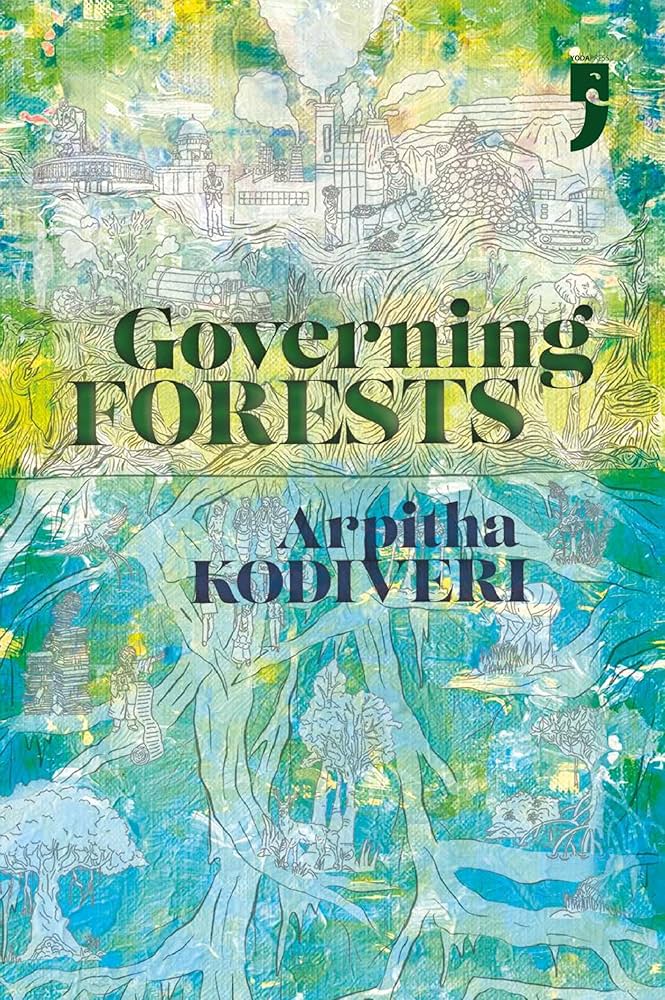
Governing Forests: State, Law and Citizenship in India’s Forests by Arpitha Kodiveri, Melbourne University Press, 2024, 174 Pages, ISBN: 9780522879568
by Azam Danish
Most city dwellers equate “forests” simply with trees and animals, and the need to safeguard “wilderness” and biodiversity due to the “threat” of climate change. Forests are also perceived through terms like “green cover” and “carbon sinks”. This pervasive lens often renders forest-dependent people and forest dwellers as invisible, despite their coexistence with biodiversity for generations. Governing Forests by Arpitha Kodiveri challenges our simplistic lens and drives our attention towards these invisible peoples, their entanglement with law and the state, and the quest for democracy in forests.
The author Arpitha Kodiveri is a legal scholar who specializes in environmental law and justice and is an Assistant Professor of Political Science at Vassar College, New York. Governing Forests traces historical developments to demonstrate that post-colonial forest governance continues the colonial state’s authoritarian legacy. Yet, the state’s encounter with marginalized forest-dwelling communities has led to resistance against authoritarian governance and shaped power struggles for democratizing forest governance. This book traverses through different states in India and integrates legal judgments, case studies, and interviews with communities and individuals entangled in the forest landscape. The author offers a critical appraisal of the present forest governance framework, the increasing role of green capitalism, international treaties and organizations, and resource extractivism. Kodiveri argues that an alternative governance informed by progressive and inclusive values is not only possible but also imperative for addressing climate change.
Authoritarianism in the Forests?
“The history of forest laws is the history of forest-dwelling communities reclaiming power.”
Governing Forests (p. 14), Kodiveri (2024)
Governing Forests critically traces the evolution of forest governance in India since the colonial period through post-independence developments towards the twenty-first century. It demonstrates how the current framework mirrors authoritarian practices of the British Raj, despite attempts towards democratisation.
Kodiveri highlights pivotal moments in legal history like the drafting of the Indian Forest Act, 1865 which formalized complete state control over forests. Colonial forest management was informed by timber demand in Europe and British colonies. The law consolidated power with the forest administration, granting officials complete authority over management and policing. The Indian Forest Act, 1927 (IFA) further entrenched state control. While it granted limited “privileges” to the forest communities, their traditional practices within reserved and protected areas were criminalized and legal provisions for forest-dwelling communities became discretionary, dependent upon the whims of the forest administration.
Post-independence, during the Constituent Assembly debates (1946–1950), Adivasi leader Jaipal Singh Munda advocated for the creation of “Scheduled Areas” to preserve traditional livelihoods, prevent over-administration, and avoid land alienation. Although the Fifth Schedule was introduced with safeguards, lack of Adivasi representation hindered its effectiveness. The 1952 Forest Policy aimed to recognize community rights but continued colonial practices, especially in the Scheduled Areas. The Coal Bearing Areas Act of 1957, introduced to address India’s energy needs, compounded land alienation by facilitating land acquisition bypassing legal recourse. The Wildlife Protection Act, 1972 (WLPA) marked a terminology shift towards conservation, in line with the international rhetoric. However, it also institutionalized exclusionary practices in National Parks – burden of conservation fell on forest dwellers as their criminalization heightened, while deforestation continued unabated.
Decentralization of rural governance in the early 1990s provided an opening for fundamental changes to the governance of Scheduled Areas – or at least promised to. The Panchayat Extension to Scheduled Areas Act 1996, (PESA) was enacted and village democracy in the form of Gram Sabha was empowered to govern in accordance with the traditional approach. This was seen as an instrument of assertion by forest-dwellers, but lack of state-level implementation limited its influence.
Forest Rights Act, 2006 – Moving towards democratic forest governance
Community led imaginings of rights led to the enactment of the Scheduled Tribes and Other Traditional Forest Dwellers (Recognition of Forest Rights) Act, 2006 – the FRA. It was grounded in community-based conservation, a management model where the Forest Department would be an assisting body rather than an authoritative landlord. The law was enacted to mend historical injustices, and it posed a landmark challenge to the draconian forest governance. Wildlife NGOs and businesses opposed power-sharing in the forests and posited FRA as antithetical to conservation, overlooking deforestation undertaken by extractive industries.
The sections on the formulation of the FRA, deliberations with various communities, and the progressive approach of the law itself offer valuable insights. The author argues that these developments are a part of “citizen-making”, that is, the state responding to the demands of the economy, thus re-forging its relationship with forest-dependent citizens. The absence of formal dialogue mechanisms pressured the government to respond to legal mobilization, pushing the state toward a more deliberative approach. Forest dwellers saw the state as aligned with business and extractive interests therefore viewed the FRA as a crucial step in preserving their livelihoods and heritage.
Kodiveri notes that the deliberative model in India has been largely accessible to dominant castes and capitalist classes. Participation has been restricted by design, leading to authoritarianism. The FRA institutionally challenged the surveillance and policing of forest-based livelihoods. However, critics argue that it gives preferential treatment to Scheduled Tribe (ST) communities over Dalit or Scheduled Caste (SC) communities. Concerns also arise about implementation, whereby Dalits are seen as “less deserving” by the bureaucracy. The author suggests that the implementation of FRA is possible only if the state moves away from pro-business and extractive approaches.
Conservation at the cost of Adivasis and Dalits
India is often lauded for its conservation efforts for ‘cosmopolitan’ animals like tigers, lions and recently introduced cheetahs (Annu Jalais, 2008). However, conservation across the Global South is undertaken at the expense of marginalized communities. Kodiveri highlights two parallel framing of conservation – “exclusionary” which derives its philosophy from Eugenics and racist framing of nature-culture (Gray Brechin, 1996) and “community-based”, drawn from a rights-based approach. Kodiveri illustrates this through interviews with forest-dwellers from Sariska Tiger Reserve in Rajasthan and BR Hills Wildlife Sanctuary in Karnataka. Livelihoods of nomadic communities in and around national parks have been dismantled through forced displacement and illegitimate rejection of claims under the FRA. It is also revealed that Adivasi communities are regularly detained, beaten, and arrested for engaging in subsistence activities like honey collection, fishing, and cattle grazing.
Governing Forests adds to the critical literature on eco-casteism and highlights emancipatory possibilities of an anti-caste climate justice framework. Dalit communities and individuals in these landscapes encounter and resist “Brahmin environmentalism” where environmentalism is seen and enacted through the lens of higher castes. Kodiveri observes that the narrow framing of “forest-dependent communities” and the biased interpretation of laws has led to the exclusion of Dalits. The forest administration sees Dalits as “outsiders”, as reflected in disproportionately high rejection rates of non-Adivasi FRA claims in Chhattisgarh, Maharashtra and Odisha.
Vagaries of “consent” in forest governance
India’s refusal to ratify the International Labour Organization (ILO) Convention 169 in 1989, which mandates consent from tribal peoples for administrative and legislative decisions, was a critical moment. PESA included provision for consent, but it remained largely “symbolic”. The FRA mandated consent from Gram Sabhas for forest diversion, yet it wasn’t until the Niyamgiri judgement of 2013 that this came into effect. The consent provision is seen as a hurdle by corporations rather than as a means of deliberation, leading to manipulative tactics to secure it. From 2014-2022 systemic legal interventions ensured that consent provision stayed a symbolic exercise. The Forest Conservation Rules, 2022 finally did away with the consent for all practical reasons, and removed the provision for Gram Sabha consent in cases where the at the time when climate crisis and deforestation have reached a tipping point.
Weakening laws and undoing authoritarianism in forests
The book proceeds to examine whether ecological losses can be compensated through plantations? The business lobby and the Indian government think so. This explains the weakening of the Forest Conservation Act, 1980 by enabling single-window clearance of forests. The Narendra Modi government has provided legitimacy to a perverse method of compensation for depleting forest cover, and erasing legal requirements for project clearance. The grotesque influence of capitalism is undeniable as single window clearance is given the go ahead, the consent process diluted to “post facto” clearance, eliminating legal processes and alienating forest communities. Forests are being institutionalized as “carbon sinks”, and even pollution can be compensated through tree-planting. Terming these developments as “autocratic legalism” (p. 104), Kodiveri argues that these “operate on the legal theory of violence and extraction” (p. 114).
The author’s critique gains further relevance as readers engage with alternatives. Law is a space of contestation and the autocratic regime is only temporary, as the past has shown us that creative legal interpretations and assertions are possible and inspire justice. The FRA challenged the undemocratic rule of forest bureaucracy, proving that law is not merely a tool for the powerful. It inspired hope across communities in India for both Adivasis and Dalits to create a vocabulary to engage with the state. The Niyamgiri judgement was another such moment. While these interventions challenged the legitimacy of the Forest Department, they bring up questions such as: why does the Department seek to dilute FRA? Perhaps, as one of Kodiveri’s interviewees from BR Hills says – “they are afraid of becoming irrelevant!” (p. 129).
Kodiveri emphasizes the need to recognize forest-dwelling communities as their legitimate stewards. Recent scientific studies also prove the effectiveness of community-based forest management models. As climate change and capitalist growth accelerate, we must ask what the inherent design of our forest laws should be. The current model is alienating– envisioning compensation for forest loss at one site through plantations elsewhere, as if forests are devoid of life. Governing Forests makes a case for a preventive approach over an extractive one. As citizens, we must decide what matters – extractive growth or environmental-social well-being.
Over seventy years later, Jaipal Singh Munda’s vision of self-governance for Adivasis remains unfulfilled. His “negotiated sovereignty framework” sought to embed deliberative and participative decision-making within law and governance. The book encourages students, journalists, activists and lawyers to look at the issue from the lens of care and repair. This lens attempts to look at the relationship between environment and the stewards not from a place of control and conflict but of respect and care.
Reference:
Brechin, G. (1996). Conserving the race: Natural aristocracies, eugenics, and the US conservation movement. Antipode, 28(3), 229-245. https://onlinelibrary.wiley.com/doi/abs/10.1111/j.1467-8330.1996.tb00461.x
Jalais, A. (2008). Unmasking the cosmopolitan tiger. Nature and culture, 3(1), 25-40.

Azam Danish is an independent researcher based in New Delhi. He examines issues related to environmental governance, political ecology and digital media studies.



 TheDaak review
Leave a comment