

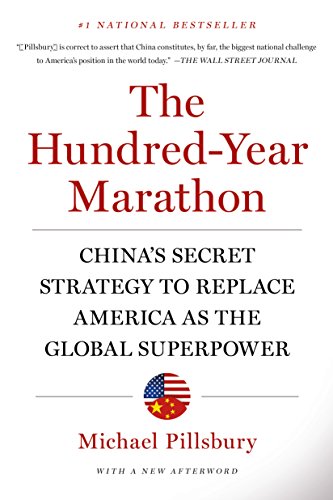

The Hundred-Year Marathon: China’s Secret Strategy to Replace America as the Global Superpower by Michael Pillsbury, Henry Holt and Co, Published: 03 Feb 2015, 336 pages, 16.5×2.54×23.13cm, ISBN:9781627790109, Price: 2265.20 (hardcover)
by Kusum Rana
The book The Hundred-Year Marathon: China’s secret strategy to replace America as a global superpower is authored by Michael Pillsbury, former CIA director, who turned from being a ‘Panda Hugger’ to a ‘China Hawk’. He is regarded as the leading voice behind the competitive turn of US strategy towards China. He is a diplomatic author, a sinologist who is writing from the realist perspective.
The title ‘The Hundred-Year Marathon’ suggests China’s long-term strategy to replace US hegemony in the international arena. The book is based on the interviews with the Chinese Hawks (Ying Pai), who view America as a major threat to their rejuvenation process. Tao Wenzhao, a specialist on US-China relations, called Pillsbury’s book a ‘conspiracy theory.’
Michael Pillsbury, in the beginning of his career, advocated the idea of America’s friendly relations with the Chinese. He, like many in the CIA, FBI, and Pentagon, didn’t expect that China was working towards the ‘China Dream’, which would eventually replace America as a global superpower. Xi Jinping has referred to 2049 as the date the dream will be realised, one hundred years after the formation of the People’s Republic of China.
At the time of the Cold War, the US believed that it could use the ‘China card’ to gain an advantage over the Soviet Union. But the Soviets knew that China wouldn’t play second fiddle. At the beginning, China used US-USSR rivalry to extract Soviet assistance. When that halted, China shifted to the Americans and acted as an ally against the Soviets.
The Chinese Hawks (Ying Pai), a group of Chinese hardliners firmly controlling the organs of the Chinese state apparatus , have drawn lessons from the Warring State period. They have successfully persuaded the Chinese leadership to view America as a ‘tyrant’ that needs to be replaced. Chinese strategy holds that the hegemon must never be provoked prematurely. The rising power must conceal its ambitions for decades, or longer, before the point of maximum opportunity.
‘Never lose sight of shi’ is at the heart of Chinese strategy. It further involves multiple components, such as to let other nations do your bidding, deceive the opponent about your real intentions, and simultaneously build your coalition while undermining your opponent from encircling you. When the opponent is a powerful adversary like America, you must find its Achilles heel.
US-China relations began during the presidency of Richard Nixon. In the 1960s, Sino-Soviet relations started deteriorating. Mao assessed the shifting shi, which was driving China out of the Soviet camp, towards the Americans. When they finally met in 1972, Mao portrayed China as harmless with a desperate need of aid and assistance. Then onwards, the Nixon administration extended great favours to the Chinese. And laid the foundation of Sino-American warm relations, though temporary in Chinese perception.
Successive US presidents continued with economic engagement and arms sales to China. American leadership believed that countering the Soviets while boosting China’s inevitable path towards democracy was the right move. The author argues that the US should have changed its approach after the Tiananmen Square massacre. It was a failure on the part of intelligence agencies and the leadership for not supporting the real reformers in CCP.
Only by 2001 did the US realise that Chinese hawks, whom they believed were ‘fringe’ elements of Chinese thought, had successfully persuaded the Chinese leadership to view America as a hegemon whom they needed to replace. China’s strategy to break the Soviet Union with the help of America was indeed quite successful.
The author has further explained ‘Assassin’s mace’, a weapon mentioned in Chinese folklore that ensures victory over a powerful adversary. It basically refers to a set of asymmetric weapons that China has developed indigenously. For example, Americans depend on their space satellite network for military communication as well as intelligence and missile guidance. China has developed weapon systems to not only blow up these satellites but also to hijack the information it gathers. Rather than only working towards military buildup, like the Soviets did, which later on contributed to their decline. The Chinese vowed not to take a similar path since it provoked the existing hegemon prematurely.
The book also elaborates on the fears of China from the United States. Since China has a long coastline, it fears blockades from the US and its allies. Since it is an export-driven economy, heavily dependent on Sea Lanes of Communications (SLOCs) to sustain its economic heft. Another major fear Chinese have is disruption of stability and orderliness within their territory. Chinese Hawks have this belief that the Americans might encourage riots and civil war inside China by assisting rebels in Taiwan, Tibet, Xinjiang through providing funds, training, arms, ammunition, etc.
China’s secret strategy also includes economic supremacy as an important component. The economic boom in China is nothing less than an economic miracle. It was largely assisted by the World Bank and other western institutions for nearly four decades. China continues to expand in the international market because it doesn’t play by the rules.
Recent assertive policies of China indicate the shifting shi; a new scenario is emerging where there is improvement in the balance of power relative to the United States according to the Chinese’s calculations. The hundred-year marathon might be concluding way ahead of schedule.
The book is mostly drawn from the author’s understanding and experience from his long career in intelligence agencies. China’s ambitions for replacing the United States were there from the start. But Americans failed to see beyond the façade of a complacent China. The Chinese used deceptive tactics to prevent the hegemon from looking at the real geopolitical situation. A rising state must bind the time and wait for the opportune moment to strike. The leader must interpret the shifting shi meticulously. Axioms and precedents from the Warring State period were applied even today by the Chinese leadership.
REFERENCES
1. Pillsbury, Michael (2015). The Hundred-Year Marathon: China’s Secret Strategy to Replace America as the Global Superpower
2.https://www.politico.com/story/2018/11/30/trump-china-xi-jinping-g20-michael-pillsbury-1034610
5.https://www.nytimes.com/2018/11/30/us/politics/trump-china-trade-xi-michael-pillsbury.html
6. https://thehundredyearmarathon.com/

Kusum Rana is currently pursuing a Master’s degree in International Relations from Jawaharlal Nehru University, New Delhi, India. Her academic interests are primarily centered on China and security studies.
She can be contacted at her LinkedIn and at kusum47_isk@jnu.ac.in.
 TheDaak review
Leave a comment