

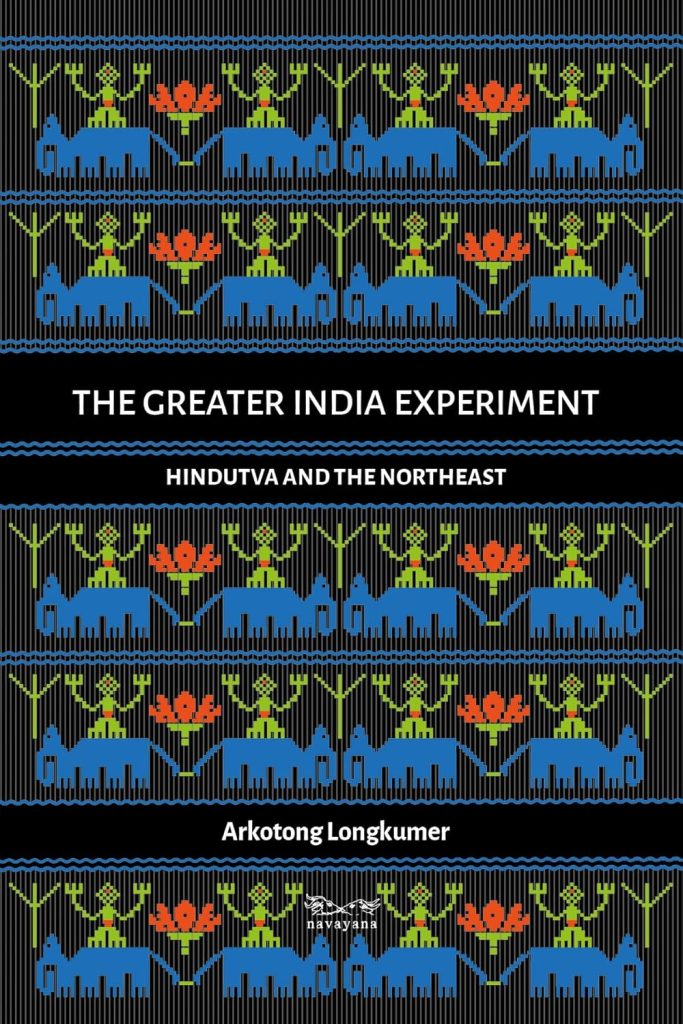
The Greater India Experiment: Hindutva and Northeast by Arkotong Longkumer, Gurugram: Navayana Publishing, 2022, ₹599
by Sandipan Saranga
At a time when Hindu nationalism has become the dominant political force in India, The Greater India Experiment: Hindutva and Northeast, a pioneering ethnographic work by Arkotong Longkumer provides a timely examination of how this ideology is expanding itself in India’s most diverse frontier. A work of political anthropology, this book seeks to demonstrate the nuances of the Sangh Parivar’s operations in the Northeast, where their conventional strategies face significant challenges and contradictions. Five years of extensive research reveal the adaptations that the Rashtriya Swayamsevak Sangh (RSS) has to make to integrate a predominantly Christian region in their idea of an Akhand Bharat, which not only includes Afghanistan, Pakistan, India, Bangladesh, Sri Lanka, Nepal, Bhutan, Tibet, Myanmar, but also in some cases Cambodia, Thailand, and Indonesia. He also employs Golwalkar’s conceptualization of the term as a cultural framework to illustrate the widespread influence of ‘Indic civilisation’ (p. 9) on these present-day nation-states.
The author has interviewed and observed the functioning of the Sangh in the states of Assam, Meghalaya, Arunachal Pradesh, Tripura, Nagaland and Manipur. The setting in which he has covered these areas vary vastly, while some were studied in the aftermath of state elections like Assam, Meghalaya, Nagaland, and Tripura, some others were covered to unearth the workings of the Sangh in educational institutions like the schools of Nagaland, Arunachal Pradesh and the accounts of a University in Meghalaya. He does not limit his writing and study to only a particular time period for each state but keeps going back and forth geographically and temporally as the chapters progress, enhancing the coherence of his arguments.
The book’s central argument lies in the analysis of Sangh politics’ predominant involvement in associating places, legends and historical figures of the region with the mainstream Hindutva narratives. Another notable point that the book makes is that the RSS operates differently in the Northeast compared to other regions. Borrowing from Sanjib Baruah’s conceptualisation of the ‘Mongolian fringes’ (p.7), Longkumer says, the activities of the Sangh are ‘quieter’ (p.16) and mostly associated with social service initiatives. This modus operandi is in stark contrast with the overt activities and occasional violence that are manifested by the Hindutva forces in the rest of the country. The author astutely delineates this contrast through the dissonance that the volunteers find in their lives at the communities they are sent to and their lives at their places of origin.
This adaptation manifests most strikingly in their dietary practices: vegetarian RSS volunteers, typically from Hindi heartland states, find themselves negotiating their deeply held food beliefs when placed in the Northeast’s meat-eating communities. These dietary compromises represent more than mere culinary adjustment, they symbolize the fundamental contradictions within the Hindutva project in the Northeast. The volunteers rationalize their shift from strict vegetarianism to accepting meat consumption as necessary for their service or ‘seva’ (p. 16), revealing the pragmatic flexibility required in translating Hindutva ideology to peripheral regions. For instance, he documents cases where volunteers initially struggled with the mere presence of meat in community gatherings but gradually adopted local food habits to avoid social isolation and in order to build trust. This microcosm of events underscores the nature of Hindutva in the Northeast which Longkumer would go on to argue in several parts of the book, ‘… is a malleable set of understandings that are both transforming and transformative’ (p. 93).
The book is divided into seven chapters. The first two chapters are in a continuum which discusses the various ways in which the discourse of Hindutva acts to incorporate the margins in its folds. Use of geographies, a constructed spatial history, myths and ideas of indigenous religions prevalent in these parts are all put to play as instruments to establish links with the Indic centres, referring to the geographical locations which are seen by the Sangh as core of the Hindu civilisation and which find mentions in religious texts (and narratives), specifically those lying in the Gangetic plains. The idea that the landscape of Northeast is connected to the Indic centres since time immemorial becomes very crucial to establish the legitimacy of the Sangh’s imagination of an Akhand Bharat. To establish such links utilisation of myths such as Rukmini belonging to the Idu community of Arunachal Pradesh who was married (abducted) by Krishna and taken to Dwarka in Gujarat becomes crucial for Hindutva political leaders to foster an idea of ‘One India, Great India’ (Ek Bharat, Shresth Bharat) (p. 49). This is also accompanied by the changes in place-names or establishing etymological links of these places with Sanskrit. He cites Savarkar to point to the importance of place-name play as a conduit in connecting the ‘remotest past to the remotest future’ (p. 74). Hence, leading to creation of ‘new futures’ (p. 74). The Northeast lies at the heart of the imagination of an Akhand Bharat, which extends well into Southeast Asia, Longkumer points out that the Northeast forms the connecting link between the Indian subcontinent and Southeast Asia and at the same time the geographical center of Akhand Bharat. This use of geospheric power is at the heart of his arguments here.
The third chapter analyses one of the most noteworthy concepts in this book. It deals with the synergy between the Hindu and the indigenous faiths. It argues that there are attempts at assimilation of the indigenous faiths into the fold of caste Hinduism via appeals to the common elements in both. Longkumer sees this as both productive and challenging. The thrust of the Hindutva forces here is to bring together the non-Christian faiths under one umbrella to resist religious conversions (p. 105), which remain one of the primary concerns of the Sangh in the Northeast, in particular and across tribal areas of India, in general. It becomes productive for both the indigenous and Sangh since the former too gains a larger political profile by associating with a greater force and the latter gets a bigger front to battle Christian influences in the region. The other side is that these notions are also full of challenges as assimilation is seen by many as problematic within the communities. The tribals are treated as ‘lesser Hindus’ (p. 123). Citing James Cox, Longkumer argues, ‘… the universalisation of the local can only be done if they are taken seriously and studied in their own right’ (p.123). Since, the Hindutva experiment fashions itself as a way of life the question arises, inadvertently, whose way of life?
The next two chapters, numbered fourth and fifth, continue this thread where the author analyses the relationship between Christianity and Hindutva. The Sangh does not seem to have an objection to a private faith distinct from Hindutva being maintained by the people but an overt public participation in the ‘Hindu national self’ (p. 188) and ritual practices is indispensable. Thus, there is a call for a Christian Hindu, one who is ‘… in touch with pre-Christian roots, and celebrates the performance of (ancestral) identity as patriotic duty’ (p.188). This is a quest to create a sameness that unites the margins with the Hindu culture. This is distinct from Savarkar’s exclusivist idea but an inclusivist notion that tries to incorporate the vastness of Bharat (p. 189) and its practices.
The sixth chapter looks at yet another instrument employed by the Sangh to associate the Northeast as an integral part of their Hindutva project via the use of iconicity. They have started to project the freedom fighter Rani Gaidinliu as an ideal woman, a ‘devi’ (p. 228) who has fought off enemies, who in this case becomes the spread of Christianity. Her iconicity as a Hindu freedom fighter who is towering in a Chirstian majority region fosters the idea of the possibility of incorporating the Christian other in the socio-political space of ‘Mother India’ (p. 221).
Chapter seven unpacks the complex interplay between citizenship, religious identity, and territorial politics in India’s Northeast. It reveals the inherent contradictions in BJP’s vision of Akhand Bharat when confronted with local ethnic realities. The examination of the Citizenship Amendment act serves as a lens to understand how the BJP’s Hindu-first nationalism must negotiate with more localized forms of ethnonationalism. The party attempts to square this circle by simultaneously championing Hindu refugees from Bangladesh while maintaining alliances with indigenous groups who oppose all Bengali migration, regardless of religion. This creates what Longkumer terms the ‘inexplicable tension’ (p. 267) at the heart of BJP’s northeastern strategy. The author demonstrates how the party’s pan-Hindu ideology must adapt to regional complexities where religious identity often takes a backseat to ethnic and linguistic considerations.
While Longkumer’s ethnographic work offers valuable insights into Hindutva’s expansion in Northeast India, some significant gaps merit attention. The book’s treatment of gender dynamics in Sangh politics remains notably thin. Critical questions about how Hindutva functions within the region’s matrilineal societies, whether women’s wings of the Sangh operate differently in the Northeast compared to mainland India, and how the organization navigates local gender norms remain largely unexplored. Furthermore, the book’s heavy reliance on perspectives from political leaders, RSS volunteers, activists, and academics, while valuable, tend to weigh lightly against the reader’s understanding of how ordinary citizens experience and respond to Hindutva’s presence. This approach though rich in insights about institutional strategies, leaves the grassroots impact of Hindutva’s expansion partially obscured.Despite these limitations, The Greater India Experiment makes a significant contribution to our understanding of both contemporary Northeast India and the evolving nature of Hindu nationalism. Longkumer’s work enters into productive dialogue with scholars like Sanjib Baruah, Christophe Jaffrelot, and Willem van Schendel, while charting new theoretical territory in understanding how religious nationalism operates in India’s peripheries. By documenting and analysing Hindutva’s adaptive strategies in a predominantly Christian, ethnically distinct region, the book offers valuable insights for scholars interested in religious nationalism, cultural assimilation, and identity politics. More importantly, it opens up crucial questions about the future of secular democracy in India’s diverse frontier regions, making it an essential reading for anyone seeking to understand the complex interplay between national integration projects and regional cultural autonomy.
Sandipan Saranga holds a Bachelor’s and Master’s in Political Science from the University of Delhi. His research interest lies in consumerism, neoliberalism, identity formation, and their intersections with culture and politics. Currently, as an SBI Youth for India Fellow in rural Rajasthan, he works on dismantling generational livelihood traps through community driven initiatives. He is a lover of books, films, and music, and balances between his creative and academic pursuits.
 TheDaak review
Leave a comment