

Ambedkar’s thoughts on Nationalism
The rich corpus of studies on Ambedkar’s invaluable contribution in striving against the injustices faced by the ‘Untouchables’ in India, and drafting the Indian Constitution which has stood the test of time, often presents his political thought as confined to his refutation of caste-based atrocities, and in juxtaposition with Gandhian thoughts on the same. Ambedkar’s ideas on nationalism are usually portrayed by the reactionary right-wing as contradictory to Gandhi or other leaders like Nehru, specifically with respect to the partition of British India. This commentary seeks to explore Ambedkar’s thoughts on nation and nationalism, particularly in the context of the creation of Pakistan, and to point out the rationale for his dissent from other leaders, along with understanding the idea of community from his political thought. Further, the commentary also deals with the intra-community dimension as viewed by Ambedkar. For Ambedkar, it is the feeling of oneness and fellowship within, and among, communities that forms the basis of a nation.
Concepts of Nation and State
For Sudipta Kaviraj, the distinction between the state and the nation lies in the fact that the former has “some elements of material, institutional fixity” while the nation “is just an idea – one of the most indefinable, intangible and yet emotionally forceful concepts affecting political action in the modern world” (Kaviraj, 2019, p.13). Further, he viewed nationalism as “an unprecedented connection of intimacy and ownership between political subjects and their state” (Kaviraj, 2019, p.14). According to Kaviraj, the simplistic story of nationalism views nationalism along with capitalist economic strength that facilitated the Western countries to establish dominance across the world. The fascination with this power derived from nationalism led other countries to adopt it. Since it was not a herculean task for Asian countries to equip themselves with the military techniques of Western countries, the reason for the latter’s dominance and emergence as colonisers lay in their power as nation-states, something which was the Western invention. The invention of the nation-state involved “a peculiar organization of emotion behind their state apparatus, and the chemistry of an affect that produced an unprecedented figuration of collective intentionality and collective action” (Kaviraj, 2019, p. 14). The strength of this force called nation-state and the Western version of nationalism appeared attractive to the elites in India, who were eager to emulate it despite the fact that neither ‘nation’ nor ‘state’ in the Western connotation of the terms, existed in India. A crucial aspect of the nation-state is the concept of sovereignty, or in simple terms, the nation is to be ruled by those belonging to the nation and not a foreign power. However, it was not sovereignty that was the root cause of worry for thinkers like Gandhi and Tagore; sovereignty was the most important component as a collective, but it was the state as a locus of all political activities and concentration that appeared problematic… The denial of sovereignty to the natives is what charged the nationalists to demand it intensively. In other words, it is state-centrism as nationalists’ aspiration that posed the major issue for Gandhi and Tagore. For Gandhi and Tagore, the nationalists’ acceptance of the all-encompassing structure of the modern state—which absorbed the freedoms once enjoyed at the societal level and erased the distinction between the political and the social—was a cause for concern. Both of them were weary of the “logic of the modern state, and techniques of modern power,” which involves a dominant political sphere with its focus on homogeneity even when it is ruled by the natives (Kaviraj, 2019, p. 20). As pointed out by Kaviraj, “Tagore argued passionately that India had never known a concept like the nation whose feeling of community was based on peoples’ common link to the political power of the modern state. And, as becomes apparent through the narrative developments of his novel, Gora, his major concern was about the homogeneity demanded and celebrated by the ideal of the European nation-state” (Kaviraj, 2019, p. 20)
Prior to colonial rule, the political and social spaces were distinct from each other, thereby ensuring that the social regulates itself and remains largely unaffected by the changes in the political one. Partha Chatterjee has also elaborated on the different socio-political set-ups in precolonial India. For Chatterjee, the political independence from British rule revealed just one aspect of anti-colonial nationalism in India; another crucial aspect that did not garner much interest was the social realm, which was fairly insulated from direct British influence. He argued that although India was a British colony politically, people experienced autonomy and independence at the societal level. In other words, British influence was limited to matters like statecraft, economy and even science and technology, categorized as “outside” domain, and people were free to follow their culture and traditions in what is categorized as the “inner” or “spiritual” domain (Chatterjee, 1993). Initially, the Indian reformers keen on reforming the traditional institutions and customs asked the colonial authority to intervene in the inner domain. In the latter phase, a reversal of this could be witnessed as although reform was still desired, there was resistance to the Western colonial intervention for the same. This latter phase that kept Western influence out of the “national culture,” for Chatterjee, is already the phase of nationalism. However, the inner domain changed where a non-Western “modern” national culture was crafted. Therefore, it was in this inner realm that the nation was imagined, already sovereign and autonomous, although politically, the colonial rule continued (Chatterjee, 1993). In short, the imagination of community in postcolonial India was dominated by the history of the postcolonial state, where the communities have a subordinated position and are overpowered by the state.
Similar to Chatterjee’s argument, Kaviraj points to the critique by Gandhi and Tagore, which is centred on the modern Western conception whereby the state takes centre stage for both political and social spaces, becoming the locus of every political and social activity. Kaviraj points out that “Tagore called this evil ‘the nation’ and an attachment to it the sentiment of nationalism” (Kaviraj, 2019, p. 27).
The resistance to supporting the idea of state centrism can rightfully lead Nandy to not view Gandhi and Tagore as nationalists; however, through this claim, Kaviraj lays out two interpretations of nationalism, which were different from the frequently cited civic and ethnic forms of nationalism. The first interpretation of nationalism deals with the anti-colonial sentiment whereby the “rule of one people by another” is considered inappropriate. It is this anti-colonial nationalism that focused on driving the British rulers out of India. The second kind of nationalism implies “a sense of cohesion among a group of members of a state that they are its ‘nation’, the people to whom the state belongs, who ‘own’ the state; which immediately produces the implication that those who cannot crowd into that definition are its internal others, marooned inside its borders but outside its collective self-definition” (Kaviraj, 2019, p. 27). While Kaviraj placed Tagore in the first category and probed into the question of whether the nation-state is the only form of political organisation for governance in the modern world, it is worthy to discuss these two forms of nationalism, which implies internal exclusion on which Ambedkar’s thoughts hold value and relevance.
Before delving into Ambedkar’s views on the two forms of nationalism, it is helpful to first note that Ambedkar faced backlash on account of his views on nation and nationalism. Most nationalists criticised Ambedkar as a ‘desh drohi’ (Guru, 2016). Ambedkar deals with the cause of anxiety of the nationalists, particularly the Hindu nationalists, to establish that India has been a ‘nation’ with Muslims as a part of it. He follows a three-step explanation to quash such claims by the Hindu nationalists, which are seen and criticised as being supportive of the creation of Pakistan.
First, he debunks the similar characteristics logic for claiming the oneness of Hindus and Muslims. For Ambedkar, while it is unrefutable that Hindus and Muslims have commonalities, such as belonging to the same race, speaking the same language, and some common traditions, believing that such commonalities indicate the same ‘nation’ was a flaw. The rationale provided by him for finding flaws in such a belief is as follows:
“But the question is : can all this support the conclusion that the Hindus and the Mahomedans on account of them constitute one nation or these things have fostered in them a feeling that they long to belong to each other. There are many flaws in the Hindu argument. In the first place, what are pointed out as common features are not the result of a conscious attempt to adopt and adapt to each other’s ways and manners to bring about social fusion. On the other hand, this uniformity is the result of certain purely mechanical causes. They are partly due to incomplete conversions…. Partly it is to be explained as the effect of common environment to which both Hindus and Muslims have been subjected for centuries….Partly are these common features to be explained as the remnants of a period of religious amalgamation between the Hindus and the Muslims inaugurated by the Emperor Akbar, the result of a dead past which has no present and no future….There is, therefore, little wonder if great sections of the Muslim community here and there reveal their Hindu origin in their religious and social life” (p. 33).
Second, he shows that the claim of being a ‘nation’ encompassing both Hindus and Muslims and, therefore, fit for self-government is faulty by putting forth the qualification of a shared, common past for being a ‘nation,’ which is inspired by Ernest Renan’s thoughts on the nation. Ambedkar points out:
“Firstly, the Hindu felt ashamed to admit that India was not a nation. In a world where nationality and nationalism were deemed to be special virtues in a people, it was quite natural for the Hindus to feel, to use the language of Mr. H.G. Wells, that it would be as improper for India to be without a nationality as it would be for a man to be without his clothes in a crowded assembly. Secondly, he had realized that nationality had a most intimate connection with the claim for self-government. He knew that by the end of the 19th century, it had become an accepted principle that the people, who constituted a nation, were entitled on that account to self government and that any patriot, who asked for self-government for his people, had to prove that they were a nation” (Ambedkar, 2014, p. 28-29).
Therefore, aligning with Tagore’s ideas, Ambedkar viewed sovereignty or self-government as a major goal for which nationalists were striving to achieve the same, and the claim of being a ‘nation’ was highlighted. Referring to Ernest Renan’s views, and agreeing with the same, Ambedkar believed in the need for common, shared glories of the past as a vital criterion to be called a ‘nation.’ Ambedkar then applies this qualification in the Muslim and Hindu communities. For Ambedkar, Hindus and Muslims have a contentious past.
“Their past is a past of mutual destruction—a past of mutual animosities, both in the political as well as in the religious fields. As Bhai Parmanand points out in his pamphlet called “the Hindu National Movement”,— “In history the Hindus revere the memory of Prithvi Raj, Partap, Shivaji and, Beragi Bir, who fought for the honour and freedom of this land (against the Muslims), while the Mahomedans look upon the invaders of India, like Muhammad Bin Qasim and rulers like Aurangzeb as their national heroes.” In the religious field, the Hindus draw their inspiration from the Ramayan, the Mahabharat and the Geeta. The Musalmans, on the other hand, derive their inspiration from the Quran and the Hadis. Thus, the things that divide are far more vital than the things which unite” (Ambedkar, 2014, p. 36)
Another recourse offered by Renan and accepted by Ambedkar is the willingness to forget the past and the emphasis on co-existing together that can still ensure the national configuration.
However, Ambedkar points out:
“The pity of it is that the two communities can never forget or obliterate their past. Their past is imbedded in their religion, and for each to give up its past is to give up its religion. To hope for this is to hope in vain” (Ambedkar, 2014, p.37).
Therefore, since the two communities uphold religions which had conflicting pasts, in order to forget the past, the element of religion needs to be forgotten, which in itself is impossible. Another aspect pertaining to the territory is mentioned later.
Third, Ambedkar distinguishes between a community and a nation, and is of the view that the demand for a separate nation by Muslims who earlier characterised themselves as a community, cannot be a sufficient reason for refusing their claim. Therefore, the will for separate existence, as pointed out by Renan, remained absent among the Muslims since they articulated their desire to break away. In his words:
“To say that because the Muslims once called themselves a community, they are, therefore, now debarred from calling themselves a nation is to misunderstand the mysterious working of the psychology of national feeling. Such an argument presupposes that wherever there exist a people, who possess the elements that go to the making up of a nation, there must be manifested that sentiment of nationality which is their natural consequence and that if they fail to manifest it for sometime, then that failure is to be used as evidence showing the unreality of the claim of being a nation, if made afterwards. There is no historical support for such a contention” (Ambedkar, 2014, p. 37-38).
He further stated:
“It is no use contending that there are cases where a sense of nationality exists but there is no desire for a separate national existence. Cases of the French in Canada and of the English in South Africa, may be cited as cases in point. It must be admitted that there do exist cases, where people are aware of their nationality, but this awareness does not produce in them that passion which is called nationalism. In other words, there may be nations conscious of themselves without being charged with nationalism. On the basis of this reasoning, it may be argued that the Musalmans may hold that they are a nation but they need not on that account demand a separate national existence; why can they not be content with the position which the French occupy in Canada and the English occupy in South Africa ? Such a position is quite a sound position. It must, however, be remembered that such a position can only be taken by way of pleading with the Muslims not to insist on partition. It is no argument against their claim for partition, if they insist upon it” (Ambedkar, 2014, p. 38).
In the aforementioned words, it is evident that Ambedkar did not discourage the attempts by Hindu nationalists to convince the Muslims to stay in unified India; however, he also highlights the validity of the wish and claim of the Muslims to break away and form a separate state.
It is also worth noting that Ambedkar accepts the existence of a sense of nationality but no wish for a separate statist existence. Therefore, Ambedkar distinguishes between nationality or national feeling and nationalism. To quote him directly offers better clarity:
“First, there is a difference between nationality and nationalism. They are two different psychological states of the human mind. Nationality means “consciousness of kind, awareness of the existence of that tie of kinship.” Nationalism means “the desire for a separate national existence for those who are bound by this tie of kinship.” Secondly, it is true that there cannot be nationalism without the feeling of nationality being in existence. But, it is important to bear in mind that the converse is not always true. The feeling of nationality may be present and yet the feeling of nationalism may be quite absent. That is to say, nationality does not in all cases produce nationalism. For nationality to flame into nationalism two conditions must exist. First, there must arise the “will to live as a nation.” Nationalism is the dynamic expression of that desire. Secondly, there must be a territory which nationalism could occupy and make it a state, as well as a cultural home of the nation. Without such a territory, nationalism, to use Lord Acton’s phrase, would be a “soul as it were wandering in search of a body in which to begin life over again and dies out finding none.” The Muslims have developed a ‘will to live as a nation’. For them nature has found a territory which they can occupy and make it a state as well as a cultural home for the new-born Muslim nation” (Ambedkar, 2014, p. 38-39).
However, this does not imply that geography or territorial or administrative congruity is the only criteria for a nation. By offering the example of administrative unity between India and Burma (present-day Myanmar) till 1937, it is argued that the common sense of belonging, the feeling of nationality (kith-kin associational feeling) is what constitutes the most crucial aspect of nationalism.
According to Ambedkar, despite having the feeling of nationality, communities can co-exist within the same nation; however, the sense of nationality metamorphoses into nationalism when the desire for a separate existence of the community steps in. Nationality is, therefore, a crucial stepping stone in leading towards nationalism; however, it is not mandatory that the sense of nationality will always intensify and evolve into nationalism. In order to transform into nationalism, the desire for a separate national existence is needed, along with the existence of a specific territory which could be formed into a state for the proposed nation. Further, Ambedkar views nationality as “a social feeling” that binds individuals together with feelings of kith and kin. Calling it a “double edged sword,” Ambedkar points to the cohesion, oneness, and belonging for the community as part of the sense of nationality (irrespective of economic and social differences), as co-existing with the feeling of exclusion or “anti-fellowship” for those not considered a part of the nationality (Ambedkar, 2014, p. 31).
It can, therefore, be argued that Ambedkar tilts towards the ethnic conception of nationalism while referring to nationality, while simultaneously accommodating the civic conception by pointing to the examples of Canada (French population) or South Africa (English population), that the different nationalities subsumed under the same ‘nation’ is also possible. His emphasis on the community as legitimate decision makers in this regard points to his liberal, non-state, and non-majority centric approach whereby coercion or cajoling of the community to not break away is opposed by him; the example of Muslims’ freedom to separate acts as a prime example for this. However, a pertinent question emerging from this discussion on Ambedkar’s views on nationality and nationalism is: what should be the exact procedure, process, strategy or way of deciding whether it is the elites of the community who decide for nationalism, i.e., a separate national existence, or the community as a whole. Since Ambedkar emphasised the injustices within the Hindu community, it is reasonable to question the similar faultlines in other communities, too, thereby posing the question of ‘how’ a community decides on launching nationalism, i.e., separate existence. Further, it appears that despite attempts at avoiding it, Ambedkar falls into the Western concept of homogeneity of nations by allowing the congruity of ethnic communities with the territory while finding this geographical unity as secondary.
Navigating Emotions in the Community
Since the feature of emotions in the context of nationality is quintessential in Ambedkar’s thoughts, it is worthy of understanding to some greater length by invoking Rajeev Bhargava’s views on the same and to grasp the ways in which emotions were used by Gandhi, Nehru, and more broadly the Congress party in calling for Hindu-Muslim unity in undivided India and the response to the same by the Muslim League. For Bhargava, “a failure to achieve the objective of living within a single, unified state (it is established fact that till 1940 political separation was not on the agenda of the Muslim League) is to be explained not just by economic or religious causes but by a lack of political imagination – shaped as it was, as much by distinct conceptions of nation and community, as by differing emotions” (Bhargava, 2000, p. 194). The emotional appeals are expressed by both Gandhi and Nehru, cited by Bhargava when the former said that wished for “not a patched up thing but a union of hearts based upon a definite recognition of the indubitable proposition that swaraj for India must be an impossible dream without the indissoluble union between the Hindus and Muslims of India” (Bhargava, 2000, p. 198). The latter also made an emotional appeal for a “conscious effort on the part of all of us for the emotional integration of all our people” (Bhargava, 2000, p. 198). However, the response of the Muslim League to emotional bonding was derived, according to Bhargava, from self-interest. While he believed that Hindu-Muslim relations went through a rough patch, emotional bonds based on mutual respect might have improved them, but the emotional appeal and interest-based dynamics acted as roadblocks.
For Bhargava, a community is “a dense network of relations binding members into a thick unity of purpose. Fusion rather than the diffusion of identity is critical to this conception. Furthermore, these bonds of solidarity must be experienced emotionally, if they are to exist or else at best they exist very weakly” (Bhargava, 2000, p. 198). Therefore, the vital components of ‘community’ in general are a strong sense of purpose and emotional bonds of solidarity. It is the shift in the understanding of community whereby Hindus and Muslims were now viewed as two distinct emotionally associated communities with a common sense of purpose within themselves that the perception of each being a nation came to the fore. Therefore, what Ambedkar characterised as nationality is what Bhargava denoted as community. For Bhargava, the perception of being a distinct community with a thick sense of purpose and emotional bonding leads to a feeling of being a ‘nation’, and demand for a separate nation-state; Ambedkar placed emphasis not merely on the sense of being a distinct nationality but on the will to demand a separate nation-state that results in a separate national existence. On the one hand, owing to this rationale laid out by Bhargava, he found the terms ‘communal’ and ‘national’ becoming “antithetical to each other” during the nationalist struggle (Bhargava, 2000, p.199). On the other hand, the earlier mentioned reasons: shared past and will to live, led Ambedkar to view Hindus and Muslims as never a singular community or nationality even prior to the nationalist struggle.
A question that emerges here is whether the wish by the Congress for a unified, undivided India with both Hindus and Muslims living together is also derived from self-interest and masquerading in emotional appeals, something that, as Bhargava notes, Muslims were already suspicious of. For Bhargava, the focus on emotional appeals by the Congress leadership appeared to be based on the passion for unification without attempting to understand the reality of growing estrangement between the two communities, while Muslims, threatened by the hegemonic rule by the majority Hindus, based their demands on self-interest. Therefore, “a sentimental conception of community affected the perception and evaluation of inter-community conduct” by both communities, thereby indicating the importance of emotions in community dynamics (Bhargava, 2000, p. 199). Therefore, in line with Ambedkar, Bhargava also points to the growing emotional distance between the communities, which for Ambedkar, had always existed due to differing pasts, and any coercion in this regard should be avoided.
Intra-Community Dimension
In the context of intra-community dynamics, it is important to understand Ambedkar’s views on the Hindu community along with his staunch opposition against the caste system, which forms another important aspect of Ambedkar’s ideas on belongingness within a religious community.
As per Ambedkar, the caste system is premised on a mindset; a change in the state of mind is needed to do away with the caste system. The root cause for such a mindset is not an unfounded misconception but religious sanctions. He argued that “To ask people to give up caste is to ask them to go contrary to their fundamental religious notions” (Thorat & Kumar, 2008, p. 291). Therefore, he emphasised two kinds of religious basis, one based on rules or principles, which he found important regarding reforms. “Religion of Principles” alone can be considered “a true religion” instead of one based on ‘rules.’ Principles are different from rules because they contain the scope of judgement and reflexivity (Ambedkar, 2002). As Rinku Lamba has pointed out, the rules absolve the doers from responsibility for the actions and prescribe a format to follow in actions, while no such prescription is involved in the case of principles (Lamba, 2019).
Furthermore, since Hinduism believed in the social system to be prescribed by “Prophets or Lawgivers” and, therefore, perceived as final and unchanging, that negates the scope for reflexivity and change in accordance with the changing times and conditions (Ambedkar, 2002, p. 299). Furthermore, as eloquently pointed out by Rinku Lamba, since Ambedkar found religion in general to be not very accepting of change, and the caste system features as part of the Hindu religion, the scope for change or reform within the Hindu community appeared negligible, thereby leading Ambedkar to put in efforts to bring in the reforms, primarily to prevent caste-based atrocities, through the state apparatus (Lamba, 2013, p. 190).
The question impending for an answer here is if the state apparatus can be used for reforming the religious community, and if possible mischief can be done by using the state apparatus for quelling the demands for separation by a community through affecting changes from within their fold. For instance, the co-optation of elites by the government in the secessionist movement of Punjab or in the case of Bodoland Council, where the new chief had less resonance among the Bodos, are instances where identitarian political movements are curbed by the state’s interference with the internal actors of the community (Singh & Kim, 2018; Bezbaruah, 2019). While Ambedkar’s objective for using the state forces (external) to initiate reformation within the community (internal) was to curb the graded inequality adversely impacting the ‘Untouchables,’ denying them equality and freedom, the governments have consistently and excessively used centralisation and state intervention to bring reforms within a religious community. The very recent law on the Waqf bill also indicates excessive state interventions with seemingly ambiguous motivations behind them. Another crucial aspect is Ambedkar’s emphasis on leaving a wide enough scope for the exit for both Muslims (from British India) and the “depressed classes” (from the Hindu religious community) if they feel a lack of belongingness as kith and kin. His commitment to allowing or ensuring this freedom to exist is evident in his words, “I prefer the Freedom of India to the Unity of India,” thereby indicating his conviction against force of any kind, especially on the minority community (Ambedkar, 1946, p. 367).
However, the hypothetical question worth asking for clarity is whether Ambedkar would have allowed the ‘depressed classes’ to secede and form a separate nation-state since, although sharing the same past with other Hindus, they were oppressed and subjected to inhuman treatment; further, by their renouncing Hindu religion (like Ambedkar and many more in his footsteps), the common religious link would be severed too. Finally, their sense of nationality developed and transformed into nationalism, which fulfilled the grounds for their separation as well.
Further, while a superficial glance might show Ambedkar in contradiction to Tagore, who was against the state being the centre of all socio-economic activities, the complexities pointed out by Ambedkar in the way of reform, internally within the Hindu community, offer sufficient justifications for state-led reforms. These three-pronged complexities include challenging the authority of the Brahmins, the caste system and the Hindu religious scriptures like Vedas and Shastras (Lamba, 2013). To answer the state-level interventions, it is worthwhile to note that Luis Cabrera in his paper dealing with Ambedkar as a cosmopolitan, has pointed out Ambedkar’s support for the “state-transcendent universal human rights”, which he found to be non-negotiable irrespective of culture, state membership or any other identity marker (Cabrera, 2017, p. 583). His opposition to “uncritical loyalty to the state” was pointed out with his argument that the loyalty to state should be conditional to the state’s protection of the people (Cabrera, 2017, p. 577). For Ambedkar, the state exists for the welfare of the people and has no moral significance apart from this role. Not only the state but institutions, practices, and even whole religions need to be examined and countered if they violate universal human rights. Third, he advocated appealing to international authorities in case of violation of human rights, which is usually the case with minority communities (Carbera, 2017).
Here, it is also helpful to take up the concept of ‘social endosmosis’ advocated by John Dewey, the scholar and educator who had a great influence on Ambedkar. The scientific meaning of the term is the flowing of fluid through a membrane, and Dewey has only once referred to social endosmosis by arguing in chapter seven of his book Democracy and Education, that “a separation into a privileged and subject-class prevents social endosmosis” (Dewey, 1997, p. 84). However, Ambedkar builds on it by arguing that only “a free social order” ensures social endosmosis whereby without discrimination and restrictions, all classes are able to intermingle and share interests “when there is a free play back and forth,” thereby leading to ease in mobility (Mukherjee, 2009, p. 261). The “like-mindedness” is what is underlined while drawing attention towards social endosmosis (Cabrera, 2017, p. 586). It can, therefore, be argued that Ambedkar did not oppose the claims of a separate nation for Pakistan and pointed out the flaws in the Hindu social order; his convictions on shared living remained intact. To sum up, Ambedkar’s views uphold the concern for minority rights, whether religious or caste-based, and his commitment to stand by his convictions despite backlash is worthy of recognition. In contemporary times when state surveillance, and friction between linguistic, regional and religious communities have intensified, Ambedkar’s thoughts hold immense relevance.
Conclusion
The commentary attempts to show Ambedkar’s views on nationalism and the aspect of community. It poses the question of whether Ambedkar’s views conform to the Western nationalist ideals of an ethnic nation, or they are based primarily on allowing the will of the community to be the basis of a separate nation-state. The importance of emotional valence is highlighted to show the then-growing estrangement between Hindus and Muslims, whereby Ambedkar allowed the scope of exit. In the case of intra-community dynamics, Ambedkar’s critique of the Hindu social order is highlighted, along with his justification for state-level interventions for reform and his support for the scope of exit while also arguing in favour of social endosmosis. To sum up, one needs to be cautious in labelling or categorising Ambedkar as a “nationalist” or “crusader”; instead, his political thoughts are premised on reason which needs to be viewed contextually to be able to better grasp him.
References:
Rodriguez, V. (2002). The Essential Writings of BR Ambedkar. London: Oxford University Press.
Ambedkar, B. (2017). DR. BABASAHEB AMBEDKAR WRITINGS AND SPEECHES VOL. 8.https://www.amazon.com/BABASAHEB-AMBEDKAR-WRITINGS-SPEECHES-VOL-ebook/dp/B074JFP225
Bhargava, R. (2000). History, nation and community: Reflections on nationalist historiography of India and Pakistan. Economic and Political Weekly, 193-200.
Bezbaruah, M. P. (2019). Cultural Sub-Nationalism in India’s North-East: An Overview. Subnational Movements in South Asia, 171-190.
Chatterjee, P. (1993). The Nation and Its Fragments: Colonial and Postcolonial Histories. Princeton University Press.
Cabrera, L. (2017). “Gandhiji, I Have no Homeland”: Cosmopolitan Insights from BR Ambedkar, India’s Anti-Caste Campaigner and Constitutional Architect. Political Studies, 65(3), 576-593.
Dewey, J. (1997). Democracy and education. Free Press.
Guru, G. (2016). Nationalism as the Framework for Dalit Self-realization. Brown J. World Aff., 23, 239.
Kaviraj, S. (2019). Tagore and the conception of critical nationalism. In Religion and Nationalism in Asia (pp. 13-31). Routledge.
Lamba, R. (2013). State Intervention in the Reform of a” Religion of Rules” An Analysis of the Views of BR Ambedkar. Secular States and Religious Diversity, 187.
Mukherjee, A. P. (2009). BR Ambedkar, John Dewey, and the meaning of democracy. New Literary History, 40(2), 345-370.
Singh, G., & Kim, H. (2018). The limits of India’s ethno-linguistic federation: Understanding the demise of Sikh nationalism. Regional & Federal Studies, 28(4), 427-445.
Thorat, S., & Kumar, N. (2008). BR Ambedkar: Perspectives on social exclusion and inclusive policies.
Caste-ing Gender: The Politics of Knowledge Production and the Call for Reflexive Feminism
Any critical engagement on the question of caste and gender must begin with acknowledging the politics of knowledge production. The politics of knowledge production involves conscious/unconscious neglect of certain sources to serve as the basis of knowledge production driven either by the desire to conform to the dominant discourses in academia or to give in to varying modes of thinking and action in the context of activism. This commentary draws attention to both these processes which directly or indirectly affect the content of feminist knowledge production on the issue of caste.
To do so, the commentary first draws on Karl Mannheim’s Sociology of Knowledge Approach to examine how knowledge is socially situated and Gopal Guru’s theorisations of how upper-caste perspectives have been historically privileged in Indian academic discourses. This results in the marginalisation of the lived experiences and intellectual contributions of Dalits, especially Dalit women as highlighted by Sharmila Rege’s work which sheds light on the ignored feminist dimension of Ambedkar’s anti-caste writings. Second, the commentary critically interrogates the fractures within feminist and anti-caste movements by analysing two major moments of selective solidarities within the feminist movement. It explores how we can engage with these moments creatively, by drawing on the works of scholars such as Susie Tharu, Tejaswini Niranjana, Nivedita Menon, and Sowjanya Tamalapakula.
Using Mannheim’s Sociology of Knowledge Approach helps us understand the social basis of knowledge. Knowledge is situated—that is, it emerges from specific social locations and cannot be entirely separated from the historical and cultural contexts in which it is produced. It is often particularising, shaped by the social position, interests, and experiences of the individuals or groups generating it. The sociology of knowledge traces practices historically over time, to understand their social origins (Mannheim, 1982).
To move beyond a tokenistic invocation of caste in academic work or movements, it is necessary to interrogate who gets to theorise and whose experiences are allowed to shape theory. ‘The Cracked Mirror’ by Gopal Guru and Sundar Sarukkai (2017) offers a powerful critique of the caste-based hierarchy of knowledge production in Indian social sciences. They draw attention to how theoretical labour has often been reserved for upper-caste scholars, while Dalits have been relegated to the domain of experience and empirical knowledge—mirroring what Guru (2002) terms the divide between “theoretical Brahmins” and “empirical Shudras.” The result is a persistent silencing of Dalit women’s voices in both feminist and anti-caste discourse.
In the context of knowledge production on caste and gender, Rege’s ‘Against the Madness of Manu: B.R Ambedkar’s Writings on Brahmanical Patriarchy’, is a small step in the direction of understanding the neglected feminist dimension in anti-caste writings of Ambedkar by non-Dalit feminists and Dalit Men (Rege, 2006). The two central themes that illuminate the gendered dimension of caste in Ambedkar’s writings are those of endogamy and exclusionary violence.
Ambedkar refers to caste as “an enclosed class”, implying that castes exist due to “the operation of the process of enclosure, either by enclosing in the case of Brahmins or by being enclosed against in the context of other castes” (Rege, 2013, 35). This enclosure is achieved primarily through the superimposition of the practice of endogamy within castes over any exogamous units of the society. The practice of endogamy stems from an attempt to control the problem of surplus women and men. The former issue is dealt with by either burning the woman with her dead husband or an imposition of widowhood. The latter, due to the superior status of men to women, do not undergo similar treatment, instead, they are provided wives from the ranks of those not yet marriageable to tie down within the group, which also results in girl child marriage. The formation of castes, thus, involves the imitation of the practice of endogamy by different castes to form an enclosed class against others (Ambedkar, 1979). Thus, Ambedkar rightly acknowledges that endogamy is the only sustaining characteristic of caste.
Rege also draws upon Ambedkar’s writings which seek to provide a comparative analysis between the experiences of women guided by the principles of Manu, and his teachings/interaction with Buddhism. It is through this comparison, that Ambedkar sought to highlight the exclusionary, discriminatory, and violent nature of Manu. The Manusmriti relegated women to an inferior and subordinate status in Hindu society. It portrayed women as inherently seductive, untrustworthy, and intellectually and morally weak. It prescribed to the husbands of all castes to strive to guard their wives, and by extension, impose restrictions and subject them to various forms of violence to achieve the same. Women were denied independence in every stage of life—subject to the authority of their fathers, husbands, and sons—and were stripped of property rights, education, religious agency, and even the right to divorce. Manu not only justified corporal punishment against women but also allowed men to abandon or even sell their wives without granting them the same liberty. By reducing women to near-slaves, devoid of autonomy, knowledge, or legal personhood, Manu codified a vision of social order that institutionalised gender-based subjugation and normalised violence and inequality against women. Ambedkar viewed the conversion of Manu into the law of the state as an important factor contributing to the fall of Hindu Women, the principles of which had always otherwise existed as a social theory (Ambedkar, 2003).
Moving ahead to the second part of our discussion on the issue of politics of knowledge production, one must draw attention to the fact that just like Ambedkar attributed the deplorable conditions of women in different castes to the process of imitation, many non-Dalit feminists conceptualise Dalit patriarchy as an extension or imitation of Brahmanical patriarchy.
The politics of knowledge production also play out in the field of activism, where activists employ varied modes of thinking and action depending on the context and larger commitments of the movement. In ‘Problems for a Contemporary Theory of Gender’, Tharu and Niranjana draw attention to two important instances – middle-class/upper-caste feminist participation in anti-Mandal agitation and the Chunduru incident which resulted in the murder of thirteen Dalits by upper-caste Reddys on the ground of accusations of eve-teasing of the upper-caste women by the Dalit men. In the case of the former, the commitment of the non-Dalit feminist movement is brought into question on the grounds of ignoring the nuances of other violent structures like the caste system and its interaction with patriarchy in favour of class-based solidarity in the face of the implementation of reservations (Tharu & Niranjana, 1994). In the context of the latter, feminist condemnation of Dalit men’s conduct in Chunduru in the background of the long history of sexual violence committed by the upper caste men against Dalit women revealed the fractures within the feminist movement in terms of the symbolic and actual commitment to the ideals of intersectionality. Both these instances are typical of moments within the feminist movement where the dominant understanding of the ‘feminist’ subject has been brought to question in the context of a rapidly globalising economy that disables alliances between feminists and other movements (caste movements in this context).
Menon (2009) suggests that both Dalit and feminist politics must destabilise each other in different contexts in order to complicate the landscapes of thinking about critical issues that involve gendered violence in a caste-based society. She advises against the fruitless debate regarding which forms the primary contradiction – whether it is caste or gender – which seeks to solidify boundaries between the two, instead of productively opening them up to critically engage with the challenge and criticism provided by the Dalit and non-upper caste feminists.
A particular step in this direction can be seen to be taken by Sowjanya in her paper titled ‘Dalits and Inter-caste Marriage’ where she critiques the traditional perspectives on endogamy, such as Ambedkar’s view of putting into motion the process of annihilation of caste by encouraging inter-caste marriage. While not completely disagreeing with Ambedkar’s proposed solution, Sowjanya highlights the politics around present-day inter-caste marriages. She asserts that contemporary Dalit ideology promotes inter-caste marriage to subvert caste endogamy, a central tenet of Hindu society. But not all inter-caste marriages are in the spirit of Ambedkar’s views expressed in ‘Annihilation of Caste’. While many Dalit ideologues and educated Dalit men promote and practice inter-caste marriage, Dalit women, on the other hand, have voiced their experiences of untouchability and caste discrimination after being married to upper-caste men (Sowjanya 2015). She argues that inter-caste marriages, rather than dismantling caste structures, often reinforce caste hierarchies through gendered oppression and exclusion.
The commentary aims to contribute to the project of epistemic justice by interrogating who gets to produce knowledge and whose voices are validated in the domain of academic knowledge production as well as in movements for social change. By highlighting Rege’s attempt to explore the feminist dimension of Ambedkar’s writings, Menon’s call to destabilise Dalit and feminist politics in different contexts, and Sowjanya’s critique of inter-caste marriage as a site of continued caste and gender-based exclusions, the commentary opens up the space for more inclusive and reflexive forms of theorising gender by being sensitive to the dimension of caste in the Indian society.
REFERENCES
Ambedkar, B. R. 1979. Castes in India: Their Mechanism, Genesis and Development. In BAWS, Vol. 1, 5–22. Mumbai: Education Department, Government of Maharashtra. (Originally published in Indian Antiquary 41 (3): 81–95).
Ambedkar, B. R. 2003. The Rise and Fall of the Hindu Woman: Who Was Responsible for It? In BAWS, Vol. 17, Pt. 2, Sec. 4, 109–130. Mumbai: Government of Maharashtra, Education Department. (Originally published in Maha Bodhi 59 (5–6)).
Gopal, Guru. 2002. “How Egalitarian Are the Social Sciences in India?” Economic and Political Weekly 37 (50): 5003–5009. http://www.jstor.org/stable/4412959.
Guru, Gopal, and Sundar Sarukkai. 2017. The Cracked Mirror: An Indian Debate on Experience and Theory. Introduction. Oxford University Press.
Mannheim, Karl. 1982. The Sociology of Knowledge. In The Sociology of Knowledge: A Reader, edited by J. E. Curtis and J. W. Petras, 109–130. London: Gerald Duckworth and Co.
Menon, Nivedita. 2009. “Sexuality, Caste, Governmentality: Contests over ‘Gender’ in India.” Feminist Review 91: 94–112. https://doi.org/10.1057/fr.2008.46.
Rege, Sharmila. 2013. Against the Madness of Manu: B. R. Ambedkar’s Writings on Brahmanical Patriarchy. New Delhi: Navayana.
Tamalapakula, Sowjanya. 2015. “Dalits and Inter-Caste Marriage.” Academia.edu, September 18. https://www.academia.edu/15840725/Dalits_and_Inter_caste_Marriage.
Tharu, Susie, and Tejaswini Niranjana. 1994. “Problems for a Contemporary Theory of Gender.” Social Scientist 22 (3/4): 93–117. https://doi.org/10.2307/3517624.
Between Blue and Saffron: Revisiting Ambedkar and the contradictions of Indian democracy today-I
A couple of years ago, in the month of April 2018, a statue of Bhimrao Ramji Ambedkar, one of the founding fathers of India’s constitutional democracy, was vandalised in a village, Badaun, in Uttar Pradesh. The statue was reinstated the following week and painted in saffron. This was unusual, as Ambedkar is usually associated with the colour blue or sometimes black. After public outrage, a Bahujan Samajwadi Party worker repainted it blue. The makeover of Ambedkar from blue to saffron to blue is representative of the tussle over his iconography. Dr B. R. Ambedkar, in recent months, has saturated the Indian political imagination in the most interesting ways, pulling him in varied directions—left, right, and centre. Babasaheb’s ideas and thoughts continue to be revisited as different political groups claim him for their own ideological purposes. While one hails him as the messiah of Dalits and the father of the Indian Constitution, the other positions him as a faithful patriot to the nation. Ambedkar today stands between blue and saffron.
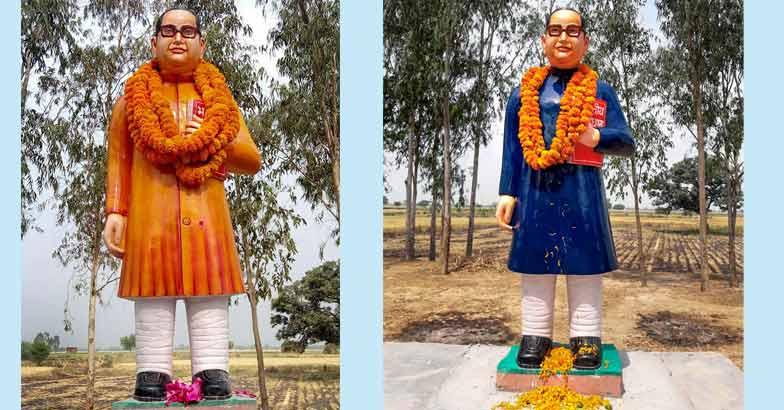
(Image Source: OnManorama, 2018)
The resilience of his legacy is exemplified in his reimagining as a leader speaking from and to the margins, alone as a universal icon—familiar, yet a little too enigmatic to be contained within the complex identitarian categories of Indian politics. His greatest offering to the Indian nation—the Constitution—has stood the test of time and continues to evolve as a document. In more recent times, the political symbolism of the Indian Constitution, used to pose an effective counter-narrative to the Hindu right-wing forces, has sacredly tethered the unbridled potential of an ‘idea of India’ with a collective political action that revitalises newer formations of ‘the people’. Ironically enough, in times of constant misuse and abuse of the Constitution, instead of burning it—as Ambedkar would have had it—the document has garnered a mystical power of its own. Preamble reading and public demonstrations of the Constitution have assumed a new performative meaning that ritualises the spirit of solidarity among sections of the population, bringing them together to achieve a common good. The Constitution has become, as Ambedkar believed, ‘a vehicle of life’ and a ‘spirit’ of this age. However, as this decade has witnessed the systematic decimation of the Nehruvian state and its ideological sway, it is imperative to ask: How did we get here? How did one of the largest democracies in the world slip into the abyss of majoritarianism? Were there predispositions for such authoritarian tendencies present since the inception of India’s democracy?
Growing Hindu majoritarian sentiments are a major blow to caste discourse, which is deliberately erased to propagate the political rhetoric of ‘Hindu unity’. Moreover, caste-based regional parties are struggling to counter the offensive march of the Bharatiya Janata Party—a party committed to the Hindutva ideology that refurbishes caste hierarchies, yet also claims to have done the most for the upliftment of Dalits and worships Ambedkar.
The Hindu right-wing does not merely aim to win elections; rather, it seeks to transform Indian society and culture into its own vision of a nation. The current life of Indian democracy is marked by a resurgence of communal registers of politics, indicating a disenchantment with secularism. Questions of caste and reform have either been swept under the carpet in the name of Hindu unity or face attacks on welfare politics itself. The fate of democracy is such that the government skirts around any deliberation on deepening socio-economic inequalities and has coercively crushed any democratic movements by marginalised groups. It is also true, however, that the latter have also failed to sustain inter-group solidarity to pose an effective counter-movement to the Hindu right. Thus, in the face of already decaying institutions and the declining health of the body politic, how do we reimagine and recalibrate the political imagination of the nation?
In a desperate search for political alternatives and a sustainable way out of the current political conundrum, this paper turns to Ambedkar’s insightful understanding of Indian society and politics. This paper recalls Ambedkar’s warning at the altar of India’s independence for the purpose of addressing the contradictions of democracy today:
“On the 26th of January 1950, we are going to enter into a life of contradictions. In politics we will have equality, and in social and economic life we will have inequality. In politics we will be recognizing the principle of one man one vote and one vote one value. In our social and economic life, we shall, by reason of our social and economic structure, continue to deny the principle of one man one value… How long shall we continue to live this life of contradictions? How long shall we continue to deny equality in our social and economic life?If we continue to deny it for long, we will do so only by putting our political democracy in peril. We must remove this contradiction at the earliest possible moment or else those who suffer from inequality will blow up the structure of political democracy which this Assembly has so laboriously built up.” – (Dr B.R Ambedkar, Constitution Assembly, 26th January, 1950)
This paper aims to provide an Ambedkarite remedy to the contradictions of Indian democracy in three interrelated measures: (i) the intricate relationship between the social and political, (ii) the reconceptualisation of democracy as ‘associated living’ as opposed to its conception as the rule of the majority, and (iii) communal questions and the ‘de-binarising’ the Hindu-Muslim debate. The paper puts forth two preliminary arguments for discussion. First, the surge of the Hindu right is not a ‘break’ from liberal democracy as usual; rather, it is only an aggressive byproduct of a troubled relationship between the social and political. Second, the Hindu-Muslim ordering of Indian secularism since the Partition and the contemporary hardening of the binaries obfuscates the socio-political realities of Indian society and politics. This paper problematises the stand of both liberal and right-wing political imaginations of Indian history as that of religious strife and contention. It revisits Ambedkar’s prominent works, particularly Annihilation of Caste, Pakistan or the Partition of India, and some of his other works and speeches.
Lastly, the urgency of writing this paper stems from a gnawing awareness of the appropriation of Ambedkar by the Hindu right in repurposing his anti-caste vision, devoid of its radical content, to articulate their Hindutva ideology. This essay comes as a wake-up call to the progressive camps regarding the Right’s absorption of Ambedkar into their ‘Hindu pantheon’, albeit it seems contradictory given the icon’s popular reputation as a critic of the Brahmanical order. However, one can no longer afford to be deluded by the seductive appeals of the Right, or we might not stand a chance to retain Ambedkar’s quintessential vision for action. This paper is divided into two parts: the first part by Aneri Vora is titled “Interweaving the Social and the Political: Ambedkar’s Compelling Vision for Socio-Political Emancipation.” The second essay by Sanjana, titled “Revisiting Ambedkar in the Times of Crisis: Rescuing Indian Democracy from the Hindu Right,” highlights Ambedkar’s views on the communal question and hinges the Hindu-Muslim relationship on caste. It argues that the Hindutva movement—and the counter to it—has phased out caste concerns. This paper makes a case for caste-inclusive transformative politics through an earnest acknowledgment of intersectionalities while forming solidarities. This will facilitate common goals and build trust, thereby creating spaces for mutuality and alliances in a deeply fractured society.
This two-part essay is a poignant ode to the everyday struggles of Dalits, Muslims, and women who have remained at the margins of democratic discourse that has been occupied by a handful of political elites, then and now.
I
The Contradictions between the Social and the Political: Locating Ambedkar between Tradition and Modernity
An important factor behind the rise and popularity of right-wing politics in India is its recognition of the importance that culture, folk idioms, and everyday practices—including moral and ethical codes of conduct based on them—hold in the self-understanding and perceptions of the electorate (Gudavarthy, 2023). The BJP draws its ideological moorings and narrative power from its overarching goal of consolidating and strengthening Hindu religion and culture, which would form the basis of the Indian nation-state. This is foremost a social project, as cultivating a Hindutva identity involves homogenising and foregrounding certain Hindu rituals and socio-cultural practices (viz. the BJP’s temple politics, emphasis on a glorious Hindu past and a golden age of Hindu history, valorising indigenous i.e. Hindu traditions and knowledge, tapping into popular sentiments of ‘pseudo-secularism’ and the ‘Muslim threat’, among others).
The BJP and its allied organisations thus prioritise the social over the political, where the state and its agencies are subservient to the larger ideological goal of securing an ethno-religiously homogeneous Hindu nation and society. The state, then, is merely a means to facilitate the societal and cultural transformation required by the Hindutva project. In line with this, the right wing has had a long history of grassroots organising and mobilisation, including civil society and non-governmental organisations that spread its message of unity (cultural, religious, and political), pride, martial discipline, and a strong sense of belonging (Andersen and Damle, 2019). This emphasis on the social over the political is unlike that of the centrist and left parties, whose orientation and leadership in recent decades have largely been top-down and elitist, which has been an important factor in their inability to capture political imagination or offer a viable political alternative.
This divide between the social and the political is also evident among the leaders of post-independent India, where leaders of the Left and Congress focused their energies on the state and its laws and institutions as the main foci of social change. Thus, not only was Nehru preoccupied with the question of how to bridge the gap between his elite social location and the lifeworld of the masses, his faith in science, technology and modernisation also led him to believe that caste, religion, and gender-based issues would be resolved through top-down modernisation and state-led policies (Parekh, 1991; Bilgrami, 1998). Similarly, the Left’s economic determinism, discomfort with socio-cultural and religious questions, and the elite locations of many of their top leaders led to a neglect of the social.
Apart from the Hindutva movement, whose emphasis on culture and tradition was largely exclusionary and status quoist, Gandhi was among the few who recognised the importance of speaking in the popular idiom and crafting a politics that draws from cultural and folk elements, using the same for his emancipatory project. However, his politico-economic programme of a polity based on autonomous villages with local self-government, economic self-sufficiency, and opposition to large-scale industrialisation was largely seen to be unviable and impractical in a world where growth and development had become synonymous with modernisation and industrialisation. While Gandhi’s programme was indeed a radical philosophical critique and rejection of the pathologies of Western civilisation, Indian leaders had much more immediate and practical concerns such as poverty alleviation, provision of basic social services such as food, housing, education and healthcare, and the development of agriculture and industry to ensure self-sufficiency in food and industrial production, among other things. Not only was economic growth and development important to achieve these aims, India also had to take its place in a world where modernity and industrialisation had become a way of life and the norm of governance, leading to a reorganisation of the international economy and the international politics of aid—especially at a time when India had been ravaged by systematic loot, deindustrialisation, pauperisation, and impoverishment due to colonial misgovernance and policies.
Gandhi’s socio-cultural project, on the other hand, while drawing on a capacious and creative reinterpretation of Hinduism and ethical self-transformation through Swaraj, Ahimsa and self-suffering, also emphasised the importance of communal harmony and religious tolerance as deeply embedded in the socio-historical fabric of India. Despite this, his vision did not outline a programme for structural criticism and change, where a radical and revolutionary praxis could attack and alter existing inequalities based on caste, gender, religion, region, and sexuality. Gandhi’s ambiguity regarding the Chaturvarna system has led to fierce debates among scholars (Dalton, 1995; Pantham, 1983; & Biswas, 2018), and his emphasis on ‘virtuous womanhood’ (Binu, 2023) shows how his vision retained elements of conservatism, falling short of radical socio-political transformation.
The discussion so far indicates a fundamental tension between programmes that draw from popular morality and cultural idioms on the one hand, and those advocating for a radical praxis for the liberation of the vulnerable and historically underrepresented groups on the other. While the former are able to better connect with the masses, they often fall prey to varying degrees of conservatism; while the latter, although conducive to modernity with an emphasis on equality and dignity for all, envisage a top-down process of change and transformation, where the masses obediently follow in the footsteps of the enlightened elite. In this context, Dr Ambedkar’s socio-political philosophy emerges as an attractive alternative.
A firm believer in the values underlying modernity and the Enlightenment, Ambedkar placed a premium on the latter’s motto of liberty, equality and fraternity. In his lifelong crusade against the rigidly hierarchical caste system and fierce criticism of ubiquitous caste-based discrimination, Ambedkar argued for the importance of cultivating the ability to think rationally and critically for oneself. Having experienced caste-based discrimination himself, Ambedkar recognised the necessity of overthrowing exploitative social structures and radically reinventing practices, customs and ways of living that oppressed individuals and groups based on ascriptive identity markers like caste, gender, religion and class. Recognising how caste-based hierarchies and practices of untouchability (among other oppressive structures and practices) gain legitimacy and permanence in the name of religious dictates and cultural pride deriving from tradition—such as sacred religious books and scriptures—Ambedkar presciently forewarned us of the dangers of blind obedience and deference to authority. For caste Hindus, rational and critical thinking would lead to a recognition not simply of the futility and irrationality of the caste system, but also of the grave moral injustice and ethical injury that the caste system represents. The existence of caste not only exposes as farcical the claims to superiority and glory of Indian civilisation and tradition but also calls for an absolute and radical ‘reconstruction’ of Hinduism where the caste system is destroyed in its entirety. Ambedkar became increasingly doubtful of the possibility of dislodging the Chaturvarna system as one of the central tenets of Hinduism, eventually converting to Buddhism on 14th October 1956.
The lower castes and Dalits, on the other hand, needed to recognise their self-worth, self-respect and dignity, boldly raise their voices against caste-based discrimination and unite in their struggle in demanding recognition of their personhood, equal human rights and opportunities, equitable material redistribution, and redressal of the sub-human treatment meted out to them for centuries. The highly popular slogan ‘Educate, Agitate and Organise’ embodies the importance Ambedkar placed on Western education and on cultivating a rational, modern outlook for the Dalits to reclaim their rightful place in Indian society and the dynamic, modern world beyond. As a national icon, Ambedkar is often represented in his trademark three-piece blue suit, armed with a book in hand. In the commonly practised politics of symbolic representation, images of iconic national leaders—through their content, source and mode of representation—come to represent competing ideas of the nation, national belonging and community, signify attempts at appropriation, and serve as important tools in struggles for meaning-making and power. In this context, Ambedkar’s representation in a blue suit, book in hand, which has been circulated, used and popularised by the Dalit community, serves as a “symbol of aspiration and striving” for the community (Kumar, 2017), based on a modern sensibility.
Given his emphasis on reason, rights, individual dignity, self-determination and autonomy, Ambedkar recognised the importance of formal law and constitutional safeguards in institutionalising and realising these normative ethical ideals in reality. Apart from his seminal contributions as the Chairman of the Drafting Committee and the first Law Minister of the country, Ambedkar was also a proponent of parliamentary democracy, contesting a national election and a by-election in 1952 and 1954 respectively, as a candidate from the Scheduled Caste Federation (a political party he founded). However, despite being a national leader, a high-ranking minister and a revered figure of socio-political emancipation, Ambedkar was never able to win an election. Thus, despite attaining high-ranking political positions and stature, Ambedkar was unable to secure broad social support for his project of a systematic and structural critique of caste Hindu society and the establishment of an open, casteless society in its wake. Similarly, despite attaining multiple higher education degrees from elite institutions abroad, Ambedkar had trouble finding housing upon his return to India.
This contradiction between the social and the political, between cultural norms and formal institutions, was a contradiction that Ambedkar had to grapple with throughout his life. Perhaps this was also the reason why Ambedkar was acutely aware that political change cannot occur without social change, and that social reform was perhaps more, if not as, important as political reform. His awareness of the importance of addressing cultural and religious practices, rituals and traditions is perhaps nowhere more evident than in his book The Annihilation of Caste. Originally meant as a speech to be delivered at the Jat-Pat Todak Mandal (a radical wing of the Arya Samaj), Ambedkar was eventually forced to self-publish 1,500 copies of this speech.
Notwithstanding the iconic status it has since attained, the most important aspects of the speech for our purposes are Ambedkar’s recognition of how the social realm has been ignored in favour of the political, and his emphasis on the indispensability of radical social and religious change, without which deep-rooted emancipatory possibilities cannot be realised. The speech initially begins with a note on the battle between the social and political organisations of the Indian National Congress, which, as Ambedkar notes, the social wing decisively lost. Ambedkar argues that the social wing lost because they mainly focused on reforms within the high-caste Hindu family, rather than advocating for the abolition of the caste system itself. To quote Ambedkar:
“It also helps us to understand how limited was the victory which the ‘political reform party’ obtained over the ‘social reform party’… that political reform cannot with impunity take precedence over social reform in the sense of the reconstruction of society, is a thesis which I am sure cannot be controverted” (Ambedkar 1936, sec. 2.16).
Ambedkar notes further:
“To sum up, let political reformers turn in any direction they like, they will find that in the making of a constitution, they cannot ignore the problem arising out of the prevailing social order” (Ambedkar 1936, sec. 2.16).
This keen awareness of the intricate relationship between the social and the political, and their repercussions in democratic life, makes Ambedkar truly unique. The caste question not only found considerable space in his political thought, but it was also complemented with a political programme.
Interweaving the Social and the Political: Ambedkar’s Compelling Vision for Socio-political Emancipation
Contesting the materialism and class primacy of Marxists and socialists, Ambedkar argues that it is religion that touches the human soul most deeply and motivates human behaviour (Ambedkar 1936). In a caste-riddled society like ours, a proletarian revolution will not abolish the caste system. Criticizing the views of those who argue that caste allows for economic efficiency or racial purity, Ambedkar notes that caste has only served to weaken and divide Hindu society. In fact, he argues that “Hindu society is a myth” (Ambedkar 1936, sec. 6.2), consisting “only (of) a collection of castes” (Ambedkar 1936, sec. 6.2). Outlining his own conception of an ideal society, he argues that mere similarity of customs, habits, beliefs and thoughts do not constitute a society. Static and closed societies where groups simply copy each other cannot be a nation/society in the true sense. As Ambedkar notes,“Men constitute a society when they possess things in common,” which is different from “having things in common” (Ambedkar 1936, sec. 6.6). The former, Ambedkar’s desired society, is a dynamic and open society where men come to possess things in common through active and constant communication. Men must “share and participate in a common activity, so that the same emotions are aroused in him that animate others” (Ambedkar 1936, sec. 6.7). This, Ambedkar refers to as the “associational mode of living”, where communities are marked by a spirit of solidarity and belonging that derives from regarding every member as an equal and as partners in a shared destiny. “Making the individual a sharer or partner in the associated activity, so that he feels its success as his success, its failure as his failure, is the real thing that binds men and makes a society of them” (Ambedkar 1936, sec. 6.7). While other communities such as the Sikhs, Muslims and Christians share such associational modes of living, the caste system prevents Hindus from doing so. The point here is not that each religious or ethnic group should have their own modes of associational living; Ambedkar rather wants to recover the impulse towards acknowledging the radical equality inherent in each individual that these religious groups recognise, which in turn serves as the glue that binds society together in a spirit of brotherhood.
For Ambedkar, there is a close connection between the society and the nation, and he often uses them synonymously. Both require an associated mode of living, based on a sense of belonging cultivated on values of equality, brotherhood and love, which a stratified caste-based society is unable to foster. Ambedkar’s conceptions of nation and society are then tied to his conception of the polity, which is far deeper than an emphasis on parliamentary democracy and human rights. It consists of what Scott Stroud has described as a pragmatic conception of democracy (Stroud, 2023a). This is a dynamic and vibrant conception of democracy where each of us puts forth our views and defends our conceptions of the good, while also remaining open to those we disagree with. Liberty, equality and fraternity for Ambedkar served as semi-transcendent ideals (Stroud, 2023b) that are neither metaphysical commands nor timeless natural rules, nor are they entirely relative, arising wholly from our community and social practices—lying somewhere in between instead. Each of these values represents separate and sometimes complementary, sometimes conflicting ideals that we fine-tune and try to bring into balance through a community based on equality and open communication with each other.
Such a society “should be mobile, should be full of channels for conveying a change taking place in one part to other parts… There should be varied and free points of contact with other modes of association. In other words, there must be social endosmosis. This is fraternity, which is only another name for democracy. Democracy is not merely a form of government. It is primarily a mode of associated living, of conjoint communicated experience” (Ambedkar 1936, sec. 14.2).
As we shall see in the second part of this article, the right wing has often used Ambedkar’s arguments on the communal question and his views on the caste system as an impediment to socio-political unity, to appropriate his thought. In arguing for the abolition of the caste system, Ambedkar often emphasised how the fragmentation and division of Hindu society along caste lines prevented a consolidated Hindu society and nation from emerging. Savarkar’s anti-caste crusade and Ambedkar’s appreciation of the former have also been used to appropriate Ambedkar. However, not only did Savarkar, as president of the Hindu Mahasabha, ensure that his anti-caste activism remained strictly separate from the Mahasabha, Ambedkar’s criticism of Savarkar for his advocacy of retaining a modified Chaturvarna system is also conveniently ignored (Islam, 2023). Ambedkar was also against the creation of a nation-state based on religious and cultural majoritarianism, advocating instead for a polity grounded in an open, dynamic and participatory society.
Moreover, in presenting him as an advocate of a homogeneous majoritarian ethno-cultural conception of nationalism, they inevitably erase the fundamental tensions between Ambedkar and the then Hindu right wing. This tension is manifest in the Jat-Pat Todak Samaj’s revocation of the invitation it had extended to Ambedkar since the latter’s speech “called for a complete annihilation of Hindu religion, doubted the morality of the sacred book of the Hindus as well as hinted at Ambedkar’s intention to leave the Hindu fold” (Gautam, 2022). After Ambedkar’s refusal to even “alter a comma” (Gautam, 2022), the Mandal withdrew its invitation.
Ambedkar’s scathing critique of Brahminical Hinduism has always been a point of tension between him and the right, which the latter refuses to acknowledge. After systematically decimating all arguments that advocate for a continued or reformed existence of the Chaturvarna, Ambedkar locates its source in the fact that caste is regarded as a sacred tenet among Hindus, which he locates in the Shastras. To quote Ambedkar, apart from inter-dining and inter-marriage, “The real remedy is to destroy the belief in the sanctity of the shastras” (Ambedkar 1936, sec.20.9). Ambedkar also criticised the institution of priesthood, calling for a radical change in the way priesthood as a profession is organised, making it democratic and meritocratic. Ultimately, it is the Brahmins who must give up their caste privileges, given that they are the vanguards of political and economic reform. However, Ambedkar does not see either the secular or the religious Brahmin leading a movement that destroys their power and privilege.
Ambedkar ultimately came to the realisation that the destruction of the caste system required stepping outside the Hindu fold and converting to Buddhism, a decision he made after carefully scrutinising other religious teachings for more than a decade. Contrary to the right wing’s assertion that Ambedkar chose Buddhism due to its affinity to Hinduism, Ambedkar recognised instead the importance of speaking to the people in their language, of framing his emancipatory project in terms they could comprehend and connect with. Buddhism, with its origins and initial growth in the Indian subcontinent, was suited to do so. More importantly, as Christopher Queen has noted, Ambedkar saw Buddhism as the religion that “met his complex requirements of reason, morality and justice” (Roychowdhury, 2017). He interpreted Buddhism as meeting “one of the most basic requirements of modernity – the exercise of individual choice, based on reason and historical consciousness” (Roychowdhury, 2017).
Ambedkar’s conversion to Buddhism highlights his awareness of the power of religion in defining our worldviews and self-conceptions, and therefore the importance of tapping into the social. While being a firm believer in the values underlying the Enlightenment and modernity, Ambedkar was an equally firm critic of British colonialism and imperialism, while also recognising the importance of ensuring that his discourse resonates with the everyday understanding of the masses. His Buddha and His Dhamma, argue Rathore and Verma (Ambedkar 2012), represents an ingenious attempt to develop a political theology that serves as a liberatory philosophy and practice for oppressed groups, grounded in ethics and morality based on universal respect, equality and compassion. They quote Bellwinkel and Schempp (2004), who argue, “Dr Ambedkar was, through the example of Hinduism and the caste system, painfully aware of the entanglement of religion and society; therefore, he intended to reconstruct Buddhism not only as a religion for the untouchables but as a humanist and social religion, which combined scientific understanding with universal truth” (Bellwinkel and Schempp, 2004, in Rathore and Verma, 2012, p. 15). Apart from reinterpreting Liberty, Equality and Fraternity through a Buddhist lens, The Buddha and His Dhamma also includes a host of ethico-political concepts that serve as the basis for a community based on radical equality, freedom and solidarity. Among other virtues such as sila, which means fear of doing wrong, khanti, which is forbearance, and karuna, which implies “loving kindness to human beings”, Ambedkar also includes maitri, which signifies “extending fellow feeling to all beings, not only to one who is a friend, but also to one who is a foe; not only to man, but to all living beings” (Ambedkar 2012, p. 78). Scholars such as Chandan Gowda and Aishwary Kumar have shown how the ideal of maitri exceeds current meanings of friendship, love, compassion and belonging. As Kumar notes, a defining feature of maitri is refusing the “foundational distinction between friend and foe” (Kumar 2013). It alludes neither to friendship nor fraternity but to “adoration, an immeasurable gift of belief and compassion across the abyss of difference” that we extend even to our enemies (Kumar 2013).
Chandan Gowda (2023) notes how maitri can serve as a powerful basis for social and political community, as an unconditional extension of mutual respect, acknowledgement and a sense of camaraderie to all without fail. This extension of fellow-feeling to all sentient beings—be it the king or the bandit, the human or the animal—is a logical extension of Ambedkar’s attempt to ground democracy and society on the basis of a radical conception of equality, which recognises the unconditional value and dignity of life itself. This then ties into Ambedkar’s emphasis on maitri as a life-giving force in contrast to modern conceptions of sovereignty, which regard the modern state’s most important feature as its power to punish, its monopoly on legitimate force and violence, and to take human life.
Quoting Ambedkar, Gowda (2023) notes: “Could anything other than maitri, he (Ambedkar) asks, ‘give to all living beings the same happiness which one seeks for one’s own self, to keep the mind impartial, open to all, with affection for everyone and hatred for none?’” As Gowda (2023) further points out, in his posthumous work Riddles of Hinduism, Ambedkar comes to ground the concepts of liberty, equality and fraternity in the Buddhist religion, and liberty and equality were sustained not by law but by fellow-feeling. This fellow-feeling was now represented not by fraternity but by maitri. “Departing from a human-centred idea of community, maitri gestures to the sentient world at large and fosters an expansive political consciousness where nation, religion, race, caste, gender and language, among other sources of social identity, do not come in the way of experiencing community life freely and vastly. The male-centred image of brotherhood implied by fraternity also makes way for a wider sense of solidarity encompassing human as well as non-human life” (Gowda 2023).
Ambedkar’s larger politico-theological project is summed up in the following quote: “Positively, my social philosophy may be said to be enshrined in three words: liberty, equality and fraternity. Let no one, however, say that I have borrowed my philosophy from the French Revolution. I have not. My philosophy has roots in religion and not in political science. I have derived them from the teachings of my master, the Buddha… Law is secular, which anybody may break, while fraternity or religion is sacred, which everybody must respect.” (Ambedkar, 1954, as quoted by Gowda, 2023).
As Ambedkar emphasised in his idea of associational living, a stratified and static society, where culture and traditions are simply diffused from one group to another, cannot be said to constitute a nation or a community. This rigidity and immobility can only be maintained through force and violence, or through a dogmatic belief in religious laws, as the caste Hindu society shows. Ambedkar’s democratic conception of society and state – which emphasises the importance of pursuing an activity in common, where every individual has the right to participate and constitute this ‘common’ – is only possible when citizens cultivate the ethic of maitri, of mutual respect and adoration across all arbitrary divisions.
Not only does Ambedkar often use ‘nation’ and ‘society’ interchangeably, he also posits an inextricable link between democracy and society by arguing that they be grounded in the twin concepts of associated living and maitri. Maitri, with its universal orientation, enables human loyalty and affiliation to extend not just to one’s own group or nation but to the world at large. At the same time, in grounding the concept in his reformulated Buddhist ethics, Ambedkar also urges us to practise maitri both locally and nationally. This, combined with a vision of a dynamic, open and mobile society whose members are in constant conversation with each other, provides resources to develop thicker, local conceptions of the community and polity based on the indigenously reinterpreted principles of liberty, equality and fraternity rooted in the norms and ethics of the Indian masses.
Thus, Ambedkar’s emphasis on the mutual constitution of the social and political, and his politico-theological project of developing an emancipatory conception of the polity and society derived from the everyday ethical understandings of the Indian people, serve as an extremely important alternative to hegemonic conceptions of community, belonging and politics today.
Tapping into the long-neglected aspect of transforming society by speaking to the people in their own language, the right has managed to drum up popular support for its conservative and exclusionary idea of the nation, as we will see in the second part. In this context, Ambedkar’s emancipatory conceptions of the nation and the community, focusing on social change while resonating with cultural idioms, require the urgent attention of progressive camps today.
Although an incisive critic of the leftists, liberals and the socialists for their hypocrisy in espousing a radical praxis while maintaining the status quo (as their organisations were dominated by caste Hindu elites), Ambedkar lived by his principle of engaging in conversation and debate to create an emancipatory society in common. The Annihilation of Caste was meant primarily for progressive, upper-caste Hindus to recognise how deep the rot of casteism ran within Indian society. Questioning and criticising the left for its belief that social change would be led mainly by workers defending their class interests, Ambedkar said: “However, what I would like to ask the socialists is this: Can you have economic reform without first bringing about a reform of the social order?” (Ambedkar 1936, sec. 3.8) “Will the proletariat of India combine to bring about this revolution? What will move men to such an action? It seems to me that, other things being equal, the only thing that will move one man to take such an action is the feeling that other men with whom he is acting are actuated by feelings of equality and fraternity and – above all – of justice… The assurance (of change) must be the assurance proceeding from a much deeper foundation — namely, the mental attitude of the compatriots towards one another in their spirit of personal equality and fraternity” (Ambedkar 1936, sec. 3.10, 3.11). It is time to bring Ambedkar’s social and political vision from the margins to the center.
Bibliography:
Ambedkar, B. R. (2014). Annihilation of Caste: The Annotated Critical Edition. Verso Books. (Original work published 1936)
Ambedkar, B. R. (with Rathore, A. S., & Verma, A.) (2012). B. R. Ambedkar: The Buddha and His Dhamma: A Critical Edition. Oxford University Press. (Original work published 1956)
Andersen, W., & Damle, S. (2019). The Brotherhood in Saffron: The Rashtriya Swayamsevak Sangh and Hindu Revivalism. Penguin Random House India.
Binu, D. (2022). Gandhi: A Flawed Feminist? The Telegraph Online. https://www.telegraphindia.com/opinion/mahatma-gandhi-a-flawed-feminist-confined-by-patriarchy-and-the-purdah-system/cid/1974869#goog_rewarded
Bilgrami, A. (1998). Nehruvian Modernity and its Contradictions. Economic and Political Weekly, 33(12), pp. 2168-2172.
Biswas, S. (2018).Gandhi’s Approach to Caste and Untouchability : A Reappraisal. Social Scientist, 46(9-10), pp. 71-90.
Dalton, D. (1995). Mahatma Gandhi: Non Violent Power in Action. Columbia University Press.
Gautam, P. (2022). Why Ambedkar Converted to Buddhism. Outlook Magazine. https://www.outlookindia.com/national/why-ambedkar-converted-to-buddhism-news-191616
Gowda, C. (2023). Ambedkar’s Ideal of Maitri. The Outlook Magazine. https://www.outlookindia.com/national/ambedkar-s-ideal-of-maitri-magazine-309546
Gudavarthy, A. (2023). Politics, Ethics and Emotions in ‘New India.’ Routledge.
Islam, S. (2022). Truth about Savarkar and Caste. Indian Express. https://indianexpress.com/article/opinion/columns/truth-about-savarkar-and-caste-7832134/
Kumar, S. (2017). Did Ambedkar want Dalits to wear three-piece suits? A clothing label raises some sartorial questions. Scroll.in. https://scroll.in/magazine/840199/did-ambedkar-want-dalits-to-wear-three-piece-suits-a-clothing-label-raises-some-sartorial-questions
Pantham, T. (1983). Thinking with Mahatma Gandhi: Beyond Liberal Democracy. Political Theory, 11(2), pp. 165-188.
Parekh, B. (1991). Nehru and the National Philosophy of India. Economic and Political Weekly, 26(1/2), pp.35-48.
Roychowdhury, A. (2017). Three reasons why Ambedkar embraced Buddhism. The Indian Express. https://indianexpress.com/article/research/buddha-purnima-special-three-reasons-why-ambedkar-embraced-buddhism-4649990/
Stroud, S. (2023a). The Evolution of Pragmatism In India: Ambedkar, Dewey and the Rhetoric of Reconstruction. The University of Chicago Press.
Stroud, S (2023b). Bhimrao Ambedkar as Theorist of Democracy. The Loop: European Consortium of Political Research’s Political Science Blog. https://theloop.ecpr.eu/bhimrao-ambedkar-as-theorist-of-democracy/
Between Blue and Saffron: Revisiting Ambedkar and the contradictions of Indian democracy today-II
A couple of years ago, in the month of April 2018, a statue of Bhimrao Ramji Ambedkar, one of the founding fathers of India’s constitutional democracy, was vandalised in a village, Badaun, in Uttar Pradesh. The statue was reinstated the following week and painted in saffron. This was unusual, as Ambedkar is usually associated with the colour blue or sometimes black. After public outrage, a Bahujan Samajwadi Party worker repainted it blue. The makeover of Ambedkar from blue to saffron to blue is representative of the tussle over his iconography. Dr B. R. Ambedkar, in recent months, has saturated the Indian political imagination in the most interesting ways, pulling him in varied directions—left, right, and centre. Babasaheb’s ideas and thoughts continue to be revisited as different political groups claim him for their own ideological purposes. While one hails him as the messiah of Dalits and the father of the Indian Constitution, the other positions him as a faithful patriot to the nation. Ambedkar today stands between blue and saffron.
(Image Source: OnManorama, 2018)
Part II: Revisiting Ambedkar in the times of crisis: Rescuing Indian Democracy from the Hindu Right
By Sanjana K.S.
The previous part of the paper underlined two themes in Ambedkar’s political thought: the intertwinement of the social and the political and the value of associational living through the Buddhist concept of maitri. Ambedkar understood the role of the state in empowering the deprived sections of the society for which the social had to be prioritised along with political development. Ambedkar’s deeply pragmatic and philosophical approach was rooted in his lived experience as a Dalit. He understood that the social in India had to be regulated by a modern democratic state that nurtured liberty, equality and fraternity as core values. Democracy was antithetical to the inequalities codified by the caste system. Hence, the modern state was to act as a tool of social justice and annihilate caste through law, policies and welfare. Thus, the foundations of the modern Indian state were closely tied to his critique of the Hindu social order itself.
The long march of Hindutva aims to threaten this very foundation of the nation envisioned by Ambedkar. He pronounced the superiority of constitutional authority to resist the tyranny of majoritarianism. The Hindu right has perverted the meaning of democracy as simply a rule of the majority, stripping democracy of its substantive meanings. It has not forsaken the democratic structure for its pursuit of a Hindu nation, instead persistently demoted the core political values of freedom of speech, and liberty as threats to national unity and sovereignty.
The peculiar political situation today has been such that the Hindu right has not only captured the political space but also regulated the social in its own vision of Hindu society. Unlike the left-liberal political organisations in India, the right-wing has a unique advantage- it has a mass organisation Rashtriya SwayamSevak Sangh (RSS) that has spread like a ‘tentacular’ organisation mobilising every social group in India (Ahmad, 2020; Jaffrelot, 2005). Another peculiarity of the Hindu right is that it aspires not only to capture political power but also to bring about a social transformation of the entire society. The ‘Sangh Parivar’ describes itself as a cultural organisation with no relation to politics. However, it is no secret that the RSS benefits from the entrenchment of power in the hands of its political outfit, the BJP. The neglect of social space by the liberal-left by narrowly focusing on gaining political power alone, has festered a vicious attack of the social on the political. There is no contention that the Congress party has failed to proactively counter the right-wing. Perhaps, except Nehru, none of its leaders truly grasped the intentions of the RSS.
The BJP which subscribes to the ideology of Hindutva has no intentions of emancipating Indians of social hierarchies and prejudices. Its philosophy and conception of an organic society envisions preserving structures of authority that Ambedkar recognised as detrimental to society. Since 2014, the populist turn has deliberately put the caste question off the table. Any discussion of caste is seen as conspiratorial of anti-Hindu or anti-national forces that can jeopardize the fundamental unity on which the fragile veneer of the nation rests. The repercussions of this pan-Hindu identity include the creation of a broad alliance of caste groups under one banner of pan-Hindu identity. It also redirects political energies away from caste reform and welfare politics towards crude identitarian politics, resulting in a singularity of identity on religious terms, taming life and politics into a farcical, reductive binary of Hindus and Muslims. The right magnifies the existing social antagonisms to create a general distrust and animosity in society. The Hindu-Muslim binary is hardened to fuel a politics of fear where the majority Hindu community is made to be the victim at the behest of the Muslim minority. However, underneath the rhetoric of ‘Hindu unity’ lies a game of caste arithmetic. The Hindu right is aware of the impediment of caste in fracturing a sense of political unity of the majority. The numerical majority of the Hindus relies on the erasure of reality of the existence of several caste minorities that constitute this ‘majority’. The Hindu right presumes an essential unity of the Hindus as an existential necessity thereby, deliberately erasing the fundamental division of the society by caste. Though the Hindu right snubs the politicisation of caste, it has not shunned the instrumental use of caste politics itself.
The question then is, if the Hindu social order is, as Ambedkar had rightly pointed out, deeply fragmented on the basis of caste, how has the Hindu right overcome these basic contradictions in society? More importantly, has the rhetoric of Hindu unity resolved caste fissures in favour of the right-wing entirely? Though these questions are beyond the scope of this paper, it is pertinent to keep in mind the limitations caste politics is capable of putting on the Hindu right-wing, without glorifying their resistance to Hindutva politics as inherent in their politics.
The contention here is that narrow attention to the exclusion of religious minorities while ignoring the process of inclusion of caste minorities occludes any serious consideration of the right’s workings in both the social and political fields. The BJP is striving to bring different sections of caste groups under its sphere of influence by pursuing a cultural strategy. Culture bridges the disparate entities of the social and the political. The Right hammers the significance of culture in the sustenance of the idea of the Indian nation. There are three valuable points to be made here with respect to the Sangh’s ambiguous relationship with caste. The Hindu right does acknowledge the impediment of caste to Hindu unity, albeit it does not see the hierarchical structure and its harmful impact. However, what explains the appeal of such an ideology among the lower castes themselves? The answer cannot be explained by Srinivas’s ‘Sanskritisation’, there is more to it. First, the Hindu right speaks an emancipatory language of dignity and not liberation. Second, the political value of equality is reinterpreted as maintaining social harmony, which essentially allows hierarchies to exist without the possibility of emancipation from it. Samajik Samrasta or social harmony is one of the key tenets of RSS’s approach towards caste groups in India. Third, it stokes sentiments of caste pride as Hindu pride which is to suggest that one can celebrate their caste difference as long as they affirm their belonging within the Hindu-fold. Thus, the Hindu Right-wing is not only dictating the terms of inclusion of caste groups but also actively carving a new political subjectivity. For this, the right-wing uses cultural myths, local icons and festivals. Birsa Munda, among others, is resignified as a ‘Hindu’ warrior and local deities become avatars of Gods and Goddesses in the Hindu pantheon. In his work ‘Fascinating Hindutva’, Badri Narayan (2009) has detailed the mobilisation strategy of the RSS in reinterpreting Dalit’s Hindu past, unifying them under the metanarrative of Hindutva. What is remarkable is how the Right continues to communalise issues while also actively pursuing and accommodating caste groups. For decades, caste politics seemed to pose an effective counter to the hegemonic project of religious nationalism. Is there a synergetic relationship between caste and Hindutva politics today? Does the use of cultural strategies by both identity movements create a conducive interface for possible interactions? It is in the context of the mobilisation of Dalits by the BJP that Ambedkar’s appropriation must be seen.
The sudden admiration for Ambedkar by the BJP is a carefully crafted strategic move that aims to consolidate the lower caste behind it. The appropriation of Ambedkar’s legacy is a symbolic power move to commandeer Ambedkar’s image without its content (Tharoor, 2025). Ambedkar’s views on communal relations between Hindus and Muslims have often been overlooked. Interestingly, the most cited book of Ambedkar by the Hindu right is ‘Pakistan or the Partition of India’ written in 1945. The book offers rich insights into the nature of communal relations in India, but the Hindu right selectively quotes from the text and misappropriates Ambedkar for peddling its own communal narrative as will be discussed in the paper. The following sections of this paper argue that Ambedkar’s affordance to the centrality of caste in social explanation can facilitate a ‘de-binarisation’ of the Hindu-Muslim discourse, while also putting welfare goals and material development back on the agenda. Through the thematic exploration of Ambedkar’s way out of the communal deadlock, this essay underscores the need for political reimagination while simultaneously resisting distortions of Ambedkar by the Hindu right. The first section of the paper discusses the appropriation of Ambedkar. The second section dabbles with the possibilities for initiating a dialogue between Savarkar and Ambedkar’s ideas of nation and caste. The penultimate section presents Ambedkar’s alternative to the communal question.
- Saffronising Ambedkar ?
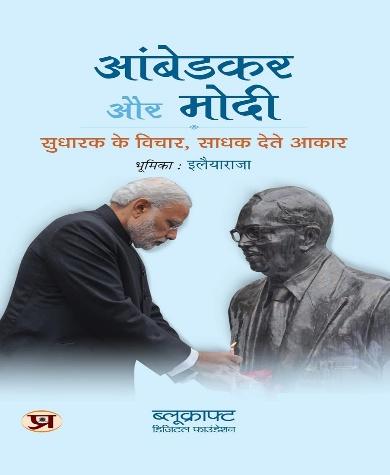
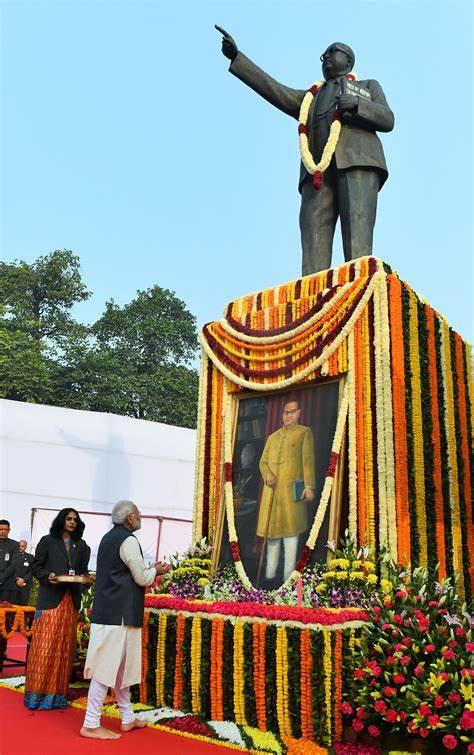
Image Source: Google Images
A few days ago, Narendra Modi claimed that a developed and inclusive Bharat would be a true tribute to Ambedkar. He has been high on Ambedkar’s symbolism and has claimed more than once that no party has honoured Ambedkar more than the BJP. A huge statue of Ambedkar has been built in Maharashtra and the Government is organising a ‘Panchteerth’ which identifies five ‘holy sites’ where Ambedkar spent the different phases of his life. One can shirk this away as a cheap political tactic but when one juxtaposes this against the visible political implications, the picture seems worrying. Traditionally, Dalits have not voted for the party. But in 2014, the BJP surpassed both the Congress and the Bahujan Samajwadi Party (BSP) by attracting a larger vote share (Verma, 2016). Moreover, the vacuum in Dalit leadership in other political parties, especially the Congress and the weakening of BSP politics has provided germane conditions for BJP’s penetration into the Dalit fold. Thus, the appropriation becomes essential, as the BJP aims to mobilise the cultural and political memory of Ambedkar that Dalits across communities and regions in India continue to hold dear, thereby, giving Ambedkar a new meaning as a ‘nationalist’, hailing him as a social reformer with the likes of Arya Samajists and Brahmo Samajists.
In 2015, in a seminar organised in New Delhi, Dr. Krishna Gopal (Former Jt. General Secretary of RSS) described Ambedkar in the following words: “Besides being a champion of the untouchables, Ambedkar was, first and foremost, a nationalist, a virulent anti-Communist and had immense faith in Hinduism; he was against Brahminical structures but some of his closest friends were from upper castes, while Brahmins provided him vital help at key moments in his life; he dismissed the historical theory of the Aryan invasion of the Indian subcontinent. Apparently, he also promised “shuddhikaran” or purification for those Dalits who had converted to Islam in Hyderabad state in 1947-48” (India Foundation, 2016).
A 2016 issue of ‘Organiser’, an RSS magazine, hailed Ambedkar as the “ultimate unifier” and a “timeless leader” who provided a “glue for nation building.” The magazine claimed that Ambedkar was not against Brahmins but against the Brahmanical order and “Babasaheb felt that pseudo-Dalit movements” are merely distorting history by capitalising on “lacuna in Hindu religion, provoking Dalits to agitate” (Organiser, 2016). The article further states that Ambedkar was closer to Vivekananda than any other nationalist leaders including Tilak and Gandhi, since he equally emphasised material and spiritual progress. Further, another article in this issue said that for Ambedkar, “the nation remained a top priority” and that he had “in his heart the image of Bharat Mata…”(Organiser, 2016). Apart from misquoting Ambedkar for having said that ‘Hindu culture’ is the basis of the unity of Bharat and taking his quotes out of context, the Hindu right has embraced Ambedkar as a patriot and nationalist who wanted social reform for a “small section of the society” (Organiser, 2016). It also claims that Ambedkar converted to Buddhism and not any other religion as it is closer to Hinduism than Islam or Christianity. Thus, Ambedkar never really wanted to leave the Hindu-fold. It is true that Ambedkar converted to Buddhism after much consideration and realised that all religions practice some form of caste discrimination. Buddhism on the other hand promoted equality, fraternity and self-development to all (Ambedkar 2003, BAWS, Vol 17, part III, 2003). In the ancient history of India, Buddhism posed an effective challenge to Brahminism which had divided the society into varnas. It introduced democracy and a socialist pattern in society. Savarkar took a diametrically opposite view of history. He asserted that Buddhism weakened Hindu military prowess with its emphasis on non-violence, making it vulnerable to foreign attacks and invasions. He blamed Buddhism for the political fragmentation which ultimately weakened Hindu society. Savarkar, nevertheless included Buddhism into the Hindu pantheon as an off-shoot of Hinduism. He saw the embrace of Buddhism by the Dalits, especially Ambedkar’s eventful conversion as a threat to Hindu unity.
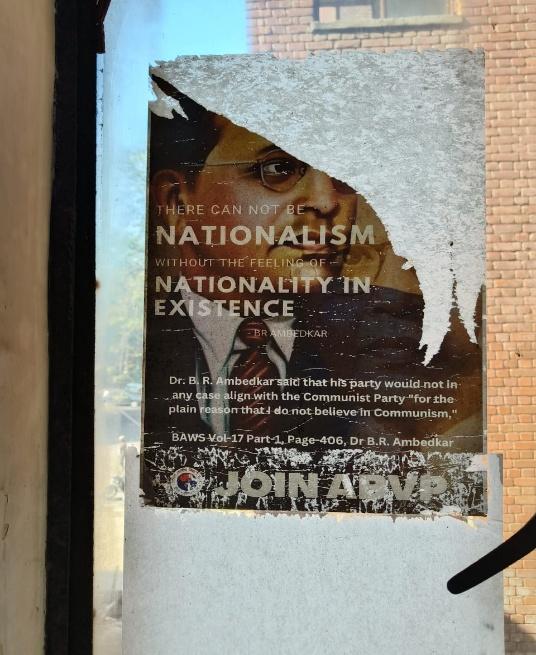
Image 1: Organiser’s April 2016 Special issue on Ambedkar
Image 2: An ABVP Poster in JNU (clicked by Sanjana)
- The Anti-heroes of the Twentieth Century India: Reading Savarkar and Ambedkar together
The two towering figures who continue to draw renewed fascination for right-wing/Hindu nationalists/BJP include Savarkar and Ambedkar. Though they both come from different social backgrounds, they both represented strong alternatives to the Indian nationalist movement led by Gandhi and Nehru. Their ideas did not have appeal with the masses initially, but were picked up later by their ‘devout’ followers. Both the ideas stood as a critique of the secular state, albeit on different ends of the political spectrum.
The RSS wove Ambedkar and Savarkar together in discourse as not friends, but as possessing ‘mutual admiration’ for each other. It is true that Ambedkar appreciated Savarkar for having clarity on communal questions, unlike the Congress who played the Muslims for ‘diplomacy’. Another interesting commonality between the two is Savarkar’s attack on caste discrimination and his half-baked anti-caste spirit. In his seminal biography of Savarkar, Chaturvedi (2024) notes that he participated in temple entry movements for Dalits and gave lectures on problems of untouchability. The district Magistrate of Ratnagiri in 1929 noted that Savarkar’s work could “create conflict and interfere with the work of Ambedkar in the region” (Chaturvedi 2024). Bakhle (2024) in her biography of Ambedkar, calls him a “heterodox brahmin” who was a devout nationalist but also anti-caste, while “constitutive contradiction was at the heart of Savarkar.” He differed from Arya Samajists and other Hindu revivalists who considered caste an essential feature of Hinduism. In advocating for a political Hindu unity tied to the idea of ethno-geographical conception of the Indian nation, Savarkar rejected Hinduism. He believed that Hinduism stood for dogmatic, ritualistic and traditional norms instead of Hindutva, which encapsulated the great history of Hindu people and nation better (Savarkar, 2021). Thus, “caste was regressive, ethnic nationalism was progressive” (Bakhle, 2024). Ambedkar also rejected Hinduism for its discriminatory nature and inherent caste system. He opted out of the Hindu fold entirely, while Savarkar wanted to retain the overall Hindu social structure, albeit sapped of its traditional hierarchical underpinnings including caste discrimination (Bakhle, 2024). Ambedkar’s project stood as a challenge to Savarkar’s program of constructing a pan-Hindu unity. Ambedkar claimed that the untouchables are not a subsection of the Hindus, that they are a separate and distinct element in the national life of India. The separation of untouchables from the Hindu pantheon was necessary for the upliftment of the untouchables (Ambedkar 2003, BAWS, Vol 17, Part III, pp. 248-83; Kumar and Jaffrelot, 2018).
This section, however, sees possible convergences only to diverge in radically different ways between the two of the most important thinkers of the 20th century. Caste and religion are the two important identities that have, since colonial times, dominated the discourse in Indian politics. Ambedkar is usually seen as a caste icon and Savarkar for his religious nationalism, but such a reductive reading of the two thinkers is futile. The conceptualisation of caste was central to both thinkers in not only how they defined collective identities, but also their entire political program that has continued to inspire two major mobilisations.
Ambedkar and Savarkar relied on history to redefine the understanding of their societies. Though the latter’s obsession with itihaas to create a common unified Hindu past bordered on fictional and often exaggerated accounts, he wasn’t concerned with the facts of history and freed himself from any such burden entirely. “Hindutva is not a word but history…Not only a spiritual or religious history…but history in full” (Savarkar, 2021). The past determined the course the future would take. Ambedkar, on the other hand, used history to bring to attention, how the Caste Hindus had institutionalised violence and systematically deprived the lower caste of basic resources. In his essay, “Castes in India: Their Mechanisms, Genesis and Development”(1917), he elucidates on the genesis of caste in the parcelling of a homogeneous cultural unity. He traces how the “artificial chopping of the population into fixed and definitive units” prevented different groups from intermixing, codifying social immobility. He further explains how through the “infection of imitation”, those on the lower level of caste hierarchy imbibed the practices of endogamy that tightened the hold of the caste system (Ambedkar, 1917). Savarkar’s obsession with history undermined the socio-political realities of Indian society that Ambedkar drew attention to, in the entirety of his catalogue. However, if caste were to stand as an impediment to a cohesive Hindu identity, Savarkar’s reinterpretation of caste assimilated the depressed classes by sacralising not the religious ‘Hindu’ identity per se as Gandhi did, but a cultural-territorial conception of a nation against the profanity of caste. The brotherhood among caste minorities was based not on common blood but on a shared history of exploitation of foreign rule, of recovering a lost glorious epoch within the geographical frontiers of ‘Bharat mata’ before the menace of caste broke the Hindu society into parcels. Thus, the loyalty of the ‘Hindus’ was not to their religion or traditions, but to the nation alone.
Savarkar demonstrated that the anuloma and pratiloma marriages had mixed the blood of different castes. He writes: “Some of us are Brahmans and some Namashudras or Panchamas…but Gauds or Saraswats, we are all Hindus and own a common blood” (Savarkar, 2021, p 91). He further adds that a “Hindu marrying a Hindu may lose his caste but not his Hindutva” (Savarkar, 2021, p 92). Savarkar understood how caste in principle kept Hindus from becoming a cohesive community as the other abrahamic religions and therefore, willed to proselytise Hinduism. This could not be done unless caste was dislodged but not dismantled as the authoritative principle guiding social and political union. He encouraged mixed marriages, though only between regions and not caste groups. He did not see the marriages between a Sudra and Brahmin as annihilating caste rather, devoted his energies to crafting a bond of unity between Hindus (Bakhle, 2024). Savarkar’s Hindu unity, unlike the European kind, did not focus on racial unity by blood; instead, it was the common cultural unity that formed the basis of a common Hindu identity (Bhatt, 2001). This allowed him to transcend the fixed divisions of caste. The feeling of oneness and of brotherhood could not be found in the Hindu religion which enabled caste divisions. Thus, since Hinduism had a lot of baggage, especially of caste, Savarkar differentiated Hinduism from Hindutva to make a case for a Hindu unity absolved of these fundamental problems. He held the view that the achievement of Hindu unity without eliminating caste hierarchies was futile. His precepts of Hindutva nevertheless retained the Brahmanical outlook but were modernist in spirit. His ambivalence towards caste proceeded from his fear of ‘the other’, especially the religious minorities who despite their marginal numbers, posed a grave threat to this presumed unity.
Ambedkar (1945) was clear that mixing religion with politics would prove disastrous for the survival of caste minorities if India were to be a democratic nation. He probes the sufficiency of these categories offered by Savarkar to deem India as a nation. First, Ambedkar takes up the social features of India that Savarkar mentions: race, language and culture. He argues that a Punjabi Brahmin will have more commonalities with a Punjabi Muslim than with a Maharashtrian Brahmin. He further notes that the commonalities between Hindus and Muslims are the result of certain ‘“purely mechanical causes”, and “they are partly due to incomplete conversions.” It is this ‘common environment’ that produces similar reactions and shared practices. By relying on certain common features like race, language and country, “the Hindu is mistaking what is accidental and superficial for what is essential and fundamental” (Ambedkar, 1945). Using Renan, one of the most important scholars on nation and nationalism, Ambedkar argues against the Savarkarite position that these three essentials are not sufficient to constitute a nation. What does then constitute a nation?
Ambedkar, like Savrakar and Nehru, tethered the idea of the unity of the nation to a territory but elevated its spiritual significance. The nation for Ambedkar was “a living soul, a spiritual principle” which includes the principle of common possession of the past, the rich heritage of memories and in the present, an active consent to live together (Ambedkar, 1945). Ambedkar used this definition of nation to ask Hindus and Muslims if they had something shared and common and wished to live together (Ambedkar, 1945). He adds however, that to have “suffered together” consolidates towards a “greater bond of union than joy.” If one takes into account the common historical antecedents between Hindus and Muslims to form a nation, the Hindu argument “falls to the ground” (Ambedkar, 1945). On the matter of Partition, he reaffirms his position that for a nation, a cultural territory is important, and if for the Muslims it is Pakistan then they have the right to form a nation. He then systematically reveals the contradictions in the Savarkarite position, which was also the Hindu organisation’s resolve on the partition of India. Ambedkar takes up three points of contention tabled by the Hindu Mahasabha, the President of which was Savarkar. He understands why the Hindus oppose partition as the partition of India would burst the idea that India has been a nation eternally. This would also harm the argument for a nation or an ‘akhand bharat’ idea that the right-wing professes. But then, Ambedkar asks if Hindus do not want Muslims to secede from India, why does Savarkar assert that Hindus and Muslims have nothing in common? Unity cannot be based on anything but the feeling of oneness. However, as history has told us, Hindus and Muslims do not have anything in common and no desire for unity, echoes Ambedkar. The second point of contention is that the weakness of the defence of India is a concern. How does having Muslims, who are presumably an internal enemy of India guarantee the security of the nation? The third point of difference asks Hindus whether, by not allowing the creation of Pakistan, the communal problem would be solved. Even with the creation of Pakistan, the communal problem in Hindustan would not be resolved.
Ambedkar makes his intentions on the state of Muslims in a post-partition India very clear: “While Pakistan can be made a homogenous state by redrawing its boundaries, Hindustan must remain a composite state” (Ambedkar, 1945 p. 104). He asks Savarkar straight-forwardly his intentions with non-Hindu minorities in his Hindu Raj. If swaraj for him bears the stamp of a Hindu Raj, by this logic, Muslims are a nation too. Savarkar and Jinnah are much closer in principle than apart. However, unlike Jinnah who believes that the non-Muslim minorities in the newly created Pakistan will live under the same constitution as the majority, Savarkar maintains a sinister silence. He maintains that Savarkar is “stripping Muslims of all the political privileges has secured so far”, thereby creating the most dangerous situation for the security of India. He writes, “Why Mr Savarkar, after sowing the seeds of enmity between the Hindu and the Muslim nations should want that they live together under one constitution and country is difficult to explain” (Ambedkar, 1945, p. 133).
Ambedkar was aware of Savarkar’s intentions and the repercussions of a Hindu supremacist ideology of nation. He made it plenty clear that Hindu nationalism had no place in India. The impossibility of aligning a deeply divided society into one homogenous Hindu whole troubled Ambedkar less than it does today to anybody living through these times. To revisit Ambedkar today is significant for two reasons: he did not see Hindus and Muslims as separate, instead believed they had much in common; the agenda of the untouchables was prioritised less over the idea of secularism, that the Muslim minority were the only ones in need of protection; and lastly, to question the idea of Hindu ‘majority’ itself.
- Ambedkar’s Alternative to the Communal Question
Despite India’s commitment to secularism since its political inception after a traumatic partition, communal contentions have failed to wane, and in the present, have acquired a vitriolic turn than ever before. At the time of severe communal clashes during the partition, thinkers addressed this situation. Nehru believed that economic issues would take precedence over communal issues as India focused its energies on development. Ambedkar, on the other hand, recognised early on that the communal question could not be remedied by economic solution alone; instead, it required cultural and even spiritual solutions. Like many of his contemporaries, Ambedkar entertained the idea of cultural unity of the Indian nation, albeit with caution. Like Nehru, he believed that Hindus and Muslims could live together as a nation, provided the minorities were guaranteed constitutional safeguards. The constitution is a living proof that the idea of India for Ambedkar was that of ethnic heterogeneity strung together with an overarching cultural homogeneity. In his essay, Castes in India (1917), Ambedkar belabours an important point: the homogenous cultural unity of India. He says: “Ethnically all people are heterogeneous. It is the unity of culture that is the basis of homogeneity” (Ambekar, 1917) He argued further that the parcellisation of this culture was ensured by the principle of endogamy, as the caste system entrenched itself across India.
The Savarkarite proposition suggested otherwise. It used cultural homogeneity to make a case for a pre-existing united Hindu nation, but excluded certain religious minorities. The Hindu Right, however, has selectively used Ambedkar’s above-mentioned quote to argue that Ambedkar also considers cultural unity as the basis for a Hindu nation and the existence of caste as a ‘unifying factor’ (Panchjanya, 2024), thereby justifying the existence of caste system as essential for maintaining cultural unity of the nation. Ambedkar acknowledged that caste was a common feature across India, but it was also the bane of the society that divided it. He also alluded that caste was the organising principle for all of Indian society and that religious divisions were “superficial” and not as fundamental as caste. However, the colonial imprints of reducing Indian history to religious conflicts and a history of Hindu-Muslim strife blurs social experiences and disjoints academic analysis from social facts. The reductive nature of Indian politics into categories of religion alone creates more problems, as Hindu nationalism and Muslim nationalism have “co-produced each other”, ignoring that a Dalit Bahujan and a Muslim Bahujan have more common issues of bread and butter that require redressal but get side-tracked in the secular-communal discourse (Ansari, 2017).
The invisibilisation of caste in the Hindu-Muslim discourse today, by even those opposing the right-wing, plays into the metanarrative of Hindu unity that comes at the cost of both Muslims and Dalit-Bahujans. Here, Ambedkar’s description of the relationship between Hindus, Muslims and the Untouchables is pivotal. Unlike Savarkar who saw nothing in common between Hindus and Muslims, Ambedkar believed that caste Hindus and Muslims share a “history of political power and rule, united by a symbolic power rather than systematic violence” (Kapila, 2021, pp. 160-162). He maintained that Hindus and Muslims were neither fundamentally different nor that they were foes. He describes their relationship as one of “estrangement” which highlights the fractured nature of coexistence in society. He further argues that Hindus and Muslims were never truly integrated to begin with, but lived in a state of mutual exclusivity without much interference in each other’s practices and customs. The relationship between Hindus and Muslims was not antagonistic. Ambedkar said that the chasm between Hindus and Muslims was religious and not social, but between Hindus and untouchables, it is both. Unlike the master-slave relationship between the untouchables and caste Hindus, the contentious relations between the Hindus and Muslims is merely of estrangement. “Social unity” in terms of race and language between the Hindus and Muslims was “honeycombed” (Kapila, 2021, p.p. 328-332), suggesting the complex and intertwined nature of his nuanced understanding of communal relations. This estrangement and not separation is actually useful. It is more realistic in its assessment than an over-whitewashing of eternal harmony and love. Ambedkar believes that Hindus and Muslims had by the time of partition, reached a point of intractable animosity. They did not have any consciousness or desire for unity. He disagrees with the Gandhian and popular nationalist position that the differences between Hindus and Muslims were a colonial construct alone. He instead argues that the divide-and-rule policy would not succeed in the first place if there were not pre-existing issues of co-existence. The Hindu-Muslim differences had a spiritual character, of which political antipathy was only a reflection forming a “river of discontent” (Ambedkar, 1945). Moreover, the inherent antagonism kept Hindus and Muslims apart on matters of faith, but also made social assimilation a challenge. The possibility for cordial brotherhood exists and needs to be worked out. While a social union existed, the possibility of a political union was challenged.
He raised two caveats with regard to the possibility of Ha indu-Muslim union: the role of government in unifying the Hindus and Muslims and the question of social-political reform. Ambedkar considered the possibility of the government acting as the unifying force. However, the Indian society which was deeply divided on race, and language prevented any fusion among the people. The government alone cannot make them into one nation. He further argued that political unity alone would not be sufficient for ensuring a peaceful co-existence. The shortcomings of the Indian secular state can be traced in the neglect of achieving a moral and social unity between the two communities that Ambedkar deemed necessary. He said, “Without social union, political unity is difficult to achieve” (Ambedkar, 1945). A mere lip service to political unity obscures and glosses over the social realities of discords and divisions that exist in society between the communities. Further, Kapila (2021, 2019) underscores Ambedkar’s agonism that saw conflicts as necessary for challenging oppressive structures and their transformative power in creating a just and equitable society. Engaging with these conflicts is productive in converting them into agonistic politics, which made way for peaceful resolution and aided in the creation of a new fraternity (‘Ambedkar’s agonism’ cited in Kapila, 2019). Thus, Ambedkar was aware of the importance and productiveness of conflicts. The problems of the social needed political solutions, and real disagreements and conflicts needed to take an agonistic form otherwise, the goal of achieving consensus would depoliticise them which can later emerge as extremism or backlash (Mouffe, 2005).
Further, Ambedkar also addressed that social issues required reforms. He said, “the Muslim society in India is afflicted by the same social evils as the Hindu society” (Ambedkar, 1945). He berated the Muslims for having no place for secular categories in their politics and being subservient to the principle of religion. The lack of organised social reform in the Muslim community is “disturbing.” Ambedkar’s steady critique of both Hindus and Muslims steers clear from any accusations of appeasement to either community and takes a firm stand against the evils of both the communities. “I have no hesitation in saying that if the Mahomedan has been cruel, the Hindu has been mean; and meanness is worse than cruelty.” (Ambedkar, 1936). He however, empathises with the Muslim community, that being in a predominantly Hindu environment, the fear of ‘de-musalmananizing’ makes the preservation of religion steadfastly as a way of preserving their identity itself (Ambedkar, 1945). However, this has resulted in social stagnation which translates into their political life as well. The secular politics in India has also always posed the question of minority as ‘religious’ questions while ignoring the material issues of the minority. Thus, the question of a Muslim even today, is always a matter of religion. This furthers a binarised narrative of Hindu-Muslim unity that is “bound to generate a conspiracy of silence over social evils.” The current dispensation and the counter to it have perverted the discourse of Hindu-Muslim unity to religious categories. Internal antagonism in Hinduism is posed in direct relation to understanding Hindu-Muslim discord. Ambedkar steps out of the binarised discourse of Hindu and Muslim, unlike his peers. His understanding of caste not only redefines the relationship between Hindus and Muslims but also carves a special space for political possibilities for caste minorities. It is also useful to question the majority-minority binary that has troubled liberal thought and unintentionally strengthened the right-wing narrative of the majoritarian claim. Caste still remains the fundamental organising principle of the country and as Ambedkar had noted, the communal problem was more superficial in nature.
- De-binarising Minority-majority
Ambedkar in his speech ‘Communal Deadlock and a Way to Solve it’, addressed in May 1945 argued for an alternative approach to the communal question. He believed that the communal deadlock was solvable and had remained a thorn in the political life of the nation because the leaders had approached it incorrectly. “The defect is that it proceeds by methods instead of principles” (Ambedkar 2003, BAWS, Vol 1, 1979). The majority’s insistence that the rule of majority is sacrosanct and must be maintained at all costs is the root cause of communal issues. Savarkar, Nehru and Gandhi were concerned more with maintaining the numerical majority of Hindus that would benefit only a section of the population while jeopardising the development of minorities, especially the untouchables. Ambedkar argued that the majority rule was not divine, natural or accepted in principle but was “tolerated as a rule.” The political majority absorbs the point of view of the minorities and so, the minority does not care to rebel against the decision. Thus, he suggests the abandonment of the principle of majority rule for Hindus itself (Ambedkar 2003, BAWS, Vol 1, 1979). He asks the Hindu community to make sacrifices and that the minorities’s rights must be constitutionally safeguarded. Further, Ambedkar distinguished between communal and political majority. While the latter was born into and not made, the former needed to be constantly made into a majority. He recognised that the categories of minority and majority were not rigid and watertight compartments, instead a majority is always made and unmade. The recognition of minorities by the colonial administrative practices had resulted in the creation of a “statutory majority”, but to convert it into a political unity would be impossible given the fragmentary nature of Hindu society (Kapila, 2021).
This adherence to the principle of majority rule made impossible the conditions for separate electorates for the Scheduled Castes. Making the untouchables a distinct entity from the Hindu fold would threaten the unity of the Hindu, thus implicitly so, the nation itself. To maintain the numerical majority of the Hindus was essential for the nation. Ambedkar asks if Sikhs and Muslims could have a separate nation, why couldn’t the caste minority. Moreover, it also allowed the Hindus to turn a blind eye to social discrimination. Thus, Indian nationalism, says Ambedkar, had developed a new doctrine of “divine rule of the majority” to rule the minorities according to the wishes of the majority. “Any claim of the sharing of power by the minority is called communism. While the monopolising of the whole power by a minority is called nationalism” (Kapila, 2021). The numerical communal majority is not equal to the political majority.
Extrapolating this argument, Ambedkar’s insistence that a political majority is made and unmade forces us to rethink the categories of a ‘Hindu’ majority. This coaxes us to focus on the process of making a political majority by accommodating different caste minorities. The liberal-secular camps need to focus on not religious minorities alone but caste minorities as well. Ambedkar’s alternative to communal deadlock puts caste consideration back into political life, finds newer ways of forming alliances between religious communities on common agendas, and compels us to rethink the category of majority and minority.
This section discussed the ideas of nation and the communal question of Ambedkar by reading him together with Savarkar. Kapila (2021) notes that both Savarkar and Ambedkar were redefining political subjectivity- their locus of sovereignty was not in the state but in the political subject. For Ambedkar, popular sovereignty should not be equated with the majority. Laying the foundation for Indian republicanism, Ambedkar brought together territory, culture, and commonality—elements that Savarkar also used as the basis for his idea of popular sovereignty—but in ways that were more accommodating of plural groups and identities. Ambedkar placed the solution for communal problems not in the political but the social. This gives a long-term agenda and a program for the left-progressive camps to capture the realm that it has increasingly abandoned- the social. Identity politics today has pressed the issue of identity in cultural terms alone, alienating material questions. Ambedkar’s insistence on the intricate relationship between social and political alludes to the Frasarian (1998) insistence on merging claims of recognition with material redistribution. Thus, seeing current issues through Ambedkar’s lens coaxes a more nuanced answer to: How do we reimagine modes of democratic living today?
Conclusion
The Hindu right’s rise to power presents new challenges to the secularism and democracy of the nation and has exposed its limitations as well. Both failed to address caste inequalities as well as deprivation among Muslim groups. Perry Anderson (2012) in his book The Indian Ideology, doubts the intentions of the secular promise of the Indian state by asking what it did to alleviate the economic well-being and conditions of the Muslims. Anderson remarks that “Indian secularism is Hindu Confessionalism by another name.” The narrow approach of secularism to the question of minorities has left caste issues marginalised. Additionally, the identity politics of caste remains stale for its lack of long-term vision. Together, they have contributed to the growth of the Hindu right-wing among other factors. As one looks to the past, to Ambedkar for answers, his alternative approach to solving the communal question stood in contrast to Jinnah, Gandhi, Nehru and even Savarkar’s proposition. He chastised all of them equally. Ambedkar did not merely turn a blind eye to the problem of communalism and especially, the demands for Hindu Raj. He took the challenge head-on and addressed it without undermining the issue of caste that for him, remained an utmost priority throughout. He did not buy into the overly rosy picture of Hindu-Muslim unity as Gandhi did nor did he stop short of calling Savarkar illogical and irresponsible for putting India’s security in danger. Further, Ambedkar categorically rejected the Hindu Raj in the same breath as he denounced the Muslim league. He made a principled rejection of Hinduism’s caste system calling it a monster and did not shy away from calling out Muslims for their inability to think beyond their religion. The secular politics finds itself in a tricky position as the Right takes up the issue of reforming Muslim women (for instance, Triple Talaq and UCC) as a cover for the criminalisation of Muslim men. Giving up on reform altogether in the name of ‘protecting minorities’, on the contrary, only aggravates the problem of caste discrimination and gender oppression present across religious minorities as well. Ambedkar’s solutions provide a way out of this fix.
Ambedkar’s views on nation focus on an inclusive nationalism which unlike Nehruvian nationalism, does not erase and invisibilise caste. Ambedkarite nationalism can bust the Hindu unity myth as well as give a social-economic programme to envision a liberating future. Ambedkar understood that mere identification of citizens is not enough to cultivate a bond of fraternity among citizens, he proposed a psychological unity as the basis for nationalism (Mohan Lal, 2024). He believed that dismantling caste was necessary for strengthening India’s unity. The caste system intensifies the fragmentation which poses a challenge to a collective imagination of cohesive national identity. Thus, fostering an inclusive sense of unity that transcends caste division as vital for establishing a genuine nationhood. In the making of a modern nation based on the principles of liberty, equality and justice, Ambedkar set a profound vision for the nation that had to overcome the contradictions of Indian democracy and its resolutions, to fight its own inner demons while encouraging constant self-introspection. Any political imagination today must ensure welfare and equality in the social realm, else political liberty and power make very little sense, resulting in further degeneration of democracy. Bringing in caste not supplemented by a cultural logic of recognition alone, but to pose questions on the larger structural and material inequalities can challenge the superficial symbolic inclusion of caste minorities into the Hindu fold. Ambedkar’s emphasis on both material welfare and cultural recognition reminds the progressive identity politics to tackle the onslaught of the right-wing virulent version. Democracy today needs a new language of inclusion and a mindful negotiation of solidarities while keeping intersectionalities of power and structures in mind. A solidarity that professes both a genuine acknowledgement of caste hierarchies and the resultant distrust of dominant savarnas as well as recognises the interconnectedness of struggles against Hindu right-wing and moves towards a common goal.
Democracy has to mean more than simply defeating the Hindu right-wing today. “The roots of democracy are to be searched in social relationships, in the terms of associated life between the people who form a society” (Ambedkar 2003, BAWS, 1979). Caste politics as well as the mainstream left-liberal politics needs to go beyond language of reservation and act swiftly as the right-wing marches onwards, offensively. Thus, a call for reclaiming Ambedkar’s revolutionary spirit beyond mere symbolism is urgent and necessary (Teltumbde, 2024). This paper attempted to critically engage with Ambedkar’s ideas and legacy to make a case for a transformative political imagination in times of social paranoia and hopelessness. Though Ambedkar’s legacy is churning between the colours of blue and saffron- it is not him who needs saving but us, and Ambedkar alone can rescue Indian democracy from its current contradictions.
References:
Ahmad, Aijaz. India : Liberal Democracy and the Extreme Right. Hyderabad: Navatelangana Publishing House, August, 2020.
Ambedkar, B R. Annihilation of Caste. 1936. Reprint, New Delhi: Rupa, 2019.
Ambedkar, B R. Castes in India: Their Mechanism, Genesis and Development . Vol. XLVI. Indian Antiquary, 1917.
Ambedkar, B R. Dr. Babasaheb Ambedkar Writings and Speeches. Maharashtra Education Department, 1979.
Ambedkar, B. R. 2003. Dr. Babasaheb Ambedkar: Writings and Speeches, Vol. 17, Part III. Edited by Vasant Moon. Mumbai: Education Department, Government of Maharashtra.
Anderson, P. The Indian Ideology. London ; New York: Verso Books, 2021.
Badri Narayan. Fascinating Hindutva Saffron Politics and Dalit Mobilisation. Los Angeles Sage, 2009.
Bakhle J. Savarkar and the Making of Hindutva. Princeton University Press, 2024.
Bhatt C. Hindu Nationalism: Origins, Ideologies and Modern Myths. S.L.: Bloomsbury India, 2020.
Bhimrao Ramji Ambedkar. Pakistan or Partition of India. Thacker & Company, 1945.
Jaffrelot C. The Sangh Parivar. Oxford University Press, USA, 2005.
Kapila, S. Violent Fraternity. Princeton University Press, 2021.
Kumar N., and Jaffrelot C. Dr. Ambedkar and Democracy : An Anthology. Delhi: Oxford University Press, 2018.
Lal, Krishna Mohan. “Dr. Ambedkar, the Architect of Inclusive Indian Nationalism.” Outlook India, December 6, 2024. https://www.outlookindia.com/national/dr-ambedkar-the-architect-of-inclusive-indian-nationalism.
Mouffe, Chantal. On the Political. London: Routledge, 2005.
Savarkar, Vinayak Damodar. Essentials of Hindutva. New Delhi, India: Global Vision Publishing House, 2021.
Singh Kumar M. “Honouring the Legacy of B R Ambedkar: Know the Panchteerth of Architect of Indian Constitution.” Organiser, August 18, 2023. https://organiser.org/2023/08/18/190594/bharat/honouring-the-legacy-of-b-r-ambedkar-know-the-panchteerth-of-architect-of-indian-constitution/.
Singh S.P. “Cover Story : Rekindling Reformist Legacy.” Organiser, April 11, 2016. https://organiser.org/2016/04/11/117634/bharat/cover-story-rekindling-reformist-legacy/.
Singh, Swadesh. “Revisiting Ambedkar’s Idea of Nationalism.” India Foundation, July 15, 2016. https://indiafoundation.in/articles-and-commentaries/revisiting-ambedkars-idea-of-nationalism/.
Teltumbde A. Hindutva and Dalits : Perspectives for Understanding Communal Praxis. Los Angeles: Sage, 2021.
——— Teltumbde A. Iconoclast: A Reflective Biography of Dr Babasaheb Ambedkar. Viking, 2024.
Tharoor S. “Competitive Adulation of B R Ambedkar.” The New Indian Express, January 9, 2025. https://www.newindianexpress.com/opinions/2025/Jan/09/competitive-adulation-of-b-r-ambedkar.
Tilak V. “Cover Story : Timeless Leader.” Organiser, April 10, 2016. https://organiser.org/2016/04/11/67233/general/r54739cef/.
Verma, R. “Desperately Seeking Ambedkar.” The Indian Express, April 29, 2016. https://indianexpress.com/article/opinion/columns/desperately-seeking-bhimrao-ambedkar-dalit-voters-narendra-modi-bjp-congress-2776888/.
Ambedkar’s Thoughts on Linguistic Provinces and Languages and their Contemporary Relevance
Dr. Bhimrao R. Ambedkar was a scholar and leader of the Dalits (then referred to as the Depressed Classes) who rose and achieved incredible heights despite facing tremendous adversities. He was a brilliant man— a jurist, economist, sociologist, and most importantly, the Father of the Indian Constitution. He was a profound thinker and visionary who had produced works on a diverse range of issues but is most famous for his pioneering work on caste. Here, we will discuss his thoughts on the linguistic reorganization of states; an issue that had assumed great prominence from the 1940s to 60s, but has remained effervescent in Indian politics ever since in some parts of the country or others. Today the issue remains prominent in the face of recent concerns like the upcoming delimitation of parliamentary seats, Hindi imposition, and Northern domination of the South and the East. We will revisit Ambedkar’s ideas on these issues and see if they remain relevant.
The older British-era provinces were often a hotchpotch of multiple linguistic and ethnic groups falling under one administrative unit. The Congress Government, though initially sympathetic to the idea of linguistic reorganisation, switched its position after independence to show that diverse groups could live harmoniously. A committee consisting of Nehru, Patel, and P. Sitaramayya rejected linguistic states. The government was forced to concede to the demand for linguistic states after the martyrdom of Potti Sriramulu. The government set up the States Reorganisation Commission (SRC) for linguistic reorganisation. Dr. Ambedkar was an unequivocal supporter of linguistic reorganisation but, thoughts on the issue differed greatly from the proposals of the SRC. His views have been summed up in his ‘Thoughts on Linguistic States’ (1955), ‘Maharashtra as a Linguistic Province’ (1948), and ‘Need for Checks and Balances’ (1953). Here we get to see his various thoughts on the idea of linguistic states. Our main focus will be on his Thoughts on Linguistic Provinces which is the last of the three books and contains the final sum of his ideas. Here he begins by quoting Emerson about consistency being the virtue of an ass, and he would not make an ass of himself. He was a thinking man so responsibility was of greater importance to him than consistency. He wrote this in the context of his previous ideas being different from the ones expressed here as he did not have the full data when he had made those public. Later, he wrote his Thoughts with extensive references to statistical data and history.
Ambedkar starts with a warning against multi-lingual states and gives the examples of old empires of Turkey and Austria. He compares these with modern unilingual states like France, Germany, and the USA. He felt that India lacked cohesion like the latter group of countries. He places importance on the use of language as a force that can be both unifying as well as divisive. He states that one language will unite people while two are bound to divide people. He strictly speaks of multi-lingual states as unacceptable because they breed hatred by one people against another. This is simply because two (or more) distinct groups staying together under one unit, will end up fighting each other on issues related to administration, division of powers, and financial resources and might end up with one group dominating another. He found this to be incompatible with democracy. In the long run, it would be detrimental to national unity, although linguistic provinces could breed secessionist tendencies, the risk of doing without them was even greater. He said that “the genius of India is to divide – the genius of Canada, South Africa, and Switzerland is to unite”, referring to the Indian history where India has seen periods when it was divided into several small groups without any cohesion. Other than administrative convenience, linguistic states created fellow-feeling. If Indians wanted to be united in the long run, they needed linguistic states. He understood the need for a common link language would be needed to maintain unity and even convenience. Here he proposes to use Hindi as the link language and even as the official language of the states and calls up all Indians to own Hindi.
Ambedkar’s main disagreement with the SRC stemmed from its use of the “One language, one state” formula against his own “One state, one language” formula. Although sounding similar, the two were quite different, as the former aimed to bring together all people speaking the same language under the same administrative unit while the latter aimed to have a single language for a state. This basically meant that people speaking a language could be divided into two or more states. He said this in response to the SRC’s initial plan where the entire Hindi-speaking population was divided into four states – Uttar Pradesh, Bihar, Rajasthan, and Madhya Pradesh, while the South was divided into several states based on which language was spoken in which area. He believed that this was bound to create problems as the bigger states of the north would end up dominating the south. Added with the use of Hindi as the official language, this dominance would not be accepted by the South. In fact, such a position of dominance by the Hindi speakers would not be taken well by any other part of India. He draws a contrast between the progressive south and the conservative north. He was a firm believer in Indian unity and wanted to prevent any situation which might lead to the separation of India. Hence, the consolidation of the north and balkanization of the South would lead to political problems. Since Southern states could not be enlarged, the solution lay in the division of the northern states. For this, he proposed to:
- Divide UP into three parts: Western UP with its capital at Meerut, Central UP with its capital at Kanpur, and Eastern UP with Allahabad as its capital.
- Divide Bihar into two parts: Northern Bihar with its capital at Patna and Southern with its capital at Ranchi.
- Divide MP into two parts: Northern MP with its capital at Bhopal and Southern with its capital at Indore.
This would ensure not only that the states were of manageable size with more or less equal population for administrative convenience but also that their influence was not disproportionate to others, i.e. no single state can dominate national politics. At the same time, all their state languages would be Hindi.
Ambedkar had devoted most attention to his home state, Maharashtra. Ironically, the SRC had decided to keep the Bombay state with Marathi and Gujarati speakers and create a separate state of Vidarbha (which consisted of Marathi speakers). He had dispelled all the arguments forwarded by the proponents of this mixed state which he believed would only create enmity between Marathis and Gujaratis. The mixed state was already dominated by Gujaratis as they held both political and economic power. A section, mostly backed by Gujaratis, demanded a separate city-state of Bombay as Maharashtrians did not form the majority in the city and the dominance of Gujaratis and Marwaris in business and industries. He also spoke against the idea of separating Bombay from Maharashtra. For him, if there was to be a united Maharashtra state, then Bombay was going to be a part of the state as Bombay and Maharashtra could not survive without one another. This was because Bombay had been built up using the labour of Maharashtrians and depended on Maharashtra for its supplies of electricity and water. He went on to counter the arguments of the proponents for the Bombay city-state ideas. At that time, he had thrown his weight behind the Samyukta Maharashtra movement. However, he changed his position later and he wanted Maharashtra to be divided into four parts:
- Western Maharashtra
- Central Maharashtra corresponding more or less with Marathwada
- Eastern Maharashtra corresponding more or less with Vidarbha
- Maharashtra City State which was Bombay with some surrounding areas
He made it clear that all these states, including Bombay, would be ruled by Marathi speakers. And he also intended to bring all Marathi speakers under these new states including those in Belgaum and Karwar. He went so far as to say that Bombay should not grant citizenship to everyone to ensure Marathi control of the city. He believed that by partitioning Maharashtra into parts balance between the new states could be ensured. Giving the example of Central Maharashtra, which had been neglected by the Nizam, was economically weaker than the other two parts and would risk being neglected in a united province of Maharashtra. The region was educationally backward as well, hence students from this region would find it difficult to compete with students from other areas for education in Pune University. Moreover, all government jobs would be taken up by Brahmins from Pune and Nagpur. Having more legislatures and ministries would have helped the people train political leaders. He also talked about the domination of these states by the Maratha caste which was quite backward then. He proposed that the central government collect the Electricity Tax from Bombay and distribute it among the other three states. Although it sounds contradictory his stance was clear – if there was a united Maharashtra, then Bombay would belong to it and if Bombay was to be separated then his plan was to be followed. (He suggested similar city-states in Calcutta and Madras). This was very different from the plans of the Gujaratis as he would not allow Gujarati domination of the city-state but he offered them protection available to them under the Constitution. He also suggested changes in taxation to make the states viable. He argued that these smaller states would be safer for minorities as well as Dalits because a great stone of the weight of a large majority would crush them. He wanted governments to be formed on the basis of political, not communal majority since a political majority grows but a communal majority is born. He accused the Congress of winning the votes by putting up candidates from castes dominant in the area. He advocated for multi-member constituencies where not only the dominant castes but also minorities and Dalits could elect their representatives. He did not want to bring back the old system of separate electorates. Here he had mentioned the government not including caste in the census data. He even advocated for two capitals for India based on historical and practical considerations. He considered Bombay and Calcutta but eventually suggested Hyderabad as the second capital.
Ambedkar had definitely come up with ideas that were novel and progressive as he tried to give a solution to the problems India was facing back then without compromising its unity. He was certainly right about the idea of dividing certain areas into more administrative units than proposed by the SRC as many of his suggested divisions took place. Bihar was divided to create Jharkhand with Ranchi as its capital. MP was divided to create Chhattisgarh from its southern districts. Both of these demands had been rejected by the SRC. Even Uttarakhand was created from UP, although the partition was not along the lines suggested by Ambedkar. His ‘one state, one language’ formula was vindicated by the creation of Telangana from the bigger Andhra Pradesh. While the partitioning of Maharashtra has not taken place, the demands for a separate Vidarbha or Marathwada have occasionally come up. The issue of Belgaum (or Belagavi) remains a bone of contention between Maharashtra and Karnataka. The most prophetic remains his prediction about future hostilities between India and China when discussing Calcutta and Bombay as second capital cities. His stance on Bombay was somewhat vindicated as the Indian Navy was in poor shape during the 1965 Indo-Pakistan War. However, we find many regressive elements in his thoughts as well. We can start with him taking South Africa as an example of a multilingual state as contemporary South Africa was no example of harmonious coexistence between different groups but rather a system based on subjugation of the majority by a minority almost akin to the caste system. Then we come to his suggestion to use Hindi, not only as a link language but as the official language of the states organized on linguistic basis. This almost seems to defeat the very purpose of linguistic reorganization of states as the regional languages would be pushed to the backseat if another language were to be used for official purposes. This would have actually distanced the masses from their governments. While a link language is needed, the imposition of Hindi seems strange as his fears about the use of regional languages for official communication leading to the break-up of India were vastly exaggerated. Regional languages are used for official works in the states but no state has seceded. The reason behind such an idea could be that he thought English was a foreign language while Hindi was Indian and already spoken by a large number of Indians. But this seems out of line with the rest of his thoughts and English would have been a much better link language as it does not advantage one group over others (in this case North Indian upper castes). Perhaps his thoughts stemmed from the desire to not use a foreign language and the elite status of English which excluded the vast majority of Indians. Today, Ambedkarites speak out against Hindi imposition as it benefits the aforementioned group. Another reactionary proposal was the idea to limit the citizenship of Bombay. Again, this can be seen as a response to the settlement of Gujaratis by the British, he sought to restrict further incoming of people from other provinces so that Maharashtrians could have control over the city, but this would not have been feasible and directly contradictory to the Constitutional provisions. He believed that these ‘outsiders’ came to Bombay only to earn money, but did not regard Bombay as their home, hence it could be justified. Another interesting omission here was of Northeast India which did not have so many states back then and these were carved out of Assam, it is difficult to say why he had not suggested anything for this diverse and complicated region in these texts.
When we see the condition of India today, we are forced to think about Ambedkar. We are forced to look back to Ambedkar as casteism prevails to this date as do many other things pointed out by him. While he had spoken about the South fearing northern domination and Hindi imposition, we are seeing the current situation in South India regarding the New Education Policy and delimitation of parliamentary constituencies. While the southern states have made rapid industrial progress, with relatively slower growth of population, the case of the northern states has been the opposite. The northern states lag behind in most indicators like per capita GDP and HDI. These states are more conservative and religious. While the buck of delimitation was being passed from one government to the next, it looks like there will be a delimitation exercise very soon. If the number of seats in the Lok Sabha is kept the same, then the southern states will lose seats to the northern states and if the number is increased, more seats will go to the north. Whatever the case may be, the southern states will incur losses, as their representation in the parliament will come down. Many South Indians see this as being penalised for doing well. A look at certain statistics will point out the clear differences between the Northern and Southern states. If we take into account the Gross State Domestic Product, per capita GSDP, maternal and infant mortality rates, percentage of students enrolling in and completing school, and investment in health and education sectors. In fact, the contribution of Southern states to -India’s GDP overshadows that of the heavily populated states like UP, Bihar, and MP. Most importantly the fertility rates of the Southern states are significantly lower, with TFR falling below replacement ratio in certain states (TFR of UP was 2.35 and of TN was 1.76). Most importantly the Southern states had reached their population control goals much earlier than the Northern states, which many of the latter are yet to achieve. While UP and Bihar had the highest under 5 mortality rates, Kerala and Puducherry had the lowest. Today south India is more industrialised than the north, the spread of education is better and the position of women is generally better than in the north. Interestingly, the number of people who prefer not to use government healthcare facilities is generally higher in the Northern states than Southern ones, implying better availability and more trust in these institutions. A combination of all these factors can be said to account for the lower fertility in these states. Many view it as the North dominating India just because of its huge population, but no other achievement. To top it off, the Southern states get less money from the Centre compared to their contributions. This has sparked debate about strengthening what is already seen as northern domination. Another issue that has sparked debate is the new National Education Policy which seeks a three-language formula in school-level education. The southern states see it as another subterfuge for imposing Hindi on the southern states coupled with the recent pressure on Tamil Nadu to implement the formula. Even though the University Education Commission had pointed out the problems with the use of what it had called High Hindi (to differentiate it from other languages spoken in North India) for education it recommended the use of Hindi over English or Sanskrit as the federal language and medium of instruction. It recommended the use of Hindi as a second language after the regional language in provinces and hoped that it would eventually replace English as the official language. It recommended the learning of three languages by students but reduced the importance of English. However, it did take note that Hindi was a young language and it could not claim superiority over any regional language, advised Hindi-speaking students to learn another modern Indian language and even expressed doubt over retaining the all-India character of educational institutions if Hindi was going to be used. The Education Commission of 1964-66 (Kothari Commission) first used the term Three Language Formula. It laid stress on developing Hindi and other regional languages. The formula suggested that the students of non-Hindi speaking states would study English and Hindi with their mother language, while the Hindi speakers would learn ‘a modern Indian language, preferably one of the southern languages’ along with Hindi and English. However, it recommended the continuation of using English in all Indian institutions while preferring the mother language in other areas. It even recommended the study of foreign languages for external communication and Hindi for internal communication. While these commissions had noble intentions of making education more accessible to the masses using regional languages and fostering mutual understanding and national integration (something which was aimed by Ambedkar as well), these commissions gave undue importance to Hindi and pushed for its use even while understanding the many disadvantages it had. Some would point out how Hindi speakers want others to speak their language while refusing to learn any other language themselves. When implementing the Three Language Formula it was seen that Hindi was being taught as a third language in non-Hindi speaking states, Hindi speakers learnt Sanskrit (a language with little purpose today) instead of modern, living Indian languages. The attempts to introduce Tamil in Haryana failed. The National Education Policy of 2020 has some laudable goals, but the policy document is high on rhetoric about protecting Indian languages and giving importance to regional languages, it continues the three-language formula with Sanskrit as an option for all practical purposes. The three-language formula was affirmed by the National Curriculum Framework for School Education as well. This created a feeling of alienation among others that their languages were less important. It is quite clear that this formula has failed in its purpose and other alternatives should have been looked at. While there is no talk about secession from India, the resentment of the southern states has been voiced clearly and the problem will only increase in the future if the issues are not sorted out as early as possible. It can be pointed out that many people feel that the only purpose of learning Hindi is to communicate with North Indians, unlike English which is needed for external communication. In fact, the use of Hindi has been detrimental to the other languages of north India like Braj Bhasha, Awadhi, Maithili, and Bhojpuri. The movement of north Indians to other parts as cheap labor has also sparked xenophobia in these areas. Perhaps the suggested division of UP into more parts would have helped these languages and definitely prevented a huge mass from dominating other parts. It can be said that as long as these problems persist Ambedkar will never become irrelevant.
References:
Ambedkar, B. R., & Moon, V. (2014). Dr. Babasaheb Ambedkar: Writings and speeches (pp. 99–171). New Delhi: Dr. Ambedkar Foundation. (Original work published 1979).
Apoorvanand. (2025, March 1). Why the Three-Language Formula Threatens South India-The Wire. Retrieved from The Wire website: https://thewire.in/education/understanding-why-the-three-language-formula-threatens-south-india/?mid_related_new
Bureau, T. H. (2025, March 12). Tamil Nadu CM Stalin alleges National Education Policy is “a saffron policy” and delimitation an exercise to benefit BJP. Retrieved March 14, 2025, from The Hindu website: https://www.thehindu.com/news/national/tamil-nadu/national-education-policy-a-saffron-policy-and-delimitation-an-exercise-to-benefit-bjp-alleges-stalin/article69322258.ece
Education Comission 1964-66. (1966). Education and National Development. New Delhi: Ministry of Education, Government of India. Retrieved from Ministry of Education, Government of India website: http://www.academics-india.com/Kothari%20Commission%20Report.pdf
Mahesh, K. (2025, March 13). Need to unite all South Indian states against proposed delimitation: KTR. Retrieved March 14, 2025, from The Times of India website: https://timesofindia.indiatimes.com/city/hyderabad/need-to-unite-all-south-indian-states-against-proposed-delimitation-ktr/articleshow/118990819.cms
Ministry of Human Resource Development. (2020). National Education Policy 2020. New Delhi. Retrieved from https://www.education.gov.in/sites/upload_files/mhrd/files/NEP_Final_English_0.pdf
Mukherjee, V. (2024, October 23). TFR in South India explained: Why are they worried about population growth? Retrieved from BSIndia website: https://www.business-standard.com/india-news/tfr-in-south-india-explained-why-are-they-worried-about-population-growth-124102300612_1.html
Press Trust of India. (2025). PTI. Retrieved March 15, 2025, from Msn.com website: https://www.msn.com/en-in/news/other/nep-a-saffron-policy-delimitation-exercise-for-bjps-benefit-alleges-tn-cm-stalin/ar-AA1ALHif?ocid=BingNewsVerp
University Education Commission . (1950). The Report of the University Education Commission (pp. 265–285). New Delhi: Ministry of Education, Government of India. Retrieved from Ministry of Education, Government of India website: http://www.academics-india.com/Radhakrishnan%20Commission%20Report%20of%201948-49.pdf
Papilio Buddha and the Cinematic Assertion of Ambedkarite Politics
by Geeta Kumari
“On 26 January 1950, we are going to enter into a life of contradictions. In politics, we will have equality and in the social and economic life, we will have inequality. In politics, we will be recognising the principle of one man, one vote, one value. In our social and economic life, we shall, by reason of our social and economic structure, continue to deny the principle of one man, one value.”
– Dr BR Ambedkar
India’s imagined tryst with destiny continues to be marred by alarming issues of caste, religion and enforced social hierarchy in the 21st century. Despite numerous measures to eradicate the caste system at its foundation, such attempts have been met with relentless resistance by the dominant castes throughout the history of ‘independent’ India despite constitutional guarantees and prohibition of discrimination. Since the dream of an India free of follies including caste system and gender disparity, among other issues, is still as elusive as it was at the time of the proclamation of our Republic, these socio-political challenges continue to be a matter of critical urgency. In this era of rapid digitalisation and the emergence of techno-feudalism, where powerful agendas are increasingly amalgamated in digital and algorithmic structures, it is imperative to reflect on such pressing socio-political concerns through various forms of media, including cinema, to both mirror and shape public consciousness in contemporary times. Against this backdrop, ‘Papilio Buddha’ (2013), a Malayalam-English-based bilingual film is an engrossing cinematic exploration of caste oppression and resistance in India. The term “Papilio Buddha”, which refers to a rare butterfly native to the Western Ghats of Kerala, has a symbolic meaning that underscores the themes of transformation and resilience within the film.
Papilio Buddha, directed by Jayan K. Cherian, an American-based filmmaker, follows a group of Dalits in the hilly regions of the Western Ghats engaged in a non-violent struggle against the authorities for land rights, which is demonstrated through their struggle for the Meppara Estate. By invoking figures such as Ambedkar, Ayyankali and Buddha throughout the movie, Cherian documents the trajectory of the struggle for land rights for over a year, with mundane everyday picturisation of the lives and challenges encountered by the people of the above-mentioned region.
The movie primarily shows the ideological evolution of the protagonist Shankaran, a Dalit, who initially wishes to adopt a Western liberal lifestyle but is later disenchanted by the hollow sloganeering and talks of ostensibly important topics like globalisation, imperialism, etc., and criticism of the struggle of Dalit land rights. The story arc is reminiscent of the classic ‘Albert Pinto Ko Gussa Kyun Aata hai’, a rant against the state of the nation, in which Albert symbolised the frustration of the common man, saying, “Iss country ka to god hi rakhwala hai”, films like these portray the participation of the lower middle class and the “other voices” as a critique to the existing inequalities, whereby Shankaran reclaims his identity and begins sympathising with the cause of the landless labourers and the struggle of the oppressed caste communities. This film provides a vision of how the contemporary nation and dominant political discourses have continuously betrayed the lower castes. Shankaran’s inner voice says, “Even though he is in the bright light, he is invisible, no one notices him….”, exposing the failure of the political organisations and discourses to address the discrimination and forced deprivation of the disadvantaged castes.
While it is based on the evolution of Shankaran’s ideology, it also touches upon the structural violence the Dalits in the Western Ghats endure at large, especially the multifaceted oppression faced by Dalit women within the community, further delving into the intersection of caste and gender. Within the narrative surrounding marginalised characters confronting systemic injustices including land rights, poverty, environmental degradation and discrimination, the film vividly reveals and resonates with Dalit women’s struggles for recognition and dignity through various characters, mainly the character of Manjusree, a brave activist and auto-rickshaw driver who fancies Shankaran. Through both Manjusree and Shankaran’s experiences, this film attacks systemic oppression and Dalit violence. Manjusree faces hostility from local male drivers who brutally gang-rape and assault her when she dares to confront them. This event is a turning point in their struggle, as local Dalits protest and demand justice for her, while Manjusree continues to advocate for her rights. This multi-layered narrative shows different shades of authoritative oppression and police brutality at various levels. The detention of Shankaran and the American national he works with shows the burgeoning trend in recent years to incarcerate Dalit-Tribal rights activists and advocates under bogus charges of being insurgents (or Maoists), and the systematic witch-hunt programmes to subdue voices of resistance (Kumar, 2010). These portrayals spur broader debates surrounding violence against Dalits and blatant neglect of Dalit causes.
The film offers a nuanced discourse on Ambedkarite ideology, portraying how it is often at loggerheads with Gandhian and Neo-Gandhian principles — thereby, as H.S. Komalesha (2015) argues, renewing the classic Gandhi-Ambedkar contradiction from a century ago. Papilio Buddha intends to deconstruct Gandhi’s problematic stance to suppress marginalised Dalit voices in India and criticises Gandhian methods of “Satyagraha,” following the Neo-Gandhian strategies used by Ramdas to vacate the land for the government and destroy the Dalit movement, eventually facing protest and slogans by Dalits saying that they are anybody’s Harijans. Shankaran points out Ambedkar’s views on Gandhian methods, stating that Satyagraha is one of the most corrosive acts. It is crucial to note that Papilio Buddha highlights significant shifts in Dalit perspectives, marking a transformative phase in the movement — particularly the rejection of Hinduism, Sanatana Dharma, and the caste system, which have long been wielded as instruments of oppression against the Dalit community, as also critiqued by Arundhati Roy (Roy, 2017).
Furthermore, it can be viewed as an exploration of the rise of Buddhism as an alternative faith amongst Dalits. The film employs the lens of Dr. Ambedkar’s seminal text ‘The Annihilation of Caste’, emphasising the immediate need to establish an egalitarian society. Another issue that the movie brings to the fore is the existence of discriminatory ideas even in India’s minority religions, as stated in the findings of the Justice Ranganath Misra Commission’s report, which concluded that the phenomenon of caste is a universal phenomenon in the Indian society and not limited to the particular religion.
What makes the film more pertinent in contemporary times is that it revolves around the argument that local feudal lords and authorities enter into an unholy alliance with the state machinery to forcefully grab land and deprive the Dalits of their rights to this day (Kar, 2018). Furthermore, the internalised caste pride that is psychologically ingrained in those belonging to the oppressor communities is portrayed through a seemingly anti-caste NGO called “SEEM” (Social and Educational Empowerment for the Marginalized) and its members who claim to work for the Pulaya Dalits, but are themselves a party to their discrimination (Sophan & Nair, 2023).
While the film tacitly suggests a neoliberal assault on the marginalised populace—alongside the evident deprivation and atrocities rooted in caste and gender—what would have made it more ad rem for me is a more direct display and exploration of this interplay, especially in light of the existing state of affairs in the country. In addition to the denunciation of the caste system, had it been able to showcase the said interplay, it would have been a more complete comprehension of contemporary times and placed accountability precisely where it needed to be.
Papilio Buddha, as a socially conscious movie, intends to place the emancipatory ideas of annihilation of caste as envisaged by Dr Ambedkar vis-a-vis Gandhi’s ‘compromised’ path and methods of Satyagraha even in the face of relentless state oppression and atrocities. It tackles the contentious question of caste, reveals the ineffectiveness of Gandhism and Left-wing politics in Dalit issues, and points to Ambedkarism and Buddhism as ways to forge a coherent Dalit consciousness (Venkatesan & James, 2017). Cherian’s style blends activism along with film-making, whereby his work is not only a documentation but a call for action for assertive social justice. The urgent need for a societal overhaul and reorganisation is at the heart of this project. In a nutshell, this movie is a protest in contemporary times that exposes the hegemonic power structures and goes back to the dominant ideological discourses, while upholding the legacy of Dr. Ambedkar and Dalit consciousness.
References
Ambedkar, B. R. (1990). Annihilation of Caste: An undelivered speech. Arnold Publishers. (Original work published 1936)
Cherian J. K. (2013). Papilio Buddha [Motion Picture]. India: Kayal Films.
Kar, G. (2018). The Enduring Prevalence of Semi-feudal Agrarian Relations in India. Journal of Labour and Society, 21(2), 193–213.
Komalesha, H. S. (2015). Reconciling Gandhi with Ambedkar. Economic and Political Weekly, 50(34), 75–76. http://www.jstor.org/stable/24482598
Kumar, A. (2010). Atrocities on Dalits: A Human Rights Perspective. ILI Law Review, 1(1), 54.
Mosse, D. (2012). Caste and Christianity. Seminar, 633, 58–63.
Raj, R. (2013). Dalit Women as Political Agents: A Kerala Experience. Economic and Political Weekly, 48(18), 56–63. http://www.jstor.org/stable/23527309
Roy, A. (2017). The Doctor and the Saint. Haymarket Books.
Sophlan, A., & Nair, A. (2023). Decolonising Caste in the Indian Context: The Psyche of the Oppressor. Psychology and Developing Societies, 35(1), 110–130.
Venkatesan, S., & Rajesh, J. (2017). Casting Caste: Dalit Identity, Papilio Buddha, and Malayalam Cinema. Economic and Political Weekly, 52(49), 48-52 http://www.jstor.org/stable/26697952
No Laughing Matter
Book review by Sakshi Sharda
Book: No Laughing Matter: The Ambedkar Cartoons, 1932-1956, Edited by Unamati Syama Sundar, Navayana Publisher, Paperback, Published: 20 May 2019, 408 pages, ISBN: 9788189059880, Rs. 599
Scholars and Dalit Activists have both recognized that discourse, theory and knowledge production have collectively done a disservice to the body of Ambedkar’s thought and writings. Lauding Ambedkar only as a champion for Dalit rights has been like shining a spotlight on one of the many facets to his thinking. Sadly, I can be accused of having done the same to No Laughing Matter. It was suggested to me as a ‘MUST READ’ by a fellow batchmate during my Masters in JNU, which became lost, but registered in my endless to-read lists. The same friend has grown to be my strongest moral compass in life, realizing that I still hadn’t read the copy, he parted with his own copy with notes scrawled in the margins and shared his intimate musings of the book with me. Even though I had the copy, it took me two more years to actually read the book, and the message that encapsulates the thoughtfulness that humour must encapsulate for all of us:
“We need to be careful what we laugh at and what we feel okay with being a subject of laughter and general amusement.”- Md Ashraf Khan, 2020
No Laughing Matter does exactly what was pointed to me through the thoughtful message, it takes a benign subject matter from Indian history but a deeply political and rigorously studied subject matter globally, that of cartoons in newspapers. This benign subject in corners of modern Indian history is revealed, and so begins a political reading of humour in modern Indian history. Suraj Yengde’s introduction to the cartoons pointedly contextualises the book for the readers, collated and published at the peak of the Ambedkar cartoon debacle in NCERT textbooks. In 2012, a particular cartoon depicting Ambedkar on a snail titled the ‘Constitution’, while Nehru was seen holding a whip behind, was heavily debated and finally removed from the textbooks. Yengde, in the light of this controversy, guides the reader to build intrigue of how Ambedkar, the father of the Indian Constitution, was represented through history?
Unnamati Syama Sundar traces Ambedkar’s cartoons in National Daily’s from 1932 to 1956, which are divided within seven time periods and are composed of the most telling and important cartoons from those periods. What was especially intriguing to me as a reader was the influence that archives hold over time. The book brings us to face a present from a past, it forces the reader to imagine those cartoons not just as historical depictions of Ambedkar but through the thorough contextualization of the cartoons, makes the reader face history. The reader no longer knows what the cartoon symbolises through the text, but through contextualisation the cartoon will now produce their own interpretation of history. The reader is no longer reading history as a given.
The uniting thread through the seven time periods is more than caste-ist discrimination that Ambedkar faced through his life, it is more than the undying love for the Congress during the National movement. It shows an almost unique form of erasure being attempted by cartoons where every effort of Ambedkar was shown in the light of foolhardiness, arrogance or complete stupidity. This erasure is not a mere absence, but through mockery misrecognising every act results in creating a history through that reading. The erasure one could say has today been overturned in the conversation of ‘Pappu’ towards Rahul Gandhi, and the mockery of Manmohan Singh’s silence. This form of humour is a concerted effort, do all participants recognise their role in a particular knowledge producing machinery? My conjecture is no.
The archival work of locating these cartoons, recognizing their artists and working on contextualizing has been done with great accuracy and diligence by Unnamati Syama Sundar. Themself a cartoonist, they have used their expertise to trace the authorship of cartoons which remained undersigned. A brief description of each cartoon titled as ‘Scratching the Surface’ does not give a history of the cartoonist, or the skill of the cartoonist but how Unnamati reads ‘the political’ in that particular cartoon. Each description does not necessarily solve the puzzle of each cartoon, it leaves the reader with the scope to build their own understanding and a political reading of the cartoon itself. The beauty of reading No Laughing Matter lies in its non verbose and easy to comprehend text. It does not challenge the reader through jargon, discourse or theory. It challenges the reader to be political, it is not a book written in an expert voice or scholarly analysis guiding your thought, but a book that contextualises an image, provides you the image and then seeks from you the act of drawing the links as an active reader. The strongest suit also became for me a misplaced expectation. Going on to read the book I had imagined being introduced to the theory of political reading and political humour beyond Greek political thought. The book only falls short on this front as a misplaced expectation by the reader and hence a word of caution to the next person who chooses the book. It is a rare feat of Unnamati Syama Sundar that they edited a book which actively involves the reader.
Riddles in Hinduism
Book review by Prabhat Sharma
Book: Riddles in Hinduism: The annotated critical selection by Dr. B.R Ambedkar, Navayana, Published: 25 April, 2016, 272 pages, 20.3 x 25.4 x 4.7 cm, ISBN-13: 978-8189059774, ₹318 (Paperback)
Religion has been a part of human civilizations since time immemorial. But at the same time, these religions are also the source of some of the most oppressive practices. Hinduism is no exception. In Riddles in Hinduism, Dr B.R. Ambedkar provides a critique of Hinduism, by exposing its contradictions and inconsistencies which are deeply ingrained in caste-based oppression. This work was not published during his lifetime, and the present book is a critical annotated selection of the original manuscript/text. Thus, this book has ten riddles out of the original twenty-four.1 Through a textual analysis of Hindu scriptures, Ambedkar raises critical questions about the legitimacy of Hindu religious and social institutions. These riddles are divided into three parts: religious, social, and political. The riddles primarily provide a moral critique of Hindu spirituality or the lack of it. Ambedkar raises very pertinent questions: Is Hindu society Sanatan? (loosely translated to mean something eternal), How did the Brahmans deceive the Hindu masses? Where are the gods mentioned in the Vedas now? The book challenges dominant narratives, urging the readers to (re)evaluate their understanding of Hinduism.
In the first part of the book, Ambedkar starts by talking about the question of religious identity and the question of what makes a person a Muslim, a Christian, or a Parsi. He argues that people belonging to these religious communities would not have difficulty in answering the question. But if the same question is asked of a Hindu, he will be awestruck by this, simply because of the multitude/diversity within. There is no single god in Hinduism; some Hindus are monotheists, some are polytheists and some are pantheists (p. 59). In fact, for many, their worship is not limited to Hindu gods. There are various examples which include, but are not limited to, the ‘Panch Piriya’ cult (worship Mohammedan saints) and ‘Sakhi Sarwar’ in Punjab (make a pilgrimage to Mohammedan shrines), ‘Matia Kunbis’ in Gujarat (followers of Muslim saint Imam Shah), etc. There is nothing common amongst the Hindus. Even rituals and customs related to the life cycle show variance. For example, in the North, one cannot marry within their near relatives, but in the South, marriages between cousins are allowed. Now one may think that the caste system is the essential feature of Hinduism, but as Ambedkar argues, caste is also observed by Muslims and Christians in India. So, what really makes one a Hindu or who is a Hindu?
Then he moves on to the question of morality in the Vedas. He takes the example of criticism of Vedas by the Charvakas, which is an indigenous school of thought, to prove that one cannot object to the criticism (that Vedas do not have any morality) by saying that these criticisms are by foreign scholars, and thus prejudiced. Also known as Lokayata, this school of thought was a materialist school of thought which rejected the authority of the Vedas, and the existence of the afterworld. Arguing on the question of morality, he attacks Hinduism for the lack of it. Take the examples from Rig Veda, the conversation between Yama and Yami (who are twins and Yami urges her brother to have sex with her), or the prayers to Agni for the fulfilment of various wishes, or offering somarasa to Gods and Goddesses, Ambedkar argues that they are not spiritually elevating and there is nothing philosophical in these so-called infallible texts (I use the words ‘spiritually’ and ‘morally’ interchangeably, as in my reading, Ambedkar does so). He also gives the example of Atharva Veda and shows how it is just a collection of black magic and sorcery. So, he concludes that the contents of the Vedas do not justify the infallibility that has been entrusted to them by the Brahmans, thus proclaiming ‘Vedas to be a worthless set of books’ (p. 56). Then he moves on to show how the practices of a modern-day Hindu are totally different from those of the ancient Aryans. For example, he says that Aryans were a race of gamblers2 (p. 85). In fact, the questions of sexuality were not as rigid as it is in present-day Hindu society. As he argues, among the Aryans, there were cases of brothers cohabiting with their sisters, father with daughter, and grandfather with granddaughter. Cases of bestiality also prevailed and wine formed a very essential part and drinking was not regarded as a sin, and also how ancient Aryans were not only meat-eaters but also beef-eaters.3 This becomes important because the present-day proponents of Hinduism place it on a moral ground above other religions by using the logic of ahimsa. This example directly contradicts it.
The second part of the book contains four riddles which are mostly on the theme of the four-fold classification of society into four varnas and the origin of mixed castes. He talks about how varna-vyavastha is the soul of Hinduism.4 But the problem is that different texts have different takes on the origin of the Varnas, thus leading one to question the whole system of varna-vyavastha. For example, not only is there a difference between Rig Veda and Yajur Veda, but also between Puranas, smritis, and the samhitas. In addition to varna dharma, another peculiar feature of Hindu society is that of ashrama dharma, to regulate the life of an individual. The life of an individual is divided into four stages viz. 1) brahmacharya, 2) grihasthashram, 3) vanaprastha, 4) sannyasa. But interestingly, there is no mention of this theory of stages in life in the Vedas. As per Manu, these stages are like a linear path, with one coming after another. But many questions are raised. For example, as per the views expressed by the Dharmasutras, the married state was optional. Then why did Manu make this an obligatory state? Also one can question why there are two stages after Grahasthashrama as there is very little difference between Vanaprastha and Sannyasa. Moving forward to the question of the origin of mixed castes, Ambedkar criticizes Manu. Manu talks about the Samkara castes, that is those who are born of parents belonging to different castes. But many of these castes mentioned by Manu have never been heard of before. So what happened to them, where are they (unless for special reasons, they died out)? In addition to this, there is a wide difference between different Smritikaras on the origin and genesis of mixed castes. But how can the conjugation of two same castes produce several different castes? Also, history does not agree with Manu. Many important castes which Manu accorded a bastard position (p. 148), had an independent existence. Take, for example, that of Abhiras. Manu, when describing Abhiras, says that they are bastards born of Brahman males and Ambastha females (born by conjugation between Brahman father and Vaishya mother). But if you look at history, Abhiras were pastoral tribes who inhabited the lower districts of north-west as far as Sindh. Vishnu Purana describes them as ruling independent tribes. The same is the case with other communities such as Ambasthas, Andhras, Magadhas, Nishadas, etc. The existence of these large numbers of castes pointed to the failure of the Chaturvarna system. Therefore, there is an attempt by Manu to explain how these castes were outside the Chaturvarna system, thus leading to the “bastardisation of huge communities” (p. 152).
In the third part of the book which deals with the political, Ambedkar focuses on how Hinduism has historically failed to provide an ethical framework for a just society. But at the same time, it has reinforced caste-based oppression and Brahmanical supremacy. He contrasts Brahma and Dharma, suggesting that while Hinduism claims to be based on the concept of Dharma, it has been manipulated to serve the interests of one caste, that is the Brahmans. Hinduism also lacks a universal moral code applicable to all individuals. Instead, it provides a caste-based morality, where different rules apply to different sections of society. In addition to all of these, the concept of karma is used as an ideological weapon to justify inequality, discouraging lower castes from questioning their subjugation. Then he talks about how Kali Yuga, the age of darkness and degeneration, is presented in Hindu scriptures as an era of moral and social decline. Ambedkar argues that Brahmins have deliberately put in the idea of Kali Yuga to instill fear and maintain social control among the lower castes. Thus, these rules and meanings are there so that the hegemony of one caste can be maintained, and not challenged.
Riddles in Hinduism provide an intellectual critique of Hinduism’s religious philosophy, which by its nature is sharp and unrelenting. Engagement with original texts of Hindu scriptures only shows the extensive scholarship of Ambedkar. However, there are some limitations of the texts. Ambedkar’s approach to historical-textual criticism is good, but it does not allow the alternate reading of the texts5. For example, communities are not passive beings who just follow the rules prescribed in texts at face value. They interact, subvert, and reinterpret those rules and values. In addition to this, Ambedkar is trying to understand religion as the source of oppression, rather than a symptom. Taking a historical materialist view and looking at historical and economic conditions that played a huge part in entrenching the oppressive system, one can see the role played by different factors. For example, the role played by colonialism and how it transformed the boundary of the caste system from fuzzy to indisputable/apparent/definite/blatant/pronounced. Ambedkar’s analysis is also somewhat structuralist in the sense that he treats Hinduism as a closed system, only analyzing it through its texts and ignoring the historical evolution of ground realities. Although this has been attempted in Ambedkar’s other writings, this criticism is still relevant keeping in mind what this particular book is about. For example, what about the role of the Bhakti tradition which challenged the Brahmanical orthodoxy? Bhakti saints like Kabir, Tukaram, Ravidas, etc provide a radical social and spiritual challenge to practices that Ambedkar is condemning, ultimately challenging the Brahmanic hegemony.
Nevertheless, this book is a seminal work and these riddles are relevant for contemporary times as caste-based inequalities and other forms of oppressive practices persist and have become more entrenched; with religious fanaticism at its peak and where people are more bothered about what one eats and the type of meat kept in one’s fridge, and the blurring the boundary between religion and statecraft in Indian politics. Religions have an element of faith where doubt is put on a pedestal. Doubt leads to inquiry and inquiry leads to Knowledge. Brahmans by placing the Vedas on a plane which makes them infallible have destroyed the very idea of doubt, thus hindering the society from progressing. In fact, we cannot progress without a sense of doubt. This book is relevant for every practicing Hindu and otherwise to get to understand the inconsistencies that exist within the religion and to understand the hypocrisy in a better manner. As Ambedkar rightly points out, “they who do not feel the darkness will never look for the light” (p. 55). This book is not merely a critique but also an eye-opener for social change. As Ambedkar said, “I am not afraid of the consequences. I shall be happy if I succeed in stirring the masses”.
- Riddles in Hinduism as published under BAWS (Dr. Babasaheb Ambedkar: Writings and speeches) volume 4 features in total twenty-four riddles and eight appendices.
- Certain technical terms were also invented. For example, the four yugas (Krita, Treta, Dvapara, and Kali) are actually the names of the dice used for gambling.
- He gives the example of madhuparka for this. It is a honey mixture which was offered to a revered guest. Flesh became the most important ingredient of Madhuparka. And for the idea on how the cow was not always holy, one can also look at Jha, D N The Myth of the Holy Cow. London ; New York: Verso. 2002
- Purusha sukta hymn in the Rig Veda embodies the official doctrine of Varna system.
- For this, one can refer to Vanita, R. (2021). The Dharma of Justice in the Sanskrit Epics: Debates on Gender, Varna, and Species. United Kingdom: OUP Oxford. She argues that one cannot outrightly reject every religious text as oppressive, and that they contain many tales which are liberatory in nature.
Beef, Brahmins and Broken men
Book review by Vedall Wasnik
Book: Beef, Brahmins & Broken Men: An Annotated Critical Selection from The Untouchables, by Dr. B. R. Ambedkar (Introduction by Kancha Ilaiah Shepherd, Edited and Annotated by Alex George and S. Anand), Navayana Publishing Pvt Ltd., 2019, 424 pages, 5.5in x 8.5in, Rs. 499, ISBN: 9788194447191
“It was the habit of beef-eating in addition to being Buddhist that the Broken Men only became Untouchables”, says B. R. Ambedkar in his 1948 work The Untouchables: Who Were They and Why They Became Untouchables? This work, re-published as Beef, Brahmins and Broken Men: An Annotated Critical Selection from The Untouchables, has been brought out by Navayana. With an incisive introduction from Kancha Ilaiah Shepherd, and a chapter and notes by the editors Alex George and S. Anand, the book includes Parts IV, V and VI from Ambedkar’s “The Untouchability” comprising eight chapters in total. The editors, with comprehensive research and annotation, reintegrate and revive Ambedkar’s pioneering work to examine the historical and cultural origins of caste discrimination in India. The book, with its critical selection, remains useful and successfully reinterprets Ambedkar’s critique of caste through the lens of symbolic politics in terms of eating habits and food choices with a due emphasis on the consumption of animals, beef per se, consequently leading to marginalisation of Dalits. It goes on to further show how historical narratives continue to shape the societal exclusion of the Dalits even today.
The book is divided into separate sections that alternate between Ambedkar’s original work and contemporary commentary, thereby providing both–historical perspectives and modern interpretations. Ambedkar’s critique of caste is demonstrated through his focus on cultural politics and how a gradual, rather forced, difference between the food habits of the Brahmins and the non-Brahmins led to the outright subjugation of the Dalits. Throughout the book, Ambedkar upholds the argument that the manipulation of the dietary practices have led to social distinctions between communities. While the Brahmins chose to adopt the vegetarian way of life, the act of beef-eating was relegated to the lower castes. According to Ambedkar, this act of drawing a line between those who consume meat, especially beef, and those who don’t was simply to regain the supremacy of Brahmins lost earlier due to the advent and spread of Buddhism. In an attempt to stand out against the latter, and recapture its dominance within the realms of life, meat (beef)-eating was deemed unnatural, since cow came to be associated as a sacred animal. For he says:
“that the Brahmins had to suspend or abrogate a requirement of their Vedic religion in order to overcome the supremacy of the Buddhist Bhikshus. If the analysis is correct, then it is obvious that the worship of the cow is the result of the struggle between Buddhism and Brahminism. It was a means adopted by the Brahmins to regain their lost position”. (Ambedkar, 2019, p.222)
He also questions the idea of the sacred cow, for he points out to historical evidence that the Brahmins not only consumed beef, but themselves were engaged in practices of animal sacrifice. Further, the theory of Broken Men, which Ambedkar provides in support of the origin of untouchability, is an important one to note. The early ages were marked by two social classes—the settled agriculturalists and the nomadic tribes. The settled agriculturalists were primarily focused on cultivating the land, and therefore they were less equipped to defend themselves against external incursions or attacks. Such an inability to defend themselves led to their loss of power and status, thereby earning them the label of “Broken Men”. These broken men who adopted Buddhism to escape from the clutches of the Brahmins were claimed to be the ancestors of people who were later referred to as the Untouchables. Ambedkar has also provided other possible accounts of the origin of Untouchability with a critical engagement with ancient texts such as the Dharma Sutras. He accounts for various social classes like the Asprashya, Antya, Antyaja, Antyavasin, etc., mentioned in the Sutras, who were regarded as impure. However, Ambedkar here questions as to whether these classes mentioned in the Dharma Sutras are the same as the so-called Untouchables of today. Therefore, some of his ideas could be speculative since he reconstructs historical events to account for current realities. Proper evaluation of these assertions would require a more intensive and detailed analysis of history.
Kancha Ilaiah Shepherd’s introduction provides additional support to Ambedkar’s arguments by linking them to current practices. The idea of vegetarianism being the standard one was a deliberate social construct. He claims,“A range of tribals and lower Shudra communities eating fresh and dry beef is commonplace. Yet, the rest of the world has been made to believe that Brahmin–Bania-led Gandhian vegetarianism is standard Indian food culture”. (Ilaiah, 2019, p.19)
Shepherd aptly demonstrates and contends that the habit of beef consumption has been primarily associated with the Dalit, tribal and Adivasi culture, and that the Brahminical effort to stigmatise it is inherently political in nature. He cites examples of student-led efforts, like the 2012 Osmania University Beef Festival, to show how food is now being used as a point of resistance against upper-caste hegemony. He further goes ahead to point out that the ban on the consumption of beef today is nothing but the state practising a severe form of untouchability with the collusion of the courts of law (Ilaiah, 2019, p.24). So his approach to support Ambedkar comes through the manner in which he bridges the past and present, and demonstrates how caste injustice is as much a part of society. His addition of the introduction to Ambedkar’s work, according to me, isn’t just any academic exploration but rather a political commentary on the prevalent conditions.
Further, the editors of the book, S. Anand and Alex George, have done a commendable job by engaging deeply with Ambedkar’s thoughts especially in a time where scholars tend to either not try to engage with him fully, or dismiss him altogether. Their annotations to Ambedkar’s work have been threefold: one, they have attempted to clarify to the readers what the latter cannot read easily of Ambedkar’s arguments; second, to establish upon the intellectual and philosophical coordinates of some of his central concepts; and thirdly, to come to terms with the several tables that Ambedkar tirelessly provides when he attempts to track down the manner in which words like Antyavasin, Mleccha, Chandala and so on have been utilised—each signifying, for Ambedkar, the Untouchable-to-come, not yet become ‘Untouchable’ in the sense that we today conceive it (Anand & George, 2019).
The reading of the original work is made easy when one reads Ambedkar and refers to the annotations alongside it. They have been quite successful in providing to the readers the details that Ambedkar has referred to in his own account, with the annotations providing useful historical and contemporary contexts. So, a reader unfamiliar with Sanskrit texts and colonial historiography might truly find this annotative work a treat to the main thesis. Further, they have also provided support to Ambedkar’s arguments by adopting an explicitly Ambedkarite stance, and highlighting its continued relevance. They have also highlighted how the Brahminical ideology pretends that it has a “total and complete” view of the universe, where Ambedkar critiques this completeness and urges people to continue questioning the social contradictions until the goal of equality is achieved (Anand & George, 2019). However, the editors acknowledge that their annotations exceed the length of Ambedkar’s original text, so it appeared to me that some of the details were unnecessary for a scholarly work. For example, they have mentioned the details of some of the ancient texts/smritis like the Prayaschit Mayukha, Apararka Smriti, and Vrddha Harita (p. 118) to provide additional scholarly background, which could have been avoided. Another major problem with their detailed analysis is their approach of speculative materialism, which challenges the belief that reality depends on human thought, and that events happen by chance, not necessity. So, for instance, whereas one might explain the caste system as a historical process shaped by social, economic, or political forces, a speculative materialist response would argue that caste hierarchies arose from chance or contingent variables over which humankind had no control. And therefore, the reason why it is a problem is because it threatens to disregard Ambedkar’s emphasis on actual historical causes for abstract philosophical speculation. Nonetheless, I think they are right in pointing out the fact that mainstream academia and intellectuals are yet to fully engage with Ambedkar’s radical critiques. This is not only because he questions entrenched structures of privilege, but also because the questions he poses and the answers he advocates for are still deeply relevant today—not merely in addressing untouchability, but in ending the caste system as a whole (Anand & George, 2019). For they say:“The annotative exercise is a fool’s errand since the wise angels are still to wake from their sleep”. (Anand & George, 2019, p. 82)
Reading the book in contemporary times and situating its relevance wouldn’t be any difficult task, for caste-based discrimination still has room in the larger realm of Indian society. The basic argument of the book revolves around food habits and consumption patterns, which are inextricably linked with caste identities even today. ‘Pure vegetarian’ restaurants represent the higher caste choices, while the consumption of meat is usually stigmatised and results in discrimination against groups such as Muslims, Dalits, and northeast groups. So for instance, the rise of the ‘pure veg’ food delivery system illustrates the manner in which caste hierarchies continue to influence modern consumer culture, thereby reaffirming segregation in the age of technology. Exclusions such as these demonstrate the way in which food politics continues to be linked with caste, wherein dietary purity is used to uphold social hierarchies (Patgiri, 2024). The food choices of Dalits, who still resort to consuming non-vegetarian food, are looked down upon. As Kikon (2021) argues, caste hierarchies today continue to shape taste, spatial arrangement, and produce everyday racism, and adversely impact the dignity of a specific community. Upper-caste housing associations regularly promulgate vegetarian-only policies to exclude meat-consumption groups, specifically the Dalits and Northeast Indians residing in other cities. Exclusion occurs within and outside the spatial confines of exclusive gated complexes, university hostels, public cafeteria spaces, etc where all forms of food other than vegetable food are derogated and absolutely prohibited, thereby perpetuating food discrimination (Kikon, 2021).
So, Beef, Brahmins and Broken Men(2019), I would say, is a critical intervention that challenges dominant narratives of caste and history, and therefore, holds contemporary relevance. The efforts of the editors, Anand & George, along with an apt introduction by Ilaiah, to situate his work in the context of contemporary struggles make this book an essential resource and compel everyone to read Ambedkar not as a historical figure, but as a guide for continued resistance.
References
Ambedkar, B. R. (2019). Beef, Brahmins, and Broken Men: An Annotated Critical Selection from The Untouchables (A. George & S. Anand, Eds.; K. I. Shepherd, Intro.). Navayana Publishing Pvt Ltd.
Kikon, D. (2021). Dirty food: racism and casteism in India. Ethnic and Racial Studies, 45(2), 278–297. https://doi.org/10.1080/01419870.2021.1964558
Patgiri, R. (2024, March 23). Digital recreates the social: What ‘pure veg’ fleet says about caste. Times of India Blog. https://timesofindia.indiatimes.com/blogs/voices/digital-recreates-the-social-what-pure-veg-fleet-says-about-caste/
 TheDaak review
Leave a comment