
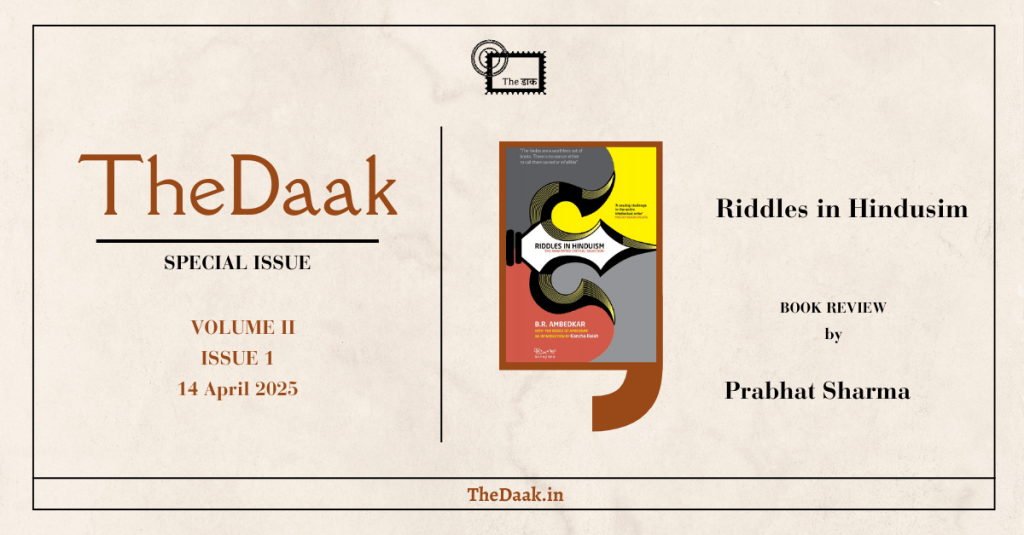

Book: Riddles in Hinduism: The annotated critical selection by Dr. B.R Ambedkar, Navayana, Published: 25 April, 2016, 272 pages, 20.3 x 25.4 x 4.7 cm, ISBN-13: 978-8189059774, ₹318 (Paperback)
Religion has been a part of human civilizations since time immemorial. But at the same time, these religions are also the source of some of the most oppressive practices. Hinduism is no exception. In Riddles in Hinduism, Dr B.R. Ambedkar provides a critique of Hinduism, by exposing its contradictions and inconsistencies which are deeply ingrained in caste-based oppression. This work was not published during his lifetime, and the present book is a critical annotated selection of the original manuscript/text. Thus, this book has ten riddles out of the original twenty-four1. Through a textual analysis of Hindu scriptures, Ambedkar raises critical questions about the legitimacy of Hindu religious and social institutions. These riddles are divided into three parts: religious, social, and political. The riddles primarily provide a moral critique of Hindu spirituality or the lack of it. Ambedkar raises very pertinent questions: Is Hindu society Sanatan? (loosely translated to mean something eternal), How did the Brahmans deceive the Hindu masses? Where are the gods mentioned in the Vedas now? The book challenges dominant narratives, urging the readers to (re)evaluate their understanding of Hinduism.
In the first part of the book, Ambedkar starts by talking about the question of religious identity and the question of what makes a person a Muslim, a Christian, or a Parsi. He argues that people belonging to these religious communities would not have difficulty in answering the question. But if the same question is asked of a Hindu, he will be awestruck by this, simply because of the multitude/diversity within. There is no single god in Hinduism; some Hindus are monotheists, some are polytheists and some are pantheists (p. 59). In fact, for many, their worship is not limited to Hindu gods. There are various examples which include, but are not limited to, the ‘Panch Piriya’ cult (worship Mohammedan saints) and ‘Sakhi Sarwar’ in Punjab (make a pilgrimage to Mohammedan shrines), ‘Matia Kunbis’ in Gujarat (followers of Muslim saint Imam Shah), etc. There is nothing common amongst the Hindus. Even rituals and customs related to the life cycle show variance. For example, in the North, one cannot marry within their near relatives, but in the South, marriages between cousins are allowed. Now one may think that the caste system is the essential feature of Hinduism, but as Ambedkar argues, caste is also observed by Muslims and Christians in India. So, what really makes one a Hindu or who is a Hindu?
Then he moves on to the question of morality in the Vedas. He takes the example of criticism of Vedas by the Charvakas, which is an indigenous school of thought, to prove that one cannot object to the criticism (that Vedas do not have any morality) by saying that these criticisms are by foreign scholars, and thus prejudiced. Also known as Lokayata, this school of thought was a materialist school of thought which rejected the authority of the Vedas, and the existence of the afterworld. Arguing on the question of morality, he attacks Hinduism for the lack of it. Take the examples from Rig Veda, the conversation between Yama and Yami (who are twins and Yami urges her brother to have sex with her), or the prayers to Agni for the fulfilment of various wishes, or offering somarasa to Gods and Goddesses, Ambedkar argues that they are not spiritually elevating and there is nothing philosophical in these so-called infallible texts (I use the words ‘spiritually’ and ‘morally’ interchangeably, as in my reading, Ambedkar does so). He also gives the example of Atharva Veda and shows how it is just a collection of black magic and sorcery. So, he concludes that the contents of the Vedas do not justify the infallibility that has been entrusted to them by the Brahmans, thus proclaiming ‘Vedas to be a worthless set of books’ (p. 56). Then he moves on to show how the practices of a modern-day Hindu are totally different from those of the ancient Aryans. For example, he says that Aryans were a race of gamblers2 (p. 85). In fact, the questions of sexuality were not as rigid as it is in present-day Hindu society. As he argues, among the Aryans, there were cases of brothers cohabiting with their sisters, father with daughter, and grandfather with granddaughter. Cases of bestiality also prevailed and wine formed a very essential part and drinking was not regarded as a sin, and also how ancient Aryans were not only meat-eaters but also beef-eaters3. This becomes important because the present-day proponents of Hinduism place it on a moral ground above other religions by using the logic of ahimsa. This example directly contradicts it.
The second part of the book contains four riddles which are mostly on the theme of the four-fold classification of society into four varnas and the origin of mixed castes. He talks about how varna-vyavastha is the soul of Hinduism4. But the problem is that different texts have different takes on the origin of the Varnas, thus leading one to question the whole system of varna-vyavastha. For example, not only is there a difference between Rig Veda and Yajur Veda, but also between Puranas, smritis, and the samhitas. In addition to varna dharma, another peculiar feature of Hindu society is that of ashrama dharma, to regulate the life of an individual. The life of an individual is divided into four stages viz. 1) brahmacharya, 2) grihasthashram, 3) vanaprastha, 4) sannyasa. But interestingly, there is no mention of this theory of stages in life in the Vedas. As per Manu, these stages are like a linear path, with one coming after another. But many questions are raised. For example, as per the views expressed by the Dharmasutras, the married state was optional. Then why did Manu make this an obligatory state? Also one can question why there are two stages after Grahasthashrama as there is very little difference between Vanaprastha and Sannyasa. Moving forward to the question of the origin of mixed castes, Ambedkar criticizes Manu. Manu talks about the Samkara castes, that is those who are born of parents belonging to different castes. But many of these castes mentioned by Manu have never been heard of before. So what happened to them, where are they (unless for special reasons, they died out)? In addition to this, there is a wide difference between different Smritikaras on the origin and genesis of mixed castes. But how can the conjugation of two same castes produce several different castes? Also, history does not agree with Manu. Many important castes which Manu accorded a bastard position (p. 148), had an independent existence. Take, for example, that of Abhiras. Manu, when describing Abhiras, says that they are bastards born of Brahman males and Ambastha females (born by conjugation between Brahman father and Vaishya mother). But if you look at history, Abhiras were pastoral tribes who inhabited the lower districts of north-west as far as Sindh. Vishnu Purana describes them as ruling independent tribes. The same is the case with other communities such as Ambasthas, Andhras, Magadhas, Nishadas, etc. The existence of these large numbers of castes pointed to the failure of the Chaturvarna system. Therefore, there is an attempt by Manu to explain how these castes were outside the Chaturvarna system, thus leading to the “bastardisation of huge communities” (p. 152).
In the third part of the book which deals with the political, Ambedkar focuses on how Hinduism has historically failed to provide an ethical framework for a just society. But at the same time, it has reinforced caste-based oppression and Brahmanical supremacy. He contrasts Brahma and Dharma, suggesting that while Hinduism claims to be based on the concept of Dharma, it has been manipulated to serve the interests of one caste, that is the Brahmans. Hinduism also lacks a universal moral code applicable to all individuals. Instead, it provides a caste-based morality, where different rules apply to different sections of society. In addition to all of these, the concept of karma is used as an ideological weapon to justify inequality, discouraging lower castes from questioning their subjugation. Then he talks about how Kali Yuga, the age of darkness and degeneration, is presented in Hindu scriptures as an era of moral and social decline. Ambedkar argues that Brahmins have deliberately put in the idea of Kali Yuga to instill fear and maintain social control among the lower castes. Thus, these rules and meanings are there so that the hegemony of one caste can be maintained, and not challenged.
Riddles in Hinduism provide an intellectual critique of Hinduism’s religious philosophy, which by its nature is sharp and unrelenting. Engagement with original texts of Hindu scriptures only shows the extensive scholarship of Ambedkar. However, there are some limitations of the texts. Ambedkar’s approach to historical-textual criticism is good, but it does not allow the alternate reading of the texts5. For example, communities are not passive beings who just follow the rules prescribed in texts at face value. They interact, subvert, and reinterpret those rules and values. In addition to this, Ambedkar is trying to understand religion as the source of oppression, rather than a symptom. Taking a historical materialist view and looking at historical and economic conditions that played a huge part in entrenching the oppressive system, one can see the role played by different factors. For example, the role played by colonialism and how it transformed the boundary of the caste system from fuzzy to indisputable/apparent/definite/blatant/pronounced. Ambedkar’s analysis is also somewhat structuralist in the sense that he treats Hinduism as a closed system, only analyzing it through its texts and ignoring the historical evolution of ground realities. Although this has been attempted in Ambedkar’s other writings, this criticism is still relevant keeping in mind what this particular book is about. For example, what about the role of the Bhakti tradition which challenged the Brahmanical orthodoxy? Bhakti saints like Kabir, Tukaram, Ravidas, etc provide a radical social and spiritual challenge to practices, that Ambedkar is condemning, ultimately challenging the Brahmanic hegemony.
Nevertheless, this book is a seminal work and these riddles are relevant for contemporary times as caste-based inequalities and other forms of oppressive practices persist and have become more entrenched; with religious fanaticism at its peak and where people are more bothered about what one eats and the type of meat kept in one’s fridge, and the blurring the boundary between religion and statecraft in Indian politics. Religions have an element of faith where doubt is put on a pedestal. Doubt leads to inquiry and inquiry leads to Knowledge. Brahmans by placing the Vedas on a plane which makes them infallible have destroyed the very idea of doubt, thus hindering the society from progressing. In fact, we cannot progress without a sense of doubt. This book is relevant for every practicing Hindu and otherwise to get to understand the inconsistencies that exist within the religion and to understand the hypocrisy in a better manner. As Ambedkar rightly points out, “they who do not feel the darkness will never look for the light” (p. 55). This book is not merely a critique but also an eye-opener for social change. As Ambedkar said, “I am not afraid of the consequences. I shall be happy if I succeed in stirring the masses”.
- Riddles in Hinduism as published under BAWS (Dr. Babasaheb Ambedkar: Writings and speeches) volume 4 features in total twenty-four riddles and eight appendices. ↩︎
- Certain technical terms were also invented. For example, the four yugas (Krita, Treta, Dvapara, and Kali) are actually the names of the dice used for gambling. ↩︎
- He gives the example of madhuparka for this. It is a honey mixture which was offered to a revered guest. Flesh became the most important ingredient of Madhuparka. And for the idea on how the cow was not always holy, one can also look at Jha, D N The Myth of the Holy Cow. London ; New York: Verso. 2002.
↩︎ - Purusha sukta hymn in the Rig Veda embodies the official doctrine of Varna system. ↩︎
- For this, one can refer to Vanita, R. (2021). The Dharma of Justice in the Sanskrit Epics: Debates on Gender, Varna, and Species. United Kingdom: OUP Oxford. She argues that one cannot outrightly reject every religious text as oppressive, and that they contain many tales which are liberatory in nature. ↩︎

Prabhat Sharma is a PhD research scholar at Centre for Political Studies (CPS), Jawaharlal Nehru University (JNU).
 TheDaak review
Leave a comment