
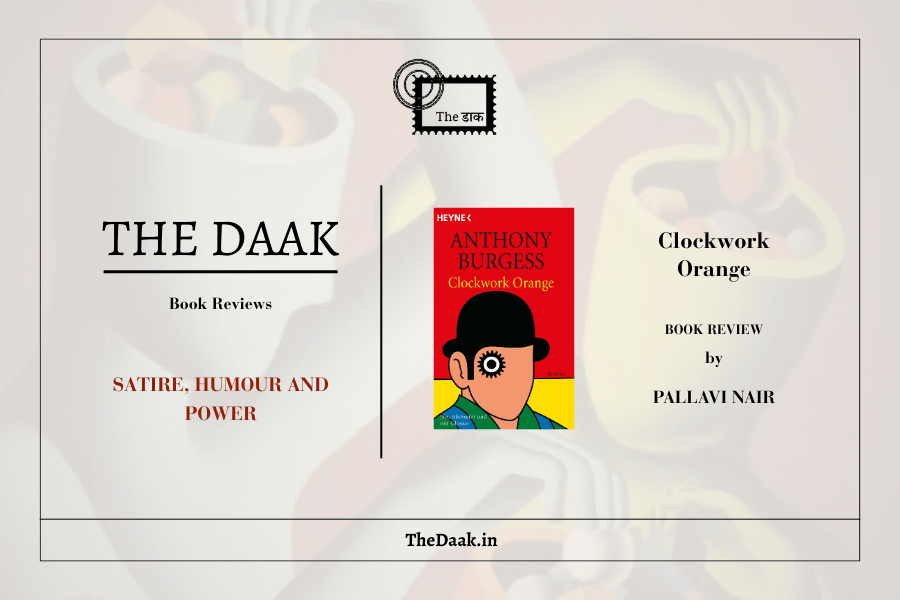
A Clockwork Orange by Anthony Burgess, London: Penguin Books, 2013; pp. viii + 352, ISBN: 9780141197531, £8.99.
by Pallavi Nair
The 1962 British novel A Clockwork Orange is set in a near-future dystopian Britain with its phenomena of youth offending, state observation, and conditioning of behavior. Written during a period when there was growing concern with juvenile crime and authoritarian trends within post-war liberal democracies, the novel reflects controversies on free will, morality, and control by institutions during that period. Anthony Burgess’s A Clockwork Orange (1962; 2013) is widely interpreted as either a dystopian novel or an aestheticised reflection on violence, youth crime, and state repression . But through the lens of satire and humour, the novel discloses itself to be a bitterly ironic critique of liberal modernity’s contradictions, specifically the need to moralise through regulation and engineer conformity through institutional authority. Burgess’s satire works not through obvious comedic mechanisms but through horrifically exaggerated grotesquerie, linguistic playfulness, and recursive inversions of victimhood and authority. This text does not employ humour for entertainment, but distorts humour with irony, parody, and grotesque hyperbole to stimulate radical scepticism regarding the systems which are linguistic, moral, and institutional, and by which knowledge and social order are fashioned. The novel thus works as a text that employs imitation and distortion not merely for humour but for epistemological criticism as well.
Satirical Disruption through Form and Language
At the level of form, Burgess subverts linguistic and narrative conventions in the invented argot of Nadsat, a Russian-Cockney fusion slang. This is not a stylistic gimmick but a satirical mechanism that alienates the reader from the sheer violence carried out by the teenage central character, Alex. By encapsulating acts of rape and “ultraviolence” in euphemistic or playful words, i.e., “the old in-out-in-out”, Burgess satirises the sanitised lingua franca in which both the state and the media regularly aestheticise and neutralise violence. The reader is forced to unravel the terminology while also being confronted with the tension between lexical beauty and moral monstrosity.
This deployment of Nadsat is a manifestation of Mikhail Bakhtin’s theory of heteroglossia, in which various voices and registers coexist to counter the superiority of any monolithic moral or linguistic code. Using Nadsat, moments of resistance against the state’s disciplinary language and moralising discourse are evoked. But the final collapse of this resistance ending in the state’s ultimate “reformation” of Alex tells the reader about the constraints of subcultural speech acts within hegemonic systems. Language is thus used both for and against power, and Burgess situates linguistic play as form of satirical protest and a kind of vulnerability unto itself.
The centre of the novel’s satirical attack is the Ludovico Technique, a government-approved experiment in behavioural conditioning. Alex, bound to a chair and his eyelids taped open, is compelled to sit through sadistic films under the effect of nausea-inducing medication. The image both frightening and cartoonishly hyperbolic, satirises alike the utilitarian morality of rehabilitation and the belief in technological progress to “cure” social ills through behaviour modification.
Burgess satirises the Enlightenment notion that reason and science will be able to complete human nature. The doctors, especially Dr. Brodsky and Dr. Branom, address Alex in rationalist, technocratic terms, as they deprive him of his ability to make ethical decisions. The conflict is the most extreme in the protest of the prison chaplain, who states:
“Goodness is something chosen. When a man cannot choose he ceases to be a man.” (p. 60).
This declaration, frequently referred to as the novel’s moral fulcrum, highlights the philosophical gist of Burgess’s satire: that moral action, when forced, ceases to be moral but is mechanistic. The title A Clockwork Orange refers to something that is alive, like an orange, but turned into something mechanical, like a clock. This image acts as a satirical metaphor for liberal paternalism, where society claims to care for individuals, but actually controls them. It suggests that beneath the polished surface of civilisation, there are hidden forms of force and manipulation.
Recursion of Power and the Absurd Reversals of Authority
One characteristic of Burgess’s satirical style is the loop of role reversal. Early in the novel, Alex is the perpetrator; afterwards, he is victimised by the same violence he had perpetrated. The grotesque irony of this situation cannot be mistaken: people once punished by the state are now acting as its agents of punishment. The state does not eliminate violence, it legitimises it by redistributing its tools.
The absurdity goes still higher in the book when Alex encounters F. Alexander, the liberal author whose wife had been among Alex’s first victims. At first sympathetic to Alex’s torment by the Ludovico Technique, Alexander intends to employ him as a symbol of governmental brutality in a wider political campaign. When he learns Alex’s identity, his sympathy turns to vengeance however. Burgess therefore declines to make sharp distinctions between oppressor and oppressed. Rather, his satire targets all institutional players, be it criminal, reformist, or revolutionary as potentially subject to moral inconsistency and instrumentalisation.
Humour, Ethics, and the Affective Politics of Violence
Humour in A Clockwork Orange is highly ambivalent. It does not provide comfort but unease, offering what Simon Critchley in On Humour could perhaps describe as humour that breaks the skin (2002). Alex’s account is studded with witty turns of phrase, literary allusions, and knowing side-glances that draw the reader into complicity. When he speaks of violence with glee, “Oh, it was gorgeousness and gorgeosity made flesh” (p.24), one is left torn between fascination and horror. This humour is satirical not because it belittles, but rather because it lays bare the volatility of moral judgment mediated by charm, beauty, or narrative familiarity.
What’s more, the satirical purpose of this humour is seen in its affective effects. This lies in how it unsettles the reader’s emotional response by combining laughter with discomfort, prompting them to question what or whom they are laughing at. This emotional tension is important because it creates a kind of moral confusion that has no easy answer. In this way, Burgess uses humour to evoke feeling not through empathy, but through confusion, contradiction, and a sense of distance. But Burgess turns this role around: the state’s dogmatic moral code, when mocked, unmasks its own ridiculousness. Humour is thus a form of resistance, but also a location of uncertainty. For subordinated subjects, humour can be a form of emotional capital, but it can also desensitise or divert attention from structural violence.
Although penned in the early 1960s, A Clockwork Orange preempts the modern shift of satire in the digital age. Under contemporary meme culture, irony tends to collapse into reflexive coolness, and satire threatens to be incorporated into the spectacle itself rather than critiquing it. The Ludovico Technique, meant to be horrific, is ironically reminiscent of the logic of viral media, in which repetition and spectacle lead to behavioural change without critical introspection.
Burgess’s novel, from this perspective, anticipates a world where satire has to struggle in order not to become part of the apparatus of control. The scenario of Alex, who becomes tame but recounts his experience with aesthetic enjoyment, illustrates precisely this tension.
Satire, Subjectivity, and the Ethics of Emancipation
A Clockwork Orange has an interesting position within the political satire tradition. It is seldom laugh-out-loud funny; its criticism, non-moralistic, is highly ambivalent. Burgess creates a world in which violence, redemption, and rule overlap within a common aesthetic logic. His satire demonstrates that the attempt to impose morality by force tends to recreate the violence it tries to eliminate. Historically, humour in literary works is employed for satire, character creation, social commentary, or relief of readers. Burgess borrows from these purposes but reverses them. Rather than employing humour to relieve tension or to distinguish moral stances, he employs it to enhance discomfort, destabilize judgment, and make readers complicit in violence. The border between irony and sincerity, play and sadism, is deliberately smudged.
While A Clockwork Orange is hailed as a satirical critique of authoritarianism and moral conditioning, what must also be considered is its representation of gendered violence, which complicates the ethical and aesthetic project of exploring these subjects. The novel consistently stages scenes of sexual violence, frequently narrated through Alex’s voice in a self-amused, ironic, or richly stylistic way. His playful use of language and literary referentiality invites not so much moral consideration as it aestheticises brutality. The risk here is that violence is part of the novel’s aesthetic pleasure, and not necessarily an object of critique.
Does Burgess satirise patriarchal violence then? Or simply reproduce it in a stylised form? The novel gives few clues for critical distance. Women are for the most part voiceless, marginal, or hypersexualised. On this level, the novel treads a thin line between satirical critique and narrative complicity. At the same time, in an era of algorithmic control and performative indignation, its satire of conformity and free will cuts bright. Meanwhile, its troubling handling of sexual violence and lack of female agency call for a critical eye, reminding us that the politics of representation are just as vital as the critique of power itself.
As a whole, Burgess challenges a reassessment of satire not as a mere mockery genre, but as a philosophical process, a way of disrupting structures of power, ethics, and subjectivity. The novel leaves us with no heroes at all, but with an unsettling awareness: that in the name of preserving social order, liberal communities can threaten to turn men into clockwork machines, bereft of freedom, rendered ridiculous in tragedy, and sadly ridiculous in their surrender.
Pallavi Nair holds a Bachelor’s degree in Sociology from Hindu College, University of Delhi.
 TheDaak review
Leave a comment