
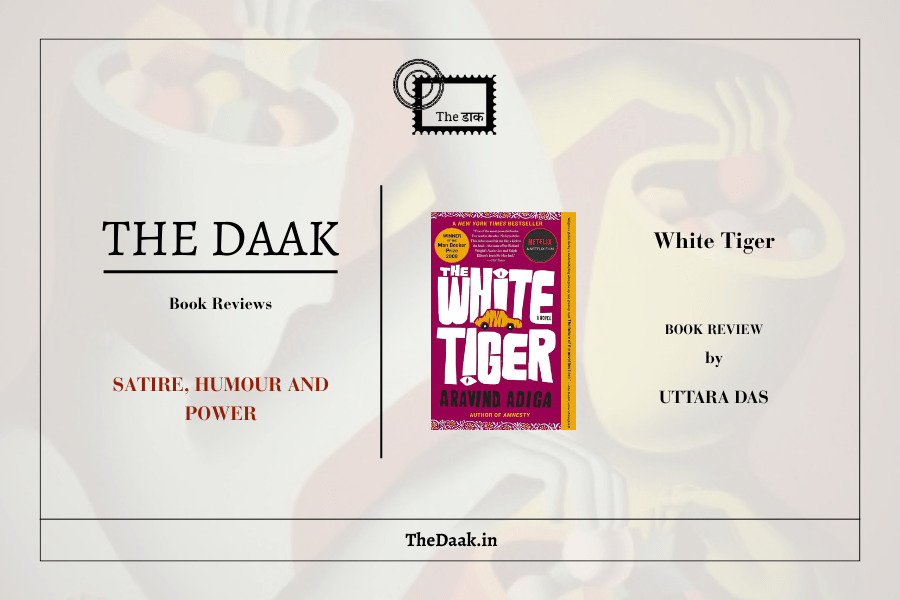
The White Tiger by Aravind Adiga, New Delhi: HarperCollins, 2008, 321 pages, ISBN 978-0-7432-7233-5, Rs. 265
by Uttara Das
Balram Halwai, the anti-hero of The White Tiger, is not a victim of misfortune. He is a product of design. His rage is not spontaneous; it is created and controlled by the system. Aravind Adiga’s debut novel might wear the easy grin of dark comedy, but make no mistake: it is a grin that bares its teeth and bites.
Adiga’s India is not one with multiple truths. It is a binary machine: Light and Darkness, big bellies and small, those who eat and those who are eaten. These are not just metaphors, but ideological coordinates; a brutal mapping of inequality. Balram emerges from the latter, and learns to devour before he is devoured. But this black-and-white schema, while effective as satire, risks flattening the variegated textures of lived reality. That is the unholy lesson of the novel: not that corruption is a moral failure, but that it is a precondition. Balram’s trajectory lays bare a society where power flows downward, never sideways; where satire becomes the only language left to articulate the absurdity of aspiration.
The Democracy of Servitude
Structured as a series of letters to the Chinese Premier, Balram’s narrative confesses, seduces, and justifies. Writing to a foreign dignitary becomes his ironic bid for validation; he seeks admiration from someone presumed to understand survival among the many. In choosing China, Adiga slyly draws a comparison between two nations forced to market their poverty as progress.
“You see, I am in the Light now. But I was born and raised in Darkness.” (p.14)
This isn’t just a metaphor. It is cartography, moral and economic. Balram’s India is a vertical nation disguised as a horizontal democracy. From Laxmangarh’s coal-sifting children to women rendered labour, ornament, or silence, the ladder is clear. The satire here is elegant and cruel. Adiga doesn’t critique capitalism by opposing it; he completes it by showing how deeply its exploitative logic has permeated personal ambition. The “invisible hand” doesn’t falter, it clenches into a fist.
The Rooster Coop and Other Fantasies
At the heart of the novel is the now-famous image of the “Rooster Coop,” India’s social structure, where servitude is inherited, not imposed. Servants don’t rebel, they wait. They do not bite, even when the hand beats them. This is not docility. It is design; a design some critics argue reveals more about the author’s vantage point than the reality he depicts (Subrahmanyam, 2008; Los Angeles Review of Books, 2020).
For some, the coop is a sharp, unsparing satire of a society complicit in its own subjugation. For others, it’s a patronising caricature. Do Adiga’s characters have the dignity of agency? Or are they pinned, like insects under glass, to serve the argument?
“The trustworthiness of servants is the basis of the entire Indian economy.” ( p.175)
When Balram murders Ashok and flees with a briefcase of bribe money, the satire crystallises. This is not liberation. It is a promotion, a blood-soaked entry into India’s entrepreneurial class.
Satire as Structure
In The White Tiger, satire is not a surface. It is structural. Balram doesn’t just mimic the language of corporate ambition; he becomes its grotesque avatar. He “brands” himself. He speaks in TED Talk aphorisms. He is the success story we all pretend to celebrate. And in that success lies the satire: we cannot cheer him without endorsing everything that made him a murderer. What does it mean when the only way out is through blood?
Gendered Absences: The Invisible Half
And yet, there is an absence louder than any presence: the women. They are everywhere, and nowhere. Balram’s mother dies unnamed and mythologised. Kusum, the grandmother, is a matriarch without agency. Pinky Madam, Ashok’s wife, is a cipher. Her exit is abrupt and unexamined. If satire exposes power, its silence here is its loudest indictment. Some argue that this absence is a flaw; Adiga fails to offer women the sparse interiority he grants Balram. But perhaps the satire, like the society it reflects, is deliberately, brutally selective.
As Arundhati Roy said in her 2004 Sydney Peace Prize lecture, “there’s no such thing as the voiceless. There are only the deliberately silenced, or the preferably unheard.” In The White Tiger, women are both.
The Ministry of Irony
At times, the novel recalls Roy’s political non-fiction, cutting through euphemisms and democratic dogma with surgical irony. Balram doesn’t preach. He shrugs. He jokes. And in that tone, he says the most devastating things:
“Free people don’t know the value of freedom, that’s the problem.” ( p.117-118)
It ridicules the shallow optimism of market democracies. In both Adiga and Roy’s work, freedom is aspirational not actual. For Balram, it arrives only after murder, a performance within the same exploitative system.
A Country That Watches
Ashok, the murdered master, is no villain. He is liberal, polite, and feels sorry for the poor. That, in Adiga’s hands, becomes his gravest fault: pity without risk.
“At that moment I looked at the rearview mirror, and I caught Mr. Ashok’s eyes looking at me: and in those master’s eyes, I saw the most unexpected emotion. Pity.” ( p.122)
If satire thrives on inversion, then Balram is the perfect satirist. He stares back. He doesn’t dismantle the system. He auditions for it.
The Laugh That Stays
When you finish The White Tiger, you don’t feel triumphant. You feel implicated. Balram owns taxis. He has made it. But his victory is built on erasure of morals, relationships, and lives.
“I’ll never say I made a mistake… I’ll say it was all worthwhile to know, just for a day… what it means not to be a servant.” ( p.320-321)
What kind of system creates a man who must kill to live, and then congratulates him for it?
Final Reckoning
The White Tiger doesn’t sit quietly on your shelf. It growls. It indicts. Its laughter weaponises discomfort. There are echoes of Jonathan Swift, minus the wigs; George Orwell, relocated to Gurugram. Even Balram’s transformation is not resistance but repackaged complicity. Adiga’s satire offers no moral victories. It reveals a world where goodness is a line-item cost. In Balram’s India, you win not by being good but by being seen winning. His humour doesn’t soothe; it exposes. The final wink isn’t meant for Delhi or Bangalore. It’s for us. And if we flinch, well, that’s the point.
Bibliography
Adiga, A.. (2015). The White Tiger. HarperCollins.
Subrahmanyam, S. 2008. Class, Caste, and the Servant Problem. London Review of Books, 30 ( 23). http://www.lrb.co.uk/the-paper/v30/n23/sanjay-subrahmanyam/class-caste-and-the-servant-problem.
The White Tiger and the Problem of Representation. (2020, Jan 28). Los Angeles Review of Books. lareviewofbooks.org/article/the-white-tiger-and-the-problem-of-representation.
Uttara Das is a writer and researcher whose work sits at the intersection of gynocriticism, social satire, and the politics of representation.
 TheDaak review
Leave a comment