
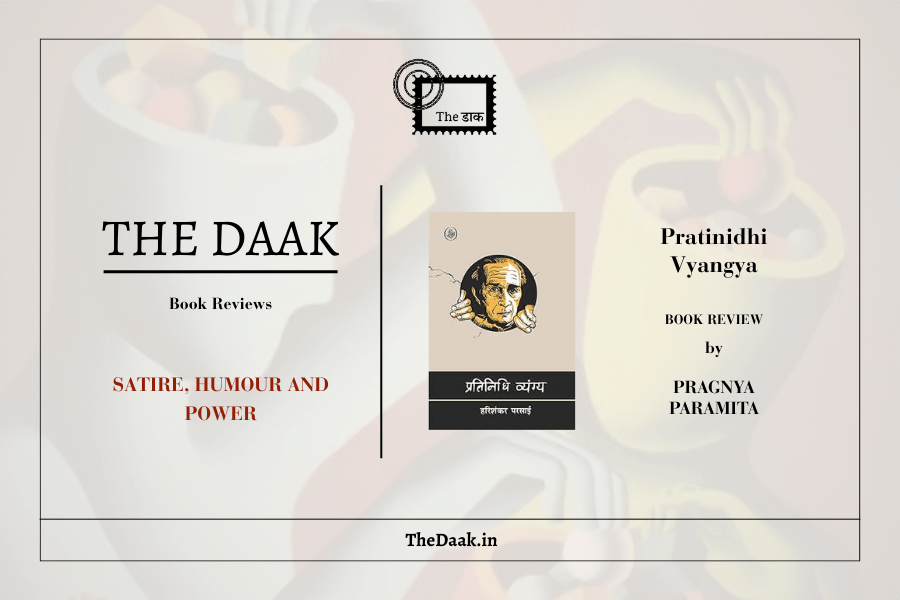
प्रतिनिधि व्यंग्य by हरिशंकर परसाई (6th edition), Delhi: Rajkamal Prakashan, 2023, 148 Pages, 17cm x 12cm, ISBN: 978-81-267-0234-3,₹150
by Pragnya Paramita
प्रतिनिधि व्यंग्य (Representative Satire) by Harishankar Parsai, an eminent satirist from Madhya Pradesh, came across as a unique satirical style that employed a conversational tone making use of metaphysical conceits such as describing a republic as shivering in ठिठुरता हुआ गणतंत्र, or by personifying a disease as one’s uncle in अपना चाचा— एशियाई फ्लू , and so on. His humour substantiates some deeper, political decay within the conceit.
Parsai grew up during a politically turbulent time in India’s history and experienced its relatively newly acquired independence, witnessing paramount events in Indian politics. His writing serves as a critical lens for examining the various issues that plagued society at that time. Wrapped in satirical prose, the sense of bleakness engendered out of reading about instances of poverty, drought, middle-class aspirations, political failings disguised as development, and the undying hopes of the common man, is brought forth brilliantly in this collection of essays. Parsai’s brilliance lies in shedding light on a public sphere that is nestled in-between the nooks and crannies of small towns and villages; in short, in places that are rarely mentioned in terms of a socio-political analysis.
In using his satire to unfold the many vagaries of Indian society, he craftily makes use of normal day-to-day activities to critique the public sphere of a newly independent India. His essays effectively paint a picture of the thought process of individuals from all backgrounds, from rich merchants and political leaders to people who survive on a single meal a day. While pretending to discourage all forms of intellectual and emotional engagement with a social issue, it in fact leads one to a greater understanding of the ills of society, albeit indirectly. This is precisely how satire escapes censorship, by not taking a straight road to activism. Rather, it does away with the idea that there is a straight path to social justice and instead leads one through secret alleyways of protest tinged with humour. The significance of bypassing censorship is crucial in all ages, as it is reflective of the spirit of tolerance and, therefore, in essence, of democracy.
In “गुड़ की चाय” (Tea of Jaggery), he begins by stating that nowadays, while drinking a cup of jaggery tea, he feels that he is being martyred (p. 18). This statement can trigger criticism for contrasting martyrdom to something as common as drinking a cup of tea. Only Parsai’s wit and satire can protect him from the wrath that such statements might induce, as in the next line, he states, like a philosopher, we live and die from these small things. What seems like mindless babble, however, is a statement that emphasises the situation of being forced to consume jaggery instead of sugar. Does one not rely on the everyday comfort of little things to judge the quality of life one is living? In using this simple metaphor, Parsai paints a different picture of the independence struggle, wherein he mentions that those who were jailed for it are the ones who now drink their tea with sugar. While those who could not benefit from such political shows of triumph are the ones who take their tea with jaggery and lament about their place in the country (p. 18). Hence, he mocks this piecemeal nationality that he believes is undemocratic for the common man who now has to struggle for his basic needs.
But the best part of this satire is when he calls sugar a secular entity (p. 20). In true Parsai fashion, he states that sugar does not discriminate according to one’s religion, and is more secular than us because it disappears from the market on both Muharram and Janmashtami. In a warped sense of utopian communal harmony, he paints a picture that hints that dearth is equal for everyone, regardless of their religion. He states that it is easier to acquire an MLA than to acquire sugar, hinting that while basic food items are all drowned under the illegal hood of black marketing, politicians, on the other hand, are in abundance everywhere. While ending the piece, he mocks the concept of stability perpetuated by the privileged who believe in maintaining law and order at the cost of relishing the continuity of a situation that does not affect them.
So, in a sense, while critiquing the lack of sugar, what Parsai is actually criticising is the lack of accountability that is so easily doled out to people ironically in sugar-coated words. He mocks those who accept the resignations of life easily without voicing their anger while sipping the insipidity of their life down with a cup of jaggery tea. Thus, Parsai centers his argument on the public’s uncritical acceptance of life as meted out to them by government officials, and their innocence which fuels such wrongful acts of deceit.
Another notable satirical piece in this collection is “अकाल उत्सव” (Famine Festival), which runs along the lines of Jonathan Swift’s A Modest Proposal (1729). In this, Parsai describes a set of vivid dreams, from a pompous celebration of famine to dreams of famished people eating up politicians and hoarders who sustain such disasters to milk political and financial benefits. Parsai comments on the strange desire for human survival stating that the desire to live is like a glue, binding together the bones of man and essentially his will to survive (p. 93). This is a deeply philosophical and disturbing observation, simply because of its truth. He marvels at their will to live, and says that they eat up the wish to die to keep themselves alive. In this desire for death, they find nourishment. This paradoxical statement highlights the morbidity of the lives of those affected and who declare that even death would be better than living like this. Further, he sketches a scene where a political leader is delivering a speech at this famine festival, wherein he gives statements such as “Famine is India’s old tradition”, and says that even bravehearts like Dronacharya died of hunger (p. 94). In satirising these speeches, Parsai seeks to strip them of their false glorifications. He is critical of this clever turnaround manner of talking, and hence makes a mockery of it. At the end of his speech, before he goes to eat his meal of chicken, we
see the politician stating that it is his desire that everyone celebrate the famine festival with joy, and that even in dire times, we must remain happy.
Parsai’s exploration of this issue poses the question, why is one supposed to put on a pretense of happiness? Can happiness for the poor only be achieved in performative spectacles and never in reality? Parsai ends this commentary by stating, “मगर लोगों को उत्सव मनाने की आदत पड़ गयी है” (But people have gotten used to celebrating) (p. 96). Hence, he again puts the public sphere into the spotlight. This time it is a public sphere of the deprived, starved individuals who will sell their own soul to buy a garland of roses for their political representatives. Here, Parsai tries to draw attention to the idea of political spectacles which keep the common man from questioning a system that has mastered the art of deceiving the public.
The public sphere is invariably under scrutiny in all of Parsai’s satires, whether it is in lamenting the ways in which the voice of the public sphere is suppressed or whether it is to mock the fallacious cloak of honour that discourses in the sphere generate. For instance, in “दूसरों के ईमान के रखवाले” (The Protector of Others’ Honour), Parsai satirises the innate tendency of people to moralise others, claiming to be upholders of honour while being morally corrupt themselves. This reflects how the public sphere gradually assumes the position of being a staunch defender of honour, and proclaims itself as the protector of righteousness by turning a blind eye to its own problems and staking a claim in being the authentic, collective voice of society. In “पगडंडियों का ज़माना” (The Era of Footpaths), Parsai brings forth a poignant criticism about people using backhand ways to accomplish their objectives. He states that no one takes the straightforward road these days because it has been closed for years and everyone uses the footpaths to reach their destinations (p. 51). By footpaths, he actually means to imply the narrow, crooked path that people choose without hesitation over the road of righteousness which is full of hindrances.
The common man of Parsai’s satires makes up this public sphere and inherits the tradition of humour but ends up becoming the laughingstock of the entire story. In trying to mock the common man’s actions, he is also generating sympathy for the politically obscure belief system that thrive in the public sphere. This obscurity stems from an inability on the part of the public to fully fathom the conniving manner in which they are exploited, be it for sugar or for deciding the threshold of their morals. His aim seems to be one of instilling awareness through humour, using his satires and nondescript ways of talking about problems to highlight the vagaries of Indian society. Parsai’s dealing with the public sphere then has multiple objectives: one, to highlight the issues that plague it; two, to initiate an understanding of how collective thought is engendered in it, and three, to show that a public sphere is not without its faults, limitations, and dangerous practice of apathy.
Parsai’s mode of satire shines the spotlight on a class of society with a set of problems that when doled out as humourous situations do not invite serious scrutiny, but in fact, unearth the grave flaws present in society. Often, we overlook the sinkhole of our situation unless we are handed over a rope by someone who seeks to save us, realizing that all this time we were slowly drowning. However, sometimes, we believe wholeheartedly that we cannot drown if we haven’t yet drowned, refusing to believe in a narrative that makes our presence unpredictable. Parsai’s satire seeks to highlight this exact narrative, one that speaks of this socio-political muddle that all of us are entrenched in.
Pragnya Paramita is currently a first-year PhD research scholar at Delhi University’s English department.
 TheDaak review
Leave a comment