
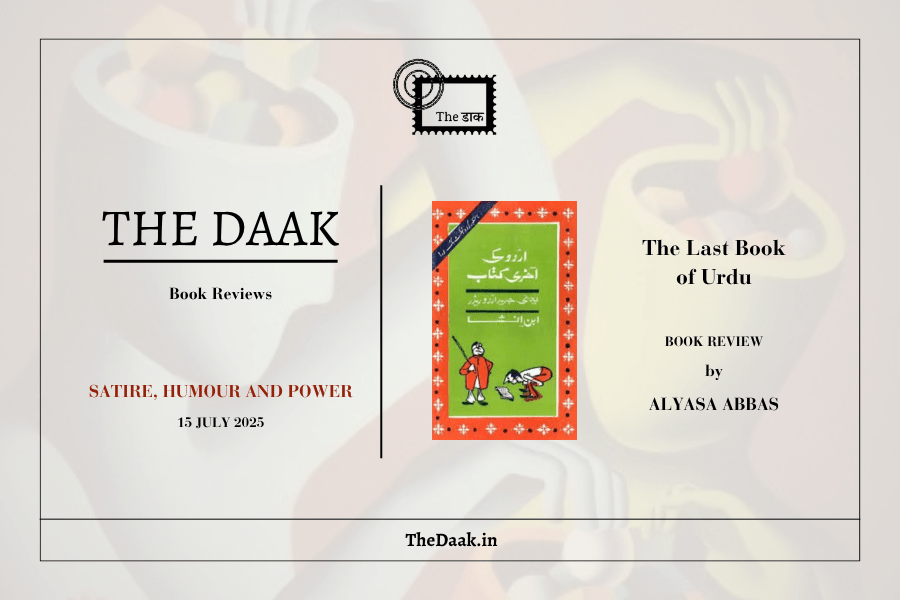
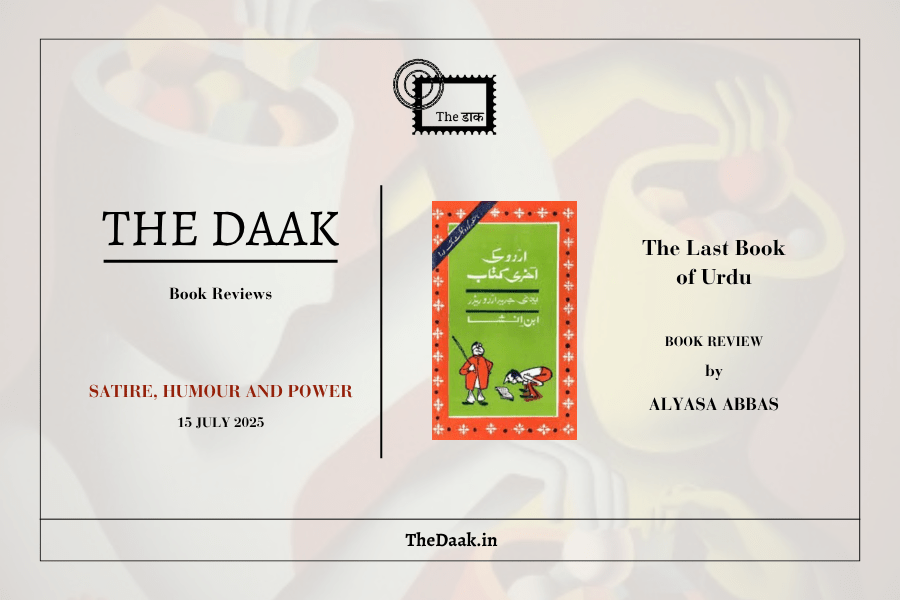
Urdu Ki Aakhiri Kitab (The Last Book of Urdu) by Ibn-e-Insha, Daryaganj, New Delhi: Rajkamal Paperbacks, 2025 (12th Edition), 155 pages, ISBN: 978-81-267-0045-5, INR 250
by Alyasa Abbas
In Insha ji’s tongue-in-cheek humour, his anguish found wings. Ibn-e-Insha, who often addressed himself as Insha ji in his poems, penned down a book which feels fresh, hilarious, and relevant to this day, despite being first published in 1971.
This satire is based in Pakistan but applies to India in an intimate manner. In his disgust with the societal injustices throughout history, Insha Ji saw India and Pakistan as one civilisation and spoke to the common ills that must be confronted.
The Last Book of Urdu is a short book of many sub-themes bound, perhaps, by the theme of an omnipresent decay. In the author’s view, the decay is not time-based, where nostalgia for the glorious past guides the satirical criticism of the degraded present. Decay has always existed. It has manifested itself in all periods of history and areas of life – in political integrity, economic justice, and societal inequalities. But decay alone does not seem to be the cause of Ibn-e-Insha’s discontentment. That this decay can be stopped – even reversed – but continues to rot our lives, was the core of Insha Ji’s anguish. This was the fire which birthed his humour, humour which masked his anger.
Ironically named The Last Book of Urdu, this satire was written as a beginner-level school textbook with lessons in history, geography, grammar, maths, and science. Insha ji picked apart the absurdities of partition, the contradictions of the historical ruling dynasties, the rotting state of education in Pakistan, censorship, and societal antagonisms, amongst other things.
The author reasoned that each good starter textbook must begin with a prayer for self and the nation. He began writing a prayer about the nation of Pakistan. Then he asked…
“But who lives in Pakistan?
Like the Persians live in Iran, and the English in England, and the French in France, the Pakistanis must live in Pakistan?
No, Sindhis live in Pakistan. Punjabis do too. Bengalis as well. These people and those people as well.
But all these people and those people live in India as well. Then why did we create a separate nation?
We made a mistake. Sorry. Next time, we won’t create it” (p.17)
The author saw no logic in the partition of India and Pakistan on religious lines, when the people were bound more closely by shared history and culture than they were separated by religion. He brought this point back in the chapter on Geography where he tried to locate India and Pakistan on the map, physically and existentially.
Most chapters of the book have end-of-chapter review questions for the students which are hilariously absurd. For instance, after the chapter on the Mughal Emperor Shahjahan, one of the questions asked is – If Shahjahan hadn’t built the Red Fort, where do you think Bahadur Shah Zafar would have held his mushairas? (p 80). Insha ji had no twinkles in his eyes for the grandness of dynasties throughout history. Grand structures seemed absurd to him, even more so their utilisation for the personal fancies of the rulers.
The author essentially took all the tropes of a beginner-level school textbook and utilised them as satirical devices – simple explanation of phenomena, high-level overview of complex events and things, simple moral tales and so on. For instance, he took the principles of addition, subtraction, multiplication and division (jod, tafriq, zarb and taqsim in Urdu) and cleverly employed these words in their multiple meanings within and outside the mathematical context to highlight wealth hoarding, ethnic animosities, hypocrisy of charities, and corruption. For example, he wrote the following as the definition of Division (taqsim),
This is a very important principle of math. Taqsim means to distribute……It is very easy to distribute using this principle. Keep the rights with yourself, distribute responsibility to others. Keep the money intact with you, and distribute assurances and promises to others. (p.100)
Ibn-e-Insha’s humour stood out from the other giants of tanz-o-mizaah (satire and humour) at the time, such as Patras Bukhari, Mushtaq Ahmed Yusufi and Kanhaiya Lal Kapoor. His humour was intimately suffused with his politics. Insha ji was a part of the Progressive Writers’ Movement and used humour as a channel for the expression of societal ills and the propagation of progressive ideology. In comparison, Patras Bukhari, the legendary Urdu humourist, wrote essays with immaculate characterisations and brought out the humour through comedies of errors. After reading an essay by Patras Bukhari, a reader is likely to carry these characterisations in their mind with all their eccentricities.
On the other hand, reading Ibn-e-Insha is a different experience. His humour was often situated in the institutions of social significance such as police stations, newspaper houses, educational departments and so on. Insha ji was willing to sacrifice immaculate characterisation (relying on caricaturing instead) to highlight the fault lines in the institutions of society. In The Last Book of Urdu, Insha ji used a comical exaggeration of several historical figures such as the early Greeks, the various rulers of India and the British colonial regime. This exaggeration was apt because these people and entities influenced huge domains of the world and took their existence rather seriously. Insha ji’s exaggeration immediately made their beings un-serious and highlighted their contradictions and petty actions. Kanhaiya Lal Kapoor, who was a student of Patras Bukhari and another legend of Urdu humour, created similar caricatures to bring out the hypocrisies of middle-class life and the anxieties of partition, amongst other things. However, a notable difference between Kapoor and Ibn-e-Insha was that Insha was also a poet and often deployed poetic sub-sections in his prose. This can be vividly seen in The Last Book of Urdu, where a substantial chunk was written as free-verse poems.
Ibn-e-Insha was an eccentric user of language. As a poet, he was often seen as a spiritual successor to the doyen Amir Khusro due to his seamless amalgamation of dialects and playful style even in themes of separation and sorrow. His wasn’t the elitist Urdu poetry which prides itself on its incomprehension by the people.
In a separate section titled ‘Twice Upon a Time…’, classic children’s tales are re-told: The Hare and the Tortoise, The Thirsty Crow, Unity is Strength and so on. But, being a master of infusing humour into the matter while keeping the structure constant, Ibn-e-Insha retold these stories in a matter-of-fact manner without the romanticisation of moral choices made by the characters in these stories. This section reads more humorous than the rest of the book, in that it serves as a comic relief contrary to the ‘textbook’ format of the book.
The real marquee of the book is the textbook format. It allowed the author to capture multiple sub-themes in a single book without things seeming disjointed. In the chapter on history, he critiqued the hypocrisy of the kings and then moved on to the lesson on science, where he explored the human condition through the definitions of physical phenomena. He could swiftly switch to geography and speak about the nature of modern nation states, and then to literature to tell stories. And all of this has been woven in a completely coherent manner to take the shape of an introductory textbook.
In introductory textbooks, the educators endeavour to provide a lot of information in simple language which can be easily comprehended by children. Ibn-e-Insha saw this as an excellent opportunity. Writing these things as chapters of introductory textbooks prevented him from over-explaining things or using complex linguistics. Additionally, it is a work of remarkable creativity. One does not often see satirical works written as textbooks. Clearly, Insha ji saw children as the drivers of tomorrow’s change, and through his humour, he attempted to instil in them a conscience against evils which plague society.
One often thinks about humour and satire as having expiry dates shorter than other forms of writing. A satire is definitively rooted in the present context of the author and is inescapably political in nature. Humour, similarly, faces this constraint. Things which were considered funny a decade ago are not deemed funny today. Still, The Last Book of Urdu remains fun and reflective. Political satires often die with the death of their subject matters, but satires on longue durée human condition are important at every age. Ibn-e-Insha manages to achieve this feat in The Last Book of Urdu. As mentioned in the beginning, behind all the witty lines, puns, and cheeky remarks, there is a tone of anguish over the consistent human decay.
The relevance of the book in our present times can be exemplified further by the fact that it has been adapted to stage as well most recently in India by the Hoshruba Repertory led by Danish Hussain and co-performed by Gopal Dutt.
Alyasa Abbas is a data analyst by profession and a student of literature by inclination.
 TheDaak review
Leave a comment