
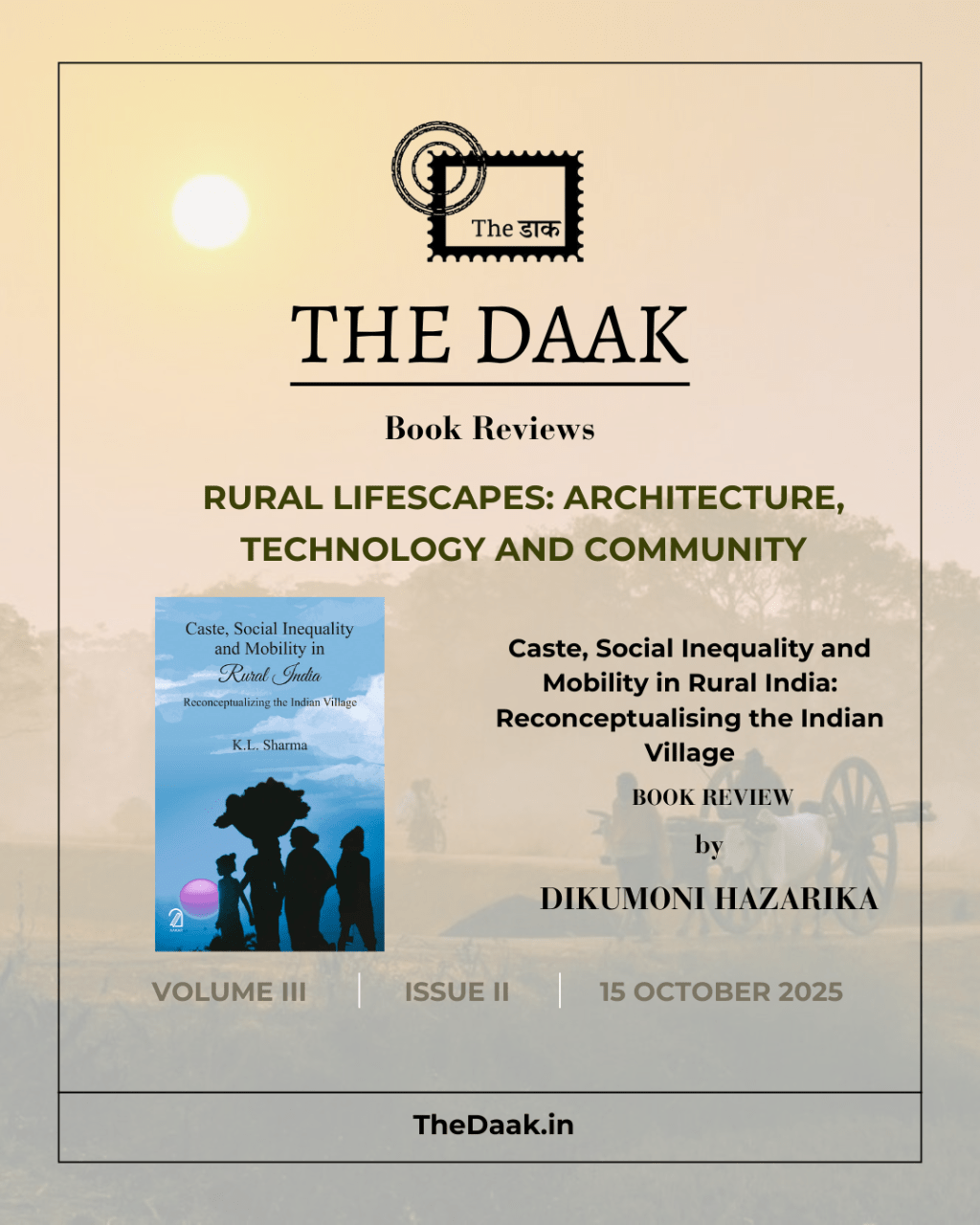

Book: K. L. Sharma, Caste, Social Inequality and Mobility in Rural India: Reconceptualising the Indian Village. Delhi: SAGE Publications, 2019, 400 pp., `1,195, ISBN 978-93-532-8201-1. DOI: 10.1177/00490857211015731
K. L. Sharma’s Caste, Social Inequality, and Mobility in Rural India: Reconceptualising the Indian Village provides an in-depth and insightful analysis of the changing dynamics of rural Indian society. Drawing upon six decades of research and a longitudinal revisit of six villages in Rajasthan, the book dismantles the notion of the Indian village as static, homogeneous, or bound solely by caste. Instead, it emphasises the importance of economic diversification, migration, education, the growing agency of individuals and families, and policies of the state, as essential drivers of change. The book’s structure is methodological as well as descriptive. K. L. Sharma places his work between traditional Indological methods and modern rural sociology by fusing conceptual innovation with long-term ethnographic evidence.
The book is divided into fifteen chapters, each of which skilfully blends historical context with current events. The author makes a strong case that the caste system, which was formerly seen as an “overriding and encompassing” social structure, is no longer important (Sharma, 2019, p. 1). Caste no longer governs daily life, although it still has significance in specific contexts like marriage and elections in rural India. Untouchability and ‘Jajmani’1 relations have largely vanished, and mobility across occupations and social spheres has become routine. This promising view, nevertheless, needs careful consideration. The book’s longitudinal research on six Rajasthan villages illustrates significant professional mobility and social engagement beyond caste boundaries; nonetheless, caste-based endogamy, political alignment, and daily prejudice persist. Inequality in Rajasthan villages, he argues, has shifted from ritual hierarchies to structural disparities shaped by state-led development programs like reservations, which have centralised status and power. Sharma explains that in rural India, inequality arises from the uneven distribution and control of resources, partly due to the lack of necessary capabilities among people to assert their entitlements, and partly due to the structural characteristics of resource allocation that enable established families to monopolise a disproportionate share. The dominating groups are not only from the traditional upper castes; instead, many have gained advantages via state-sponsored policies and development programs that have, over time, reinforced their influence.
A significant contribution of the book lies in its emphasis on the individual-family relations as determining the quantum of agency available. Families allow individuals to access more possibilities, exercise agency, and challenge inflexible structures such as caste-based prohibitions by pooling their resources, skills, and social networks. The author shows how strict caste-based restrictions and hereditary professions have been replaced by aspirations and practical tactics, encapsulated in Amartya Sen’s “Three R’s” (Reach, Range, Reason) (Sen, 2005). The author skilfully demonstrates how education, urban work, and migration have created new social trajectories, particularly among younger generations. However, the handling of gender in this paradigm is constrained. While the book acknowledges the rise of nuclear families and higher education for daughters, it minimises the gendered barriers that continue to limit access to wealth and mobility. Men’s migration frequently enhances economic prospects, whereas women’s mobility is hampered by patriarchal norms, salary disparities, and unequal domestic roles.
Sharma’s discussion of economic diversification and the declining centrality of agriculture captures the changing occupational landscape of rural India. More open and inclusive economic places have replaced traditional markets that were controlled by merchant castes. Rural economies have been transformed by new business enterprises and contractual agreements among rural villages. The book demonstrates how migration and the rural-urban nexus have blurred the traditional divide, producing “villages in towns” and “town-like villages” (Sharma & Gupta, 1991). Political changes, particularly democratisation and the assertion of rights by marginalised groups, further reveal new pathways to power and status. It depicts the rise of a new rural middle class across caste boundaries, the enduring power of democratic dynasties, and the paradox of growing cultural equality alongside ongoing economic and political disparities.
Sharma highlights that both the cognitive and ontological foundations of rural life have undergone profound change since Independence. Sharma also rethinks what it means to be “rural”. He does not see the village as a moral community or a decreasing residual space; instead, he sees it as an adaptive, integrated social formation. Sharma emphasises the importance of macro-level changes, such as adult franchise, land redistribution, and different state policies and programs, in allowing rural populations to access resources and opportunities. Infrastructure developments, including schools, healthcare facilities, roads, transportation, MNREGA, and empowered Panchayati Raj Institutions (PRIs) have altered rural life, changing social dynamics and fuelling rivalry for prestige, power, and resources.
While Sharma’s empirical depth is formidable, the book could have further engaged with contemporary theoretical debates, including intersectionality and neoliberal rural restructuring. Comparative insights from other regions could also have enhanced the generalisability of his findings. Nevertheless, these omissions do not diminish the book’s scholarly significance; rather, they give point to productive avenues for future research.
K. L. Sharma, placing social mobility within the prisms of agency on the part of the individual, structural change, and intervention by the state, establishes a compelling argument to rethink the Indian village beyond stereotypical notions of caste-designed immobility. Sharma contends that caste is no longer a closed system, but rather an adaptable matrix that interacts with class, education, politics, and development, transforming the Indian village into a porous and dynamic social structure. The rural is not a simple antithesis to the urban but a continuum where tradition and modernity coexist dynamically. Moreover, he successfully disproves the colonial idea that “village republics” were autonomous, isolated communities. Rather, he contends that Indian villages have always been vibrant, with inter-village trading and rural-urban ties. At the same time, he emphasises that education, migration, and urban employment have emerged as key drivers of social mobility in rural India.
References
The Editors of Encyclopaedia Britannica. (1998, July 20). Jajmani system | Characteristics & Facts. Encyclopedia Britannica. https://www.britannica.com/topic/jajmani-system
Sen, A. (2005). The three R’s of reform. Economic and Political Weekly, 40(19), 1899–1905
Sharma, K. L., & Gupta, D. (1991a). Country-town nexus (Studies in social). Rawat Publications
- Jajmani system is a “reciprocal social and economic arrangements between families of different castes within a village community in India,” whereby one family offers services to the other pertaining to rituals or agricultural labour in exchange of payment in the form of a share in agricultural harvest, protection and employment. These relations are often hereditary in nature and the patron family can also offer servies to another family, thereby being its client. The hereditary nature of the system makes it a kind of bonded labour where the client family is obligated to serve the patron generation after generation ((The Editors of Encyclopaedia Britannica, 1998). ↩︎

 TheDaak review
Leave a comment