
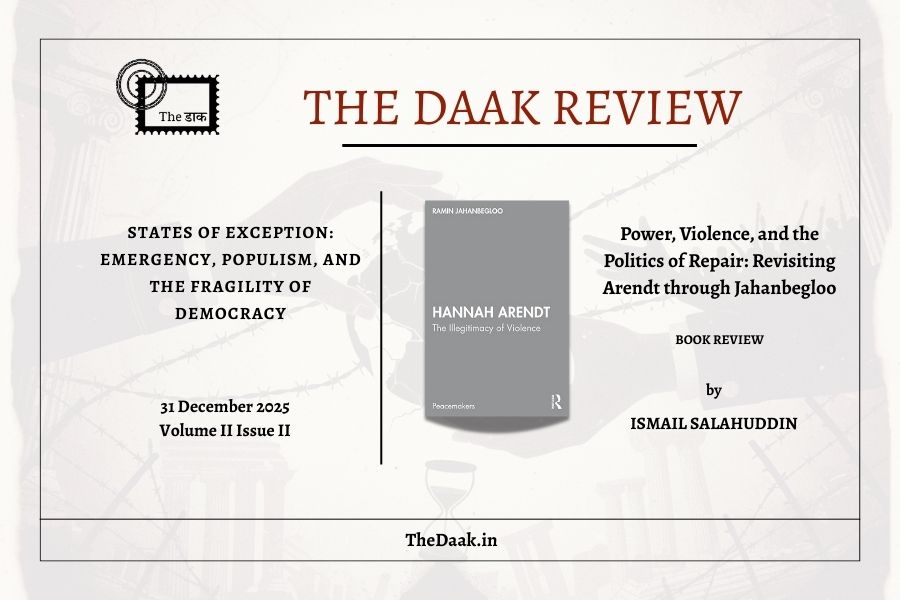
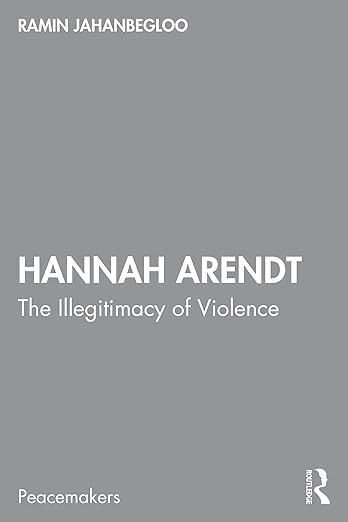
Book: Hannah Arendt: The Illegitimacy of Violence by Ramin Jahanbegloo, Routledge, 2025, 104 pages, 197 × 126 × 9 mm, ISBN 9781032968117, price 988 INR.
Ramin Jahanbegloo’s Hannah Arendt: The Illegitimacy of Violence is a slim yet striking intervention in contemporary political thought. Barely over a hundred pages, the book reads more like an extended essay than a monograph. Yet its brevity should not be mistaken for superficiality. On the contrary, Jahanbegloo uses the concision to great effect, offering a clear and incisive re-articulation of Hannah Arendt’s fundamental claim. At the centre of Jahanbegloo’s reading of Arendt is a sharp distinction between violence and political authority, a distinction that is often blurred in both revolutionary and state-centric thinking. For Arendt, violence and power are not only different; they move in opposite directions. Violence is a tool, it can destroy existing structures, silence opposition, and impose obedience. But destruction, by itself, does not amount to political authority. Authority emerges only when people recognise a shared order as legitimate, and they consent to act together, honour promises, and sustain institutions over time.
This is precisely where Arendt departs from thinkers like Frantz Fanon. Fanon understood violence as a creative force: the destruction of the colonial order was, for him, the condition for constructing a new political subject and a new world. Violence, in this view, is not merely negative but productive; it clears the ground for freedom. Arendt was sceptical of this claim. She did not deny that violence could overthrow domination, but she insisted that overthrowing a regime is not the same as founding authority. The moment violence becomes the primary language of politics, she argued, the space for persuasion, plurality, and mutual recognition begins to collapse.
Political authority, in Arendt’s sense, is therefore not located in weapons, armies, or even revolutionary acts. It is located in people acting together, recognising each other as equals, and committing themselves to a common world. This is why she famously wrote that “all government rests on opinion.” When states rely increasingly on coercion, they are not demonstrating strength but revealing the absence of consent. Violence may force compliance, but it cannot generate legitimacy. Authority does not flow from fear; it flows from collective belief and participation.
Jahanbegloo’s intervention lies in making this distinction visible again at a time when violence is routinely mistaken for power. By placing Arendt alongside Fanon, he forces the reader to confront a difficult question: even if violence can destroy an unjust order, what enables a political community to endure afterward? For Arendt, the answer is clear and unsettling—only shared action, trust, and institution-building can do that work. Violence may open a moment, but it cannot sustain a political world.
At a time when states across the globe increasingly rely on coercion, whether through authoritarian crackdowns, mass surveillance, or brute militarisation, Jahanbegloo reminds us of the deceptively simple Arendtian maxim: “All government rests on opinion” (Arendt 1969, 45). What appears to be overwhelming power in regimes that silence dissent or criminalise opposition is, in fact, an admission of fragility. Violence can produce obedience, but not legitimacy. This distinction, first articulated in Arendt’s 1969 essay On Violence, animates the whole of Jahanbegloo’s book and is given new vitality through his comparative lens (Jahanbegloo 2025, 22–23).
The book opens by restating Arendt’s central insight with unusual clarity. In On Violence, Arendt argued that violence is always instrumental. It relies on tools—weapons, technologies, and bureaucratic mechanisms, and operates strictly as a means to an end. Unlike power, which emerges from people acting together, violence substitutes force for consent and can therefore never generate legitimacy (Arendt 1969). Power, by contrast, exists wherever people act together in concert, bind themselves through promises, and sustain institutions over time (Arendt 1958, 200–201). Yet power, in this sense, is not identical with political authority. Power can exist without legitimacy, and it can be mobilized in ways that exceed or even undermine authority. Political authority, for Arendt, depends not only on collective action but on its recognition as rightful and binding by those who participate in it. Where such recognition erodes, power may still operate, but authority begins to unravel. Power is not a property one can hoard but a relation that arises between human beings. It is grounded in plurality, in the “space of appearance” where people meet as equals.
The distinction between power and violence is not merely conceptual but diagnostic. For Arendt, the turn to violence signals the erosion of authority rather than its consolidation. When rulers must rely on force, it is because consent has already weakened and the public realm has begun to collapse. Violence may secure obedience, but it cannot generate legitimacy or sustain a political community over time (Arendt 1969).
What matters in Jahanbegloo’s reading is not simply the restatement of this claim but its contemporary resonance. In a political moment saturated with images of military strength and state coercion, his insistence on separating violence from authority cuts against common sense. By treating violence as a symptom of fragility rather than power, Jahanbegloo invites the reader to rethink how regimes maintain control and what they lose when coercion replaces consent (Jahanbegloo 2025).
The book’s most compelling feature is its comparative method, especially because it brings into view the limits of Arendt’s own framework. Arendt’s reflections on violence were shaped largely by European experiences of totalitarianism and revolution, and she was often sceptical of struggles emerging from colonial contexts. As a result, her sharp distinction between power and violence leaves little room for situations in which violence is understood not only as domination but as a response to historical dispossession. Jahanbegloo’s comparisons do not dilute Arendt’s insights; they test them. By placing her in conversation with thinkers such as Frantz Fanon, he shows where Arendt’s categories illuminate political life and where they strain against experiences she did not fully theorise.
For Fanon, violence occupied a very different political and psychological register. It was not simply an instrument used to end colonial rule, but a process of self-making forged under conditions of extreme domination. Colonialism, Fanon argued, did not merely exploit the colonized; it systematically stripped them of agency, dignity, and recognition. In this context, violence became a means through which the colonized could reclaim a sense of self and collective existence that colonial power had denied them. Destruction, in other words, was imagined as the precondition for construction. “Violence”, Fanon wrote, “is man re-creating himself” (Fanon 1963, 44).
Arendt could not be further from Fanon’s position, but the disagreement turns on a crucial distinction that is often blurred: the difference between revolt and war. Fanon wrote from within a context where anti-colonial revolt unfolded as a condition of permanent war, structured by racial domination and military occupation. Arendt, by contrast, was deeply shaped by Europe’s experience of total war and totalitarianism. For her, violence, whether deployed by states or movements, tends to erode the very conditions that make politics possible. Where Fanon saw catharsis and self-recovery, Arendt saw fragmentation: the collapse of speech, plurality, and the fragile trust on which a public realm depends.
Jahanbegloo does not attempt to reconcile these positions, nor does he reduce one to the other. Instead, he treats them as answers to different political predicaments. Fanon centres the moment of revolt, the breaking of an imposed order; Arendt remains preoccupied with what follows—how a common political world can be founded and sustained after domination ends. From Arendt’s perspective, building a public realm through violence is counterintuitive, because violence substitutes force for consent and undermines the mutual recognition on which authority rests. This raises a difficult question that Jahanbegloo deliberately leaves open rather than resolving too quickly: if violence cannot generate political authority, how do the oppressed gain access to power? Arendt’s answer points not to armed revolt but to collective action, council forms, promises, and institution-building, forms of power that emerge through participation rather than coercion. Whether such alternatives are always available under conditions of extreme oppression is not fully answered in the book, and it is precisely this tension that gives the comparison its critical force.
The second comparison is with Gandhi, whose satyagraha — disciplined, collective nonviolent resistance, was the cornerstone of India’s independence movement. Gandhi insisted that truth, self-suffering, and nonviolence were not only ethical imperatives but also strategic instruments for mass mobilisation. Through boycotts, marches, and fasts, Gandhi aimed to convert the opponent while creating new forms of solidarity among the oppressed (Gandhi 1927, 112–14).
Arendt, however, was wary of Gandhi’s ethic as a kind of moralism, too rooted in compassion and pity to count as properly political. For Arendt, politics required distance which offered the capacity to deliberate in a public realm of equals and not the merging of public and private through sentiment. Compassion, she wrote, “abolishes the distance essential for politics” (Arendt 1963, 79).
Jahanbegloo is fair to Arendt but also critical. He shows that Gandhi’s campaigns were not merely moral performances but involved concrete practices of political organization: the building of local committees, disciplined networks of volunteers, and participatory forums that coordinated boycotts, strikes, and negotiations. These structures did not dissolve once a campaign ended; they helped institutionalize new forms of collective action and political participation that reshaped India’s public life (Jahanbegloo 2025, 64–66). In other words, Gandhi’s moral force was also a political technology, capable of producing exactly the kind of institutions that Arendt claimed only politics could create. Here Arendt’s blind spot is clear: her insistence on separating morality and politics underestimates how moral frames can themselves be instruments of political innovation.
The third interlocutor is Max Weber, whose famous definition of the state as the entity that claims the “monopoly of the legitimate use of physical force” (Weber 1919, 78) has framed political science for over a century. Arendt knew Weber well, but she inverted his definition. For her, the reliance on force was not the proof of legitimacy but its erosion. States that must constantly assert their monopoly are already losing it. Legitimacy, she insisted, comes from opinion, not force.
Jahanbegloo underscores how radical this reversal is, especially in today’s world, where governments habitually conflate coercion with authority. The lesson is stark: fear can secure obedience, but it cannot generate trust or durability (Jahanbegloo 2025, 82). By trust, Jahanbegloo means the expectation that political institutions will endure beyond moments of coercion and that rulers will remain accountable to those they govern. Durability refers to the capacity of a political order to reproduce consent over time, not through constant enforcement but through shared belief in its legitimacy. In this sense, legitimacy emerges when people recognise authority as rightful, even when they disagree with particular decisions. In deeply unequal societies, however, this recognition is uneven and fragile. Where large sections of the population experience exclusion, dispossession, or structural violence, trust cannot be assumed; it must be actively built through participation, representation, and institutional fairness. Jahanbegloo’s point is not that coercion disappears in such contexts, but that without trust, even the most forceful state remains politically unstable.
The book’s greatest strength is its pedagogic clarity. Jahanbegloo writes in a conversational tone, avoiding jargon while retaining precision. His comparisons are crisp, his explanations lucid. He neither lionizes Arendt nor caricatures her. Instead, he presents her as a stubborn, brilliant interlocutor who forces us to reconsider easy assumptions about resistance, legitimacy, and repair.
For students encountering Arendt for the first time, the book is an excellent entry point. For scholars, it offers a useful provocation: an invitation to rethink Arendt’s insights, which were shaped largely by European experiences of revolution, total war, and totalitarianism, by placing them in conversation with anti-colonial and non-Western political traditions such as those represented by Fanon and Gandhi. The juxtapositions with Fanon and Gandhi are particularly effective, forcing readers to confront the limits of Arendt’s Eurocentric framework while still valuing her analytic sharpness.
Jahanbegloo’s book is thoughtful and insightful, but two limitations are worth noting.
First, Jahanbegloo does not press hard enough on Arendt’s dismissal of moral movements. Gandhi’s satyagraha and the American civil rights movement were not simply moral appeals but deeply political innovations, capable of creating durable institutions (King 1963, 91). They converted private suffering into public claims, institutionalised new repertoires of protest, and created organisations that outlasted individual campaigns. Arendt’s suspicion of compassion led her to underestimate these movements’ political creativity. Jahanbegloo acknowledges this but leaves it underexplored.
Second, the book stops short of a concrete theory of reconstruction after violence. Jahanbegloo repeatedly asks what remains after revolt, but his answers are gestural: storytelling, solidarity, mutual action. What is missing is a programmatic vocabulary of institutional repair. If violence destroys the space of appearance, what practices can reliably recreate it? Truth commissions, transitional councils, local assemblies and constitutional safeguards, are not merely technical fixes but vital mechanisms for rebuilding trust. Here the book leaves its readers wanting more.
Yet these criticisms point less to weaknesses than provocations. The book’s enduring gift is its insistence on the question that underlies every struggle: after the shooting stops, what do we have left? That question is not academic. It faces every postcolonial state, every revolution, every democracy struggling under authoritarian pressure. Violence may bring liberation or catharsis, but politics requires something else, institutions, trust, promises, plurality.
By foregrounding this question, Jahanbegloo turns Arendt’s insight into a tool for our present. His book warns against romanticising revolt while also rejecting complacent moralism. It demands that we think not only about how to resist domination but also how to rebuild the fragile, plural world in which freedom can endure.
Hannah Arendt: The Illegitimacy of Violence is a short book with long echoes. It restores Arendt’s sharp distinction between power and violence, places her in dialogue with Fanon, Gandhi, and Weber, and forces readers to confront the political costs of violence in all its forms. At the same time, it challenges us to extend Arendt’s thought beyond its limits to recognise the political creativity of moral movements, and to theorise the institutional labour of reconstruction after conflict.
Written in prose that is both accessible and precise, the book is suitable for students, scholars, and general readers alike. It does not settle the debate, nor should it. Its value lies in its capacity to reopen the question of violence, legitimacy, and repair with fresh urgency.
In a world where governments increasingly equate coercion with authority, Jahanbegloo’s Arendt reminds us that violence is always a confession of weakness. Power, she insists, rests not on fear but on the fragile miracle of people acting together. To remember this is to resist the allure of domination and to insist, even amid conflict, on the possibility of rebuilding the public world.
References:
Arendt, Hannah. 1963. On Revolution. New York: Viking.
Arendt, Hannah. 1969. On Violence. New York: Harcourt Brace.
Fanon, Frantz. 1963. The Wretched of the Earth. Translated by Constance Farrington. New York: Grove Press.
Gandhi, Mohandas K. 1927. An Autobiography: The Story of My Experiments with Truth. Ahmedabad: Navajivan.
Jahanbegloo, Ramin. 2025. Hannah Arendt: The Illegitimacy of Violence. New Delhi: Routledge India.
King, Martin Luther, Jr. 1963. Strength to Love. New York: Harper & Row.
Weber, Max. 1919. Politics as a Vocation. Munich: Duncker & Humblot..
Ismail Salahuddin is a researcher & columnist based in Delhi and Kolkata
 TheDaak review
Leave a comment