
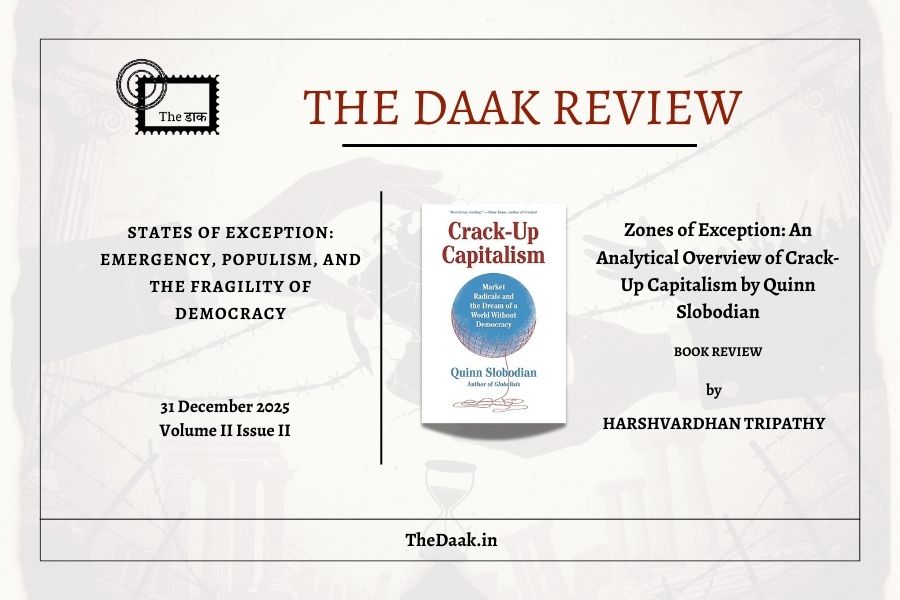
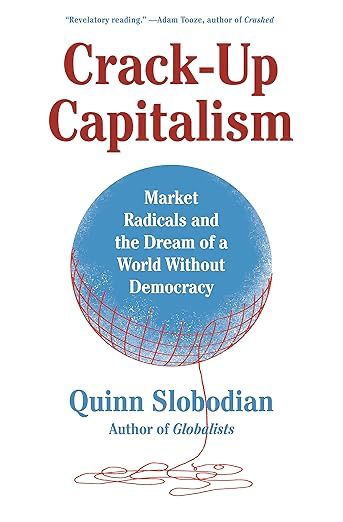
Book: Crack-Up Capitalism: Market Radicals and the Dream of a World Without Democracy by Slobodian, Quinn. 2023. Random House. 336 Pages, 16.64 x 2.92 x 24.38 cm, ISBN: 1250753899, Price: 998 INR (Hardcover).
The global political order, comprising different political formations such as liberal democracies, state socialist regimes, and authoritarian or theocratic states, nonetheless projects an illusion of coherence and uniformity encapsulated within the nation-state. Each of these ‘types’ of political formations is generally imagined as a ‘whole,’ a totalistic system. In such a totalistic system, state sovereignty, embodied in constitutional rights and juridical authority, is presumed to extend seamlessly across its territorial domain and population. However, in reality, seamless sovereignty is a fiction: nation-states themselves produce zones of exception where sovereignty is fractured. These zones, such as SEZs, EPZs, FTZs, and Free Ports, exist as exceptions within the juridical and territorial fabric of the state, where the normal constitutional order is suspended to attract capital investment.
As the juggernaut of global capitalism advances, it does not flatten or homogenise the world, as classical modernisation theories once imagined. Instead, it produces an archipelago of differentiated spaces calibrated to the capitalist logic of profit maximisation through legal, fiscal, and labour exceptionalism. These islands, which can exist both inland and literally on an island, can be described as depressions or elevations created by the capitalist juggernaut over the perceived flat surface of national sovereignty. In Crack-Up Capitalism: Market Radicals and the Dream of a World Without Democracy (2023), Quinn Slobodian conceptualises these zones as enclaves carved out of national jurisdictions and freed from ordinary regulation, enabling investors to dictate their own rules (p. 2). He links their global proliferation to strands of libertarian thought, such as anarcho-capitalism, right-libertarianism, and paleo-libertarianism—whose shared objective is to insulate capital from democratic accountability and to construct forms of capitalism detached from popular sovereignty (p. 9). Slobodian traces the evolution of this ideological project through a global itinerary that includes Hong Kong, Singapore, London’s docklands, apartheid South Africa, Dubai, microstates and tax havens, and emerging virtual spaces. Across these cases, the book shows how experiments in political-economic geography have informed libertarian imaginaries of a post-democratic capitalist order governed by market logic rather than democratic constraint.
Although the first Special Economic Zone (SEZ) was established in Ireland in the late 1950s, SEZ as a global phenomenon emerged in the late 1960s. It was a time when developing countries such as India, China, and those in Latin America and East Asia carved out territorial enclaves to attract domestic and foreign capital for industrialisation and export growth. However, the success of Hong Kong, a former British colony and now a Special Administrative Region of China, specifically captured the imagination of free-market radicals. Following his visit during the 1978 Mont Pelerin Society meeting, Milton Friedman famously described Hong Kong as a ‘laboratory experiment’ of neoliberal economics, a view later echoed by Alvin Rabushka of the Hoover Institution, who called it an approximation of the textbook neoclassical model (p. 19). This enthusiasm was further amplified by Reason magazine’s call for ‘two, three, many Hong Kongs’ (p. 23).
What attracted these ideologues, policy-makers and think tanks towards Hong Kong was the total absence of any form of electorate. Until electoral reforms in 1985, it was governed by an unelected colonial administration, lacked trade unions, permitted widespread hire-and-fire practices, maintained minimal tariffs and welfare provisions, and imposed a flat income tax of 15 per cent. These conditions ensured economic policymaking free from popular pressure, a feature celebrated by Friedman’s claim that political freedom was not a prerequisite for economic freedom (p. 14). Hong Kong thus emerged as an archetype of capitalism organised through a juridically engineered state of exception, a model later replicated by neoliberal policymakers across diverse territorial and even virtual contexts.
The second chapter examines ‘the City’ of London, also known as the ‘Square Mile’, a distinct juridical and administrative enclave at the heart of London and one of the world’s most influential financial districts. Its separateness is symbolically expressed in two ways. First, through its own Lord Mayor and ceremonially reinforced by the British Crown. Second, it is institutionally sustained through a distinctive electoral system in which corporations, alongside residents, possess voting rights. With business votes significantly outnumbering resident voters, corporate interests exercise direct influence over local governance, earning ‘the City’ the label of the ‘Vatican of capitalism’ (p. 40). Slobodian also discusses Canary Wharf, a privately owned business district often described as “Hong Kong on Thames” (p. 40). Developed over the ruins of the London docklands, which declined after the container revolution of the 1960s, Canary Wharf emerged through Thatcher-era policies. The policies designated the area as an enterprise zone governed by the London Docklands Development Corporation – an unelected body dominated by corporate and real estate interests. On the one hand, public land was sold at a lower price, infrastructure investment was guaranteed, and tax concessions were offered to corporations. On the other hand, local populations were displaced, and social welfare was sidelined. Through these measures, Canary Wharf was transformed into a global financial hub, exemplifying the neoliberal remaking of urban space and anticipating what Saskia Sassen later theorised as the ‘global city.’
The third chapter examines the emergence of Singapore from the margins to become a model for the reorganisation of capitalism and the state for market radicals, particularly British conservatives in the 1970s–80s and later Brexit proponents. Singapore embodied the neoliberal conception of the state as both a market-making authority and an enforcer capable of suppressing working-class resistance. The Singaporean solution combined a limited social security net for citizens with a rigidly tiered labour regime that rendered foreign workers disposable, rightless, and subject to hire-and-fire practices. This arrangement enabled the state to maintain legitimacy among citizens in three major ways. First, the state subsidised housing, compulsory savings, and infrastructure. Second, it insulated capital accumulation from democratic pressures by excluding noncitizens from political claims. Third, the state exercised tight control over unions and the press. Singapore also legitimised its political-economic order through the idiom of ‘Confucian capitalism,’ a framework later echoed in China’s formulation of ‘socialism with Chinese characteristics’ (p. 71).
The first part of the book examines the emergence of small sovereign enclaves and city-states as templates for reorganising capitalism without democracy. The second part, titled Phyles, goes on to explore the attempts made by market radicals to create self-governing communities. These communities were created through secession from the nation-state by mobilising tribal and racial categories. The earliest experiment appeared in apartheid South Africa, where Friedman declared in 1978 that democracy was overrated and that voting by dollars was superior to voting by ballots (p. 82). Drawing on the examples of Hong Kong and Singapore, the apartheid regime balkanized South Africa into tribal-based Bantustans. The Bantustans were envisioned as ‘African Hong Kongs’ – with Ciskei referred to as “the pseudo-nation” which was “on the Eastern Cape, in the southeast of South Africa,” serving as the primary model of deregulation, privatisation, export-processing zones, and racial segregation under conditions of political exclusion (p. 84). This model later inspired libertarians in the United States and was further developed by figures such as Leon Louw and Frances Kendall, who proposed a canton system dividing South Africa into racially and ideologically distinct jurisdictions competing for capital investment.
The chapter titled ‘The Wonderful Death of the State’ explores how secession, the breakup of large nation-states into smaller polities, has animated libertarian thought since the 1970s, gaining momentum after the collapse of the Soviet Union. Libertarians such as Murray Rothbard and Lew Rockwell, founders of institutions like the Cato Institute and the Ludwig von Mises Institute, celebrated secession on the grounds that smaller nations would become potential zones; small competitive jurisdictions in a global marketplace of legal difference, suitable to carry out radical economic experiments and magnets for footloose investors seeking cheap labor, tax-breaks, and shielded from democracy. The chapter also examines the convergence of paleo-libertarians and paleo-conservatives into a ‘paleo alliance’ combining free-market radicalism with racial segregationist politics in the United States.
The sixth chapter, titled ‘Cosplaying the New Middle Ages,’ traces the emergence of gated communities in the United States during the 1960s and their appeal to anarcho-capitalist thought, which seeks to privatise state functions ranging from infrastructure to law itself. Championed by David D. Friedman, the son of Milton Friedman, provided an opportunity to experiment with anarcho-capitalist ideas where a small segment of privately owned land would secede from the nation-state to become a quasi-sovereign zones defined by contractual, not democratic governance, where rules concerning land use, security, public space, and even conflict resolution were set and enforced privately rather than through municipal or state institution; an inspiration derived from medieval Iceland where law was privately enforced. Modelled on medieval Iceland and fortified settlements, these enclaves were envisioned as racially homogeneous spaces detached from the wider political order. The final chapter of the second section examines the rise of tax havens, using the case of Liechtenstein as an example. Liechtenstein is a microstate that originated in the medieval period and is celebrated by libertarians as a prototype of the state as a service provider with its citizens as customers (p. 133). Emerging as a major tax haven in the 1950s, Liechtenstein, ruled by an absolute monarch with a symbolic parliament, offers secrecy, capital mobility, and even a constitutional right of secession, making it a laboratory of libertarian fantasies of ‘competitive sovereignties,’ which commodified citizenship.
In the third and final section, titled ‘Franchise Nation,’ Slobodian examines the attempts to realise the libertarian dream of free markets without democracy. He drew on lessons from Hong Kong, Singapore, and Liechtenstein concerning commodified sovereignty, authoritarian control, and gated enclaves. One key example is war-torn Somalia, which functioned as a virtually stateless society between 1991 and 2000. Central to this case was the Dutch libertarian lawyer Michael van Notten, described by Slobodian as a ‘postindustrial tribal anarchist,’ who viewed Somalia as a laboratory for competitive, non-democratic governance. Van Notten celebrated customary clan-based law and compensation-based justice as alternatives to centralised state authority, envisioning portable polities based on nomadic culture, that rejected democratic dictatorship of the 51%, and framed decentralisation as a radical form of decolonisation – freedom from the Western model of the central state and democracy (p. 153). The next chapter traces the emergence of Dubai from a Trucial state under British rule into a major node in global finance, embodying neo-reactionary thinker Curtis Yarvin’s vision of mini-states as ‘patchworks’ – a global web of sovereign micro-polities (p. 172). A neo-medieval absolute monarchy, Dubai governs not as a unified nation-state but as a mosaic of semi-autonomous zones. Each zone comprises distinct legal regimes and incentives for capital, populated largely by non-citizen migrants without democratic rights, income taxes, trade unions, or opposition parties (p. 171). Dubai thus emerged not only as a city tailored for globalisation but also as a model “brand nation,” marketed through initiatives such as Dubai Inc. to attract footloose investors.
The next chapter opens with a provocative thesis by Stanford economics professor Paul Romer, who justifies colonialism for creating the ‘right’ rules in former colonies like Hong Kong. He argues that former colonies could emerge as capitalist utopias only because colonialism introduced an appropriate institutional culture. Romer therefore proposed “charter cities,” a new variant of colonialism in which poorer nations would cede patches of territory to richer ones as “startup” jurisdictions (p. 188). His ideas were tested in places such as Madagascar, where the government allotted 1.2 million hectares of agricultural land to a Hong Kong based conglomerate, a project later abandoned after a coup. A similar experiment occurred in Honduras, where zones were granted to private corporations with powers to craft their own civil and commercial laws and conduct international relations, functioning as blank slates to jump-start capitalism.
The final chapter examines what may be the most radical attempt by market liberals to escape not only democracy but also physical territory, by imagining a future located in the cloud or metaverse. Enabled by digital technologies and grounded in the concept of the ‘sovereign individual,’ thinkers such as James Dale Davidson and William Rees-Mogg envision the exit of hypermobile ‘high-IQ’ individuals from nation-states to form self-governing polities in virtual space. In such spaces, they are freed from social obligations and are responsible only to themselves (p. 206). In a similar vein, tech radicals like Balaji Srinivasan proposes this digital exit as a two-step process; first, the aggregation of affluent individuals through online networks, followed by the acquisition of physical territory to establish a gated community with its own sovereign authority (p. 211).
After taking us through the fascinating journey of the attempts by free-market radicals to create a capitalist utopia free from the constraints of democracy, Slobodian concludes with the central contradiction of this project. This contradiction is the reliance on the state to create and sustain supposedly “stateless” zones, a paradox that undermines anarcho-capitalist rhetoric but remains largely unacknowledged by its proponents. As Slobodian argues, zones function as state instruments that advance the interests of capital by dispossessing marginal populations. Such selective suspension of democracy within designated territories is justified under the guise of the nation-state’s democratic legitimacy.
Building on Carl Schmitt’s theory of sovereignty, Giorgio Agamben, in State of Exception (2005), argues that true sovereignty resides in the capacity to suspend the law. In other words, the normal juridical order embodied in constitutional rights can be suspended during moments of political or economic crisis. The power to suspend constitutional guarantees and the rule of law thus becomes the ultimate test of sovereign authority. ‘Zones,’ often imagined in libertarian fantasy as spaces of exit from state power, are in fact manifestations of the state’s supreme sovereignty. It is the state that creates zones through policy, enforces their territorial and juridical boundaries through coercive apparatuses, and ultimately retains the authority to modify or revoke the very exceptions that sustain them.
Zones also exemplify the contemporary normalisation of the state of exception that Agamben identifies in sites such as Guantánamo Bay, detention camps, refugee zones, and anti-terror legislation. In such sites, constitutional protections are suspended, and individuals are reduced to rightless subjects. These zones, which have been historically developed and theorised in free-market radical discourse, function as miniature states of exception. In other words, these zones can be viewed as juridically carved territories where ordinary law is selectively suspended under the rhetoric of development and investment. Within these enclaves, non-citizens labour without substantive legal protection, generating profits for a narrow elite. Far from diminishing sovereignty, zones intensify it by reaffirming the state’s power to decide where law applies, where it is withdrawn, and who is recognised as a citizen.
References:
Agamben, Giorgio. 2005. State of exception. University of Chicago Press.
Slobodian, Quinn. 2023. Crack-Up Capitalism: Market Radicals and the Dream of a World Without Democracy. Random House.
Harshvardhan Tripathy has a PhD from Centre for the Study of Social System, Jawaharlal Nehru University.

 TheDaak review
Leave a comment