
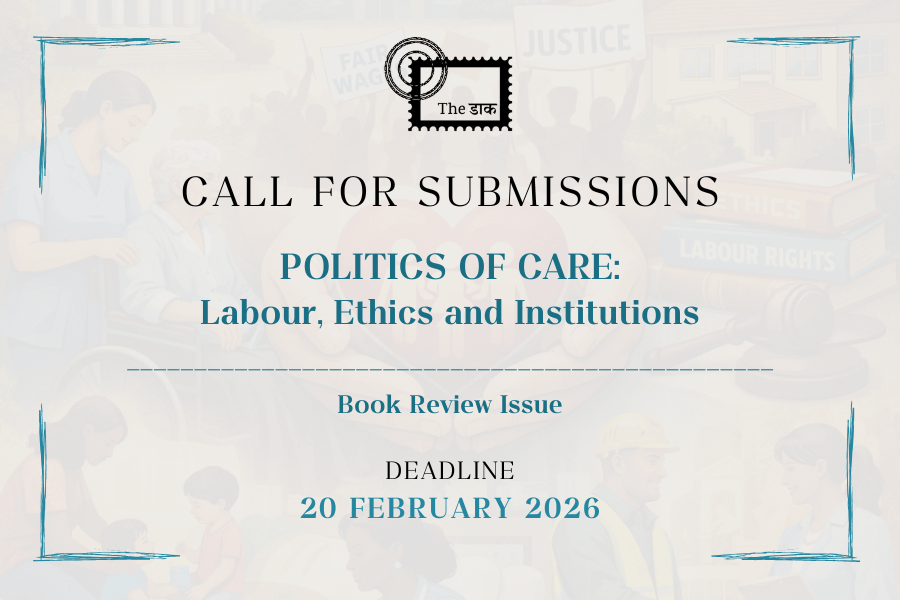
POLITICS OF CARE
LABOUR, ETHICS AND INSTITUTIONS
Care is everywhere in political life, yet rarely recognised as political. It sustains families, communities, institutions, and ecosystems, while remaining systematically undervalued, feminised, and rendered invisible. In recent years, amid pandemics, ecological crises, welfare retrenchment, and democratic crisis, the question of care has returned with urgency. Who is cared for, who provides care, under what conditions, and at what cost, are no longer marginal ethical concerns but central political questions.
Philosophically, care unsettles dominant political assumptions about autonomy, rationality, and independence. Feminist theorists have long argued that political theory has been built on an image of the self as self-sufficient, masking the dense networks of dependency that make social life possible. Care theory re-centres vulnerability and interdependence, revealing how political and economic systems rely on unpaid, underpaid, or coerced care work. Yet care is not inherently emancipatory; it can reproduce hierarchies, paternalism, caste and gender domination, and moral discipline. A politics of care must therefore grapple with both its ethical promise and its political ambivalence.
In the Indian context, care is deeply entangled with caste, gender, kinship, and informality. From domestic labour and sanitation work to community health and elder care, care practices are often moralised while remaining institutionally unsupported. The state frequently invokes familial responsibility even as it withdraws from public provisioning, producing a landscape where care is expected but not guaranteed. At the same time, traditions of mutual aid, solidarity, and collective care, within social movements, neighbourhoods, and marginalised communities offer alternative political imaginaries grounded in relationality and dignity. In our present times, where relationality is predominantly mediated by technology, with online interactions becoming a mainstay, the questions of care work through chatbots and technologically mediated setups have opened new fields of inquiry.
This issue invites book reviews that engage with care across disciplines – political theory, sociology, feminist studies, economics, law, history, anthropology, environmental studies, and public policy.
Discussions on books that speak to the theme of Politics of Care, including, but not limited to:
- Care and Feminist Political Theory
- Care, Labour, and Political Economy
- Care and State
- Care, Caste and Social Hierarchies
- Care, Emotion, and Moral Regulation
- Care in times of crises
- Care and ecology
- Care, Law, and Constitutionalism
- Care as Resistance and Solidarity
- Care and Artificial Intelligence
.
Please send your book reviews and review essays using the link here. The deadline for the same is 20 February 2026. This issue is due for publication on 21 March 2026. Book reviews should ideally be 1200-1500 words and review essays should not be more than 2000-2500 words.
Please note that if you are looking for a book recommendation on the current theme or want to discuss your book with our editorial team, you can write to us at editor@thedaak.in
Editorial Team
 TheDaak review
Leave a comment