
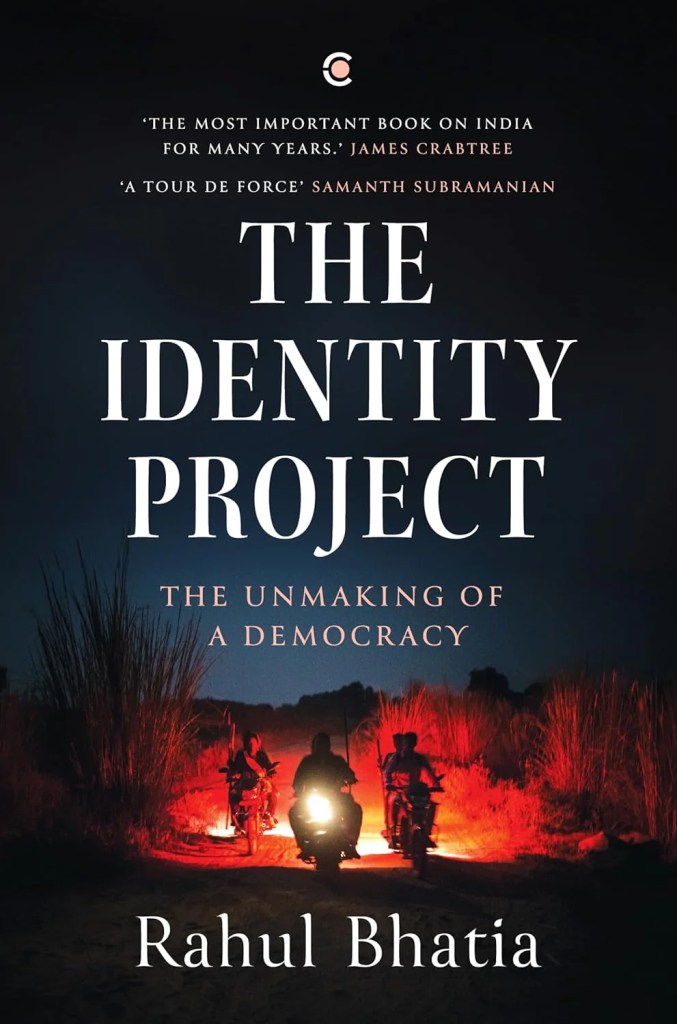
Book: The Identity Project: The Unmaking of a Democracy by Rahul Bhatia (New Delhi: Context/Westland Books, 2024), 464 pages, 23.4 × 15.6 cm, ISBN: 9789360458195, ₹899 (Hardback).
by Sanjana KS
Rahul Bhatia’s (2024) book ‘The Identity Project: The Unmaking of a Democracy’ is a valuable addition to the burgeoning literature on the rise of Hindutva in contemporary India. Yet it distinguishes itself by seamlessly weaving together in-depth interviews, personal anecdotes, testimonials, letters and diary entries, rich archival research to present a textured narrative that captures how the quiet transformation of Indian democracy is lived, felt and experienced. Its methodological sensibility and stylistic choice gives the book a lively and spirited tone that is often missing in academic accounts on the subject. Bhatia does not simply offer an authoritative account of the impact of decade-long communal polarization and violence; rather he invites the reader to see the transformations for themselves. Through spotlighting first-hand accounts of activists, riot survivors and political leaders among other personalities the author demonstrates how people encounter fear, uncertainty and everyday violence. Bhatia takes the reader through the lanes of Northeast Delhi and to university campuses to offer an exhaustive first-hand witness accounts of anti-CAA protestors as well as survivors of the 2020 Delhi riots. The book’s many protagonists are real people whose lives have been altered over the past decade; Ali (student of History at Jamia Milia Islamia) J (student at Ambedkar University, Delhi) and Nisar (a resident of Mustafabad) narrate their anxieties, fear, displacement and hopelessness. Most importantly it humanizes the Muslim minority by recording insightful conversations that serve as a crucial entrypoint into the lifeworld of people that inhabit the democracy.
This book is divided into five parts: Aftermath, A New Country, Family Matters, Technical Difficulties and An Education.
The first two parts are set in the context of the passage of the Citizenship Amendment Act (CAA) and the counter-protests. The book maps how dissent unfolded across multiple sites in Delhi and Mumbai. The author does not romanticise resistance as has been the case in general observations with respect to the nationwide anti-CAA protests. Instead, Bhatia shows how the movement endured the state’s constant attack, the changing nature of dissent and how different people in varied social locations experience the impact unevenly. This comes out most effectively in his account of the 2020 Delhi riots where he focuses not only on the incident but the aftermath of violence which is often overlooked. He records how institutions of the state- police and courts rather than being sites of protecting and enforcing law and order, exercise power over the marginalised minority. These sections foreground a crucial question that primarily drives Bhatia’s investigation: how has an ideology come to strip people of earlier feelings of belonging, coexistence and mutuality?
The provocative question of ‘where did the poison come from?’ propels the book to move in a historical direction in the part on Family Matters. This section relies heavily on archival material to trace the long genealogy of Hindu right-wing movement from the nineteenth century revivalism of Dayanand Saraswati to the formation of Arya Samaj, Anushilan Samiti, Hindu Mahasabha and the Rashtriya Swayamsevak Sangh’s initial days. This historical account is a prompt reminder on first, the heterogeneous nature of right-wing movement in India and; second, the modus operandi of these groups with the circulation of rumors, producing affect and strategically carrying out violence. This insight resonates with authoritative accounts of Gyanendra Pandey (1990 and 2005) and Paul Brass (2003 and 2006) on communal violence. This section also features a detailed interview with Partha Banerjee who recounts his experience with the Sangh. Through the interview, Bhatia describes how the Hindu right operates- specifically, its diffuse yet intimate presence. Held together through shakhas, personal contact and a culture of brotherhood the RSS’s organisational expanse makes it indistinguishable from the society. This allows the organisation to be visible and simultaneously maintain a discreet presence: it is ‘everywhere yet nowhere’.
It is precisely here that the book’s novelty begins to thin. Despite its ethnographic richness, the search for the source of ‘poison’ ultimately circles back to a familiar explanatory frame: the organisation and its ideology. This slides into the established narrative in many studies on Hindutva that explains democratic erosion in elite-driven ideological production. What remains under-theorized is why this ideology finds such deep resonance across social groups today, beyond the reach of the organisation’s infrastructure. The affective appeal, the aspirations it articulates and the moral ethical restructuring is sidelined. As a result the book stops short of fully explaining what it ambitiously promises to do.
The book consciously paces itself between the past and the present. The timeline jumps back-and-forth sometimes without making a coherent claim. As a result, the following part of the book ‘Technical Difficulties’ suffers the most. The story jumps from the present (in 2020) to the earlier part of the decade when the Unique Identification Project popularly known as ‘Aadhar’ was introduced. To demonstrate how history plays a recurring role in the present, the book looks into the surprising origins of India’s Identification project. This section, while thematically intriguing, feels abrupt and analytically undercooked. Bhatia narrates the Aadhar story as the brainchild of Nilekani who emerges as a sympathetic anti-hero in this story. His strongheaded persona pushes his vision for introducing Identification technology to ensure efficiency in implementing welfare policies, refusing to hear the naysayers who drew his attention to its possible misuse by the state. Years later, the subsequent enthusiastic embrace of Aadhaar by the Narendra Modi government and its push to link citizens’ bank accounts and mobile numbers to Aadhar is presented as evidence of the state’s reach this technology enables. This expansion and penetration of Aadhar in the everyday lives not only reduces citizens to numerical digits and thumb imprints, it also provides ‘data’ for the state to monitor and surveille. The past of the UIDAI haunts the present as the project is made to align with the fantasies of making a Hindu rashtra. The biometric system once used as a welfare mechanism now possibly fuels a surveillance state that actively designs laws for excluding. However, the most ambitious aspect of the book is also its weakest: the building of a connection between the Citizenship Amendment Act (CAA) and National Register of Citizens (NRC) with the Aadhar Identification project. The author notes how the CAA takes the identification system to its extreme logical conclusion. The state holds the ultimate authority to choose who belongs, leaving the citizen to prove his credentials as a legitimate citizen. This state-controlled framework of identification which began with Aadhar has now become a political weapon. CAA makes religion a legal criterion for determining citizenship marking a shift from neutral bureaucratic identification marker to communal identities. Thus, making identification systems themselves a tool of exclusion rather than inclusion. He makes it adequately apparent that the CAA cannot be understood without going back to the Aadhar story. This plausible link between a technocratic identification project and the ideological consolidation of a Hindu nation is not made clear. The reader is tasked with much of the job of making these analytical connections between surveillance, citizenship and majoritarian politics for themselves. Thus, Bhatia could have made a powerful theoretical intervention into the technopolitics of authoritarianism, but this potential remains unrealised.
In the final part, the book abruptly returns to the present and the conclusion feels rushed. However, the last chapter of the book deserves a special mention as it evokes an aching sense of loss, agony and doubt at what once felt familiar and safe- neighbours, neighbourhoods and places one could reckon as ‘home’ were no longer the same. The chapter details Nisar, a survivor of the Delhi Riots’ return to his village. Upon discovering that his old friend now works for the BJP he murmurs under his breath poignantly, “Perhaps it was not as I (Nisar) remembered”. This line conveys the unsettled realization most of us find ourselves in- disoriented by the incongruence of memory and the transferred present. Bhatia leaves us with a powerful reflection on whether the past was idealized or whether the present has simply morphed beyond recognition.
The book presents broader concerns with the transformation in India– how ordinary citizens adapt to normalised violence and how the right-wing reworks the contours of who belongs and who does not, not only through passing citizenship legislations (CAA) but technologies of governance (Aadhar). The title of the book, ‘Identity project’, serves as a valuable ‘conceptual hook’ to understand how the state constructs the idea of belonging and exclusion through two identification projects, thereby, fundamentally redefining the contract between the state and its citizens in modern India. Its greatest contribution lies in showing how Hindutva inhabits everyday life outside of formal politics. How it has reshaped dining table conversations, mohallas (neighbourhoods), our moral vocabularies and injected a new imagination of the nation. The book is an immersive narrative investigation into how communal ideology, identity and state power are reshaping modern India. It is useful for academics, journalists and ordinary readers as perusing through each chapter of the book reiterates an evocative story of the unmaking of the world’s largest democracy. As a narrative account this book succeeds in capturing the micro-shifts but it struggles to make an analytical intervention.
References:
Pandey, Gyanendra. “Notions of community: Popular and subaltern.” Postcolonial studies 8, no. 4 (2005): 409-419.
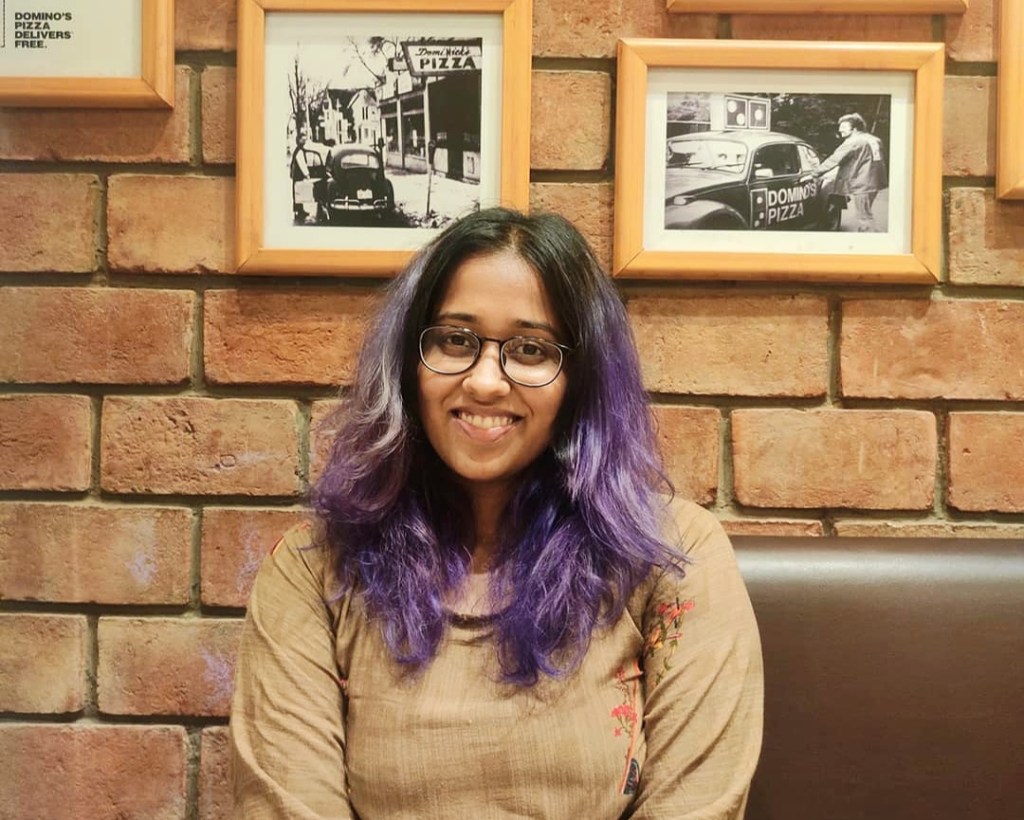
Sanjana (She/Her) is pursuing her PhD from the Centre for Political Studies, JNU.
©TheDaak2023
 TheDaak review
Leave a comment