
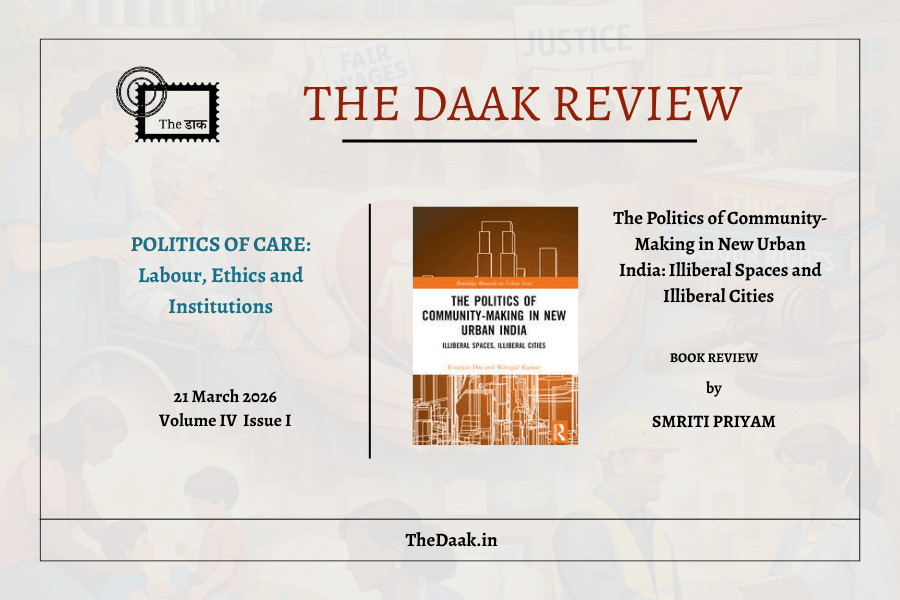
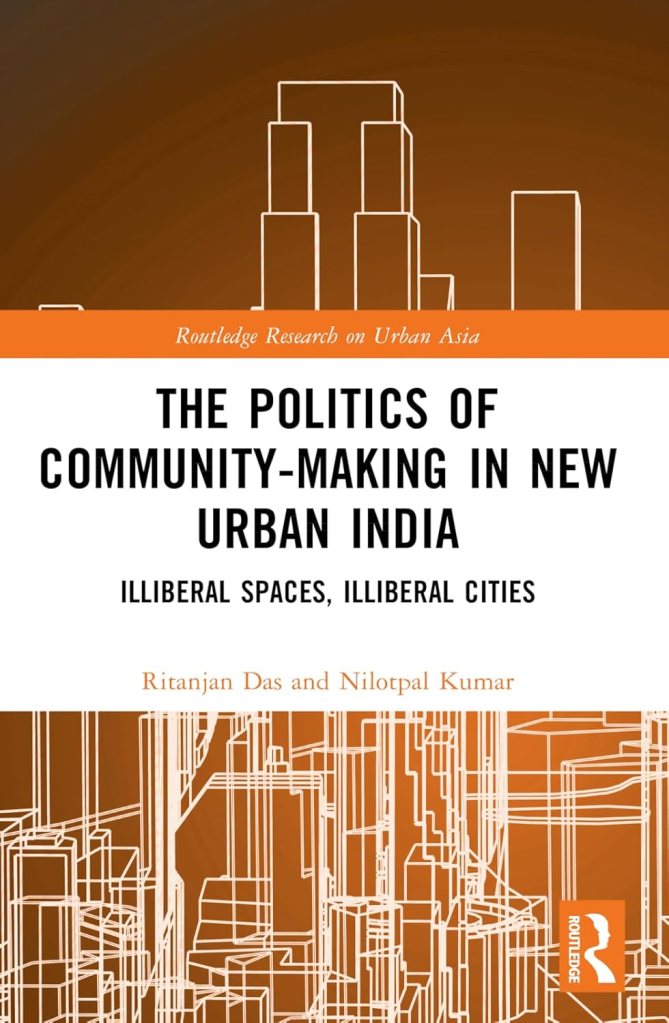
Book: The Politics of Community-Making in New Urban India: Illiberal Spaces and Illiberal Cities by Ritanjan Das and Nilotpal Kumar (New York: Routledge, 2023), 262 pages, 9.2 × 6.1 × 0.6 inches, ISBN 9781032096549 (paperback edition), USD 60.
Urban communities are often imagined as spaces sustained by mutual care and shared belonging. However, in contemporary Indian cities, the discourse of care often coexists with practices of suspicion, inequality, and exclusion. The Politics of Community-Making in New Urban India: Illiberal Spaces, Illiberal Cities, by Ritanjan Das and Nilotpal Kumar provides a thorough and theoretically ambitious analysis through its ethnographic engagement with everyday life across multiple urban sites. Instead of treating the community as a naturally cohesive social entity, the authors explain how it is deliberately constructed through practices that regulate belonging and differentiate between insiders and outsiders. This review analyzes the book through the framework of the politics of care, positing that the book depicts care not only as an emotional connection but as a disputed and contested social relationship that both fosters community and facilitates exclusion in modern urban India. The book primarily inquires if the production of new urban spaces in post-liberalization India promotes community forms that are majoritarian, exclusive, and resentful of liberal democratic principles (Das & Kumar, 2023). Drawing on the notion of the social production of space, the authors contextualize Noida within the larger frameworks of neoliberal accumulation, state-driven land acquisition, and real estate-driven growth. The transformation of agricultural land into gated communities, urban villages, and informal settlements generates distinct spatial settings that both need and inhibit certain forms of solidarity and care.
The prologue, recounting the Mahagun Moderne incident in Noida, serves as an analytic entry point into the intricate politics of care and mistrust. The episode, in which a domestic worker was violently assaulted by residents of the gated community on suspicions of theft, illustrates how the relationships between residents and service workers are determined by fragile and unequal power relations, despite their everyday proximity and interdependence. A dispute between residents of gated communities and migrant workers has rapidly been reinterpreted through collective narratives that portray the latter as dangerous outsiders. The incident therefore does more than recounting a moment of conflict within a housing society; it depicts that proximity does not inherently promote empathy and solidarity. On the contrary, care relations, such as domestic labor, become sites of distrust, securitization, and communalization (Das & Kumar, 2023).
Building on this opening episode, the book explores how practices of care operate across the three spatial sites it examines. The authors see care not just as a neutral or ethical disposition, but as a political and contentious social interaction influenced by hierarchy, labor, and institutional frameworks. Across these sites, care manifests in various interconnected forms: as protection and regulation within residential communities, as daily negotiations between residents and workers, and as informal practices through which marginalized individuals maintain support and solidarity. By emphasizing these shifting discourses, the book illustrates that care is fundamentally integrated into the formation of urban communities while simultaneously producing borders of inclusion and exclusion.
The first spatial context analyzed in the book centers on residential complexes and gated communities, whereby collective welfare and neighborhood security are presented as central concerns of community life. These spaces are governed by institutional mechanisms like resident welfare associations, apartment owners’ associations, surveillance systems, and informal norms that regulate behavior within the community. These unions foster solidarities around security, aesthetic order, and property maintenance. In this context, caring becomes a protective practice aimed at preserving the enclave’s existence. It is a care invested in walls, surveillance, and ritualized performances of cultural belonging, which serve to reinforce social boundaries and maintain the status quo within the enclave. Such solidarities are exclusive and defensive, supporting what the authors describe as illiberal community formation (Das & Kumar, 2023).
The second site focuses on the everyday interactions between residents and the workers who ensure the smooth functioning of these residential environments. Despite the fact that residents depend significantly on domestic labor and other forms of service work, these relationships are still characterized by mistrust and hierarchy. Care in this context becomes embedded within labour relations and institutional arrangements that regulate access and conduct within residential spaces. Rather than operating simply as an expression of moral concern, care is characterized by a negotiated relationship that is influenced by unequal authority, where gestures of responsibility coexist with practices of regulation and control.
The third site broadens the perspective by emphasizing the experiences of those who inhabit the margins of these urban communities. Here the analysis highlights the informal networks and daily solidarities that develop among workers and other marginalized actors navigating these regulated spaces. Unlike care shown through surveillance or institutional governance, care in this context is expressed through small acts of mutual assistance, shared knowledge, and collective negotiations. These behaviors show that care may also serve as a resilience resource, helping people maintain forms of support in otherwise hierarchical situations and cope with the exclusions inherent in modern urban settings. In the urban villages of Noida, predominant caste agricultural elites mobilize a collective identity centered on eviction and land acquisition. Solidarity arises from common experiences of state expropriation and spatial marginalization. Rather than unequivocally appreciating or criticizing these solidarities, it contextualizes them within historically established systems of caste, land, and political patronage. The analysis of jhuggi settlements further substantiates the argument. Migrant Communities negotiate precarious access to water, power, and tenure security through informal leaders, trade unions, and local political intermediaries. Care in these environments is collective and pragmatic. It manifests in the everyday practices of mutual assistance, resource allocation, and mobilization of essential services. However, these solidarities are hierarchically organized according to caste, religion, and regional identity (Das & Kumar, 2023).
The book asserts that care should be understood not merely as an emotional connection but as a contested social relationship through which communities create inclusion while concurrently producing exclusion. By examining these dynamics across different spatial contexts, the authors offer a significant insight into how everyday practices that sustain urban communities are interconnected with the processes that regulate who can legitimately inhabit these spaces.
Notwithstanding these contributions, certain conceptual questions remain insufficiently explored. The book clearly demonstrates exclusionary practices in contemporary urban communities, but it falls short in explaining the concept of illiberalism. Although the term effectively captures the restrictive dynamics observed across the sites discussed in the book, its broader theoretical relationship with debates on liberalism, citizenship, and urban governance is not completely elaborated. A more profound engagement with these theoretical discussions could have strengthened the conceptual clarity of the care framework and situated the book more firmly within broader debates on urban political forms.
Another limitation concerns the relatively limited engagement with gender. Gendered expectations and hierarchies severely impact the interactions described in the book, which encompass domestic labor, caregiving, and household relations. However, the analysis mostly ignores gender. A more comprehensive examination of the impact of gender on the structuring of care and labor in these urban environments could have strengthened the argument and expanded the book’s contribution to the discourse on the politics of care.
Overall, The Politics of Community-Making in New Urban India represents a relevant and analytically significant contribution. By foregrounding the ways in which care operates within the relations of hierarchy, mistrust, and negotiations, it challenges idealized notions of urban communities as naturally cohesive or inclusive. It demonstrates how communities establish their boundaries and regulate belonging through deeply interconnected practices of care. In doing so, the book provides a significant perspective for comprehending the politics of care in rapidly transforming urban spaces and will be of particular interest to scholars working in urban sociology, community development, and the everyday politics of urban life. By emphasizing how neoliberal urban restructuring is intertwined with illiberal solidarity, Das and Kumar challenge readers to reconsider the moral economy of care in contemporary cities. The book posits that the urban space is not only a space for social interactions. It actively contributes to the way communities view themselves, the people they decide to keep safe, and the people they exclude. In this context, care serves as both a means of survival and a battleground, exposing the intricate politics of belonging in contemporary urban India.
References
Bourdieu, P. (1984). Distinction: A social critique of the judgement of taste. Harvard University Press.
Harvey, D. (2009). Social justice and the city (Rev. ed.). University of Georgia Press. (Original work published 1973)
Smriti Priyam is a doctoral candidate in the Department of Sociology at Jamia Millia Islamia.

 TheDaak review
Leave a comment