
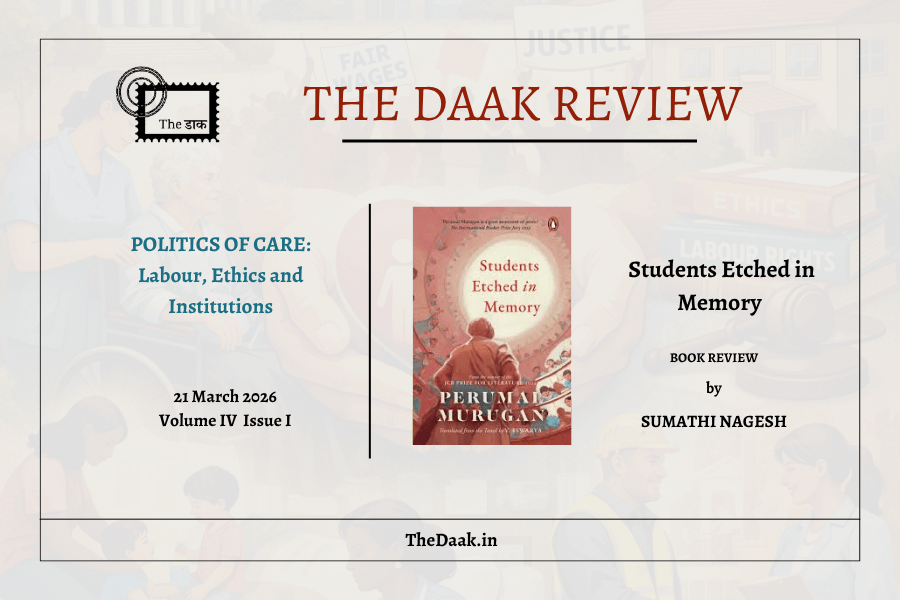
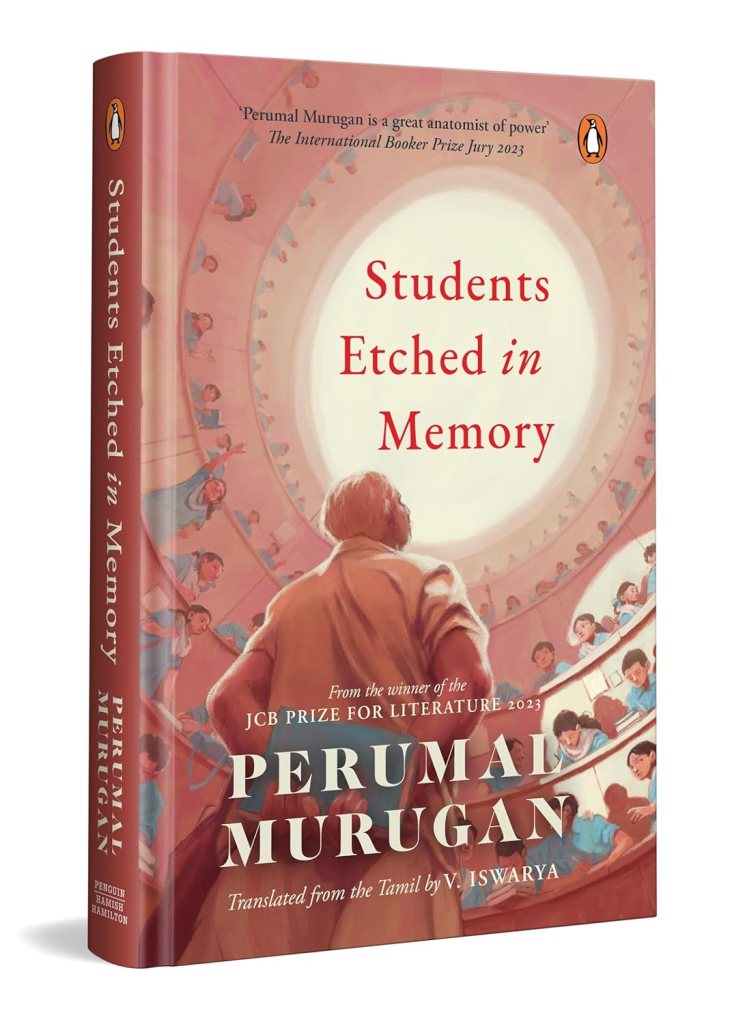
Book: Students Etched in Memory by Perumal Murugan, Translated by Iswarya V (Haryana, India: Penguin, 2025), 220, ISBN 9780143468066, Rs. 599
When I read Perumal Murugan’s book Students Etched in Memory, I immediately connected with the narrator’s angst. “Should a teacher discuss with his students only their studies? What was wrong with discussing everything else too? Can a teacher not be a friendly companion and confidant to his student? So my thoughts ran.” (90) In this book, Murugan recalls his experiences teaching across several government colleges in rural Tamil Nadu through a collection of forty stories originally written for the newspaper. Instead of romanticising the vocation of a teacher as a noble one, this book presents education as a complex form of labour that extends beyond the classroom, involves overcoming institutional constraints and one that is often shaped by caste and class hierarchies. In doing so, he offers a critique of educational systems while making a compelling political claim for reimagining teaching through an ethics of care.
In recent scholarship, the framework for understanding care work has undergone significant change. Care labour is no longer understood primarily as a “labour of love” (England 2005), but as affective and material labour shaped by social hierarchies and institutions. (Federici 2012). The “prisoner of love” model views emotional and moral satisfaction as compensatory rewards for care work, thereby explaining why much of the labour is either unpaid or underpaid. But feminist and intersectional ethics of care have challenged this conceptualisation by highlighting empathy, compassion, and the context of care, in contrast to the traditional theories that value care as an abstract principle. Hence, the feminist theory of care highlights how gender norms, caste location, and class position fundamentally shape who provides care, who receives it, and under what conditions (Collins and Bilge 2016). Care pedagogy extends care to all students and does not consider certain students as needing more care. In that, care is not just an emotional engagement, but must be institutionalised, in the syllabi and within the infrastructure of an institution.
In this context, Perumal Murugan’s Students Etched in Memory, sensitively translated into English by Iswarya V, contributes to the discourse through an introspective, politically informed commentary on teaching as care work. Murugan begins his book with a provocation: “What needs to be done? We are stuck with a pedagogical system that has failed miserably.” (xii) Through this question, he sets the narrative tone that follows, underscoring that the failure of education is neither natural nor inevitable. He neither offers any generalising policy reforms nor abstract solutions. Instead, his stories are grounded in the everyday pedagogical encounters, exposing how structural inequalities are actively engaged with learning and teaching. He remembers occasions when he has called the parents of some students to persuade them to let them pursue their higher studies. (73) Teaching, in his account, is clearly reclaimed as emotional labour that extends far beyond the classroom, even many years after the student has graduated, as in Rasu’s story. (29) The leitmotif of once a teacher, always a teacher captures how a teacher’s responsibilities transcend time and circumstances.
One of the most significant interventions of the book lies in the attention to rural educational spaces, which Murugan presents in stark contrast to the private universities and elite institutions located in urban centres. The students at rural colleges are confronted with layered forms of deprivation: economic precarity, (Rajesh, the gunny sack dealer in “Yellow Devil”, 135) enduring caste-based stigma, (students who engaged in manual labour, “Time for a Turnaround”, 71) and scarcity of basic living conditions and financial support. The translator’s note offers a fitting observation that classrooms are not spaces shielded off from the real world; rather, they are microcosms of society itself. They are burdened with the same gendered aspirations, social anxieties, and linguistic hierarchies associated with the paralysing fear of not being able to speak English. These structural inequalities are not merely sociological; they actively shape students’ academic growth and alter the way they imagine their futures.
Within this context, the teacher emerges as a dependable source of care amid other systemic failures. Many of Murugan’s narratives reiterate how students from marginalised communities inhabit a world where support is not just scarce, but also precarious. Thus, teachers are compelled to intervene on multiple fronts – not only pedagogically but emotionally, socially, and sometimes, economically. From helping students navigate bureaucratic procedures to organising academic events with no institutional budget whatsoever, as in Chinnadurai’s story of the folk song competition (1), Murugan demonstrates how teaching can become a framework of care that prioritises empathy over punitive measures and emphasises the economic and social context of care labour at the intersection of care, class, and caste. These narratives expose the invisible political economy of care, to reveal a form of emotional labour that restores and repairs institutional neglect and deprivation. In the narrative titled “Jhansi’s Beanie,” Murugan observes, “The classroom, as such, does not allow space for personal mentoring. Generally, I place no restrictions on students approaching me or interacting with me outside class hours.” (73) This statement evidently dismantles the myth that teaching ends within the confines of the physical classroom space, insisting instead that emotional labour extends beyond the timetable, syllabus, and textbook teaching. Yet, one could raise concerns about the valuation of such care work. One might read between the lines here to merely ponder if the undervalued, underpaid emotional labour is then exploitative? Murgugan, of course, leaves this lingering question unanswered.
Yet, Murugan refuses to valorise acts of careful teaching. Instead, his portrayal is marked by candour and vulnerability. The book lays bare the ugly, unforgiving, and complex dimensions of pedagogy, alongside moments of frustration and emotional fatigue. Teachers are neither saviours nor moral exemplars but simply individuals navigating systems that constrain them. This refusal of heroism challenges any established understanding of care that glorifies teaching as selfless sacrifice. In doing so, Murugan dismantles the notion that care work is altruistic and therefore, as Paula England (2005) argues, warrants neither lower economic remuneration nor symbolic rewards. Through these specific narratives, the book asserts that if care should be taken seriously, it must first be rid of the morality attached to it.
Caste and class do not merely serve as a backdrop in the book but make up the structural backbone of Murugan’s narrative. The characters in his stories are students who often come from families engaged in manual labour, their lives ridden with economic anxieties of everyday survival that unwittingly enter the classroom space, as in the story of the “Parotta Master”, Gopalakrishnan. (149) Their educational trajectories are marked by uncertainty, interrupted schooling, and quite undertones of social exclusion. His work refuses to romanticise success over struggle. None of the narratives is a classic tale of rags-to-riches that absolves the systems of their silent oppression. Instead, each story is above-board with the unsettling truth – even those who manage to get past the gates of an educational institution, deeply entrenched caste and class hierarchies and precarious economic conditions continue to shape their lives, disallowing them from getting much further. In this representation of Muthaiyan’s story, the institutions are gatekeepers of social mobility; decisions of who survives and who does not is not determined by chance, but by fate. (“The Professor’s Stall”, 165)
Several such stories illustrate this dynamic. The episode involving Chinnadurai and the folk song competition is telling of the cultural hierarchies that dominate formal spaces. Here, Murugan highlights how musical traditions of certain subordinated communities are excluded through implicit invalidation. Yet, in this narrative, Murugan expresses that although temporarily, education has the potential to become a site for cultural subversion, even when the larger institutional structures remain resistant to such inclusion. His critique does not stop at the material conditions of pedagogy but extends to the philosophy of teaching. He is sharply critical of the disciplinary infrastructure of education rooted in surveillance, punishment, and authority. The persistence of “discipline and punish” (ix) regimes, inherited from colonial and bureaucratic traditions, he suggests, emerges as an obstacle to genuine, meaningful learning. Against this harsh reality, Murugan calls for a pedagogy grounded not in rigid evaluation frameworks but in empathy and understanding. Whether teaching addresses the tricky terrain of students’ lived realities, is a question the book deliberately leaves open, but in true Murugan social commentary style, it surely offers a compelling prompt.
This pedagogical stance echoes bell hooks’ call to “teach to transgress,” where education is perceived as a practice of freedom that challenges domination and centres voices that were relegated to the margins for far too long (hooks 1994). Murugan’s work furthers this vision while grounding it in the everyday struggles of educators in rural educational spaces. His narratives show that transformative teaching is not an abstraction but is often an emotionally exhausting practice burdened by systemic constraints. In foregrounding care as the ethical core of pedagogy, the book is a powerful commentary on meritocratic and outcomes-driven models of education. It is in this failure that the book explores alternative conditions under which learning or unlearning can actually occur. For instance, in the story “The Nose Comes First,” his students “hung out” at Murugan’s house all the time. He thinks of the time when, “there was no divide between the teachers and students under our roof…I believe my students absorbed more than they did in my classroom.” (78) By opening up his home, he created the space, physically and metaphorically, for those students who did not have housing and had to resort to manual labour while they studied in college.
At the same time, Murugan remains attentive to the limits of care. He repeatedly emphasises that emotional labour alone, however genuine, is not a suitable substitute for systemic reform. Without funding, institutional support, and accountability, no meaningful transformation is possible, and the book has no misgivings about this. While systems remain unchanged, care risks becoming an unsustainable burden on individual teachers, and change becomes the responsibility of specific care providers, not of the system. This recognition situates the book within a broader critique of the political economy of education, exposing how neoliberal educational institutions work. The norm is to delegate care responsibilities to educators, who are already overburdened, while withholding sufficient state support. (Graham 2013, Collins-Dogrul 2023 and others discuss this at length) In this sense, Murugan’s narrative gestures toward the need for collective and institutional interventions, and it is for the reader to deliberate if this is a possibility or an unreasonable ask.
The contrast Murugan draws between rural and urban educational spaces further sharpens this critique. In elite urban colleges, teacher–student relationships often assume transactional forms, shaped by material logics and career advancements. On the other hand, teachers such as Murugan make it possible to foster deep bonds through everyday interactions by reaching out to his students even after they graduate, checking in on them if they fail to attend class, or even attending their wedding and wishing them well. The book leaves no doubt that the care extended by educators is a form of compensation, both in kind and care. Although this is exhausting, it is a consistent effort to fill the void left by structural limitations that offer very little to its most vulnerable students.
Despite its criticality, the book is not without limitations. Murugan narrates one story after another, but readers could have benefited from a deeper engagement. The experiences are powerful, and linger on with emotional intensity, however, it leaves one wanting more analytical commentary, waiting to explore what lies beneath. Perhaps Murugan’s narrative strategy is deliberate, suggesting that one needs to really feel the story, engage with it, and infer it through one’s own lived experiences. In this sense, the text retains its affective urgency while inviting readers to undertake their own interpretive labour. Ultimately, Students Etched in Memory offers a moving and incisive account of teaching as care work. What stays with the reader, long after closing the book, is a quiet contemplation about teaching as more than a profession, as unrecognised emotional labour. Each of the characters is etched in the reader’s memory; their struggles weigh heavily; the many subtle ways they are made aware of their precarity sometimes dampen the eye.
These are stories for the present times, when education is reduced to detached data points and performance metrics. Murugan’s work offers hope, reminding educators, scholars, and policymakers that at the heart of it all lies care and kindness. His stories compel one to confront uncomfortable truths about inequality, labour, and institutional failure, while imagining a more just and compassionate educational future. This book stands as an urgent reminder of the invisible cognitive and affective labour of teachers in a climate where educators are surveilled, disciplined, or dismissed based on their private life choices. It calls to memory the 2022 controversy at Kolkata’s St. Xavier University, a professor who was forced to quit her job (“Kolkata St Xavier’s teacher: ‘I was forced to resign over bikini photos’”, Pandey, 2022), or the tragic persecution of Dr Ramchandra Siras at Aligarh Muslim University (“Mystery shrouds death of AMU professor”, Sarkar, 2021), remembered in the poem “Aligarh” by Akhil Katyal. (“How Many Countries Does The Indus Cross”, 2019) The book makes an insistent case for teaching not as sainthood or heroic, but as radical in its everyday commitment, showing up for students, holding space for them, and mostly not letting the system take away hope. Murugan leaves the reader with a simple question; can the pedagogy of care survive in this world that is built to break it?
Dr Sumathi Nagesh is Assistant Professor at the Department of Liberal Arts, Humanities and Social Sciences, Manipal Academy of Higher Education, Manipal, India

 TheDaak review
Leave a comment