
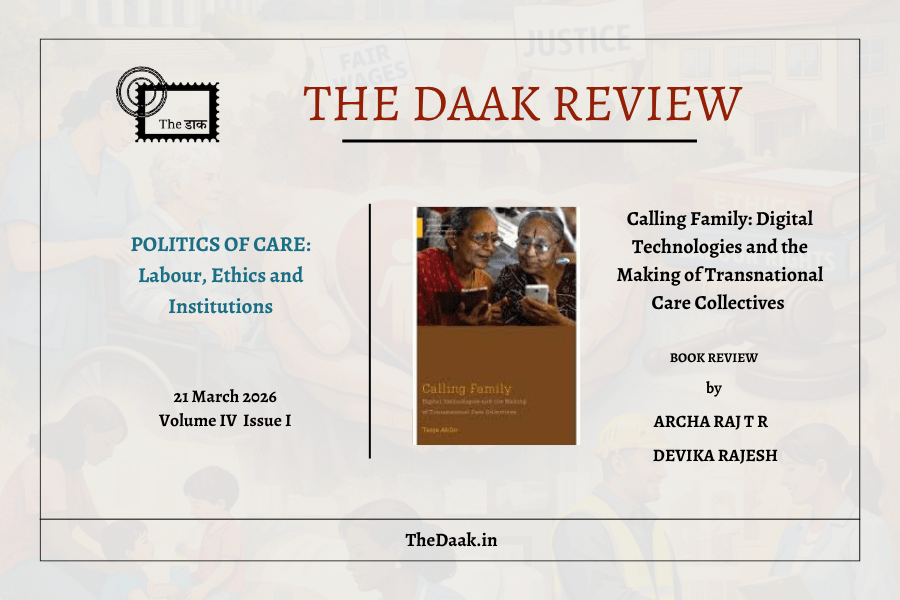
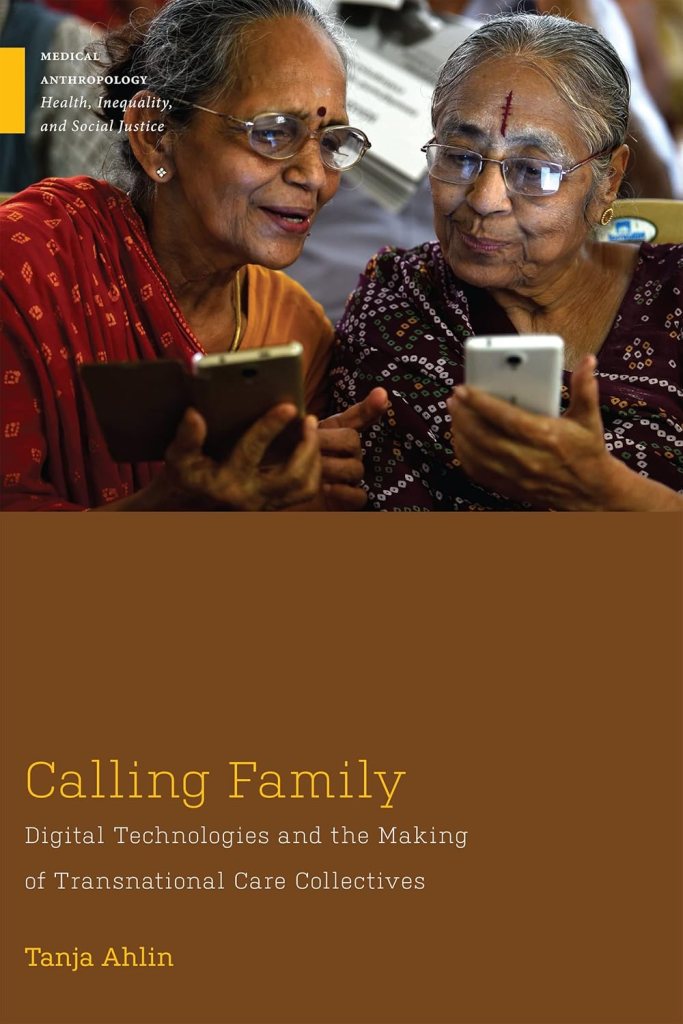
Book: Calling Family: Digital Technologies and the Making of Transnational Care Collectives by Tanja Ahlin (New Brunswick: Rutgers University Press, 2023), 212 pages, 22.86 × 15.24 cm, ISBN: 9781978834323, $ 37.95 (Paperback)
by Archa Raj T R and Devika Rajesh
Calling Family: Digital Technologies and the Making of Transnational Care Collectives, by Tanja Ahlin, is a well-researched ethnographic account that significantly contributes to the field of medical anthropology, migration and carework. Ahlin adopts a material-semiotics, empirical ethics, and science and technology studies (STS) approach in her study. She conducts her ethnographic study among thirty-three migrant nurses, mostly from the Syrian Christian community in Kottayam (a district in Kerala). The ethnographic fieldwork is carried out in Kerala and Oman, and also digitally across geographies over a period of ten years, intermittently from 2011 to 2022. This book primarily explains how transnational adult children administer care to their ageing parents from a distance using digital technologies. In the Indian context, co-residence with ageing parents is crucial to provide‘good care’. However, Ahlin says that the norms of care and filial obligations are ‘fluid and subject to change’, depending on the society and time (p. 144).
The book is divided into two parts. In the first part, called “Mapping Landscapes”, the author opines that the questions of healthcare and care are related and cannot be viewed as separate from each other. Ahlin’s work tries to blur this problematic distinction between formal and informal caregiving practices by examining how local concepts of good care are disrupted by geographic distance. Owing to the traditional notions of gender dynamics of care being tied to women, female migrant nurses constitute a major component in her study. She uses the concept of ‘transnational care collectives’ to fully understand how these migrant nurses enact care for their family members (p.16). In such collectives, one constantly tries to determine what constitutes good care when performed from a distance, integrating digital technologies with human actors. Through the material semiotics approach, she analyses the roles played by material objects, namely the non-human actors, including digital technology, telecom infrastructures available in the respective countries, money (in the form of remittances), and specialised health care devices, that become part of this collective.
Ahlin notes that only an ‘omnipresent co-presence’ can be created by migrating adult children to accomplish their filial obligations through online technologies (p. 12). The author highlights the relevance of digital technologies in people’s lives and relationships during the COVID-19 pandemic, as physical meetings were restricted. She also compares the experiences of ageing parents co-residing with their children to those living under institutionalised care. An important component of her study is the analysis of how money shapes the extent of agency experienced by residents of old-age shelters, which, in turn, helps determine whether they are abandoned or agentive residents. The author also admits that caring from a distance might not always work when parents have chronic diseases and require proximate care. In such cases, some of her interlocutors either travelled back willingly or left their jobs and permanently returned to Kerala to stay with their parents. However, Ahlin clearly misses a crucial point in the discourse on elderly abandonment— some ageing parents genuinely wish to enjoy life while staying with their children and grandchildren, yet they are left alone to lead isolated lives (Irudaya Rajan et al., 2017).
In the following part, titled Caring through Transnational Collectives”, the author describes in detail the ways through which care is enacted. Practices like frequent calling become a major component for implementing care in a transnational collective. Mostly, the digital devices and internet services were paid for by the migrating children to create and sustain these collectives. People ‘tinker’ with technologies, telecommunication infrastructures, work schedules, and time zones to find out which best suits all members of the collective (p. 16). In the book, through Mary’s example (p. 72), Ahlin shows how Mary’s technical know-how in creating the transnational care collective challenges the traditional hierarchies of gender, age, and ownership of the digital devices. The act of calling as an act of care became very evident when there was a lack of calling; the families perceived that as a case for concern.
The author mainly discusses cases where the decision to migrate was a collective family decision, and parents willingly took on the financial burden of sending their children abroad, as an investment for their old age. In contrast, the book does not address instances in which adult children migrate abroad against family decisions, nor does it examine how care is enacted in such situations. Although Syrian Christians in Kerala follow a patrilineal kinship, sending remittances regularly to the family becomes a responsibility and a filial obligation even for daughters. By earning significantly higher incomes in transnational workplaces, these women nurses can bargain more effectively with their in-laws’ families to take care of their parents and children. Financial support (such as sending remittances) is significant for aging parents in India, as only a few are eligible for pensions, and most health care expenses are paid out of pocket. Ahlin provides examples (case of Sara and Alwin, p. 114) of a redistribution of carework amongst those involved in the transnational care collective— with the migrating women taking on the role of financial providers, their husbands often shift to providing care by staying with the families.
Ahlin’s main argument is that care does not completely vanish from the picture, but is rather transformed within the transnational care collectives. In these collectives, the emphasis shifts from practices that require physical proximity to practices that use digital technologies, such as online calling or webcam. Ahlin posits that the formal healthcare system can employ digital technologies, such as telemedicine, provided a basic level of digital literacy amongst the population is ensured. The book tries to break stereotypes surrounding elderly parents’ ability to navigate digital tools and the internet. However, owing to the better social and economic position of Syrian Christians in Kerala, it is imperative to acknowledge the community’s already existing access to digital technologies and their familiarity with digital devices.
Nicola Yeates (2009) explains the concept of ‘double helix’ through which the transfer of nursing care from source to the host country is intertwined with the transfer of motherly care because most nurses are also mothers. Despite this, Ahlin omits a major category of left-behind children of these nurses from her analysis. Therefore, it’s questionable whether she was able to give complete justice to the title of the book. Some scholars use the concept of ‘immobilising regimes’ to refer to mobility constraints imposed by the state on migrants under restrictionist policies. This, in turn, greatly impedes ‘transnational care circulation’ (Merla et al., 2020). Ahlin’s work fails to capture such accounts and treats staying behind as part of transnational arrangements, instead of acknowledging that caring from a distance is the only means available to those unable to join their families. The concept of care involves questions of class, economic status of an individual, nation, and race, which she has not addressed in her work.
However, Ahlin has successfully showed the care dynamics at play in transnational families by studying a very mundane act of calling a family member. In fact, this book makes an appeal to its readers to acknowledge the significance of material objects (everyday digital technologies) as participants in human relations and sustaining transnational care collectives.
References:
Irudaya Rajan, S., Sunitha, S., & Arya, U. R. (2017). Elder Care and Living Arrangement in Kerala. In S. Irudaya Rajan & G. Balagopal (Eds.), Elderly Care in India: Societal and State Responses.
Yeates, N. (2009). Globalizing care economies and migrant workers: explorations in global care chains. Basingstoke Palgrave Macmillan.
Merla, L., Kilkey, M., & Baldassar, L. (2020). Examining transnational care circulation trajectories within immobilizing regimes of migration: Implications for proximate care. Journal of Family Research, 32(3).
Archa Raj T R holds a Masters in Development & Labor Studies from Jawaharlal Nehru University.
Devika Rajesh holds a Masters in Development & Labor Studies from Jawaharlal Nehru University.
 TheDaak review
Leave a comment