
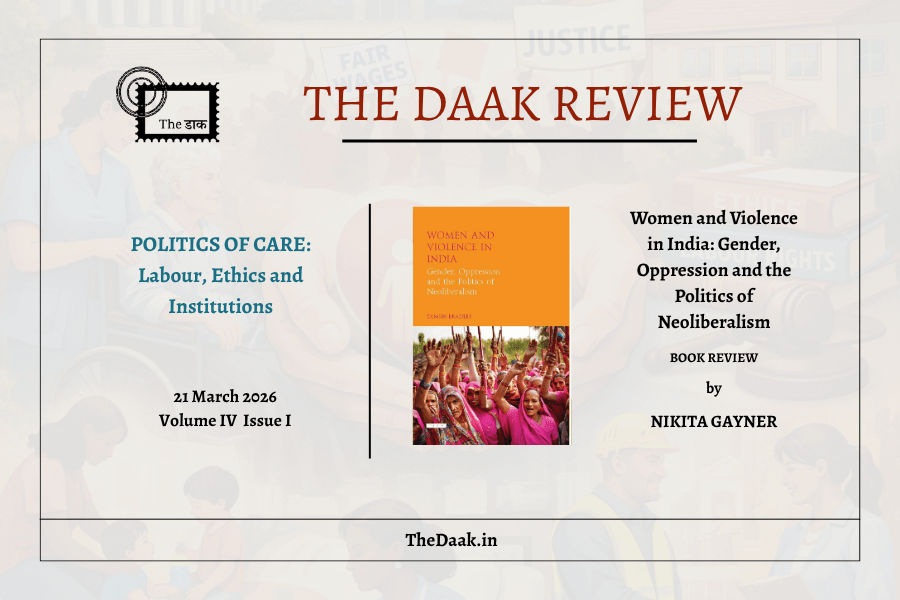
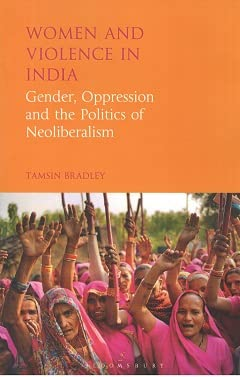
BOOK: Book: Women and Violence in India: Gender, Oppression and the Politics of Neoliberalism, Bloomsbury Publishing, 2017, 266 pages, 23*15*3 cm, 978-9356400795, Rs. 539
Debates on violence against women in India are generally framed around two narratives. The first locates violence at a cultural, traditional, or religious level, often representing it as an inherited attribute of social backwardness (Lomazzi, 2023; Gopalakrishnan et al., 2025). The second relies on liberal development discourses, suggesting that economic growth, increased education, and women taking up paid work will ultimately erode patriarchal norms and reduce violence (Simister and Makowiec, 2008; Bergvall, 2024). Women and Violence in India contests both of these perspectives. Read through the lens of the politics of care, Tamsin Bradley’s argument acquires additional urgency. She suggests that violence against women is not something preserved culturally or simply a question of development, but a structural feature of present political and economic arrangements. Written in the aftermath of the 2012 Delhi gang rape, which brought international attention, the book asks a deceptively simple question: why does violence persist, and at times even intensify, despite decades of feminist mobilisation, legal change, and development-focused interventions? Bradley argues that neoliberalism, instead of weakening patriarchal power, strengthens it by reshaping the social relations that make violence against women appear normal rather than exceptional.
Bradley’s argument falls within feminist political economy and development theory, where disparities are viewed as structural problems. She challenges the assumption that empowerment and development coexist and argues that vulnerability can persist even when the state implements market reforms, rights-based policies, and legal interventions.
The book can be broadly divided into four sections. The first is devoted to introducing the conceptual framework, which establishes neoliberalism as a political and cultural system that affects aspirations, values, and power. Bradley suggests that it carries not only the destructive power of consumerism but also a system of values related to an idealised image of what it means to be ‘modern.’ Democracy, freedom, and empowerment are used without considering the context. For example, Bradley indicates that dowry practices have become more common due to consumerist pressures, where gifts and money are associated with being ‘modern’ and gaining status, respectability, and honour.
In the second part, the author examines rape and the way it is represented in society; focusing on the way the Indian and Western media treat some victims and perpetrators over others. The third section reflects on feminist politics in the face of rising conservatism. It discusses the internal contradictions of feminism, including global funding and rights-based approaches, and the presence of religious and right-wing feminism. Conservatism is not seen as being outside the economy but as part of a neoliberal trajectory that accepts patriarchal dominance as long as the market is not challenged. Bradley illustrates this with the use of household gender roles, where women’s education and work can create a backlash if economic roles change and patriarchal dominance is challenged.
The last section examines harmful practices in society, such as dowry and female genital mutilation. These chapters also show that such so-called ‘traditional’ practices do not decline through development and modernisation. Rather than disappearing with economic development, patriarchal practices can be reinvented and even accelerated through consumerism and market rationality. Bradley points to the commodification of women within marriage arrangements, where women’s social value becomes linked to material transactions and family prestige. In a sense, market-driven notions of modernity reshape rather than dismantle patriarchal norms. I find this argument persuasive in highlighting how economic change can coexist with, and even intensify, gender hierarchies rather than automatically producing social equality.
The most important contribution of the book is its understanding of neoliberalism as a gender-stratified and hierarchical project. Bradley incorporates feminist analysis to critique neoliberal capitalism, claiming that patriarchy underwrites the development of neoliberal governance not as a parallel system or residue of society, but as a structural or social regime. Neoliberalism generates stark inequalities, while eroding social institutions that can address them. It heightens aspirations via consumer culture and market imagery, while silencing opportunities of stable jobs, social protection and political voice. This disparity between aspiration and reality produces frustration, much of which is passed on to women. Thus, violence is a mechanism through which social order is maintained and gender hierarchies are re-established. A strength of the book is its rejection of linear narratives of empowerment. Bradley shows that women’s access to educational and employment opportunities do not necessarily translate into safety or autonomy. In many cases, these changes invite backlash in households and communities that are still in the hands of patriarchal power. Empowerment without structural change, the book suggests, can heighten vulnerability rather than reducing it.
Much of the book focuses on examining how violence against women appears in public spaces. Bradley’s analysis of rape coverage in Indian and international newspapers shows a pattern of selective visibility. Media narratives focus primarily on sensational cases involving urban, middle-class victims, whereas the everyday violence suffered by Dalit, rural, and economically marginalised women remains largely invisible. Parallely, perpetrators are frequently cast as deviant ‘others’ (often poor, rural, or lower-caste men). This framing helps insulate middle-class and elite groups from responsibility, even though patriarchal beliefs about women’s autonomy and sexuality are common for all sections of society. So, violence is individualised and pathologised rather than being viewed as structurally produced. Bradley’s analysis of international media in particular is highly pointed and provides a scathing critique, showing how colonial stereotypes continue to inform the framing of India as culturally backward. This distorts popular understandings of feminist struggles and undermines the movement.
Bradley gives a nuanced critique of feminist politics in India. Instead of idealising and dismissing feminist activism, she takes the effort to examine the constraints within which it exists. Attention is also paid to the impact of global development agendas and funding regimes that are designed to favour technocratic solutions and quantifiable results at the expense of structural analysis, for example, programmes focused on measurable indicators such as women’s health, education and employment, which are often prioritised over deeper structural questions related to patriarchy, caste, and social power. Analysis of state-led programmes reveals the gap between formal legal commitments and substantive political change. Legal reforms coexist with weak enforcement, which fails to challenge patriarchal norms in political institutions. She does not treat the growth of conservative and religious politics in isolation, but rather as part of a broader ideological convergence where market-led economic policies and socially conservative belief systems coexist.
The chapters on dowry and related harmful practices constitute some of the book’s strongest empirical contributions. Bradley questions the premise that education and health improvements alone are enough to overcome gendered exploitation. She shows that the institution of dowry has expanded beyond particular religious and social identities to assume a more monetised form in line with consumerist culture. Marriage, therefore, becomes an institution of wealth redistribution, in which women are valued in terms of their contribution of material resources to the marital family. Further, Bradley’s analysis speaks directly to the labour and ethics of care. Marriage, family, and domestic life are sites of unpaid care work, yet under consumer capitalism, these relationships are reorganised around extraction and exchange. Violence against brides thus appears not as a cultural anomaly but as a predictable outcome of market rationalities penetrating intimate life. Care is commodified, and women’s bodies become economic assets.
Women and Violence in India provides a thorough and disturbing account of the ways in which gender-based violence continues to persist even in the context of economic development. While the book’s analysis is necessarily based on qualitative and interpretive approaches, a greater incorporation of large-scale quantitative data could have added to the empirical foundation of the book, such as National Family Health Survey (NFHS) data on violence against women, domestic violence prevalence, and gender attitudes. However, this is more a reflection of the book’s methodological commitments than a fault. More significantly, this book offers a different perspective to the ongoing debates in the fields of labour, ethics, and institutions. Bradley shows that the state’s withdrawal from social welfare and the increased dominance of the market in social life results in the privatisation of care labour within the family. This increases the burden of responsibility on women. Therefore, ineffective institutions that fail to provide protection, justice, and social security help violence against women to sustain and flourish.
Bradley’s important argument about the complementarity between neoliberalism and patriarchy has implications far beyond India. The book treats violence against women as a political economy problem that exists due to institutional failure. Therefore, violence is an outcome of the structural collapse of collective care, not a law-and-order failure, as responsibility shifts from public institutions to private households, where women bear the cost of the extra burden. Women and Violence in India thus criticises the politics of care for creating gendered vulnerability and normalising violence. This is a timely, provocative, and necessary viewpoint. It not only deepens understanding about the structural roots of violence, but also calls for renewed institutional accountability and collective responsibility to build more just and caring societies. Therefore, this book is relevant not just in the Indian context, but for any society undergoing rapid liberalisation, where care responsibilities are shifting from public institutions to private households.
References
Bergvall, S. (2024). Women’s economic empowerment and intimate partner violence. Journal of Public Economics, 239, Article 105211. https://doi.org/10.1016/j.jpubeco.2024.105211
Gopalakrishnan, L., Bertozzi, S., Bradshaw, P., Deardorff, J., Shakya Baker, H., & Rabe-Hesketh, S. (2025). The role of gender norms on intimate partner violence among newly married adolescent girls and young women in India: A longitudinal multilevel analysis. Violence Against Women, 31(1), 182–205. https://doi.org/10.1177/10778012231208999
Lomazzi, V. (2023). The cultural roots of violence against women: Individual and institutional gender norms in 12 countries. Social Sciences, 12(3), 117. https://doi.org/10.3390/socsci12030117
Simister, J., & Makowiec, J. (2008). Domestic violence in India: Effects of education. Indian Journal of Gender Studies, 15(3), 507–518. https://doi.org/10.1177/097152150801500304
Nikita Gayner is a Ph.D. Scholar at the Symbiosis Centre for Management Studies (SCMS), Noida, with research interests in feminist political economy, gender, labour, and development studies.

 TheDaak review
Leave a comment