
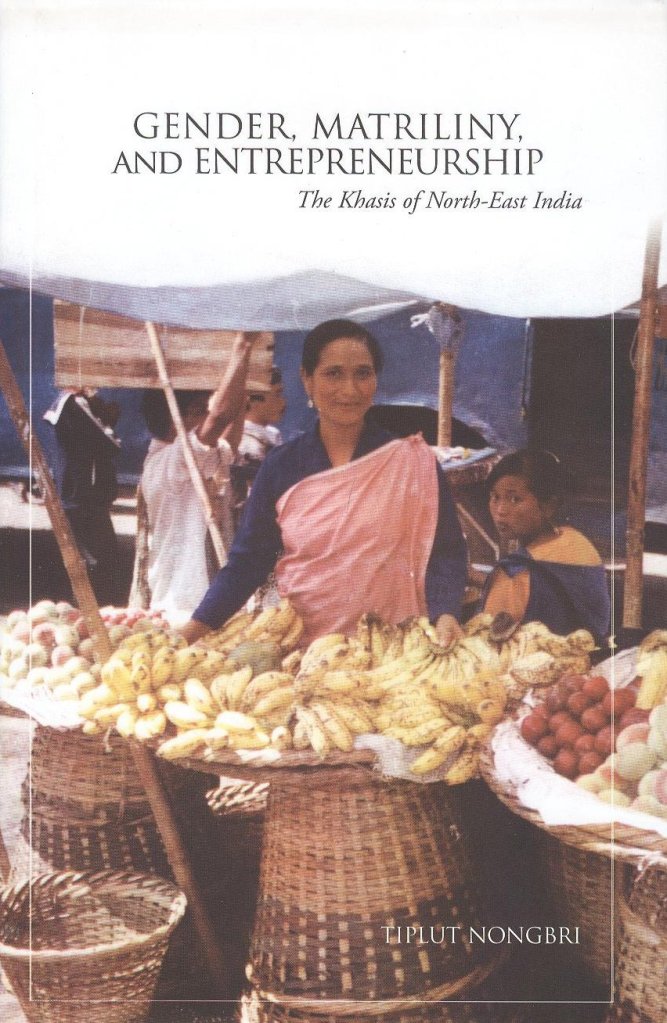
Book: Gender, Matriliny and Entrepreneurship – The Khasis of North-East India by Tiplut Nongbri (New Delhi: Zubaan, 2008), 220 pp., 22×23 cm, ISBN: 978-8189013769, ₹350 (Hardback)
In Gender, Matriliny and Entrepreneurship – The Khasis of North-East India, Tiplut Nongbri explores the intersection between gender, kinship and economic life in the matrilineal Khasi society, intervening in long-standing debates on matriliny and women’s empowerment. By challenging the mainstream assumption that matriliny grants women authority and empowers them, Nongbri demonstrates that matrilineality by itself doesn’t mean the absence of gender subordination for women. In Khasi matriliny, even though women are central to both inheritance and household organisation, it is the men who exercise control. Further, drawing on ethnographic research, the book explores how economic activity, familial responsibilities and systems of care intersect with each other to produce a social arrangement where women’s productive capacities and labour are indispensable, yet invisibilised.
Nongbri begins by giving an account of the matrilineal institutions of Khasi society. Descent is traced along female lines, with the youngest daughter, Ka Khadduh, inheriting the ancestral house, parental property and family heirlooms. However, the book further examines how this heiress, responsible for maintaining the household and caring for members of the family, does not possess authority commensurate with her duties and has little say in the control and management of the property. It is the mother’s brother, U Kni, who enjoys these privileges and controls management. This contradiction illustrates the redistribution of responsibilities but not authority in a matrilineal social structure, as attributes of power remain associated with masculinity, leading to gender inequality and a gendered ideology.
The right of descent on the mother equates to the responsibility of rearing children. In case of a divorce, a woman is on her own or dependent on her brother/sister for assistance. Further, the matrilocal pattern of residence sometimes leads to situations where the brother is not readily available to attend to his sister’s needs. Thus, for subsistence and rearing of children, it becomes a necessity for women to work for their livelihood.
The author illustrates how, as a consequence, the matrilineal kinship structure among the Khasis makes trade and other economic activities a natural extension of their familial responsibilities. While women actively participate in the economy, primarily in the informal sector (for reasons including lack of capital and formal education), it doesn’t translate into economic security or autonomy, as they continue to be treated as mere secondary workers whose potential and contribution remain disregarded.
Nongbri shows that Khasi women invest long hours of labour and energy trying to build and sustain a business. However, they continue to stagnate. Those who do achieve the peak of success, slide down into oblivion after a while. Drawing on this, the author develops this argument and explores the factors behind this problem through an ethnographic study of a small segment of self-employed Khasi women working in the informal sector in Meghalaya. The ethnographic data collected during 1992-2003 includes interviews with about 120 women entrepreneurs, case studies, and government records. While the analysis focuses more on contemporary Meghalaya, a historical approach has also been applied by the author to trace the changes from modernisation to post-partition state development. This focused approach constitutes a methodological strength of Nongbri’s work.
Nongbri’s analysis of the marketplace of Meghalaya, home to the Khasi tribe, reveals that women dominate petty trade, but remain at the margins, working for their survival only. Greater participation by women in entrepreneurial enterprises remains a form of survival labour only, sustained through family support and long hours of work. For these petty traders, profit remains low, only enough to sustain their households. For Khasi women entrepreneurs, income generation does not simply mean an economic activity but rather an ethical obligation tied to motherhood and societal expectations. Case studies and interviews discussed particularly in chapter 3 and later sections of the book depict that earnings are primarily spent on children’s education, healthcare, and kin obligations imposed by the prescribed system. This leaves little scope for reinvestment or expansion of trade/household.
While these petty traders constitute the majority of the sample size, some women move into manufacturing or government contracting, marking the emergence of a new middle class. However, Nongbri argues, success in the market and occupational mobility depend less on market competition than on access to credit, networks and institutional support. For example, most of the women contractors working for the government either have male intermediaries or strong political backing. Nongbri successfully captures these dynamics in detail in chapter 5.
Further, Nongbri highlights how Khasi women are positioned between two contradictory tendencies that operate in the society. On the one hand, the matrilineal principle of descent and inheritance provides the enabling condition for women’s economic participation. On the other, gendered ideology not only views women as inferior to men, but even when women work, they are treated merely as secondary workers, their economic potential simply regarded as something that the family can fall back on in times of need (Nongbri 2008). Here, Nongbri successfully captures how politics of care remain deeply embedded within a matrilineal social organisation.
Drawing on ethnographic accounts, the book further highlights how the state comes into play to intersect with the politics of care. New opportunities were created by government policies and development programmes to assist women entering small-scale and contracting industries, but the access to these sectors often relies on bureaucratic discretion and constraints, political connections and informal networks. Women who do manage to succeed in these sectors often do so through family connections, male intermediaries or alliances with established contractors. These institutional constraints limit the autonomy of emerging women entrepreneurs. Thus, Nongbri’s analysis suggests that the state institutions, instead of being neutral facilitators promoting gender equality, reinforce the gender hierarchies.
The book’s strength lies in its rich empirical depth. Though its most significant contribution lies in its refusal to romanticise matriliny as inherently empowering for women. The book establishes that matriliny shall not be viewed as a marker of female empowerment, but a kinship system redistributing responsibilities rather than power. The categorisation, though not water-tight, allows the reader to differentiate within a single category of ‘women entrepreneurs’ as traders, small scale manufacturers and contractors, rather than viewing it as a homogeneous entity. More importantly, the book further illustrates how ethical obligations imposed by kinship systems and institutional constraints by the state intersect to produce a condition in which women’s labour remains in a stranglehold.
However, the book does not theoretically engage with the broader feminist scholarship on labour. Also, the repetitive use of the word ‘entrepreneur’ for subsistence traders blurs the distinction between survival labour and capital-oriented enterprise. The study also touches upon the emergence of the middle class and rising class differentiation without fully theorising its implications. The differences among entrepreneurs arising based on caste, religion and region also remain under-analysed. For the category of contractors and manufacturers, the analysis doesn’t take into account the wage relations, labour relations and hiring practices.
While many questions remain there to be explored further, the book adds to a broader perspective on women’s labour in a matrilineal social structure and ultimately demonstrates how it engages with moral obligations and politics of care.
Richa Miglani is a fourth-year undergraduate student of Political Science at Daulat Ram College, University of Delhi.
 TheDaak review
Leave a comment