
Between Care and Exclusion: Reframing Community in New Urban India
Book: The Politics of Community-Making in New Urban India: Illiberal Spaces and Illiberal Cities by Ritanjan Das and Nilotpal Kumar (New York: Routledge, 2023), 262 pages, 9.2 × 6.1 × 0.6 inches, ISBN 9781032096549 (paperback edition), USD 60.
Urban communities are often imagined as spaces sustained by mutual care and shared belonging. However, in contemporary Indian cities, the discourse of care often coexists with practices of suspicion, inequality, and exclusion. The Politics of Community-Making in New Urban India: Illiberal Spaces, Illiberal Cities, by Ritanjan Das and Nilotpal Kumar provides a thorough and theoretically ambitious analysis through its ethnographic engagement with everyday life across multiple urban sites. Instead of treating the community as a naturally cohesive social entity, the authors explain how it is deliberately constructed through practices that regulate belonging and differentiate between insiders and outsiders. This review analyzes the book through the framework of the politics of care, positing that the book depicts care not only as an emotional connection but as a disputed and contested social relationship that both fosters community and facilitates exclusion in modern urban India. The book primarily inquires if the production of new urban spaces in post-liberalization India promotes community forms that are majoritarian, exclusive, and resentful of liberal democratic principles (Das & Kumar, 2023). Drawing on the notion of the social production of space, the authors contextualize Noida within the larger frameworks of neoliberal accumulation, state-driven land acquisition, and real estate-driven growth. The transformation of agricultural land into gated communities, urban villages, and informal settlements generates distinct spatial settings that both need and inhibit certain forms of solidarity and care.
The prologue, recounting the Mahagun Moderne incident in Noida, serves as an analytic entry point into the intricate politics of care and mistrust. The episode, in which a domestic worker was violently assaulted by residents of the gated community on suspicions of theft, illustrates how the relationships between residents and service workers are determined by fragile and unequal power relations, despite their everyday proximity and interdependence. A dispute between residents of gated communities and migrant workers has rapidly been reinterpreted through collective narratives that portray the latter as dangerous outsiders. The incident therefore does more than recounting a moment of conflict within a housing society; it depicts that proximity does not inherently promote empathy and solidarity. On the contrary, care relations, such as domestic labor, become sites of distrust, securitization, and communalization (Das & Kumar, 2023).
Building on this opening episode, the book explores how practices of care operate across the three spatial sites it examines. The authors see care not just as a neutral or ethical disposition, but as a political and contentious social interaction influenced by hierarchy, labor, and institutional frameworks. Across these sites, care manifests in various interconnected forms: as protection and regulation within residential communities, as daily negotiations between residents and workers, and as informal practices through which marginalized individuals maintain support and solidarity. By emphasizing these shifting discourses, the book illustrates that care is fundamentally integrated into the formation of urban communities while simultaneously producing borders of inclusion and exclusion.
The first spatial context analyzed in the book centers on residential complexes and gated communities, whereby collective welfare and neighborhood security are presented as central concerns of community life. These spaces are governed by institutional mechanisms like resident welfare associations, apartment owners’ associations, surveillance systems, and informal norms that regulate behavior within the community. These unions foster solidarities around security, aesthetic order, and property maintenance. In this context, caring becomes a protective practice aimed at preserving the enclave’s existence. It is a care invested in walls, surveillance, and ritualized performances of cultural belonging, which serve to reinforce social boundaries and maintain the status quo within the enclave. Such solidarities are exclusive and defensive, supporting what the authors describe as illiberal community formation (Das & Kumar, 2023).
The second site focuses on the everyday interactions between residents and the workers who ensure the smooth functioning of these residential environments. Despite the fact that residents depend significantly on domestic labor and other forms of service work, these relationships are still characterized by mistrust and hierarchy. Care in this context becomes embedded within labour relations and institutional arrangements that regulate access and conduct within residential spaces. Rather than operating simply as an expression of moral concern, care is characterized by a negotiated relationship that is influenced by unequal authority, where gestures of responsibility coexist with practices of regulation and control.
The third site broadens the perspective by emphasizing the experiences of those who inhabit the margins of these urban communities. Here the analysis highlights the informal networks and daily solidarities that develop among workers and other marginalized actors navigating these regulated spaces. Unlike care shown through surveillance or institutional governance, care in this context is expressed through small acts of mutual assistance, shared knowledge, and collective negotiations. These behaviors show that care may also serve as a resilience resource, helping people maintain forms of support in otherwise hierarchical situations and cope with the exclusions inherent in modern urban settings. In the urban villages of Noida, predominant caste agricultural elites mobilize a collective identity centered on eviction and land acquisition. Solidarity arises from common experiences of state expropriation and spatial marginalization. Rather than unequivocally appreciating or criticizing these solidarities, it contextualizes them within historically established systems of caste, land, and political patronage. The analysis of jhuggi settlements further substantiates the argument. Migrant Communities negotiate precarious access to water, power, and tenure security through informal leaders, trade unions, and local political intermediaries. Care in these environments is collective and pragmatic. It manifests in the everyday practices of mutual assistance, resource allocation, and mobilization of essential services. However, these solidarities are hierarchically organized according to caste, religion, and regional identity (Das & Kumar, 2023).
The book asserts that care should be understood not merely as an emotional connection but as a contested social relationship through which communities create inclusion while concurrently producing exclusion. By examining these dynamics across different spatial contexts, the authors offer a significant insight into how everyday practices that sustain urban communities are interconnected with the processes that regulate who can legitimately inhabit these spaces.
Notwithstanding these contributions, certain conceptual questions remain insufficiently explored. The book clearly demonstrates exclusionary practices in contemporary urban communities, but it falls short in explaining the concept of illiberalism. Although the term effectively captures the restrictive dynamics observed across the sites discussed in the book, its broader theoretical relationship with debates on liberalism, citizenship, and urban governance is not completely elaborated. A more profound engagement with these theoretical discussions could have strengthened the conceptual clarity of the care framework and situated the book more firmly within broader debates on urban political forms.
Another limitation concerns the relatively limited engagement with gender. Gendered expectations and hierarchies severely impact the interactions described in the book, which encompass domestic labor, caregiving, and household relations. However, the analysis mostly ignores gender. A more comprehensive examination of the impact of gender on the structuring of care and labor in these urban environments could have strengthened the argument and expanded the book’s contribution to the discourse on the politics of care.
Overall, The Politics of Community-Making in New Urban India represents a relevant and analytically significant contribution. By foregrounding the ways in which care operates within the relations of hierarchy, mistrust, and negotiations, it challenges idealized notions of urban communities as naturally cohesive or inclusive. It demonstrates how communities establish their boundaries and regulate belonging through deeply interconnected practices of care. In doing so, the book provides a significant perspective for comprehending the politics of care in rapidly transforming urban spaces and will be of particular interest to scholars working in urban sociology, community development, and the everyday politics of urban life. By emphasizing how neoliberal urban restructuring is intertwined with illiberal solidarity, Das and Kumar challenge readers to reconsider the moral economy of care in contemporary cities. The book posits that the urban space is not only a space for social interactions. It actively contributes to the way communities view themselves, the people they decide to keep safe, and the people they exclude. In this context, care serves as both a means of survival and a battleground, exposing the intricate politics of belonging in contemporary urban India.
References
Bourdieu, P. (1984). Distinction: A social critique of the judgement of taste. Harvard University Press.
Harvey, D. (2009). Social justice and the city (Rev. ed.). University of Georgia Press. (Original work published 1973)
Beyond a Pedagogy of Care
Book: Students Etched in Memory by Perumal Murugan, Translated by Iswarya V (Haryana, India: Penguin, 2025), 220, ISBN 9780143468066, Rs. 599
When I read Perumal Murugan’s book Students Etched in Memory, I immediately connected with the narrator’s angst. “Should a teacher discuss with his students only their studies? What was wrong with discussing everything else too? Can a teacher not be a friendly companion and confidant to his student? So my thoughts ran.” (90) In this book, Murugan recalls his experiences teaching across several government colleges in rural Tamil Nadu through a collection of forty stories originally written for the newspaper. Instead of romanticising the vocation of a teacher as a noble one, this book presents education as a complex form of labour that extends beyond the classroom, involves overcoming institutional constraints and one that is often shaped by caste and class hierarchies. In doing so, he offers a critique of educational systems while making a compelling political claim for reimagining teaching through an ethics of care.
In recent scholarship, the framework for understanding care work has undergone significant change. Care labour is no longer understood primarily as a “labour of love” (England 2005), but as affective and material labour shaped by social hierarchies and institutions. (Federici 2012). The “prisoner of love” model views emotional and moral satisfaction as compensatory rewards for care work, thereby explaining why much of the labour is either unpaid or underpaid. But feminist and intersectional ethics of care have challenged this conceptualisation by highlighting empathy, compassion, and the context of care, in contrast to the traditional theories that value care as an abstract principle. Hence, the feminist theory of care highlights how gender norms, caste location, and class position fundamentally shape who provides care, who receives it, and under what conditions (Collins and Bilge 2016). Care pedagogy extends care to all students and does not consider certain students as needing more care. In that, care is not just an emotional engagement, but must be institutionalised, in the syllabi and within the infrastructure of an institution.
In this context, Perumal Murugan’s Students Etched in Memory, sensitively translated into English by Iswarya V, contributes to the discourse through an introspective, politically informed commentary on teaching as care work. Murugan begins his book with a provocation: “What needs to be done? We are stuck with a pedagogical system that has failed miserably.” (xii) Through this question, he sets the narrative tone that follows, underscoring that the failure of education is neither natural nor inevitable. He neither offers any generalising policy reforms nor abstract solutions. Instead, his stories are grounded in the everyday pedagogical encounters, exposing how structural inequalities are actively engaged with learning and teaching. He remembers occasions when he has called the parents of some students to persuade them to let them pursue their higher studies. (73) Teaching, in his account, is clearly reclaimed as emotional labour that extends far beyond the classroom, even many years after the student has graduated, as in Rasu’s story. (29) The leitmotif of once a teacher, always a teacher captures how a teacher’s responsibilities transcend time and circumstances.
One of the most significant interventions of the book lies in the attention to rural educational spaces, which Murugan presents in stark contrast to the private universities and elite institutions located in urban centres. The students at rural colleges are confronted with layered forms of deprivation: economic precarity, (Rajesh, the gunny sack dealer in “Yellow Devil”, 135) enduring caste-based stigma, (students who engaged in manual labour, “Time for a Turnaround”, 71) and scarcity of basic living conditions and financial support. The translator’s note offers a fitting observation that classrooms are not spaces shielded off from the real world; rather, they are microcosms of society itself. They are burdened with the same gendered aspirations, social anxieties, and linguistic hierarchies associated with the paralysing fear of not being able to speak English. These structural inequalities are not merely sociological; they actively shape students’ academic growth and alter the way they imagine their futures.
Within this context, the teacher emerges as a dependable source of care amid other systemic failures. Many of Murugan’s narratives reiterate how students from marginalised communities inhabit a world where support is not just scarce, but also precarious. Thus, teachers are compelled to intervene on multiple fronts – not only pedagogically but emotionally, socially, and sometimes, economically. From helping students navigate bureaucratic procedures to organising academic events with no institutional budget whatsoever, as in Chinnadurai’s story of the folk song competition (1), Murugan demonstrates how teaching can become a framework of care that prioritises empathy over punitive measures and emphasises the economic and social context of care labour at the intersection of care, class, and caste. These narratives expose the invisible political economy of care, to reveal a form of emotional labour that restores and repairs institutional neglect and deprivation. In the narrative titled “Jhansi’s Beanie,” Murugan observes, “The classroom, as such, does not allow space for personal mentoring. Generally, I place no restrictions on students approaching me or interacting with me outside class hours.” (73) This statement evidently dismantles the myth that teaching ends within the confines of the physical classroom space, insisting instead that emotional labour extends beyond the timetable, syllabus, and textbook teaching. Yet, one could raise concerns about the valuation of such care work. One might read between the lines here to merely ponder if the undervalued, underpaid emotional labour is then exploitative? Murgugan, of course, leaves this lingering question unanswered.
Yet, Murugan refuses to valorise acts of careful teaching. Instead, his portrayal is marked by candour and vulnerability. The book lays bare the ugly, unforgiving, and complex dimensions of pedagogy, alongside moments of frustration and emotional fatigue. Teachers are neither saviours nor moral exemplars but simply individuals navigating systems that constrain them. This refusal of heroism challenges any established understanding of care that glorifies teaching as selfless sacrifice. In doing so, Murugan dismantles the notion that care work is altruistic and therefore, as Paula England (2005) argues, warrants neither lower economic remuneration nor symbolic rewards. Through these specific narratives, the book asserts that if care should be taken seriously, it must first be rid of the morality attached to it.
Caste and class do not merely serve as a backdrop in the book but make up the structural backbone of Murugan’s narrative. The characters in his stories are students who often come from families engaged in manual labour, their lives ridden with economic anxieties of everyday survival that unwittingly enter the classroom space, as in the story of the “Parotta Master”, Gopalakrishnan. (149) Their educational trajectories are marked by uncertainty, interrupted schooling, and quite undertones of social exclusion. His work refuses to romanticise success over struggle. None of the narratives is a classic tale of rags-to-riches that absolves the systems of their silent oppression. Instead, each story is above-board with the unsettling truth – even those who manage to get past the gates of an educational institution, deeply entrenched caste and class hierarchies and precarious economic conditions continue to shape their lives, disallowing them from getting much further. In this representation of Muthaiyan’s story, the institutions are gatekeepers of social mobility; decisions of who survives and who does not is not determined by chance, but by fate. (“The Professor’s Stall”, 165)
Several such stories illustrate this dynamic. The episode involving Chinnadurai and the folk song competition is telling of the cultural hierarchies that dominate formal spaces. Here, Murugan highlights how musical traditions of certain subordinated communities are excluded through implicit invalidation. Yet, in this narrative, Murugan expresses that although temporarily, education has the potential to become a site for cultural subversion, even when the larger institutional structures remain resistant to such inclusion. His critique does not stop at the material conditions of pedagogy but extends to the philosophy of teaching. He is sharply critical of the disciplinary infrastructure of education rooted in surveillance, punishment, and authority. The persistence of “discipline and punish” (ix) regimes, inherited from colonial and bureaucratic traditions, he suggests, emerges as an obstacle to genuine, meaningful learning. Against this harsh reality, Murugan calls for a pedagogy grounded not in rigid evaluation frameworks but in empathy and understanding. Whether teaching addresses the tricky terrain of students’ lived realities, is a question the book deliberately leaves open, but in true Murugan social commentary style, it surely offers a compelling prompt.
This pedagogical stance echoes Bell Hooks’ call to “teach to transgress,” where education is perceived as a practice of freedom that challenges domination and centres voices that were relegated to the margins for far too long (hooks 1994). Murugan’s work furthers this vision while grounding it in the everyday struggles of educators in rural educational spaces. His narratives show that transformative teaching is not an abstraction but is often an emotionally exhausting practice burdened by systemic constraints. In foregrounding care as the ethical core of pedagogy, the book is a powerful commentary on meritocratic and outcomes-driven models of education. It is in this failure that the book explores alternative conditions under which learning or unlearning can actually occur. For instance, in the story “The Nose Comes First,” his students “hung out” at Murugan’s house all the time. He thinks of the time when, “there was no divide between the teachers and students under our roof…I believe my students absorbed more than they did in my classroom.” (78) By opening up his home, he created the space, physically and metaphorically, for those students who did not have housing and had to resort to manual labour while they studied in college.
At the same time, Murugan remains attentive to the limits of care. He repeatedly emphasises that emotional labour alone, however genuine, is not a suitable substitute for systemic reform. Without funding, institutional support, and accountability, no meaningful transformation is possible, and the book has no misgivings about this. While systems remain unchanged, care risks becoming an unsustainable burden on individual teachers, and change becomes the responsibility of specific care providers, not of the system. This recognition situates the book within a broader critique of the political economy of education, exposing how neoliberal educational institutions work. The norm is to delegate care responsibilities to educators, who are already overburdened, while withholding sufficient state support. (Graham 2013, Collins-Dogrul 2023 and others discuss this at length) In this sense, Murugan’s narrative gestures toward the need for collective and institutional interventions, and it is for the reader to deliberate if this is a possibility or an unreasonable ask.
The contrast Murugan draws between rural and urban educational spaces further sharpens this critique. In elite urban colleges, teacher–student relationships often assume transactional forms, shaped by material logics and career advancements. On the other hand, teachers such as Murugan make it possible to foster deep bonds through everyday interactions by reaching out to his students even after they graduate, checking in on them if they fail to attend class, or even attending their wedding and wishing them well. The book leaves no doubt that the care extended by educators is a form of compensation, both in kind and care. Although this is exhausting, it is a consistent effort to fill the void left by structural limitations that offer very little to its most vulnerable students.
Despite its criticality, the book is not without limitations. Murugan narrates one story after another, but readers could have benefited from a deeper engagement. The experiences are powerful, and linger on with emotional intensity, however, it leaves one wanting more analytical commentary, waiting to explore what lies beneath. Perhaps Murugan’s narrative strategy is deliberate, suggesting that one needs to really feel the story, engage with it, and infer it through one’s own lived experiences. In this sense, the text retains its affective urgency while inviting readers to undertake their own interpretive labour. Ultimately, Students Etched in Memory offers a moving and incisive account of teaching as care work. What stays with the reader, long after closing the book, is a quiet contemplation about teaching as more than a profession, as unrecognised emotional labour. Each of the characters is etched in the reader’s memory; their struggles weigh heavily; the many subtle ways they are made aware of their precarity sometimes dampen the eye.
These are stories for the present times, when education is reduced to detached data points and performance metrics. Murugan’s work offers hope, reminding educators, scholars, and policymakers that at the heart of it all lies care and kindness. His stories compel one to confront uncomfortable truths about inequality, labour, and institutional failure, while imagining a more just and compassionate educational future. This book stands as an urgent reminder of the invisible cognitive and affective labour of teachers in a climate where educators are surveilled, disciplined, or dismissed based on their private life choices. It calls to memory the 2022 controversy at Kolkata’s St. Xavier University, a professor who was forced to quit her job (“Kolkata St Xavier’s teacher: ‘I was forced to resign over bikini photos’”, Pandey, 2022), or the tragic persecution of Dr Ramchandra Siras at Aligarh Muslim University (“Mystery shrouds death of AMU professor”, Sarkar, 2021), remembered in the poem “Aligarh” by Akhil Katyal. (“How Many Countries Does The Indus Cross”, 2019) The book makes an insistent case for teaching not as sainthood or heroic, but as radical in its everyday commitment, showing up for students, holding space for them, and mostly not letting the system take away hope. Murugan leaves the reader with a simple question; can the pedagogy of care survive in this world that is built to break it?
Gender and Entrepreneurship : Khasis in North East India
Book: Gender, Matriliny and Entrepreneurship – The Khasis of North-East India by Tiplut Nongbri (New Delhi: Zubaan, 2008), 220 pp., 22×23 cm, ISBN: 978-8189013769, ₹350 (Hardback)
In Gender, Matriliny and Entrepreneurship – The Khasis of North-East India, Tiplut Nongbriexplores the intersection between gender, kinship and economic life in the matrilineal Khasi society, intervening in long-standing debates on matriliny and women’s empowerment. By challenging the mainstream assumption that matriliny grants women authority and empowers them, Nongbri demonstrates that matrilineality by itself doesn’t mean the absence of gender subordination for women. In Khasi matriliny, even though women are central to both inheritance and household organisation, it is the men who exercise control. Further, drawing on ethnographic research, the book explores how economic activity, familial responsibilities and systems of care intersect with each other to produce a social arrangement where women’s productive capacities and labour are indispensable, yet invisibilised.
Nongbri begins by giving an account of the matrilineal institutions of Khasi society. Descent is traced along female lines, with the youngest daughter, Ka Khadduh, inheriting the ancestral house, parental property and family heirlooms. However, the book further examines how this heiress, responsible for maintaining the household and caring for members of the family, does not possess authority commensurate with her duties and has little say in the control and management of the property. It is the mother’s brother, U Kni, who enjoys these privileges and controls management. This contradiction illustrates the redistribution of responsibilities but not authority in a matrilineal social structure, as attributes of power remain associated with masculinity, leading to gender inequality and a gendered ideology.
The right of descent on the mother equates to the responsibility of rearing children. In case of a divorce, a woman is on her own or dependent on her brother/sister for assistance. Further, the matrilocal pattern of residence sometimes leads to situations where the brother is not readily available to attend to his sister’s needs. Thus, for subsistence and rearing of children, it becomes a necessity for women to work for their livelihood.
The author illustrates how, as a consequence, the matrilineal kinship structure among the Khasis makes trade and other economic activities a natural extension of their familial responsibilities. While women actively participate in the economy, primarily in the informal sector (for reasons including lack of capital and formal education), it doesn’t translate into economic security or autonomy, as they continue to be treated as mere secondary workers whose potential and contribution remain disregarded.
Nongbri shows that Khasi women invest long hours of labour and energy trying to build and sustain a business. However, they continue to stagnate. Those who do achieve the peak of success, slide down into oblivion after a while. Drawing on this, the author develops this argument and explores the factors behind this problem through an ethnographic study of a small segment of self-employed Khasi women working in the informal sector in Meghalaya. The ethnographic data collected during 1992-2003 includes interviews with about 120 women entrepreneurs, case studies, and government records. While the analysis focuses more on contemporary Meghalaya, a historical approach has also been applied by the author to trace the changes from modernisation to post-partition state development. This focused approach constitutes a methodological strength of Nongbri’s work.
Nongbri’s analysis of the marketplace of Meghalaya, home to the Khasi tribe, reveals that women dominate petty trade, but remain at the margins, working for their survival only. Greater participation by women in entrepreneurial enterprises remains a form of survival labour only, sustained through family support and long hours of work. For these petty traders, profit remains low, only enough to sustain their households. For Khasi women entrepreneurs, income generation does not simply mean an economic activity but rather an ethical obligation tied to motherhood and societal expectations. Case studies and interviews discussed particularly in chapter 3 and later sections of the book depict that earnings are primarily spent on children’s education, healthcare, and kin obligations imposed by the prescribed system. This leaves little scope for reinvestment or expansion of trade/household.
While these petty traders constitute the majority of the sample size, some women move into manufacturing or government contracting, marking the emergence of a new middle class. However, Nongbri argues, success in the market and occupational mobility depend less on market competition than on access to credit, networks and institutional support. For example, most of the women contractors working for the government either have male intermediaries or strong political backing. Nongbri successfully captures these dynamics in detail in chapter 5.
Further, Nongbri highlights how Khasi women are positioned between two contradictory tendencies that operate in the society. On the one hand, the matrilineal principle of descent and inheritance provides the enabling condition for women’s economic participation. On the other, gendered ideology not only views women as inferior to men, but even when women work, they are treated merely as secondary workers, their economic potential simply regarded as something that the family can fall back on in times of need (Nongbri 2008). Here, Nongbri successfully captures how politics of care remain deeply embedded within a matrilineal social organisation.
Drawing on ethnographic accounts, the book further highlights how the state comes into play to intersect with the politics of care. New opportunities were created by government policies and development programmes to assist women entering small-scale and contracting industries, but the access to these sectors often relies on bureaucratic discretion and constraints, political connections and informal networks. Women who do manage to succeed in these sectors often do so through family connections, male intermediaries or alliances with established contractors. These institutional constraints limit the autonomy of emerging women entrepreneurs. Thus, Nongbri’s analysis suggests that the state institutions, instead of being neutral facilitators promoting gender equality, reinforce the gender hierarchies.
The book’s strength lies in its rich empirical depth. Though its most significant contribution lies in its refusal to romanticise matriliny as inherently empowering for women. The book establishes that matriliny shall not be viewed as a marker of female empowerment, but a kinship system redistributing responsibilities rather than power. The categorisation, though not water-tight, allows the reader to differentiate within a single category of ‘women entrepreneurs’ as traders, small scale manufacturers and contractors, rather than viewing it as a homogeneous entity. More importantly, the book further illustrates how ethical obligations imposed by kinship systems and institutional constraints by the state intersect to produce a condition in which women’s labour remains in a stranglehold.
However, the book does not theoretically engage with the broader feminist scholarship on labour. Also, the repetitive use of the word ‘entrepreneur’ for subsistence traders blurs the distinction between survival labour and capital-oriented enterprise. The study also touches upon the emergence of the middle class and rising class differentiation without fully theorising its implications. The differences among entrepreneurs arising based on caste, religion and region also remain under-analysed. For the category of contractors and manufacturers, the analysis doesn’t take into account the wage relations, labour relations and hiring practices.
While many questions remain there to be explored further, the book adds to a broader perspective on women’s labour in a matrilineal social structure and ultimately demonstrates how it engages with moral obligations and politics of care.
Very Important people; Making Miss India Miss World.
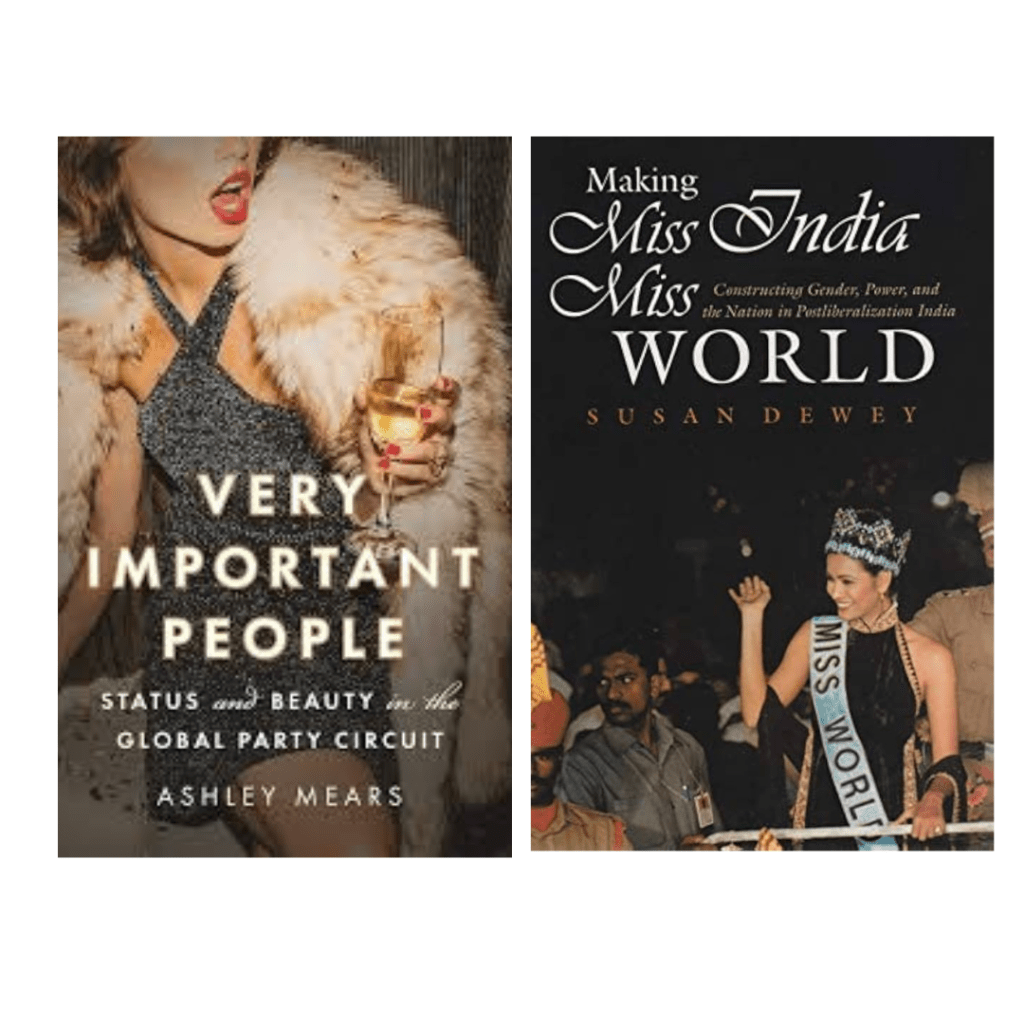
Very Important People: Status and Beauty in the Global Party Circuit by Ashley Mears (Princeton, NJ: Princeton University Press, 2020), 320 pp., 6.12 x 9.25in., ISBN 9780691168654, $19.95
Making Miss India Miss World: Constructing Gender, Power, and the Nation in Post liberalization India by Susan Dewey (Syracuse, NY: Syracuse University Press, 2008), 260 pp., 9 × 6 in., ISBN 9780815631767, ₹3323
by Riya Kumar
Ashley Mears’ 2020 book Very Important People: Status and Beauty in the Global Party Circuit is based in the United States, or more specifically, it details the life of nightclubs of Miami, Los Angeles, and New York. Instagram stories, wild party scenes, women in exquisite dresses, are all so dazzling and glamorous that they often successfully mask that the entry to such nightclubs is severely restricted. However, not restricted to all. ‘Models’, ‘good civilians’ and ‘girls’ are more than welcome. In detailing her conversation with (club) promoters, Mears describes ‘girls’ as a ‘social category of woman recognized as so highly valuable that she has the potential to designate a space as “very important.” She has to be a “quality” woman’.1 Similarly, ‘good civilians’ were ‘modelesque women, who, in addition to beauty, have the two most important bodily cues that signal high status.’ If models or modelesque were allowed, who wasn’t? Fat, short, ugly women were often berated at the club doors for attempting to enter, much like they would be shown out of contests like Miss India or Miss World. Susan Dewey in her 2008 work Making Miss India Miss World: Constructing Gender, Power and Nation in Postliberalisation India discusses contestants of the Miss India pageant, tracing their journey of preparation for Miss World. Women undergo severe exercise regimens, follow a strict diet prescribed by their ‘guardian’ experts and sculpt and tone their bodies to be a participant in the international contest.
The lives of the ‘girls’ and the contestants of the beauty pageant reveal how the beauty and fashion industry is closely connected to the idea of care. Models, contestants, and ‘girls’ take great pains to continuously care for their bodies through dieting, grooming, fitness, and beauty treatments to remain young and competent in the contest or be invited by the promoters, because anyone over 30 starts to ‘go bad’. Both models and contestants must be charming, ‘polite’, social, engaging and engage in what scholars call emotional labour to be cordial in these settings. While the contestants are not allowed to speak to their families or anyone outside the academy, in case of the ‘girls’, sexist and uncordial remarks by wealthy men in clubs happen on a daily basis. Both perform the labour of managing their emotions, labour of taking care of their bodies and learning social etiquettes. All this, however, is often made invisible because this labour is gendered and cast aside as part of women’s jobs as beautiful and feminine beings.
In the nightworld of clubs, conspicuous consumption, champagne wars, and the status of the wealthy men are not marked by men’s wealth, but by ‘girls’. It is only by the presence of a plethora of ‘girls’ around a man that marks his wealth, and more importantly, the ‘quality’ of girls. Slender, taller, prettier, the better. As Mears writes, while beauty is women’s currency in entry into these clubs, ‘girls’ often end up becoming currency for the wealthy men. Similarly in the international pageants, victory of the Indian model-contestant leads the entire nation to bask in reflected glory. Women, in both contexts, are harbingers, or markers of status, be it a high-status club where one finds ‘quality’ women, or a nation, where an intriguing nation is the one that produces exotic, beautiful women. Entangled within the logics of labour and care, the books narrate the story of women in the fashion and beauty industry, imparting crucial insights for women all around the world who negotiate and struggle to emulate the beauty queens and models in their everyday lives. The discussion of the books becomes pertinent today where pressures of the perfect post-worthy picture, anxiety of not looking good enough and constant self-criticism consumes millions of young women around the world. The following consolidated book review discusses themes discussed in both books: beauty, class, and agency of young women participating in a culture dependent on them but largely out of their grips.
In the beginning itself, in a moment of self-reflection, both authors admitted to having access to these places as they themselves are perceived as beautiful. Such an admission corroborates the findings of the books that are commentaries on the fragile position of women in the modeling, fashion and consumer industry where boldly capital alone determines their fate. Immersed in their respective contexts, both authors follow an ethnographic approach. Mears and Dewey followed Margarethe Kusenbach’s “go-along” method, a hybrid of interviewing and participant observation where researchers follow participants on their daily (and nightly) rounds, recording their interactions through space and their interpretations of events as they unfold in situ, as a way to study the social architecture around physical places.2 Through instructive vignettes, Mears and Dewey delineated how they use their social positions as a ‘former model’ and an ‘exotic foreigner’, respectively, to garner a degree of acceptability within the groups they attempted to study, and be privy to insights that women lacking certain bodily capital would otherwise miss out on. Thus, an important finding through the course of their research was the idea of beauty as a marker of acceptance in spaces, and inhabiting beauty as a performance.
Mears discussed through colourful examples how only certain kinds of women could become ‘girls’ and allowed to enter the clubs. If girls didn’t ‘fit the look’, or in other words, be slim, young, tall , white, wear heels and makeup, she would be insulted out of the club. Similarly, women older than age of 30 were often seen with disdain and be described as ‘bleak’ or ‘used up’. Dewey showed how models underwent rigorous training to not only fully change their bodies under expert surveillance and guidance, but to emerge several months later as ‘fundamentally altered human beings’ having learnt how to fluently speak English, enormous knowledge of Western and European culture and sophisticated and elegant behaviour. Both authors also stressed models’ and girls’ avowal to women’s empowerment while simultaneously affirming characteristics like fair skin, extraordinary height, slim body, and others as markers of beauty. More importantly, both authors successfully bring about the understanding of the lies behind these counterintuitive behaviors. Such ideas reflect a thinking that understands the body as a machine with parts to be ‘worked on’ and sculpted under extreme dietary regimen and expert assistance, as needed for a sense of empowerment. The ‘construction’ of twenty-six potential Miss India contestants from a group of relatively ordinary young women points to ways in which the body is both cultural plastic3 and a space for the performance of gendered identity4.
The discussion in the book shows how the beauty capital of these models/girls translates into cultural and symbolic capital. Miss India models were often seen promoting agendas of governmental and international organizations (e.g. spreading awareness about HIV/AIDS-related diseases). Similarly, girls in the club were seen as decorations, as embellishment that made the men look better, as a status signifier that caught the attention of other men. This was a crucial insight because while these men appreciated women’s company, they never monetarily compensated them. As Mears argued, girls were very rarely directly paid as it would tarnish their aesthetic function. Their function is to provide sexiness, not sex5. As several authors6 have shown, parasexuality drives contemporary entertainment and service industries, with sales floors designed to harness men’s attention with sex even when the goods and services are far removed from sex: ‘gallerinas’ in art galleries, ‘booth babes’ at tech conferences, flight attendants on airplanes, hotel concierges, even office secretaries. This is evident in the way these beautiful women who are so desirable, often remain un-marriable. There is often an assumption about the loose sexual character of these women who seem confident and sexy in public. The desire to dress freely and fashionably is often equated with sexual promiscuity. As Dewey argued, beauty is often described as dangerous in India because the beautiful female body is always an object of display whether by choice or not. Raising an important question that why do girls consent to being objectified, Mears responds that objectification itself may be pleasurable and empowering for women, especially when being objectified by the rich. As she quoted a girl saying, “there was something incredibly enticing about being invited to become the object of rich men’s desires.”7 Exclusivity is central to pleasure here, that is, girls liked that they were valued more than women who couldn’t get so close to elite men. The excitement partly stems from joining a space that excludes and undermines those not included.
The authors shed light on another important aspect of partaking in one’s objectification: the aspirations of social mobility. In the case of Miss India, to be awarded such a title represents social mobility and immense national pride in a new urban India. Participating in the pageant allowed young women a form of social mobility that they otherwise would not have had; even though this mobility came at the price of modifying their bodies and, to some degree, their very selves. In the case of the elite club circuit, the aspirations of promoters were discussed. Promoters’ dreams of upward mobility highlight the perils of service work performed for superrich clients, whose absurd wealth skewed promoters’ definitions of success and stoked their desires to be boundlessly rich as well.
The dynamics of inclusion and exclusion are central to this world (8). In the elite nightlife scene and in the realm of national and international beauty pageants, the exclusion of some is a source of both: one’s pleasure of being included and one’s aspirations of social mobility. Inclusion too rests on great costs, costs often borne by the bodies of these young women, who underwent severe forms of transformations to be among the ones included. However, it is crucial to note that even as these authors engage in extremely sensitive conversations, observing training and surveillance of the bodies of young women by experts and promoters, they are careful not to colour these relationships with moral rapprochement. Dewey admits to having considered writing a book that would have alternatively critiqued the pageant as a consumption-driven celebration of misogyny, and yet celebrated it for the agentive opportunities it creates for the contestants, which they would otherwise never encounter. Instead, the text that she has produced bears witness to the complexities of the beauty pageants, which neither a denouncing nor a celebrating stance would adequately capture. In her analysis, Miss India remains a contested ground, where ‘oppression meets emancipation, and commodification, patriarchy, and the maintenance of India’s extreme class inequalities rub shoulders uneasily with agency, empowerment, and aspiration’8. Similarly, Mears is careful not to equate girls’ desire to go out, look beautiful, dance and party with rich men as submitting to their objectification. As she showed, a lot of times, women used these places as avenues for an advancement in their career by pitching their ideas to business tycoons or procuring general assistance in starting something new.
Lastly, the authors analysis’ also discusses the role of the class positions of their participants. While the girls and models often hailed from modest backgrounds, they were often in the company of supremely wealthy men. While the bodies were capital for women, it was wealth for men. In a world where having a swarm of beautiful women in your arms displayed social significance and high status, to achieve that itself required extremely high status and money. Interestingly, while race alongside class was an important marker for women: white models were insurmountably preferred, similarly, north eastern women and Kashmiri women were praised for their exotic beauty. Race was not a determinant in case of wealthy men or body training experts who simply needed pockets full of money or experience in dealing with bodies to be accepted in the elite realm of those who were included. Yet, significant differences in age, class, and social status between contestants and the men who have control over their success in the media provide much fodder for salacious gossip in the Indian press. Similarly, it raised doubts about the sexual fidelity of girls and models who partied every night. The desire to mobility also came with unwarranted attention. Both authors were extremely sensitive in their approach and careful not to let their sympathies and concerns get in the way of giving comprehensive accounts of the elite nightlife or the beauty pageants.
In a way, both Miss India contestants and models and beautiful girls who frequent the clubs become aspirational figures for young women all over the world. The body, beauty, and looks achieved by these women are admired by women irrespective of their socio-economic background. The standards of attractiveness set by these women are not only emulated, but often function to instill an internal, narcissistic gaze that is constantly evaluating the body, its habits, its ‘problem areas’. But these processes of bodily remaking, monitoring, and self-discipling often cater to the personal aspirations and pleasures of the women. Linda Scott challenges the traditional feminist critique that fashion is inherently oppressive or superficial. Instead, she argues that fashion, including practices like wearing lipstick,9 can be empowering and a form of self-expression for women. Scott suggests that fashion allows women to navigate identity, agency, and social norms on their own terms rather than being simply tools of patriarchal control. Scott decouples beauty and objectification in mainstream feminist ideals to show beauty as a form of identity expression. The subjectivity then is both shaped by a social panopticon of dietary and beauty regimens as is produced by a sense of self-pleasure. This interesting duality comes out eloquently in both the books, more sharply however, in the case of Dewey’s Making Miss India Miss World. While the strength of Mears’ book lies particularly in capturing the essence of models’ internal dialogue that both aspires to be desired by the rich even as it understands that a degree of exploitation lies beneath undergirding/feeding this sense of being desirable. Where both texts lack, however, is in investigating the aspirations and subjectivities of those who make the world even as they fail to be a part of it. Countless makeup artists, dietary specialists, tailors, stylists, bartenders, etc. too constitute this elite social world even as they remain far removed from it. They make the models, the girls, the contestants but do they simultaneously want to make themselves? I believe this could be an interesting point of entry into understanding the subjectivities of those who are employed in these industries, but lacking in bodily, class or social capital and/or lack of desire/will, do not end up as the beautiful girls/models they help make. But nonetheless, both texts significantly enhance the sociological understanding of the makers of the nightworld/ beauty pageant world and contribute immensely to the literature attempting to understand beauty and its relation to the body and consumer industry.
Bibliography
Bailey. 2007. Parasexuality and Glamour: The Victorian Barmaid as Cultural Prototype. Gender & History 2, no. 2, 148–172.
Besnier, Niko. 2011. Review of Making Miss India Miss World: Constructing Gender, Power, and the Nation in Postliberalization India, by Susan Dewey. Wagadu: A Journal of Transnational Women’s & Gender Studies 9 (1).
Butler, Judith. 1993. Bodies That Matter: On the Discursive Limits of “Sex”. New York: Routledge, 1993.
Davis, Kathy. 1995. Reshaping the Female Body: The Dilemma of Cosmetic Surgery. New York: Routledge.
Dewey, Susan. 2010. Making Miss India Miss World: Constructing Gender, Power, and the Nation in Post-Liberalisation India. New Delhi: Routledge.
Hochschild, Arlie. 1983. The Managed Heart: Commercialization of Human Feeling. Berkeley: University of California Press.
Kusenbach, Margarethe. 2003. “Street Phenomenology: The Go-Along as Ethnographic Research
Tool.” Ethnography 4, (3): 455–485.
Mears, Ashley. 2020. Very Important People: Status and Beauty in the Global Party Circuit. New York: Princeton University Press.
Otis, Eileen M. 2016. “Ridgework: Globalization, Gender, and Service Labor at a Luxury Hotel.” University of Oregon, USA.
Pryke, Sam. 2021. “Very Important People by Ashley Mears.” The Sociological Review Magazine, April 8.
Scott, Linda M. 2005. Fresh Lipstick: Redressing Fashion and Feminism. Basingstoke: Palgrave Macmillan.
- Mears 2020↩︎
- Kusenbach 2003 ↩︎
- Davis 1995 ↩︎
- Butler 1993 ↩︎
- Pryke 2021 ↩︎
- Bailey 1990, Hochschild 1983, Otis 2016 ↩︎
- Mears 2020 ↩︎
- Besnier 2011 ↩︎
- Scott 2005
CALLING FAMILY
Book: Calling Family: Digital Technologies and the Making of Transnational Care Collectives by Tanja Ahlin (New Brunswick: Rutgers University Press, 2023), 212 pages, 22.86 × 15.24 cm, ISBN: 9781978834323, $ 37.95 (Paperback)
by Archa Raj T R and Devika Rajesh
Calling Family: Digital Technologies and the Making of Transnational Care Collectives, by Tanja Ahlin, is a well-researched ethnographic account that significantly contributes to the field of medical anthropology, migration and carework. Ahlin adopts a material-semiotics, empirical ethics, and science and technology studies (STS) approach in her study. She conducts her ethnographic study among thirty-three migrant nurses, mostly from the Syrian Christian community in Kottayam (a district in Kerala). The ethnographic fieldwork is carried out in Kerala and Oman, and also digitally across geographies over a period of ten years, intermittently from 2011 to 2022. This book primarily explains how transnational adult children administer care to their ageing parents from a distance using digital technologies. In the Indian context, co-residence with ageing parents is crucial to provide‘good care’. However, Ahlin says that the norms of care and filial obligations are ‘fluid and subject to change’, depending on the society and time (p. 144).
The book is divided into two parts. In the first part, called “Mapping Landscapes”, the author opines that the questions of healthcare and care are related and cannot be viewed as separate from each other. Ahlin’s work tries to blur this problematic distinction between formal and informal caregiving practices by examining how local concepts of good care are disrupted by geographic distance. Owing to the traditional notions of gender dynamics of care being tied to women, female migrant nurses constitute a major component in her study. She uses the concept of ‘transnational care collectives’ to fully understand how these migrant nurses enact care for their family members (p.16). In such collectives, one constantly tries to determine what constitutes good care when performed from a distance, integrating digital technologies with human actors. Through the material semiotics approach, she analyses the roles played by material objects, namely the non-human actors, including digital technology, telecom infrastructures available in the respective countries, money (in the form of remittances), and specialised health care devices, that become part of this collective.
Ahlin notes that only an ‘omnipresent co-presence’ can be created by migrating adult children to accomplish their filial obligations through online technologies (p. 12). The author highlights the relevance of digital technologies in people’s lives and relationships during the COVID-19 pandemic, as physical meetings were restricted. She also compares the experiences of ageing parents co-residing with their children to those living under institutionalised care. An important component of her study is the analysis of how money shapes the extent of agency experienced by residents of old-age shelters, which, in turn, helps determine whether they are abandoned or agentive residents. The author also admits that caring from a distance might not always work when parents have chronic diseases and require proximate care. In such cases, some of her interlocutors either travelled back willingly or left their jobs and permanently returned to Kerala to stay with their parents. However, Ahlin clearly misses a crucial point in the discourse on elderly abandonment— some ageing parents genuinely wish to enjoy life while staying with their children and grandchildren, yet they are left alone to lead isolated lives (Irudaya Rajan et al., 2017).
In the following part, titled Caring through Transnational Collectives”, the author describes in detail the ways through which care is enacted. Practices like frequent calling become a major component for implementing care in a transnational collective. Mostly, the digital devices and internet services were paid for by the migrating children to create and sustain these collectives. People ‘tinker’ with technologies, telecommunication infrastructures, work schedules, and time zones to find out which best suits all members of the collective (p. 16). In the book, through Mary’s example (p. 72), Ahlin shows how Mary’s technical know-how in creating the transnational care collective challenges the traditional hierarchies of gender, age, and ownership of the digital devices. The act of calling as an act of care became very evident when there was a lack of calling; the families perceived that as a case for concern.
The author mainly discusses cases where the decision to migrate was a collective family decision, and parents willingly took on the financial burden of sending their children abroad, as an investment for their old age. In contrast, the book does not address instances in which adult children migrate abroad against family decisions, nor does it examine how care is enacted in such situations. Although Syrian Christians in Kerala follow a patrilineal kinship, sending remittances regularly to the family becomes a responsibility and a filial obligation even for daughters. By earning significantly higher incomes in transnational workplaces, these women nurses can bargain more effectively with their in-laws’ families to take care of their parents and children. Financial support (such as sending remittances) is significant for aging parents in India, as only a few are eligible for pensions, and most health care expenses are paid out of pocket. Ahlin provides examples (case of Sara and Alwin, p. 114) of a redistribution of carework amongst those involved in the transnational care collective— with the migrating women taking on the role of financial providers, their husbands often shift to providing care by staying with the families.
Ahlin’s main argument is that care does not completely vanish from the picture, but is rather transformed within the transnational care collectives. In these collectives, the emphasis shifts from practices that require physical proximity to practices that use digital technologies, such as online calling or webcam. Ahlin posits that the formal healthcare system can employ digital technologies, such as telemedicine, provided a basic level of digital literacy amongst the population is ensured. The book tries to break stereotypes surrounding elderly parents’ ability to navigate digital tools and the internet. However, owing to the better social and economic position of Syrian Christians in Kerala, it is imperative to acknowledge the community’s already existing access to digital technologies and their familiarity with digital devices.
Nicola Yeates (2009) explains the concept of ‘double helix’ through which the transfer of nursing care from source to the host country is intertwined with the transfer of motherly care because most nurses are also mothers. Despite this, Ahlin omits a major category of left-behind children of these nurses from her analysis. Therefore, it’s questionable whether she was able to give complete justice to the title of the book. Some scholars use the concept of ‘immobilising regimes’ to refer to mobility constraints imposed by the state on migrants under restrictionist policies. This, in turn, greatly impedes ‘transnational care circulation’ (Merla et al., 2020). Ahlin’s work fails to capture such accounts and treats staying behind as part of transnational arrangements, instead of acknowledging that caring from a distance is the only means available to those unable to join their families. The concept of care involves questions of class, economic status of an individual, nation, and race, which she has not addressed in her work.
However, Ahlin has successfully showed the care dynamics at play in transnational families by studying a very mundane act of calling a family member. In fact, this book makes an appeal to its readers to acknowledge the significance of material objects (everyday digital technologies) as participants in human relations and sustaining transnational care collectives.
References:
Irudaya Rajan, S., Sunitha, S., & Arya, U. R. (2017). Elder Care and Living Arrangement in Kerala. In S. Irudaya Rajan & G. Balagopal (Eds.), Elderly Care in India: Societal and State Responses.
Yeates, N. (2009). Globalizing care economies and migrant workers: explorations in global care chains. Basingstoke Palgrave Macmillan.
Merla, L., Kilkey, M., & Baldassar, L. (2020). Examining transnational care circulation trajectories within immobilizing regimes of migration: Implications for proximate care. Journal of Family Research, 32(3).
Care, Violence, and the Market: Rethinking Violence as a Crisis of Care
BOOK: Book: Women and Violence in India: Gender, Oppression and the Politics of Neoliberalism, Bloomsbury Publishing, 2017, 266 pages, 23*15*3 cm, 978-9356400795, Rs. 539
by Nikita Gayner
Debates on violence against women in India are generally framed around two narratives. The first locates violence at a cultural, traditional, or religious level, often representing it as an inherited attribute of social backwardness (Lomazzi, 2023; Gopalakrishnan et al., 2025). The second relies on liberal development discourses, suggesting that economic growth, increased education, and women taking up paid work will ultimately erode patriarchal norms and reduce violence (Simister and Makowiec, 2008; Bergvall, 2024). Women and Violence in India contests both of these perspectives. Read through the lens of the politics of care, Tamsin Bradley’s argument acquires additional urgency. She suggests that violence against women is not something preserved culturally or simply a question of development, but a structural feature of present political and economic arrangements. Written in the aftermath of the 2012 Delhi gang rape, which brought international attention, the book asks a deceptively simple question: why does violence persist, and at times even intensify, despite decades of feminist mobilisation, legal change, and development-focused interventions? Bradley argues that neoliberalism, instead of weakening patriarchal power, strengthens it by reshaping the social relations that make violence against women appear normal rather than exceptional.
Bradley’s argument falls within feminist political economy and development theory, where disparities are viewed as structural problems. She challenges the assumption that empowerment and development coexist and argues that vulnerability can persist even when the state implements market reforms, rights-based policies, and legal interventions.
The book can be broadly divided into four sections. The first is devoted to introducing the conceptual framework, which establishes neoliberalism as a political and cultural system that affects aspirations, values, and power. Bradley suggests that it carries not only the destructive power of consumerism but also a system of values related to an idealised image of what it means to be ‘modern.’ Democracy, freedom, and empowerment are used without considering the context. For example, Bradley indicates that dowry practices have become more common due to consumerist pressures, where gifts and money are associated with being ‘modern’ and gaining status, respectability, and honour.
In the second part, the author examines rape and the way it is represented in society; focusing on the way the Indian and Western media treat some victims and perpetrators over others. The third section reflects on feminist politics in the face of rising conservatism. It discusses the internal contradictions of feminism, including global funding and rights-based approaches, and the presence of religious and right-wing feminism. Conservatism is not seen as being outside the economy but as part of a neoliberal trajectory that accepts patriarchal dominance as long as the market is not challenged. Bradley illustrates this with the use of household gender roles, where women’s education and work can create a backlash if economic roles change and patriarchal dominance is challenged.
The last section examines harmful practices in society, such as dowry and female genital mutilation. These chapters also show that such so-called ‘traditional’ practices do not decline through development and modernisation. Rather than disappearing with economic development, patriarchal practices can be reinvented and even accelerated through consumerism and market rationality. Bradley points to the commodification of women within marriage arrangements, where women’s social value becomes linked to material transactions and family prestige. In a sense, market-driven notions of modernity reshape rather than dismantle patriarchal norms. I find this argument persuasive in highlighting how economic change can coexist with, and even intensify, gender hierarchies rather than automatically producing social equality.
The most important contribution of the book is its understanding of neoliberalism as a gender-stratified and hierarchical project. Bradley incorporates feminist analysis to critique neoliberal capitalism, claiming that patriarchy underwrites the development of neoliberal governance not as a parallel system or residue of society, but as a structural or social regime. Neoliberalism generates stark inequalities, while eroding social institutions that can address them. It heightens aspirations via consumer culture and market imagery, while silencing opportunities of stable jobs, social protection and political voice. This disparity between aspiration and reality produces frustration, much of which is passed on to women. Thus, violence is a mechanism through which social order is maintained and gender hierarchies are re-established. A strength of the book is its rejection of linear narratives of empowerment. Bradley shows that women’s access to educational and employment opportunities do not necessarily translate into safety or autonomy. In many cases, these changes invite backlash in households and communities that are still in the hands of patriarchal power. Empowerment without structural change, the book suggests, can heighten vulnerability rather than reducing it.
Much of the book focuses on examining how violence against women appears in public spaces. Bradley’s analysis of rape coverage in Indian and international newspapers shows a pattern of selective visibility. Media narratives focus primarily on sensational cases involving urban, middle-class victims, whereas the everyday violence suffered by Dalit, rural, and economically marginalised women remains largely invisible. Parallely, perpetrators are frequently cast as deviant ‘others’ (often poor, rural, or lower-caste men). This framing helps insulate middle-class and elite groups from responsibility, even though patriarchal beliefs about women’s autonomy and sexuality are common for all sections of society. So, violence is individualised and pathologised rather than being viewed as structurally produced. Bradley’s analysis of international media in particular is highly pointed and provides a scathing critique, showing how colonial stereotypes continue to inform the framing of India as culturally backward. This distorts popular understandings of feminist struggles and undermines the movement.
Bradley gives a nuanced critique of feminist politics in India. Instead of idealising and dismissing feminist activism, she takes the effort to examine the constraints within which it exists. Attention is also paid to the impact of global development agendas and funding regimes that are designed to favour technocratic solutions and quantifiable results at the expense of structural analysis, for example, programmes focused on measurable indicators such as women’s health, education and employment, which are often prioritised over deeper structural questions related to patriarchy, caste, and social power. Analysis of state-led programmes reveals the gap between formal legal commitments and substantive political change. Legal reforms coexist with weak enforcement, which fails to challenge patriarchal norms in political institutions. She does not treat the growth of conservative and religious politics in isolation, but rather as part of a broader ideological convergence where market-led economic policies and socially conservative belief systems coexist.
The chapters on dowry and related harmful practices constitute some of the book’s strongest empirical contributions. Bradley questions the premise that education and health improvements alone are enough to overcome gendered exploitation. She shows that the institution of dowry has expanded beyond particular religious and social identities to assume a more monetised form in line with consumerist culture. Marriage, therefore, becomes an institution of wealth redistribution, in which women are valued in terms of their contribution of material resources to the marital family. Further, Bradley’s analysis speaks directly to the labour and ethics of care. Marriage, family, and domestic life are sites of unpaid care work, yet under consumer capitalism, these relationships are reorganised around extraction and exchange. Violence against brides thus appears not as a cultural anomaly but as a predictable outcome of market rationalities penetrating intimate life. Care is commodified, and women’s bodies become economic assets.
Women and Violence in India provides a thorough and disturbing account of the ways in which gender-based violence continues to persist even in the context of economic development. While the book’s analysis is necessarily based on qualitative and interpretive approaches, a greater incorporation of large-scale quantitative data could have added to the empirical foundation of the book, such as National Family Health Survey (NFHS) data on violence against women, domestic violence prevalence, and gender attitudes. However, this is more a reflection of the book’s methodological commitments than a fault. More significantly, this book offers a different perspective to the ongoing debates in the fields of labour, ethics, and institutions. Bradley shows that the state’s withdrawal from social welfare and the increased dominance of the market in social life results in the privatisation of care labour within the family. This increases the burden of responsibility on women. Therefore, ineffective institutions that fail to provide protection, justice, and social security help violence against women to sustain and flourish.
Bradley’s important argument about the complementarity between neoliberalism and patriarchy has implications far beyond India. The book treats violence against women as a political economy problem that exists due to institutional failure. Therefore, violence is an outcome of the structural collapse of collective care, not a law-and-order failure, as responsibility shifts from public institutions to private households, where women bear the cost of the extra burden. Women and Violence in India thus criticises the politics of care for creating gendered vulnerability and normalising violence. This is a timely, provocative, and necessary viewpoint. It not only deepens understanding about the structural roots of violence, but also calls for renewed institutional accountability and collective responsibility to build more just and caring societies. Therefore, this book is relevant not just in the Indian context, but for any society undergoing rapid liberalisation, where care responsibilities are shifting from public institutions to private households.
References
Bergvall, S. (2024). Women’s economic empowerment and intimate partner violence. Journal of Public Economics, 239, Article 105211. https://doi.org/10.1016/j.jpubeco.2024.105211
Gopalakrishnan, L., Bertozzi, S., Bradshaw, P., Deardorff, J., Shakya Baker, H., & Rabe-Hesketh, S. (2025). The role of gender norms on intimate partner violence among newly married adolescent girls and young women in India: A longitudinal multilevel analysis. Violence Against Women, 31(1), 182–205. https://doi.org/10.1177/10778012231208999
Lomazzi, V. (2023). The cultural roots of violence against women: Individual and institutional gender norms in 12 countries. Social Sciences, 12(3), 117. https://doi.org/10.3390/socsci12030117
Simister, J., & Makowiec, J. (2008). Domestic violence in India: Effects of education. Indian Journal of Gender Studies, 15(3), 507–518. https://doi.org/10.1177/097152150801500304
The Death of Nature
Book: The Death of Nature: Women, Ecology, and the Scientific Revolution by Carolyn Merchant (San Francisco: HarperOne, 2020), 384 pages, 20.3 x 13.5 cm, 978-0-06-250595-8
by Meena Vinodkumar Prakashchand
Carolyn Merchant’s The Death of Nature: Women, Ecology, and the Scientific Revolution (1980) is considered to be one of the foundational texts in environmental history and ecofeminist thought, a classic. In this well-researched, groundbreaking work, Merchant argues that the Scientific Revolution of the 16th and 17th centuries, also remembered as the Age of Enlightenment or the Age of Reason, marked a decisive transformation in Western conceptions of nature. There was a systematic shift from an ‘organic’ worldview, one that imagined the cosmos as a living, nurturing entity – a feminine entity, towards a ‘mechanistic’ worldview – one that conceived of nature as inert matter operating like a machine. Now, this novel ideation did not merely alter scientific theory but it also reshaped economic practices, social relations, and gender hierarchies in early modern Europe. Merchant’s central claim is that the subjugation of nature and the subordination of women were historically interconnected processes, both legitimised through the same philosophical and scientific frameworks set by various rationalising theorisations.
At the heart of the book lies a conceptual transition of the idea of Europe. In medieval and early Renaissance Europe, nature was widely understood through organic metaphors, which were reminiscent of their age-old values of the Christian and primordial beliefs. The earth was imagined as a living mother who nourished her children. This metaphor was not ornamental; it carried moral implications. If the earth were a mother, then human beings would bear an inherent ‘congenital’ obligation of restraint and care towards the planet. Extractive practices such as mining were often viewed with suspicion to a point of apprehension. Merchant draws attention to classical and early modern critiques of mining, where digging into the earth was described in violent imagery as tearing open a body i.e. ripping apart the earth’s womb (p. 160-161). Such imagery reinforced an ethic of limits. Nature, being alive, deserved the reverence of the civilisational order.
Merchant makes sure that she does not romanticise this period as environmentally harmonious with reference to a modern sense. Rather, she argues that the organic worldview functioned as a cultural constraint, such that it provided symbolic and ethical boundaries that discouraged unrestrained exploitation. This restraint began to erode in the 16th and 17th centuries under the combined pressures of demographic growth, expanding markets, and early capitalist enterprise. As Europe transitioned toward a market-oriented economy, land and natural resources increasingly became commodities, fit enough for incessant capitalistic consumption. Beyond the soil itself, natural resources – forests, minerals, and water were abstracted from their ecosystem and treated as inputs for industrial production. Thinkers like Karl Polanyi called this ‘fictitious commodity’ (Polanyi 1944, p. 39-44).
The enclosure movement in England exemplifies this transformation. Common lands, once used collectively by peasants for subsistence, agriculture, and grazing, were fenced off by landlords seeking to profit from wool production. Subsistence gave way to commercial agriculture, and in that way, Europe saw the gradual transition from a feudal society to a capitalist mode of production. Wetlands such as the Fenlands in eastern England, which were naturally marshy, supporting a rich ecology and numerous species, were ultimately drained to create arable land for market crops. Forests were cleared extensively to meet the energy demands of shipbuilding, metallurgy, and urban expansion industries, only to see the rise of new cities like Sheffield. Merchant tries to place these developments within a broader pattern of the reorganisation of ecological systems to serve profit rather than communal survival, thus completely and permanently damaging the sensitive ecological food chains.
This material transformation required an accompanying intellectual shift. The older image of nature as a living organism was increasingly incompatible with large-scale extraction and environmental manipulation. A new metaphor emerged: nature as machine. Influenced by developments in mechanics, clockwork engineering, and hydraulic technology, natural philosophers began to conceptualise the universe as composed of discrete parts governed by mechanical laws. Thinkers such as René Descartes advanced a dualistic framework in which matter was inert and devoid of intrinsic purpose. He gave one of the most problematic statements under the garb of neo-intellectualism – ‘Cogito, ergo sum’ translated as ‘I think, therefore I am’. It was originally published in French in his 1637 work ‘Discourse on the Method’. While intended as an absolutely secure foundation for knowledge, the cogito became highly controversial and ‘problematic’. Nature no longer possessed agency or vitality; it operated according to predictable principles that could be mathematically described and technologically controlled.
This ‘theoretic-mechanical’ mentality was further accentuated by other thinkers as well. Thomas Hobbes, for instance, extended mechanical reasoning into political theory, likening the state to an artificial machine designed to regulate inherently self-interested individuals. Within this worldview, intervention into nature was not morally suspect. A machine could be dismantled, adjusted, and optimised without ethical concern. Merchant interprets this intellectual transformation as the ‘death’ of nature – not in a literal sense, but as the death of a symbolic and ethical framework that once positioned nature as a living presence. The new mechanistic philosophy rendered the earth passive and manipulable. This redefinition provided ideological support for expanding scientific experimentation and industrial exploitation.
In the context of early modern Europe – an era marked by witch trials and gendered violence – such metaphors acquire additional significance. Merchant argues that the conceptual association of nature with the feminine made scientific ‘mastery’ of nature symbolically parallel to the subordination of women. The witch hunts of the 16th and 17th centuries illustrate this convergence. Women, particularly those who were older, poor, or socially marginal, were frequently accused of consorting with demonic forces and disrupting natural order. Merchant suggests that women were perceived as closer to nature – emotionally, bodily, and symbolically. As nature was redefined as chaotic and in need of control, women, too, became associated with disorder and irrationality. The persecution of alleged witches can thus be read as part of a broader effort to discipline both nature and femininity within a newly rationalised social order.
This restructuring also affected everyday forms of women’s labour and knowledge. Midwifery, once a domain of female expertise rooted in communal practice and experiential understanding, gradually came under the authority of male medical professionals. The professionalisation of medicine, accompanied by licensing requirements and institutional training from which women were excluded, marginalised traditional female healers. The introduction of instruments such as forceps symbolised the increasing intervention of mechanical technique into childbirth. Merchant interprets this transition as emblematic of the broader displacement of organic knowledge by instrumental control. She resonates with Michel Foucault’s concept of ‘biopower’ which refers to the modern mechanisms of power that manage, regulate, and control human life, thereby disciplining individual bodies and regulating populations (biopolitics), which are intrinsically crucial for capitalism and modern governance.
Merchant further examines early modern theories of reproduction to show how scientific discourse reinforced gender hierarchies. Building upon Aristotelian notions that distinguished between active male form and passive female matter, early modern thinkers often characterised women as vessels rather than creative agents. She disagrees with the misogyny of Aristotle when he wrote that women were ‘naturally inferior’, ‘deformed’, and ‘mentally subordinate to men’ (Freeland 1994, p. 145-146), arguing that the male is by nature more expert at leading while the female is ‘fit only to be ruled’. Even when empirical investigation advanced anatomical understanding, conceptual frameworks frequently preserved male generative superiority; this thinking continued to intertwine with the Cartesian notions which naturalised women’s subordinate status under the authority of science. Importantly, Merchant does not present the mechanistic worldview as uncontested. She highlights alternative intellectual traditions that preserved elements of the organic perspective. For instance, during the English Civil War, radical groups such as the Diggers articulated visions of communal land ownership and ecological interdependence. Gerrard Winstanley described the earth as a “common treasury,” challenging emerging property regimes and market logics.
Her analysis underscores the interconnectedness of environmental and social justice. The same conceptual frameworks that justified mastery over nature reinforced hierarchies of gender and class. Environmental degradation and social inequality emerge from shared historical roots. Thus, ecological renewal cannot be separated from broader struggles for equity and inclusion.
Critically, Merchant’s work has prompted debate. Some historians argue that the distinction between organic and mechanistic worldviews risks oversimplification, while others question whether symbolic metaphors alone can account for large-scale economic transformation. Nonetheless, even where one disagrees with aspects of her thesis, Merchant’s contribution remains substantial. She opens a field of inquiry that integrates environmental history, feminist theory, and intellectual history in a rigorous and provocative manner. In consideration of the theme of care and ecology, The Death of Nature offers a powerful reminder that cultural narratives shape material realities. To cultivate ecological care, one requires confronting the intellectual inheritance of the Scientific Revolution and reconsidering the values embedded within modernity itself.
References:
Polanyi, Karl. The Great Transformation. 1944.
Freeland, Cynthia. “Nourishing speculation: A feminist reading of Aristotelian science.” in Engendering origins: Critical feminist readings in Plato and Aristotle (1994): 145-46.
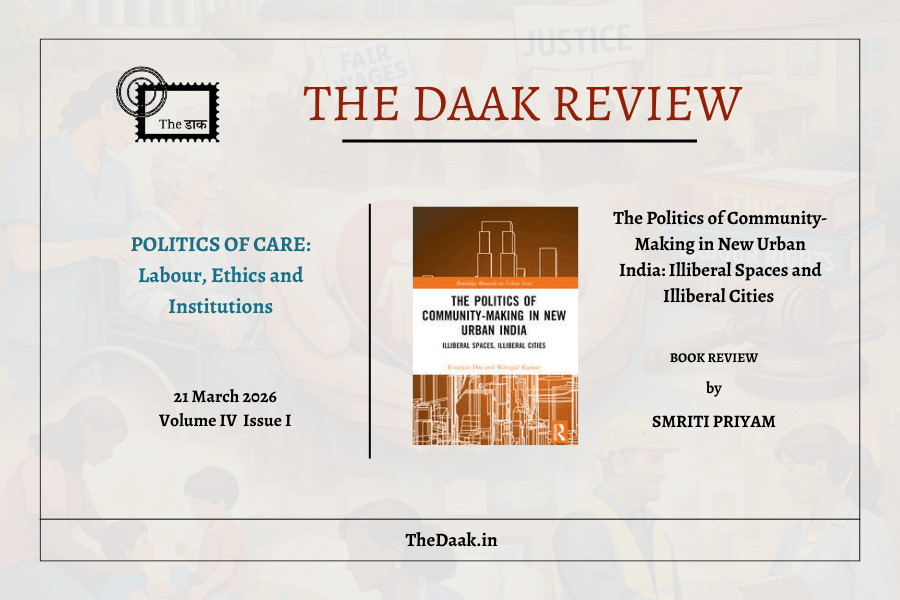
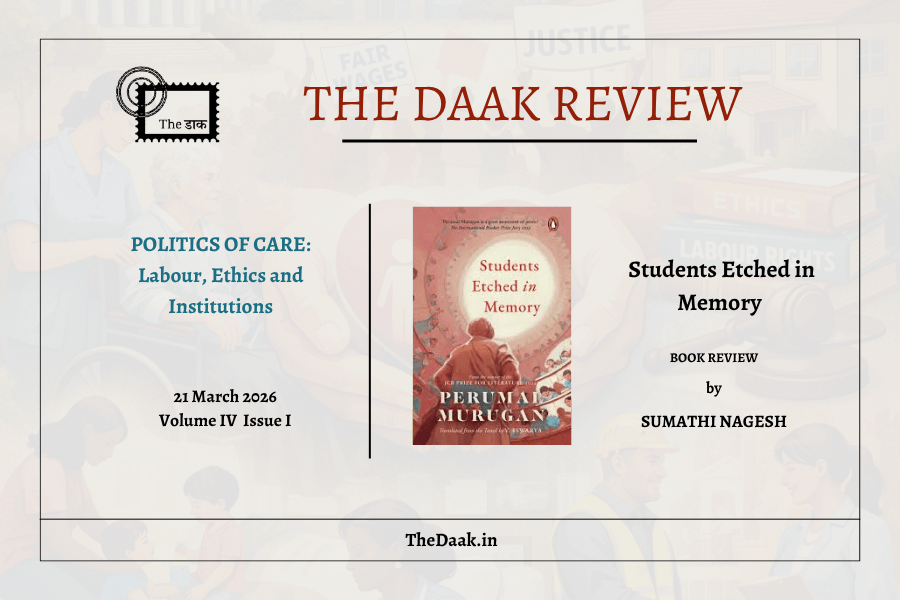
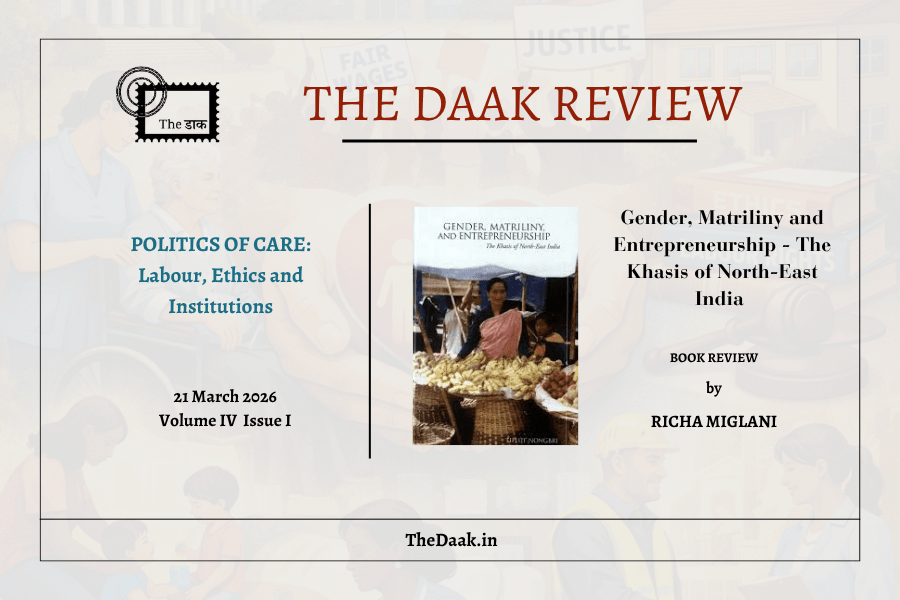
 TheDaak review
Leave a comment