
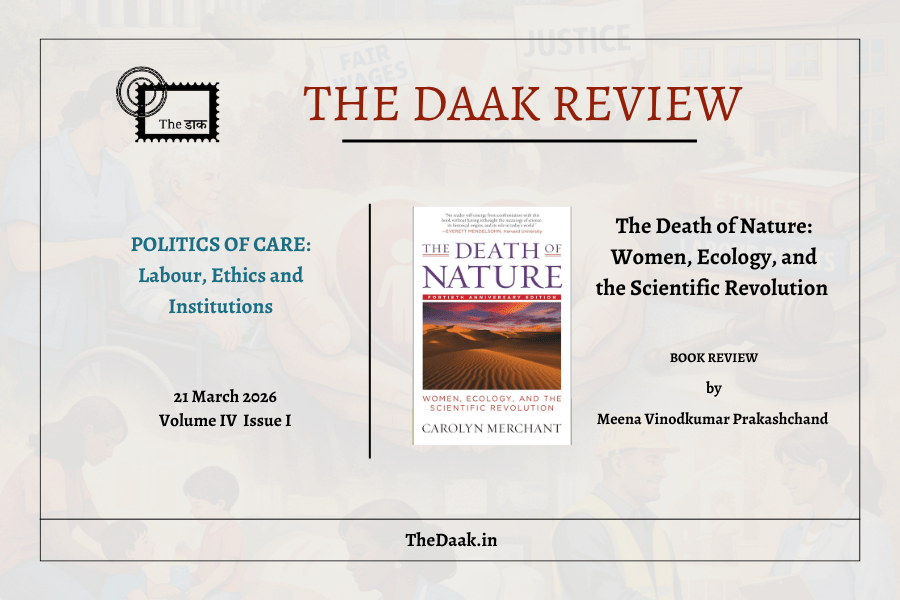
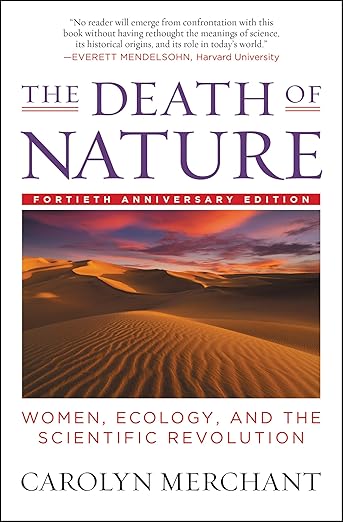
Book: The Death of Nature: Women, Ecology, and the Scientific Revolution by Carolyn Merchant (San Francisco: HarperOne, 2020), 384 pages, 20.3 x 13.5 cm, 978-0-06-250595-8
by Meena Vinodkumar Prakashchand
Carolyn Merchant’s The Death of Nature: Women, Ecology, and the Scientific Revolution (1980) is considered to be one of the foundational texts in environmental history and ecofeminist thought, a classic. In this well-researched, groundbreaking work, Merchant argues that the Scientific Revolution of the 16th and 17th centuries, also remembered as the Age of Enlightenment or the Age of Reason, marked a decisive transformation in Western conceptions of nature. There was a systematic shift from an ‘organic’ worldview, one that imagined the cosmos as a living, nurturing entity – a feminine entity, towards a ‘mechanistic’ worldview – one that conceived of nature as inert matter operating like a machine. Now, this novel ideation did not merely alter scientific theory but it also reshaped economic practices, social relations, and gender hierarchies in early modern Europe. Merchant’s central claim is that the subjugation of nature and the subordination of women were historically interconnected processes, both legitimised through the same philosophical and scientific frameworks set by various rationalising theorisations.
At the heart of the book lies a conceptual transition of the idea of Europe. In medieval and early Renaissance Europe, nature was widely understood through organic metaphors, which were reminiscent of their age-old values of the Christian and primordial beliefs. The earth was imagined as a living mother who nourished her children. This metaphor was not ornamental; it carried moral implications. If the earth were a mother, then human beings would bear an inherent ‘congenital’ obligation of restraint and care towards the planet. Extractive practices such as mining were often viewed with suspicion to a point of apprehension. Merchant draws attention to classical and early modern critiques of mining, where digging into the earth was described in violent imagery as tearing open a body i.e. ripping apart the earth’s womb (p. 160-161). Such imagery reinforced an ethic of limits. Nature, being alive, deserved the reverence of the civilisational order.
Merchant makes sure that she does not romanticise this period as environmentally harmonious with reference to a modern sense. Rather, she argues that the organic worldview functioned as a cultural constraint, such that it provided symbolic and ethical boundaries that discouraged unrestrained exploitation. This restraint began to erode in the 16th and 17th centuries under the combined pressures of demographic growth, expanding markets, and early capitalist enterprise. As Europe transitioned toward a market-oriented economy, land and natural resources increasingly became commodities, fit enough for incessant capitalistic consumption. Beyond the soil itself, natural resources – forests, minerals, and water were abstracted from their ecosystem and treated as inputs for industrial production. Thinkers like Karl Polanyi called this ‘fictitious commodity’ (Polanyi 1944, p. 39-44).
The enclosure movement in England exemplifies this transformation. Common lands, once used collectively by peasants for subsistence, agriculture, and grazing, were fenced off by landlords seeking to profit from wool production. Subsistence gave way to commercial agriculture, and in that way, Europe saw the gradual transition from a feudal society to a capitalist mode of production. Wetlands such as the Fenlands in eastern England, which were naturally marshy, supporting a rich ecology and numerous species, were ultimately drained to create arable land for market crops. Forests were cleared extensively to meet the energy demands of shipbuilding, metallurgy, and urban expansion industries, only to see the rise of new cities like Sheffield. Merchant tries to place these developments within a broader pattern of the reorganisation of ecological systems to serve profit rather than communal survival, thus completely and permanently damaging the sensitive ecological food chains.
This material transformation required an accompanying intellectual shift. The older image of nature as a living organism was increasingly incompatible with large-scale extraction and environmental manipulation. A new metaphor emerged: nature as machine. Influenced by developments in mechanics, clockwork engineering, and hydraulic technology, natural philosophers began to conceptualise the universe as composed of discrete parts governed by mechanical laws. Thinkers such as René Descartes advanced a dualistic framework in which matter was inert and devoid of intrinsic purpose. He gave one of the most problematic statements under the garb of neo-intellectualism – ‘Cogito, ergo sum’ translated as ‘I think, therefore I am’. It was originally published in French in his 1637 work ‘Discourse on the Method’. While intended as an absolutely secure foundation for knowledge, the cogito became highly controversial and ‘problematic’. Nature no longer possessed agency or vitality; it operated according to predictable principles that could be mathematically described and technologically controlled.
This ‘theoretic-mechanical’ mentality was further accentuated by other thinkers as well. Thomas Hobbes, for instance, extended mechanical reasoning into political theory, likening the state to an artificial machine designed to regulate inherently self-interested individuals. Within this worldview, intervention into nature was not morally suspect. A machine could be dismantled, adjusted, and optimised without ethical concern. Merchant interprets this intellectual transformation as the ‘death’ of nature – not in a literal sense, but as the death of a symbolic and ethical framework that once positioned nature as a living presence. The new mechanistic philosophy rendered the earth passive and manipulable. This redefinition provided ideological support for expanding scientific experimentation and industrial exploitation.
In the context of early modern Europe – an era marked by witch trials and gendered violence – such metaphors acquire additional significance. Merchant argues that the conceptual association of nature with the feminine made scientific ‘mastery’ of nature symbolically parallel to the subordination of women. The witch hunts of the 16th and 17th centuries illustrate this convergence. Women, particularly those who were older, poor, or socially marginal, were frequently accused of consorting with demonic forces and disrupting natural order. Merchant suggests that women were perceived as closer to nature – emotionally, bodily, and symbolically. As nature was redefined as chaotic and in need of control, women, too, became associated with disorder and irrationality. The persecution of alleged witches can thus be read as part of a broader effort to discipline both nature and femininity within a newly rationalised social order.
This restructuring also affected everyday forms of women’s labour and knowledge. Midwifery, once a domain of female expertise rooted in communal practice and experiential understanding, gradually came under the authority of male medical professionals. The professionalisation of medicine, accompanied by licensing requirements and institutional training from which women were excluded, marginalised traditional female healers. The introduction of instruments such as forceps symbolised the increasing intervention of mechanical technique into childbirth. Merchant interprets this transition as emblematic of the broader displacement of organic knowledge by instrumental control. She resonates with Michel Foucault’s concept of ‘biopower’ which refers to the modern mechanisms of power that manage, regulate, and control human life, thereby disciplining individual bodies and regulating populations (biopolitics), which are intrinsically crucial for capitalism and modern governance.
Merchant further examines early modern theories of reproduction to show how scientific discourse reinforced gender hierarchies. Building upon Aristotelian notions that distinguished between active male form and passive female matter, early modern thinkers often characterised women as vessels rather than creative agents. She disagrees with the misogyny of Aristotle when he wrote that women were ‘naturally inferior’, ‘deformed’, and ‘mentally subordinate to men’ (Freeland 1994, p. 145-146), arguing that the male is by nature more expert at leading while the female is ‘fit only to be ruled’. Even when empirical investigation advanced anatomical understanding, conceptual frameworks frequently preserved male generative superiority; this thinking continued to intertwine with the Cartesian notions which naturalised women’s subordinate status under the authority of science. Importantly, Merchant does not present the mechanistic worldview as uncontested. She highlights alternative intellectual traditions that preserved elements of the organic perspective. For instance, during the English Civil War, radical groups such as the Diggers articulated visions of communal land ownership and ecological interdependence. Gerrard Winstanley described the earth as a “common treasury,” challenging emerging property regimes and market logics.
Her analysis underscores the interconnectedness of environmental and social justice. The same conceptual frameworks that justified mastery over nature reinforced hierarchies of gender and class. Environmental degradation and social inequality emerge from shared historical roots. Thus, ecological renewal cannot be separated from broader struggles for equity and inclusion.
Critically, Merchant’s work has prompted debate. Some historians argue that the distinction between organic and mechanistic worldviews risks oversimplification, while others question whether symbolic metaphors alone can account for large-scale economic transformation. Nonetheless, even where one disagrees with aspects of her thesis, Merchant’s contribution remains substantial. She opens a field of inquiry that integrates environmental history, feminist theory, and intellectual history in a rigorous and provocative manner. In consideration of the theme of care and ecology, The Death of Nature offers a powerful reminder that cultural narratives shape material realities. To cultivate ecological care, one requires confronting the intellectual inheritance of the Scientific Revolution and reconsidering the values embedded within modernity itself.
References:
Polanyi, Karl. The Great Transformation. 1944.
Freeland, Cynthia. “Nourishing speculation: A feminist reading of Aristotelian science.” in Engendering origins: Critical feminist readings in Plato and Aristotle (1994): 145-46.
Meena Vinodkumar Prakashchand is a postgraduate student of History at St. Stephen’s College, University of Delhi.
©TheDaak2023
 TheDaak review
Leave a comment