
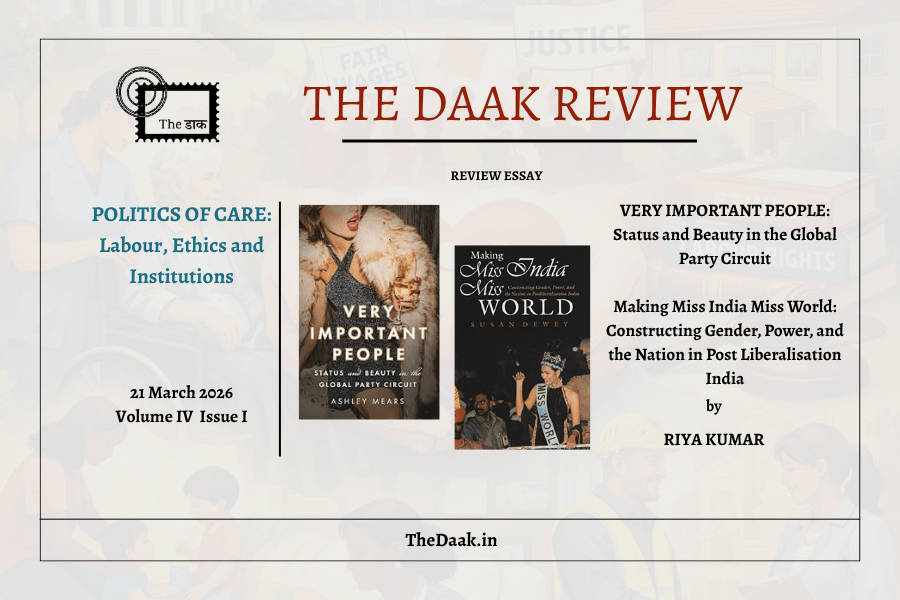
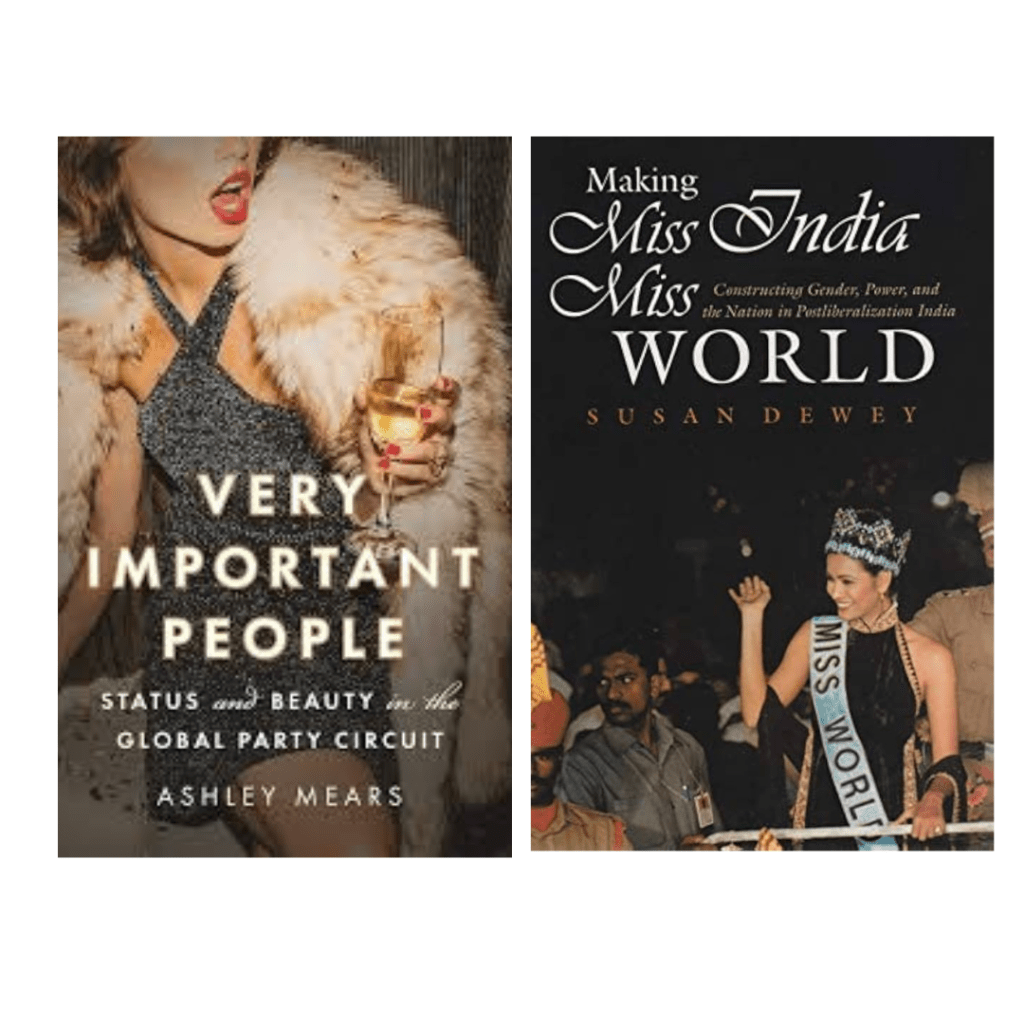
Very Important People: Status and Beauty in the Global Party Circuit by Ashley Mears (Princeton, NJ: Princeton University Press, 2020), 320 pp., 6.12 x 9.25in., ISBN 9780691168654, $19.95
Making Miss India Miss World: Constructing Gender, Power, and the Nation in Postliberalization India by Susan Dewey (Syracuse, NY: Syracuse University Press, 2008), 260 pp., 9 × 6 in., ISBN 9780815631767, ₹3323
By Riya Kumar
Ashley Mears’ 2020 book Very Important People: Status and Beauty in the Global Party Circuit is based in the United States, or more specifically, it details the life of nightclubs of Miami, Los Angeles, and New York. Instagram stories, wild party scenes, women in exquisite dresses, are all so dazzling and glamorous that they often successfully mask that the entry to such nightclubs is severely restricted. However, not restricted to all. ‘Models’, ‘good civilians’ and ‘girls’ are more than welcome. In detailing her conversation with (club) promoters, Mears describes ‘girls’ as a ‘social category of woman recognized as so highly valuable that she has the potential to designate a space as “very important.” She has to be a “quality” woman’.1 Similarly, ‘good civilians’ were ‘modelesque women, who, in addition to beauty, have the two most important bodily cues that signal high status.’ If models or modelesque were allowed, who wasn’t? Fat, short, ugly women were often berated at the club doors for attempting to enter, much like they would be shown out of contests like Miss India or Miss World. Susan Dewey in her 2008 work Making Miss India Miss World: Constructing Gender, Power and Nation in Postliberalisation India discusses contestants of the Miss India pageant, tracing their journey of preparation for Miss World. Women undergo severe exercise regimens, follow a strict diet prescribed by their ‘guardian’ experts and sculpt and tone their bodies to be a participant in the international contest.
The lives of the ‘girls’ and the contestants of the beauty pageant reveal how the beauty and fashion industry is closely connected to the idea of care. Models, contestants, and ‘girls’ take great pains to continuously care for their bodies through dieting, grooming, fitness, and beauty treatments to remain young and competent in the contest or be invited by the promoters, because anyone over 30 starts to ‘go bad’. Both models and contestants must be charming, ‘polite’, social, engaging and engage in what scholars call emotional labour to be cordial in these settings. While the contestants are not allowed to speak to their families or anyone outside the academy, in case of the ‘girls’, sexist and uncordial remarks by wealthy men in clubs happen on a daily basis. Both perform the labour of managing their emotions, labour of taking care of their bodies and learning social etiquettes. All this, however, is often made invisible because this labour is gendered and cast aside as part of women’s jobs as beautiful and feminine beings.
In the nightworld of clubs, conspicuous consumption, champagne wars, and the status of the wealthy men are not marked by men’s wealth, but by ‘girls’. It is only by the presence of a plethora of ‘girls’ around a man that marks his wealth, and more importantly, the ‘quality’ of girls. Slender, taller, prettier, the better. As Mears writes, while beauty is women’s currency in entry into these clubs, ‘girls’ often end up becoming currency for the wealthy men. Similarly in the international pageants, victory of the Indian model-contestant leads the entire nation to bask in reflected glory. Women, in both contexts, are harbingers, or markers of status, be it a high-status club where one finds ‘quality’ women, or a nation, where an intriguing nation is the one that produces exotic, beautiful women. Entangled within the logics of labour and care, the books narrate the story of women in the fashion and beauty industry, imparting crucial insights for women all around the world who negotiate and struggle to emulate the beauty queens and models in their everyday lives. The discussion of the books becomes pertinent today where pressures of the perfect post-worthy picture, anxiety of not looking good enough and constant self-criticism consumes millions of young women around the world. The following consolidated book review discusses themes discussed in both books: beauty, class, and agency of young women participating in a culture dependent on them but largely out of their grips.
In the beginning itself, in a moment of self-reflection, both authors admitted to having access to these places as they themselves are perceived as beautiful. Such an admission corroborates the findings of the books that are commentaries on the fragile position of women in the modeling, fashion and consumer industry where boldly capital alone determines their fate. Immersed in their respective contexts, both authors follow an ethnographic approach. Mears and Dewey followed Margarethe Kusenbach’s “go-along” method, a hybrid of interviewing and participant observation where researchers follow participants on their daily (and nightly) rounds, recording their interactions through space and their interpretations of events as they unfold in situ, as a way to study the social architecture around physical places.2 Through instructive vignettes, Mears and Dewey delineated how they use their social positions as a ‘former model’ and an ‘exotic foreigner’, respectively, to garner a degree of acceptability within the groups they attempted to study, and be privy to insights that women lacking certain bodily capital would otherwise miss out on. Thus, an important finding through the course of their research was the idea of beauty as a marker of acceptance in spaces, and inhabiting beauty as a performance.
Mears discussed through colourful examples how only certain kinds of women could become ‘girls’ and allowed to enter the clubs. If girls didn’t ‘fit the look’, or in other words, be slim, young, tall , white, wear heels and makeup, she would be insulted out of the club. Similarly, women older than age of 30 were often seen with disdain and be described as ‘bleak’ or ‘used up’. Dewey showed how models underwent rigorous training to not only fully change their bodies under expert surveillance and guidance, but to emerge several months later as ‘fundamentally altered human beings’ having learnt how to fluently speak English, enormous knowledge of Western and European culture and sophisticated and elegant behaviour. Both authors also stressed models’ and girls’ avowal to women’s empowerment while simultaneously affirming characteristics like fair skin, extraordinary height, slim body, and others as markers of beauty. More importantly, both authors successfully bring about the understanding of the lies behind these counterintuitive behaviors. Such ideas reflect a thinking that understands the body as a machine with parts to be ‘worked on’ and sculpted under extreme dietary regimen and expert assistance, as needed for a sense of empowerment. The ‘construction’ of twenty-six potential Miss India contestants from a group of relatively ordinary young women points to ways in which the body is both cultural plastic3 and a space for the performance of gendered identity4.
The discussion in the book shows how the beauty capital of these models/girls translates into cultural and symbolic capital. Miss India models were often seen promoting agendas of governmental and international organizations (e.g. spreading awareness about HIV/AIDS-related diseases). Similarly, girls in the club were seen as decorations, as embellishment that made the men look better, as a status signifier that caught the attention of other men. This was a crucial insight because while these men appreciated women’s company, they never monetarily compensated them. As Mears argued, girls were very rarely directly paid as it would tarnish their aesthetic function. Their function is to provide sexiness, not sex5. As several authors6 have shown, parasexuality drives contemporary entertainment and service industries, with sales floors designed to harness men’s attention with sex even when the goods and services are far removed from sex: ‘gallerinas’ in art galleries, ‘booth babes’ at tech conferences, flight attendants on airplanes, hotel concierges, even office secretaries. This is evident in the way these beautiful women who are so desirable, often remain un-marriable. There is often an assumption about the loose sexual character of these women who seem confident and sexy in public. The desire to dress freely and fashionably is often equated with sexual promiscuity. As Dewey argued, beauty is often described as dangerous in India because the beautiful female body is always an object of display whether by choice or not. Raising an important question that why do girls consent to being objectified, Mears responds that objectification itself may be pleasurable and empowering for women, especially when being objectified by the rich. As she quoted a girl saying, “there was something incredibly enticing about being invited to become the object of rich men’s desires.”7 Exclusivity is central to pleasure here, that is, girls liked that they were valued more than women who couldn’t get so close to elite men. The excitement partly stems from joining a space that excludes and undermines those not included.
The authors shed light on another important aspect of partaking in one’s objectification: the aspirations of social mobility. In the case of Miss India, to be awarded such a title represents social mobility and immense national pride in a new urban India. Participating in the pageant allowed young women a form of social mobility that they otherwise would not have had; even though this mobility came at the price of modifying their bodies and, to some degree, their very selves. In the case of the elite club circuit, the aspirations of promoters were discussed. Promoters’ dreams of upward mobility highlight the perils of service work performed for superrich clients, whose absurd wealth skewed promoters’ definitions of success and stoked their desires to be boundlessly rich as well.
The dynamics of inclusion and exclusion are central to this world (8). In the elite nightlife scene and in the realm of national and international beauty pageants, the exclusion of some is a source of both: one’s pleasure of being included and one’s aspirations of social mobility. Inclusion too rests on great costs, costs often borne by the bodies of these young women, who underwent severe forms of transformations to be among the ones included. However, it is crucial to note that even as these authors engage in extremely sensitive conversations, observing training and surveillance of the bodies of young women by experts and promoters, they are careful not to colour these relationships with moral rapprochement. Dewey admits to having considered writing a book that would have alternatively critiqued the pageant as a consumption-driven celebration of misogyny, and yet celebrated it for the agentive opportunities it creates for the contestants, which they would otherwise never encounter. Instead, the text that she has produced bears witness to the complexities of the beauty pageants, which neither a denouncing nor a celebrating stance would adequately capture. In her analysis, Miss India remains a contested ground, where ‘oppression meets emancipation, and commodification, patriarchy, and the maintenance of India’s extreme class inequalities rub shoulders uneasily with agency, empowerment, and aspiration’8. Similarly, Mears is careful not to equate girls’ desire to go out, look beautiful, dance and party with rich men as submitting to their objectification. As she showed, a lot of times, women used these places as avenues for an advancement in their career by pitching their ideas to business tycoons or procuring general assistance in starting something new.
Lastly, the authors analysis’ also discusses the role of the class positions of their participants. While the girls and models often hailed from modest backgrounds, they were often in the company of supremely wealthy men. While the bodies were capital for women, it was wealth for men. In a world where having a swarm of beautiful women in your arms displayed social significance and high status, to achieve that itself required extremely high status and money. Interestingly, while race alongside class was an important marker for women: white models were insurmountably preferred, similarly, north eastern women and Kashmiri women were praised for their exotic beauty. Race was not a determinant in case of wealthy men or body training experts who simply needed pockets full of money or experience in dealing with bodies to be accepted in the elite realm of those who were included. Yet, significant differences in age, class, and social status between contestants and the men who have control over their success in the media provide much fodder for salacious gossip in the Indian press. Similarly, it raised doubts about the sexual fidelity of girls and models who partied every night. The desire to mobility also came with unwarranted attention. Both authors were extremely sensitive in their approach and careful not to let their sympathies and concerns get in the way of giving comprehensive accounts of the elite nightlife or the beauty pageants.
In a way, both Miss India contestants and models and beautiful girls who frequent the clubs become aspirational figures for young women all over the world. The body, beauty, and looks achieved by these women are admired by women irrespective of their socio-economic background. The standards of attractiveness set by these women are not only emulated, but often function to instill an internal, narcissistic gaze that is constantly evaluating the body, its habits, its ‘problem areas’. But these processes of bodily remaking, monitoring, and self-discipling often cater to the personal aspirations and pleasures of the women. Linda Scott challenges the traditional feminist critique that fashion is inherently oppressive or superficial. Instead, she argues that fashion, including practices like wearing lipstick,9 can be empowering and a form of self-expression for women. Scott suggests that fashion allows women to navigate identity, agency, and social norms on their own terms rather than being simply tools of patriarchal control. Scott decouples beauty and objectification in mainstream feminist ideals to show beauty as a form of identity expression. The subjectivity then is both shaped by a social panopticon of dietary and beauty regimens as is produced by a sense of self-pleasure. This interesting duality comes out eloquently in both the books, more sharply however, in the case of Dewey’s Making Miss India Miss World. While the strength of Mears’ book lies particularly in capturing the essence of models’ internal dialogue that both aspires to be desired by the rich even as it understands that a degree of exploitation lies beneath undergirding/feeding this sense of being desirable. Where both texts lack, however, is in investigating the aspirations and subjectivities of those who make the world even as they fail to be a part of it. Countless makeup artists, dietary specialists, tailors, stylists, bartenders, etc. too constitute this elite social world even as they remain far removed from it. They make the models, the girls, the contestants but do they simultaneously want to make themselves? I believe this could be an interesting point of entry into understanding the subjectivities of those who are employed in these industries, but lacking in bodily, class or social capital and/or lack of desire/will, do not end up as the beautiful girls/models they help make. But nonetheless, both texts significantly enhance the sociological understanding of the makers of the nightworld/ beauty pageant world and contribute immensely to the literature attempting to understand beauty and its relation to the body and consumer industry.
Bibliography
Bailey. 2007. Parasexuality and Glamour: The Victorian Barmaid as Cultural Prototype. Gender & History 2, no. 2, 148–172.
Besnier, Niko. 2011. Review of Making Miss India Miss World: Constructing Gender, Power, and the Nation in Postliberalization India, by Susan Dewey. Wagadu: A Journal of Transnational Women’s & Gender Studies 9 (1).
Butler, Judith. 1993. Bodies That Matter: On the Discursive Limits of “Sex”. New York: Routledge, 1993.
Davis, Kathy. 1995. Reshaping the Female Body: The Dilemma of Cosmetic Surgery. New York: Routledge.
Dewey, Susan. 2010. Making Miss India Miss World: Constructing Gender, Power, and the Nation in Post-Liberalisation India. New Delhi: Routledge.
Hochschild, Arlie. 1983. The Managed Heart: Commercialization of Human Feeling. Berkeley: University of California Press.
Kusenbach, Margarethe. 2003. “Street Phenomenology: The Go-Along as Ethnographic Research
Tool.” Ethnography 4, (3): 455–485.
Mears, Ashley. 2020. Very Important People: Status and Beauty in the Global Party Circuit. New York: Princeton University Press.
Otis, Eileen M. 2016. “Ridgework: Globalization, Gender, and Service Labor at a Luxury Hotel.” University of Oregon, USA.
Pryke, Sam. 2021. “Very Important People by Ashley Mears.” The Sociological Review Magazine, April 8.
Scott, Linda M. 2005. Fresh Lipstick: Redressing Fashion and Feminism. Basingstoke: Palgrave Macmillan.
- Mears 2020 ↩︎
- Kusenbach 2003 ↩︎
- Davis 1995 ↩︎
- Butler 1993 ↩︎
- Pryke 2021 ↩︎
- Bailey 1990, Hochschild 1983, Otis 2016 ↩︎
- Mears 2020 ↩︎
- Besnier 2011 ↩︎
- Scott 2005 ↩︎
Riya Kumar a Phd Scholar at JNU, studying Biopolitics, Gender and Politics of Care.
 TheDaak review
Leave a comment