
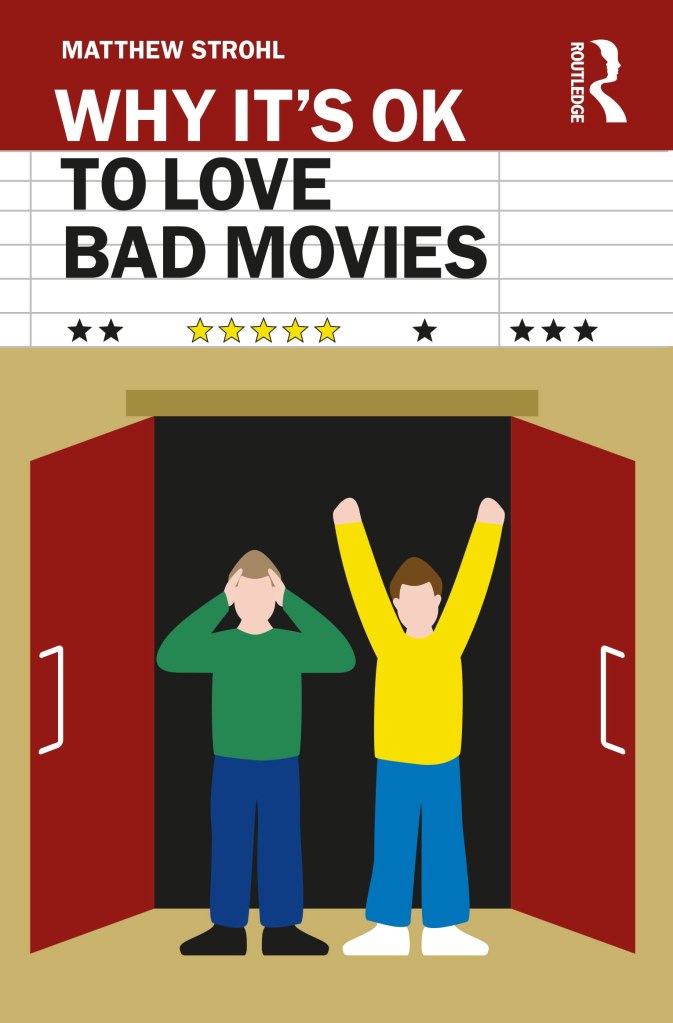
Book: Why It’s OK to Love Bad Movies? by Mathew Strohl, New York: Routledge; 219 $170 (hardcover)
Before the review, the objective of the title is integral to understand the complexity of the book at hand. The ‘Why it’s OK’ project is a select group of philosophers who aim to philosophise mundane human behaviour. The book ‘Why It’s OK to Love Bad Movies?’ by Mathew Strohl speaks to a defence for people who love disreputable movies. It suggests evaluating cinema from the lens of engagement, the formation of a community, the aesthetic life of the movie, and the standards of the audience.
The book takes on itself a mammoth task to explain the value behind the human desire for watching bad movies. Pop psychology and internet reels have gradually ingrained in me the idea that watching or repeatedly re-watching bad movies is an emotive act. It was an act stemming from desperation, frustration, anxiety, or exhaustion from a stimulus. They gave us the illusion of control and the possibility of shutting our minds. Strohl is aware of the phenomenon and chooses to engage with the philosophy of choosing to watch bad movies for the aesthetic value of the art itself. His argument is that the fact that human beings continue to make these choices gives bad movies their value in lieu of both artistic and aesthetic value.
The biggest concern that preoccupies the text is the act of assigning the tags of good, bad, and the Avant-garde to art. While the objective of the title is to explain the act of choosing to watch bad movies, the content and writing takes more upon itself. The synonymous use of the word art, cinema, and movies makes the task for the author even more profound. The author seems to lose himself in the aesthetic value of his argument, and misses the uniqueness of his object of study, which is movies. Movies hold a unique interaction with their audience and society which even in the presence of a screen is more reflective, less elite and one of the most accessible forms of art today. The discipline of filmmaking has gone through such a huge revolution that cinema has the quality of a ‘spectacle’ both with and without huge monetary assistance. Yet, his central argument about re-evaluating the tenants of what constitutes the value in bad movies still holds.
Strohl from the get-go makes it clear to the reader that for him the value of cinema lies in its ability to constitute engagement. Cinema creates ‘a people’, the audience that watches a particular movie is stimulated to engage with the movie, from organised internet chat circles to impromptu party conversations. The engagement of the art form of movies holds the ability to both unite and divide. What is recognised by the sensibilities of movie critics to be bad, if that movie goes on to fulfil its aesthetic life by creating an engagement of a community beyond mockery, constitutes a valuable experience.
Strohl goes on to insist, “that Bad Movie Love is a different practice from Ridicule… if one loves a movie because it’s bad, doesn’t that necessarily involve some measure of mockery and disdain?” (p. 30). Ridicule continues to be an expression of contempt still guided by the requirement to experience fun at the expense of the movie, the artist, the characters, its screenwriting- all the components that made the movie bad.
The case being made in the book is for the movies that were wronged by being tagged ‘bad’, because of artistic and aesthetic failure. These movies have lost their claim to aesthetic success only because they flout the norms of ‘being good’. The aesthetic rules that create the institutions, norms, and the tag of good fail to recognize that movies that have flouted those roles also have their own institutions, their own norms and hence, do not deserve the tag of ‘bad movies’. Then what constitutes ‘the bad movies’ that Strohl indicates to build communities?
The second qualifier the book helps the reader with is that these bad movies are not the Avant-garde movies. Avant-garde movies flout good movie sensibilities as a conscious decision to speak against the norms. These are boundary-pushing, experimental works that are transgressive and irreverent- which aren’t the movies that Strohl is attempting to justify as a choice. It is the ones that constitute neither of these two categories.
These ‘bad’ movies have flouted roles and transgressed because of the ‘mindlessness’ that has gone into the creation of these massive spectacles. These spectacles create communities of an audience that has emotionally invested itself in the viewership of the ‘bad’ movies. Additionally, these aren’t tempered emotions but strong feelings of love. What defines being ‘good’? If the audience decides that a movie is worth their time, attention, and emotions it has lived its aesthetic life. For Strohl the movie has lived its purpose, it has created a community and engagement and hence, it needs to be valued for its ‘activity of engagement’.
There is a further qualification in the emotiveness that comes forth, the engagement that is generated not through the act of ridicule but through movies that are created with the purpose of outrageous aestheticism. These movies represent an even more unique expression of unaltered, unadulterated, untampered human eccentricity. The value of this eccentricity is the creation of collective laughter. The eccentricity gives expression to outlandish ideas that would not settle within the norms of aesthetic value.
What do these arguments do to the larger questions of filmmaking and film critiquing? Strohl should not be mistaken to be an anarchist for his film critics. He is not making the case for no conventions. He is wondering whether the ‘standard of value’ is too high a demand for any medium of art, specifically movies. What defines and constitutes value is not only subjective to time, space, and context, tagging based on that value results in stationing an art in a particular context alone.
While the conventional rules are important for the discipline and the institutions of filmmaking; a rigid adherence to them can not only stifle artistic expression, but it could also result in the discipline of cinema losing engagement with a large audience. An interesting example that is pointed out in the book is the metres and ratings employed within the business of film critiquing. All these metres have a homogenising tendency, an institutional creation to discipline the norms of good and bad for audience viewership. The book is not making the case to ban Rotten Tomatoes and its brethren, but to recognize the value of engagement by movies as an art form for human beings, even when devoid of aesthetic and artistic value.
The book is not the most lucid and easy read for someone not well-versed in select American cinema and American cinematic culture. Its arguments crutch on a very in-depth reading of four very different genres of movies from mainstream Hollywood- Plan 9 from outer space, Troll 2, The Room, and Twilight. It also uses a lot of anecdotal references to point to lapses in judgments which are attributed to explicate the category of mindlessness for the reader. It makes the argument more convoluted for those who are not well-versed in the disciplines of philosophy and cinema, but a very interesting read for the readers of the discipline. I as a reviewer would not have held the book to this standard if its objective was not to make sense of the average human behaviour, the love of everyday audiences for ‘bad movies’. Largely, Strohl’s argument recognizes life within the object of bad movies and tries to aggregate aesthetic value from the audience and viewership.

Sakshi Sharda is a Research Associate at Social Policy Research Foundation and an Editorial Consultant with Taylor and Francis, India. She has completed her MPhil from the Centre for Political Studies, Jawaharlal Nehru University and is an enthusiastic book reader and book hoarder.
She can be reached at s.sakshisharda@gmail.com
©TheDaak2023


Leave a Reply