
Cinema is probably one such concept that transcends disciplinary boundaries. It is a deeply philosophical experience at one end where human beings find themselves reflected in its various forms. At the other end it is one of the most fun and hustling events, where ‘going to the cinema’ itself constitutes a lighter experience. In between these two, there exists a myriad number of ways in which cinema finds itself inextricably linked to the project of nation building, in competing language spheres replicating the politics and social of regional aspirations as well as regional pride. Cinema also replicates social hierarchies of gender, caste and class. But it also liberates, it provides puddles of happinesses. For this issue on Cinema and Affect, contributions at TheDaak have spoken to and against all such iterations of Cinema and its affect. The reviews under this theme seem to be bringing in interesting conversations that dwell deep into the relationship of books, characters and movies. The interdisciplinary engagement of the reviewers through their interesting insights on various affects of cinema was intriguing and it was a privilege to curate the submissions for our readers. The centrality of audiences and the circling in on the idea that cinema is an affectual relationship between the art and its audiences. That audience makes art valuable, and that representation, identity and language all point to the cinematic relationships of those who are present, as well as those who are not.
Masculinity, Nationalism and Bollywood
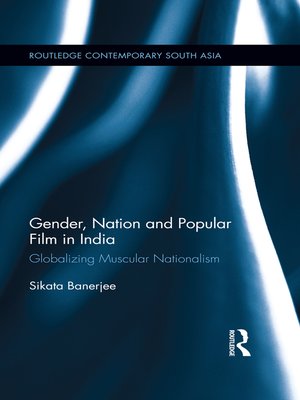
Book: Gender, Nation and Popular Film in India Globalizing Muscular Nationalism by Sikata Banerjee, Routledge, New York152 Pages, Published 2017, 24.10 × 20.32 cm, ISBN: 978-1-138-65399-3, $45.56
Banerjee is a political scientist whose work has focused on gender, masculinity and nationalism. Like her previous work, Banerjee in Gender, Nation and Popular Film in India: Globalizing Muscular Nationalism has sought to understand how manhood and nationalism have been portrayed in Bollywood movies by exploring what she called ‘muscular nationalism’. The 1990s saw the implementation of economic liberalisation and globalisation programs in India, which brought about significant socio-cultural and political changes and the ascendancy of Hindutva politics in India. Banerjee notes in her book that the ascendancy of Hindu nationalism and the triumphalism linked to post-1990s globalisation has constructed a context where “the male body” became “a signifier of India’s new self-confidence on a global stage” (p. 10). By applying the lens of ‘muscular nationalism’ to the popular commercial Bollywood cinema, the author analyses the social construction of manhood and nation in these movies. The author defines ‘muscular nationalism’ as “the idea of nation animated by an idea of manhood associated with martial prowess, muscular strength, and toughness” (p. 9).
The book has been divided into six chapters which examine the different aspects of this ‘muscular nationalism’ by examining different movies to understand –
- the evolution of muscular nationalism in Hindi commercial movies, which is represented by a Hindu male body that is either ready to sacrifice for the nation like in the case of Sarfarosh and Rang de Basanti;
- or defending against the Imperial British, like in Mangal Pandey and Lagaan. Banerjee (2017) analyses the movies like ‘Lagaan,’ ‘Mangal Pandey’ and ‘Rang de Basanti’, to note how these movies validate the contemporary forms of muscular nationalism as a nationalistic challenge to the imperial image of ‘effeminized Indian men’ (p.71). The white women created opposite to the Indian men in these movies have also been portrayed as ones who desire Indian manhood, which challenges the imperial masculinity of the British empire (p.71).
In this background of male muscular Hindu nationalism, Banerjee’s book has also sought to locate Muslim male bodies as represented in popular Hindi movies. There are four substantive chapters which trace the ‘fluctuations’ in the depiction of masculinity in film since independence (Chapter 2), validate muscular nationalism to counter the Imperial effeminized image of Indian men (Chapter 3), locate Male Muslim bodies in popular cinemas (Chapter 4), and the multifaceted muscular nationalism in the imagined Indian diaspora (Chapter 5).
The book is an academic read which allows the author to sit back and rethink all the movies through a gender lens. The book, through various chapters, has etched the idea of ‘muscular nationalism’ in Hindi movies. This idea of muscular nationalism, as portrayed in different films, is embodied through a Hindu male body in the backdrop of the globalizing world. In her analysis of the various sets of movies in separate chapters, Banerjee also paints the picture of a ‘subordinate’ female as opposed to the hegemonic muscular male portrayed in these popular commercial cinemas.
This muscular nationalism is ‘Hindu-tinged’ nationalism which is not necessarily aggressive or violent because “economic globalization has increased religiosity among the Hindu majority”, and ‘Indian’ culture is popularly being conflated with Hinduness (p. 35). In such a depiction of nationalism, the book also notes that Hindi movies do not mechanistically cast all Muslims as the “terrorists” or enemy of India. Rather, the filmic depictions of these men and women have attempted to contain them within the binary of “good Muslim/bad Muslim”, which is “defined by rejections of an aggressive Islamic identity and steadfast explicit patriotism” (p. 79). Islam in popular film, as Banerjee (2017) notes, is not depicted “as a question of private faith but as a public ideology,” i.e. for a Muslim man, Islam dictates his ideology, his identity and all aspects of his social actions (p. 77). As the book notes, Muslim women also occupy an ambiguous position in the Indian body politic. Often, movies portray a Hindu man marrying a Muslim woman to save her from an oppressive religion.
The author compares Indian movies like Pardes, Swades, Kabhi Khushi Kabhi Gham and Namastey London with films like Bend it Like Beckham, Nina’s Heavenly Delights and others written by diasporic Indians. The book notes how those Indian movies are often based on a romanticized idea of India. While diasporic movies often point out how second-generation youth define their spaces in the West while exploring their own cultural identities and spaces. The masculinity projected in the Indian film by the male hero is self-confident and assertive, but at the same time metrosexual in that he can interact with women in the family to take their ‘feminine’ concerns seriously. His proper manhood is articulated by the steadfast belief in protecting Indian women’s virtue. Femininity is again portrayed in terms of modesty, chastity and supporting roles to the male hero.
I remember watching the song Zara Sa Jhoom Loon Mein in Dilwale Dulhania Le Jayenge and thinking that the female actors do not feel cold. The female characters are often characterised in two extreme ways in popular Hindi films. From portraying an ‘abla nari’ or ‘supporting wife/girlfriend’ to independent working women who ‘drink alcohol’, smoke and are promiscuous, these are two extreme portrayals of women in mainstream Bollywood movies. Somehow women have to ‘drink alcohol and be sexually promiscuous’ in a typecasted idea of ‘modern independent women’.
The author highlights the plight of the representation of female characters as chaste, supporting the male character and often in need of the man’s support in the background of muscular nationalism portrayed in Bollywood movies. Masculinity, like femininity, is socially constructed, and hegemonic masculinity dominates other forms of subordinating masculinities and femininities. The book elaborates on how a notion of muscular Hindu nationalism has dominated the idea of ideal men in popular cinemas. The female lead has been constructed in a way which complies with such masculinity. Female (lead) characters in these movies are primarily created as an embodiment of ‘chastity’ and in a supporting role to their masculine counterpart. However, regardless of what form of femininity is embodied in muscular nationalism, purity has been a constant trait of the female body, symbolising national honour and providing a moral code for the lives of women in the nation. Muscular nationalism generally centres on a gendered binary: martial man/chaste woman (p.10). Like the plural nature of masculinities, there are multiple forms of femininities – one which conforms to hegemonic masculinity and one which challenges such norms.
As mentioned earlier, the book has aimed to locate the embodiment of the ‘Hindu Male Body’ in popular Bollywood cinema as a new idea of muscular nationalism in India. The book steers itself in this direction from the get-go. While curving its way through different movies, the book brings forth a new lens of – gender, masculinity and nationalism – in analysing the ‘popular’ Bollywood film. In doing so, Banerjee’s book does fall short in many aspects.
First, the conflation of popular cinemas with Bollywood Hindi movies personally does not suit the narrative of popular cinemas and muscular nationalism. Even though Bollywood Hindi movies can have more commercial value, in this current situation where regional cinemas dominate the theatres and are dubbed in Hindi, it is a severe limitation to conflate popular films with just Bollywood movies.
Secondly, the book has a long list of movies which Banerjee uses to convince the readers to agree with her arguments. Banerjee’s argument of the creation of subordinate female characters in Bollywood movies is very restrictive, whereby she has limited her analysis to look at the female lead in the movies. She has not expanded much on the ‘sacrificing mothers’ portrayed in the movies like Rang de Basanti and Lagaan in supporting these ‘masculine men’.
Thirdly, the choice of movies and the list of films is so expansive that the readers tend to get lost in the chapters. The book also locates the movies in a fifteen-year time frame- 1995-2010, without justifying why this particular period was chosen. Certain films were selected to set the tone of the author’s arguments throughout the book. The preferred movies are either critically acclaimed or have done great at the box office. Moreover, the movies selected by the author claim to be popular. However, the films have no parity in their performance or critical acclaim. For instance, Mangal Pandey was technically a ‘flop’ movie paired with Lagaan to understand the imperial history behind the new muscular nationalism in India. However, the author does not justify why a particular cluster of the film was chosen for specific contexts by the author has not been examined properly.
Similarly, the movie My Name is Khan (2010), which was a box office success, somehow did not make it to the list of the author even when she locates the portrayal of the Muslim male body in Hindi films. Movies like Gupt (1997), and Dil Chahta Hai (2001), which were commercial successes, should have been included in the discussion. It feels like the movies were chosen to fit a particular preconceived notion.
Moreover, although the author has examined several films against the backdrop of muscular nationalism, it remains unclear how this form of masculinity intersects with other identities – caste, race and colour in popular cinema. There cannot be a monolithic idea of gender – femininity or masculinity. The book does not go beyond the character portrayal of the male lead in different movies to understand the intersection of his masculinity with his other identities- caste, class, race, colour etc. A closer read of the societal positioning of the male ‘heroes and a deeper understanding of how the notion of muscular nationalism intersects with the different identities will give the much-needed nuance to the idea of muscular nationalism.

Sanjukta is a PhD scholar from the Centre of International Politics, Organisation and Disarmament, Jawaharlal Nehru University. She is passionate about research and currently pursuing different research engagements.
Reading the Muslim on Celluloid: Bollywood, Representation and Politics

Book: Reading the muslim on celluloid: Bollywood, Representation and Politics by Roshni Sengupta, Primus Books, New Delhi, 2020, 340 pp., 1250.00, ISBN : 978-93-89850-87-1
“You don’t need to be a voice for the voiceless. Just pass the mic.”- Dr Su’ad Abdul Khabeer
Dr Su’ad Abdul Khabeer, an academic, tweeted this a few years ago. She called for individuals or groups with privilege and power to step back and allow marginalised groups to speak for themselves. Moreover, it acknowledges that some people can speak more easily and loudly than others, and that this can create imbalances in who gets heard and who is silenced. Therefore, access to the mic is central to the politics of representation. There is every possibility that someone’s representation may be partially or fully defined by the politics of the mic holder. Due to the limited scope of this review, it is not possible to delve into the specifics of what representation entails. However, it is sufficient to mention that ‘mic’ as a metaphor may be construed as a text, an image, a film, or any other form of representation that seeks to speak for the object of representation.
After the advent of the modern age, the scale of representation has become wider and more expansive. We have progressed from ancient forms of representation like petroglyphs and hieroglyphics to artistic forms like painting, and finally to modern forms including photography and film, leading to even newer forms of representation through digital technology. With this background in mind, can one claim that such historical developments have finally led to an era where it is genuinely possible to represent something or someone? There have also been debates on whether mystic or poetic experiences can be translated into words. Some people argue that such experiences are ineffable. The famous case of Mansūr Hallaj’s execution for saying “I am the truth” is reflective of the dangers of representing the ineffable through language. Similarly, the representation, in any form – textual, pictorial, or cinematic, of a person, a group or a community, isn’t an easy task. Roshni Sengupta has painstakingly presented a detailed account of how Muslims— “the socially (and politically) marginalised group”, have been represented in popular Hindi films (Bollywood films), particularly produced in the turbulent decades of the 1990s and 2000s (specifically from 1991 to 2012).
On the one hand, there is the inherent limitation of the media of representation; on the other hand, there is a possibility of construction, contortion, and distortion in the process of representation. Moreover, as Sengupta writes, “The phenomenon of representation does not stand for something given in society.” (p. 33). She quotes Brian Seitz, who argues “representation is itself ‘constitutive’ of the subject of representation.” (p. 33). Therefore, there is no objective reality of Muslims to be represented through the medium of cinema, rather, the subject of representation (Muslims in this case) is constructed to either create certain narratives, or fit the newly created entities into some already existing discourses.
The first chapter provides clarity on various definitions of cinema, which is very helpful for non-connoisseurs of cinema. It explains in detail the question of representation in cinema, and how the scholarship has evolved around the various approaches to representation in cinema. She attempts to
highlight whether cinema “has an essence” which is “mediated by ontology” and goes beyond “lexicology and social history” . Relying on Trevor Ponech’s definition of cinema, Senguputa affirms that cinema is a “public concept” with which people engage, take part in it, and share it; and it is “a mental item which sorts external objects, states of affairs, or events.” (p. 30). After a thorough perusal of various theories and the varied perspectives on what constitutes cinema, she defines it thus: “cinema is a medium of communication involving moving images where content remains the mainstay of the film genre and it is this key distinguishing factor that differentiates cinema from several other forms of art.” (p. 33).
Sengupta divides the representation of Muslims in Bollywood into four categories: the Muslim in Empire cinema, the Muslim in Partition cinema, the Muslim in Islamicate cinema, and the Muslim in the non-Islamicate cinema. She argues that empire cinema, produced in the colonial period, constructed the notion of ‘Muslim menace’. Citing an example from the British film The Drum, she argues that this film “constructed a Muslim identity as communal, depicted Muslims as fundamentalist, backward and anti-national.” (p. 86) Moreover, she affirms that Muslims are depicted as “overtly religious, bloodthirsty hordes of convoluted souls, plunged to the depths of depravity” (p. 88) in Western cinema. Relying on Marshall Hodgson’s invention of the concept of Islamicate, she defines Islamicate cinema as the cinema which “refers to the social and cultural complex historically associated with Islam and the Muslims” (p. 91) and not directly to the religion or the religious belief. She argues that music genres associated with Muslims, like ghazal and qawwali, reflect Islamicate influence on Hindi cinema. Mehboob Khan is described as the greatest Muslim director who has directed Muslim socials like Najma and Elaan. Sengupta argues that his ‘cinematic ventures’ make a clear statement of “the urgent need for the emancipation of the Muslims of India.” (p. 91). She argues that the Islamicate films “show a variety of clothing that is regarded as appropriate for Muslims to wear in the Mughal court in the presence of the courtesan in the kotha” (p. 92). She construes this as the “signature portrayal” of women in some popular Islamicate films. The Partition cinema focussed on highlighting human miseries (Garam Hawa) more than anything else. Moreover, as she has brilliantly articulated, “the symbolism of freedom is almost entirely punctuated by a sense of loss and deep sadness.” (p. 89). The non-Islamicate cinema, she argues, has presented the Muslim as the ‘Other’. She argues that films like Bombay (1995) constructed this image of the ‘Other’, wherein a hierarchical structure of society is presented, in which the Muslim family is lower in the hierarchy as compared to its Hindu counterpart.
Sengupta has majorly focussed on Muslim representation in the films produced in the period 1991-2012. As she has mentioned, this period was full of “great communal churning” (p. 267), which also resulted in ‘fluctuations’ and ‘volatility’ in the representation of Muslims. The decade of the1990s witnessed the Babri demolition and political mobilisation based on majoritarian politics. Consequently, Muslims were represented as violent, aggressive, and communal. In the following decade, Muslims were represented as fully committed to their religious cause as well as individuals not fully loyal to their nation. She has highlighted that films in the post-independence period have tried to contribute to the process of ‘nation-building’ and “Constructing a culturally unified nation.” (p. 90). Therefore, the representation of a minority group is very much linked to the process of constituting a nation. In the same decade, she contends, Muslims were also represented as “meticulous, intelligent and sharp, owing allegiance to global terror networks.” (p. 267). The representation of Muslims as terrorists and ‘prone to violence’ is mostly visible in the post-Babri period. However, Sengupta asserts that a majority of the Muslim characters in these films are not terrorists. She maintains that alongside the negative portrayals of Muslims, there is also “positive stereotyping” of Muslims, in films like A Wednesday, Aamir, etc.
There is also a difference in the post-Babri and the post-9/11 period, in terms of the characterisation of Muslim terrorists in these films. In the first decade, the terrorist is represented as “a victim of targeted communal violence, state apathy and injustice” (p. 218). While in the post-9/11 period, the representation follows the American cinema wherein the terrorist is represented as “suave and sophisticated international terrorist and weapons expert, the nationality of whom is not always revealed to the audience, but whose cold-blooded character stands him apart from his counterparts in the 1990s.” (p. 218). Moreover, there are two more significant forms of representation of the Muslim which emerged in this decade: first is the secularised Indian Muslim or the ideal positive Muslim, who is celebrated for his role in the project of nation-building. On the other hand, there is also a representation of the ‘violent Muslim’ (Gangs of Wasseypur) whose violence isn’t inspired by religion or beholden to the community. Sengupta’s main idea is that popular Bollywood films no doubt present a negative portrayal of the Muslim. However, there is also a ‘balancing out’ wherein there is an unmistakable presence of positive Muslims in almost all the narrative structures where there is a presence of the negative Muslims. Moreover, these films not only ‘balance out’ the negative portrayal with the positive one, but also emphasise a victory of the positive Muslim over the negative Muslim.
The book is a labyrinth of complex arguments as Sengupta has provided a detailed review of academic literature on the themes of cinema and representation. At times, her own arguments become overshadowed by the dominating presence of the views of so many scholars whose work she has reviewed, which makes it a difficult read for the common reader. A detailed discussion of the emerging trends of Islamophobia could have enriched the book further. However, anyone interested in cinema must go through this very well-researched book to know more about the debates on communalism, notions of cinematic representation, and how the politics and culture of society impact film-making. Although she has not explicitly dealt with this question, one gets an idea of why the likes of Rahat Fateh Ali Khans and Atif Aslams are not found in India anymore. To conclude, there is enough evidence that majoritarianism has its hold on the mic, and it will not be passed on to the Muslims anytime soon.

Ishtiaq Ahmed Shauq is a research scholar at the Centre for Political Studies (CPS), JNU. His areas of interest include Modernity, Sufism, ‘Religion’ and Decoloniality. He is passionate about Sufi music and writes Urdu poetry (fursat ke lamhooN maiN).
He can be contacted at Ishtia81_ssd@jnu.ac.in
Film, Media and Representation in Postcolonial South Asia: beyond partition

Book: Film, Media, And Representation in Postcolonial South Asia Beyond Partition, Edited by Nukhbah Taj Langah and Roshni Sengupta, London, Routledge, 2022, 242 pages, ISBN:9781003167655, $136
The book Film, Media, and Representation in Postcolonial South Asia Beyond Partition provides a more nuanced understanding about politics, media, and films; set in the backdrop of the South Asian context. As the title of the book suggests, it provides the reader an insight beyond the recurrent theme of partition. Films, cinema or media are a part of popular culture and have gained traction in academics today. This edited volume uniquely attempts to initiate a conversation and presents a vivid picture of the relationship between cinema, media and politics. Centering around partition, the book is divided into three parts discussing cinema, art, and cyberspace. The book pointedly discusses how various modes of communication like media, art, and digital spaces have shaped and influenced discourses on identities, memories, and remembrance.
Cinematic spaces both create and stereotype identities. Cinema is able to do so because it recognises elements of plasticity associated with identities. The concept of ‘plasticity’ is addressed by Sudipta Kaviraj (1997). It connotes that identities are fluid and can be moulded in the way desired by the hegemon. Institutions act as a major hegemonic force to do so, either through institutional capabilities or through the support of the public, one such institution being cinema. In the case of films, Bollywood has lent an open space for the formation of the same moulded identities especially in the context of Muslims and more specifically, the Kashmiri Muslims. The book draws on this with the work of Rachel Dweyer who argues, “Bollywood reflects peoples’ histories and histories can shape their views and attitudes towards politics.” (p. 11) Furthermore, the book introduces Khatun’s recognition that “Specific popular Bollywood films in the historical genre have dealt with the liminality of the Muslim ‘other’ in the nation-space by either representing Muslims in stereotypical ways or by vilifying their image” (p. 12).
Speaking about Kashmir in the preface, Claire Pamment elucidates the soft power Bollywood holds. The movies like Fanna, Yahaan, Lamha, Mission Kashmir, and Kashmir Ki Kali are just a few examples that depict how mainstream Bollywood has presented Kashmir and the Kashmiris to the audience. The audience viewed the ‘Bollywood created image’ of Kashmir and the Kashmiris both spatially and demographically. The valley and its people have been used as one of the means by Bollywood to sustain the idea of India. Julia Szivak writes specifically about “the films work towards reinforcing the dominant state narrative on the Kashmir insurgency” (p. 19).
Films shot in Kashmir have always put two images before their audience. The first is a peaceful place with a cinematographic focus on mountains and rivers, sidelining the disputed side. An example of this image is ‘Kashmir Ki Kali’ (p. 22). Another image shows the dilemma between the conflict and the beauty of the valley, but ends the movie blaming the individual Kashmiri, who is thought to be brainwashed, and the need for the state’s assistance to be corrected. For example, Fanaa and Mission Kashmir (p. 23, 24). In both cases, the cinema wins through its capacity to penetrate a large section of the audience. What is shown does not match the ground reality. “The cinematic interpretation of the Kashmir insurgency was portrayed as a law and order problem and not as an aggregation of valid political claims” (p. 22). Doing so formulated a different vision of the Kashmiris, as incapacitated people unable to think for themselves, thus in need of the superior other.
The overall image of ‘the Muslim’ depicted in Bollywood is a medium to comprehend the biased narratives propagated against them. It was only with the film Haider that Kashmir was tried to be viewed from a different lens in mainstream Bollywood, invoking different emotions contrary to the traditional portrayal. Nishat Haider contributes “while the film predominantly charts the trajectories of the major characters within the original play, the political issues in Haider are transferred to the complex politics of Kashmir” (p. 34).
The case of Kolkata theatre is distinct, where “the dominant trend noticed is the absence of partition narratives” (p. 46). The absence of such narratives has pushed and helped fuel communal sentiments. This is done through efforts to present a glamorized picture of each other’s socio-economic gains, the tussle of such competition inflames a call of threat among various identities. Such threatened groups in fact need the ‘other’, because power can be authorized properly in that sense. The ‘other’ in this process is further dehumanized. Dehumanisation becomes banal and is reinforced by what Mamdani (2020) calls the ‘neglect of addressing the root cause and political reform’. And that is what Cinema has majorly reduced the Muslim identity to – the identity picked to get fame and then its dimensions cherry picked to defame the same.
The book further focuses on the role of media. Media, primarily television, is influential in shaping opinions. The power of the screen is deemed to produce expected and unexpected consequences. There is no dearth of material that can be presented to the public through TV. On the other hand, the “role of the audience in shaping the media agenda is also vital” (p. 71). No state would want the most appealing modes of communication to turn against them, hence, maintaining integrity becomes a tough task. Despite curtailment, the media has at times played an exemplary role. For example, the role of the media in the case of the Panama Papers was profound as “it informed the global audience about financial corruption in many different countries” (p. 72).
Art and visual means are also strong carriers of remembrance. The book leaves one in awe while going through the sections on art and visual mode because they remind one of the capacities that such media hold in preserving memories. The works of artists like Paresher, Satish Gujral, Imran Channa, Bani Abidi, and Tayeba Begum Lipi discussed by Kamayani Kumar and Shruti Parthasarathy are nothing less than realizations. They make one reassess the importance of paintings and drawings. It is not merely the artist moving the pencil, but the movement of both thought and hand to finally decide what they go ahead with. Photographs as a medium are another profound example which “draw affective associations between readers and a past they did not experience” (p. 106).
The book finally deals with emerging cyberspaces that have created and recreated discourses on identities. The melange of concepts associated with identities is further used in these spaces to tarnish images of individuals or communities or degrade people. The ease of knowledge and communication with all the communities worldwide has reinforced differences, discriminations, stereotypes, etc. Debanjana Nayak points out that, “the lens of the journalist’s camera casts a distinct gaze on individuals which then extends to the print media, electronic media, and digital media” (p. 162). It is not just an individual that gets politicised through gazes of different forms of media, “rather the gaze is directed towards the body of a country with whom the self is at war and also in love” (p. 166). Apart from acting as a surveillance site, digital platforms have provided immense space for people to express their anger.
The various modes of displaying popular narratives and sentiments like films, art, and digital space have scope to further discourses. They can tilt the narratives to any side as desired.Restating Julia Szivak, “films do not even attempt to present precise accounts of history, but they build on the capacity of the medium to invoke emotions and depict history in a holistic way” (p. 20). Similarly, other mediums also infuse energy among the audience which shapes politics and thus, the opinions of the public.
This book helps one to comprehend many tailored concepts surrounding cinema and media. However,one cannot negate that the language used is complicated. It takes the postmodernist lens to analyze, the episteme of which is not easily comprehensible. Nonetheless, the bracing insights makes the book unique in itself. This volume revolves around the ability of films to capture life, the ability of photographs to generate memories, besides the biases/ inequalities created by cinema and media but also standing as torch bearer in some cases. All this and much more can be derived from this read.
References
Appadurai, Arjun. (2006). Fear of Small numbers: An Essay on the Geography of Anger. Durham, NC: Duke University Press.
Kaviraj, Sudipta. (1997). Religion and Identity in India. Ethnic and Racial Studies 20(2): 325-44. https://doi.org/10.1080/01419870.1997.9993964.
Mamdani, Mahmood. (2020). Neither Settler nor Native. London, England: Belknap Press.
Disclaimer: The book “Film, Media, And Representation in Postcolonial South Asia Beyond Partition”, Edited by Nukhbah Taj Langah and Roshni Sengupta as stated, is an edited volume. The review has focused selectively on keen and interesting themes from the book, at the discretion of the contributor.

The author is a Masters student at Department of Political Science, Jamia Milia Islamia, New Delhi.
The author can be reached at workdurdana@gmail.com
കപ്പിത്താന്റെ ഭാര്യ/Kappithante Bharya (Captain’s Wife)

Book : Kappithante Bharya by Bipin Chandran, Malyalam, Mathrubhumi Books, 2021, paperback, 104 pages, ISBN: 9789355490650, ₹150
by Mileena Saju
From Rajavinte Makan 1to Titanic: A review of Bipin Chandran’s Kappithante Bharya.
While giving me a copy of Kappithante Bharya (The Captain’s Wife), the guy at the DC Books counter told me that it is impossible to keep the book down until one finishes reading it. I would not exactly agree with him as I kept the book aside several times, once as I was tempted to revisit the Malayalam classic film Rajavinte Makan, and the second time to google Octavio Paz’s poem “Whenever two people kiss,” both mentioned in the Novel.
Kappithante Bharya (The Captain’s Wife) is the very first attempt of fiction by the Malayalees favourite ‘Cinema Ezhuthukaran’ (one who writes about films) Bipin Chandran. Bipin Chandran has mostly done his work on non-fiction around Malayalam Cinema, and it is no wonder that his first novel shows the qualities of cinematic realism. Nothing can be said about this novel without drawing an image of two desperate women staring at a poster of Jack and Rose on the deck of the Titanic, an image that festoons the cover page of this novel. This image defines the novel and the intricacy of everyday life that it portrays. This Malayalam Novel Kappitante Bharya (The Captains Wife) by Bipin Chandran is a story of two strong and independent women, Annie and Rosily, who fight the piercing judgements and expectations of family in particular and society at large while they wait for their lovers to come free from the clutches of the Ocean.
The novel and its plot and the life that is woven around it expresses the potential to break away from the conventional boundaries of Malayalam literature tainted by elitism and patriarchy. The author dares to move away from the typical Malayalam literary settings of ‘significant happenings’ and of a long narrative of the misery of human life intended to satisfy the upper layer of readers, which used to define Malayalam literature, to simple everyday life. Though the shift away from the elitist imaginations of fiction writing makes the novel acceptable for a wider audience, the author somewhere fails to replace the old orders with new politics.
Bipin Chandran walks us through a hoard of films released during the 1980-1990s and unveils the life of Thomas, Annie and Rosily in a tiny village in Kerala. Thomas, who was in love with Annie, had to go through unprecedented events in his life, which are beyond the imaginations of a Malayalee simpleton and is separated from Annie for years. The sea parts them as he is being imprisoned revengefully on the island of Mali. Annie lives with Rosily Aunty, an elderly woman who is also separated from her husband, John Fernandes, who was the captain of a sailing ship that disappeared in the blues of the ocean. While a friend’s betrayal designed Thomas’s fate, John Fernandes’s disappearance is shrouded in mystery. Even though everyone believed that Fernandes was dead, even after time fluttered from Rajavinte Makan to Titanic, Rosily did not lose hope.
In the universe of Kappithante Bharya, cinema determines time. It is through the films played in the Leela Mahal that people look back at their lives in retrospect and introspect. Cinema, for them, is memory; it reminds them of that time in their life, their love, lust, hunger and sorrow. Annie’s and Thomas’s romance started blooming when Rajavinte Makan was being screened at Leela Mahal, a local film theatre around which community life revolves. A new mimicry troop was created by Thomas and his friends when Leela Mahal was screening Ramji Rao Speaking2, Thomas was betrayed by his friend while Kilukkam3 was being screened. Leela Mahal is the centre of Bipin Chandran’s fictional Universe. Every incident, every tiny life story is marked by the films played in this theatre. Finally, Annie and Rosily are reunited with Thomas and John Fernandes while Titanic was being screened, not at Leela Mahal, something equally unusual in the narrative as the sudden shift to a Hollywood film.
Cinema is the only true witness of their lives. The community life is enhanced with the spectacle of popular Malayalam films, villagers imitating the popular heroes and adding popular dialogues into their everyday language. Every comparison, each reference point, and all the ‘rememberings and forgettings’ are guided by these films. Rosily Aunty, the captain’s wife, often reminds people of Balan Mash from the film Thaniyavarthanam4. Her longing for her husband, who was long lost at sea, and her belief that he will come back reminds them of Amaram5. Finally, Titanic brings closure – a fairy tale ending- a meaning to their lives. I was unable to digest at first how the beautiful narration of pure life, simple yet complicated, guided and recorded by Malayalam cinema and its classic characters, was taken over, all of a sudden by a Hollywood movie, The Titanic, which eventually plays a determining role in the life of Annie and Rosily.
The language of the novel indeed, as Benyamin in his foreword says, is ‘enchanting and haunting’ (p. ix). The language has been skilfully chosen and it carries a degree of poetics that can create a ‘longing for home’ for the Malayalee diaspora. The language indeed is not the standard elite textbook Malayalam but a language that is always spoken at home, which carries the feeling of home. The narrative style reminded me of the bedtime stories that my father used to tell me when I was young, in a language that is close to the simple existence, the day-to-day lives of the village.
The author attempts to undo the hierarchy that privileges the Savarna outgrowths of Malayalam literature which prefers a certain kind of language and a certain kind of narrative over the other. Basheer6 was a rebel, and Bipin Chandran attempted to be so. It could not be a coincidence that Basheer’s literature has been given an important space in Bipin Chandran’s fiction. Like Basheer’s Andakadaham7 (World), Bipin Chandran’s universe will also survive the miseries of elite expectations. Bipin Chandran’s women, too, do not speak the language that is traditionally written for women, but needless to say, Chandran fails to attribute enough importance to these women as ‘women.’
The ‘fairy taleness’ in the story is disappointing. The novel does not show any justice towards the title ‘Kappitante Bharya.’ Neither is Rosily given an appropriate space in the Novel nor is the term Captain’s wife politically suitable. The identity of Rosily Aunty, even though she is portrayed as an independent woman with frequent descriptions of her bold character – a feminist perhaps – is almost always referred to as the captain’s wife, and her story is solely completed by the happiness of meeting her man after years of loneliness. Love and loneliness of the protagonists are powerful emotions which deserve their own space in literature, and indeed Bipin Chandran’s language has beautifully done its part in evoking a catharsis with the emotional undercurrents of his characters. We do sympathise with Annie, and we do find happiness when Rosily meets John Fernandes after years of suffering. But it is the privileging of the women’s love for their man, over and above their individual personality, depriving them of any other sort of existence, is what happens to be disturbing in the narrative. Both the women are enslaved within the boundaries of a house, whereas the men are out in the world, in the unknown waters and in an alien land. The same old fashion man-women relations are redrawn with new colours and sketches, something that the readers would not have expected from young writers like Bipin Chandran.
Bipin Chandran’s obsession with Cinema, Kadal (Ocean) and Kappal (Ship) is beautifully translated into the story (This obsession is evident in the preface, which is, again, brilliantly crafted). The Sea is a silent character in this film, sometimes romantic, sometimes brutal. The Sea took away loved ones from Annie and Rosily, and the ocean united Thomas and Fernandes. The relationship between Rosily Aunty and Annie is more beautiful than their relationship with their men. Beyond her role as a home nurse, Annie develops deep friendship and sisterhood with Rosily Aunty, who guides her in her life and gives her the courage to fight for her love. Annie and Rosily help the film survive the currents of male heroic adventures and make the space available to discuss the politics of society and family.
Indeed, Bipin Chandran dared to take the road that was least travelled by and one does expect Bipin Chandran to travel more through the thorny dense wilderness and dissent with the expectations that normalise life in an unfair society.
New Malayalam films are being released, and the readers are waiting.
Notes
- Rajavinte Makan (The Prince) is a 1986 classic Malayalam film directed by Thampi Kannanthanam. The novel begins with a reference to this film.
- Ramji Rao Speaking is a 1989 Malayalam comedy film directed by Siddique and Lal.
- Kilukkam (Jingle) is a 1991 Malayalam film directed by Priyadharshan.
- Thaniyavarthanam (Repetition) is a1987 Malayalam film directed by Sibi Malayil. Balan Mash, the protagonist of the film, was deemed mentally ill by the villagers.
- Amaram (Stern) 1991 Malayalam film directed by Bharathan. This film revolves around the life of a fisherman named Achootty. Sea plays a prominent role in this film.
- A popular Malayalam author and freedom fighter.
- From Basheer’s dictionary.

Mileena is pursuing her Masters in Modern History from Centre for Historical Studies, JNU. Her areas of interests are contemporary politics, women studies and Dalit studies.
She can be reached at mileenaksaju@gmail.com
The Trinity of Tamil Cinema: People, Passion and Politics

Book : Selvaraj Velayutham (ed.), Tamil Cinema: The Cultural Politics of India’s Other Film Industry (Abingdon: Routledge, 2008), ISBN 978-0-415-39680-6, 188 pp., $225.00
by Sanjana K.S
From movies like Mother India to Chak De India, the Indian Cinematic Universe has come a long way in evoking passions and contributing to the political imagination of citizens alike. In its journey over the decades, Indian cinema has diversified in its production of films every year, audience, technology and representation. Cinema has moved beyond merely being a source of entertainment and recreation, to become an effective and powerful medium of political communication. Every decade of cinema has reflected the socio-political milieu: the ‘devoted son’ of post independence mother India, the ‘angry young man’ in the decade of mass political discontent in the 1970’s, the ‘romantic and/or rebellious youth’ of the neo-liberal consumerist times and the ‘hyper nationalist bhakt’ of this decade. Cinema has played an invaluable role in constructing and representing the identity of its viewers or consumers. Stimulating a collective sentiment that taps into their sensibilities can translate into emotions that gain political capital. This review aims to understand the affective potential of cinema in exploring its relation to politics. It makes a case for viewing cinema as a political tool for drawing mobilization by generating the collective identity of a ‘people’- (the Tamil people in this case) through a review of Selvaraj Velayutham’s book ‘Tamil Cinema: The cultural politics of India’s other film industry’.
The book is a profound and systematic study of the industry also known as ‘Tollywood’ or ‘Kollywood’. Published in 2008, reading the book over a decade after its publication seems fitting in a time when South Indian films have taken a pan-Indian turn. Unfortunately, Hindi cinema overshadows the diverse film industries in the country and relegates films from different regions of the country as merely ‘regional cinema’ . As Rajadhyaksha and Willemen note, “for millions of Indians, where they live, a major part of ‘India’ derives from its movies”(Cited in, “Tamil Cinema: The cultural politics of India’s other film industry” Velayutham, 2008: 5). It is pertinent to shift our gaze to the other film industries to understand the influence of cinema on the people. This is exactly what Velayutham’s book does. Despite regional differences there has been an incredible amount of crossover and synergy between the film industries in India. Tamil, Telugu, Kannada and Bengali cinema have existed parallelly and contribute to the ‘Indian-ness’ in Indian Cinema. Though many scholarly attempts and books have dealt with Indian cinema, a lacuna in comprehending one such ‘other film industry’ is the Tamil cinema which despite producing nearly 200 feature films every year has been overlooked. The book under review attempts precisely that- to present Indian cinema as ‘multiple, conflicting and contentious sites of cultural production and highlight Tamil cinema’s distinct characteristics’ (Velayutham, 2008: 2).
The significance of the book lies in the formidable presence of Tamil cinema over eighty years yet understudied. Tamil cinema taps into the sensibilities and taste cultures of the film audience. It has shaped what it means to be a Tamilian, the collective identification of a people.
The author begins the book with analysis of the distinctiveness of Tamil Cinema embodied in the Language and the political and social content of Tamil cinema. Historian Ramaswamy in his book Language Devotion in Tamil Nadu writes that for Tamils, ‘language is the essence of their culture, the bearer of their traditions, and the vehicle of their thoughts from time immemorial’ (Cited in, “Tamil Cinema: The cultural politics of India’s other film industry” Velayutham, 2008: 6). Use of Tamil generates a symbolic embodied and affective connection to ‘Tamilness’. The use of language binds the people across a specific ethno-linguistic space, thereby, echoing a distinctly Tamil identity. Velayutham rescues the industry from the overbearing presence of Hindi cinema by highlighting the distinctiveness of Tamil cinema in relation to various themes ranging from construction of gender and sexuality, politics, religion, caste, iconography of actors turned politicians, politics of identity and diaspora. This book offers a critical study of role, representations and cultural meaning of films. The Tamil identity is symbolically performed through the screens.
The book presents a historical trajectory of Tamil cinema starting from silent films in the early twentieth century to the talkies in the 1930s to the multi-screen experience in recent times. It systematically lays down the changes in trends and themes in the content of tamil cinema: the colonial past where movies pushed the nationalistic and Gandhian message wrapped in visuals alone, the post-colonial fervor of development and socialist narrative which was in line with the nationalistic homogenous political imagination of India and the radical shift to linguistic overtones of Dravidian movement and the decline of such themes in favor of romance and action films. Through the eleven chapters of the book, the author focuses on the power of cinema in provoking and molding the ideas of the Tamil audience in their everyday thinking and banal actions. All the chapters in the book are comprehensive and clearly put forth the arguments supported with sufficient examples of Tamil movies to make their case.
In the first two chapters of the book, the making and consolidation of the ‘Tamil woman’ in the binaries of good and bad women and pleasurable object vs passive subject is discussed in detail. C.S. Lakshmi in her chapter explores the various ‘images’ of women in Tamil movies and their correlation to the attitudes towards women in Tamil culture. Through movies such as Manohara (1954) the screenplay and dialogues written by Karunainidhi, the duty of a true Tamil mother is represented as a devoted wife and a pure woman who asserts herself within the confines of patriarchal moralities; in Velaikari (1949) for which C.N. Annadurai has written the story and dialogues, the figures of good and bad women are juxtaposed to bring out the Tamil cultural values. It is interesting to note that the writers of these two films cited above draw direct political lineage from Periyar, (a Tamil social reformer who advocated for women’s rights).The author in this chapter notes that in Tamil cinema, male and female gender identities remain fixed and unchanging. Even the portrayal of an independent and liberated woman in a movie like Aval Appadithan (1978) puts the blame on a stubborn and fickle mother who is responsible for the troubles in her daughter’s life only if she has been a “good mother”. The author drives home the point that since family is the hub of Tamil culture in Tamil cinema, unusual women characters
are “taught the lessons” and brought back to the realm of family. Thereby, linking the cultural, affective potential of cinema to the attitudes of Tamil people towards women. In the second chapter, Sathiavathi Chinniah traces the transformation of the heroine from a ‘passive subject -chaste, sari-clad docile protagonist to the modern scantily-clad pleasurable object’ (p. 29).
Other chapters in the book the art of banner advertisements, the impact of Tamil film in rural areas and the Tamil diaspora and global circulation of Tamil cinema trace new dimensions of aesthetics and geography in the industry. It has been noted in the book that Tamil cinema can not be relegated to the margins of Indian cinema. The author cites the case of Mani Rathnam’s film Roja to establish the point that the former has represented the question of nation albeit in different ways- bounded by ethno-linguistic passions. In Roja, a Tamil hero and small-town Tamil girl who does not know Hindi or English lands herself in Kashmir begging for her husband’s secure release from the clutches of terrorists in the region. The Tamil hero does not remain simply a Tamil native but transcends his identity, ready to sacrifice himself for his nation. The singularisation of national cinema with the banner of Bollywood masks the heterogeneity of Indian cinema. It underscores the different political imaginations and representations that co-exist in the space of cinema. Thus, the author of the book delivers on his aim to understand the complexities of Indian Cinema while pushing forward the other industry i.e., Tamil cinema from the margins (p.168).
‘Cinema, one of the cheapest and most effective instruments of communication for social mobilization in India, has played a vital role in the creation of a national self-conscious Tamil people’. (Robert Hardgrave)
Majority of the chapters focus on analyzing the symbiotic relationship that exists between Tamil cinema and politics. The relationship relied on the instrumentality of cinema as a political tool for mobilization. In the chapter on ‘Politics and the Film in Tamil Nadu’, Robert L. Hardgrave Jr. discusses how Cinema stars used their stardom to draw mobilization. Velayutham notes that since 1967, every Chief Minister of the state has had something to do with cinema. The character of MGR as a common man, an auto rickshaw driver in many films made him relatable. The omnipresence of films in the everyday life of a Tamil citizen has a huge bearing on the political functioning of the state. Tamil films contributed to Tamil nationalism in the late 1950s. Most of the leaders of DMK were associated with films. C.N. Annadurai and Karunanidhi were film writers, S.S Rajendran, K.R. Ramaswamy, MGR and Shivaji Ganesan were actors. The author concludes that for decades, the DMK used films to promote its own ideology.
Without a doubt the affective power of cinema has translated into political mobilization for the Dravidian movement and its aftermath. Films with social messages challenging brahmanical domination were successful on the screens. When MGR split from the DMK and formed his own party AIADMK, his success as an actor overlapped with his dominance in Tamil politics. The cult following that these ‘actors-turned-leaders’ amassed were nurtured through their films. Case in point, Jayalalitha’s image as ‘Amma’. The populist message in these films that attracted the mass following was translated into the populist policies of the AIADMK. In his other works, Velayutham notes how through Tamil cinema not only audiences were cultivated but also the voting public. The way Tamil cinema has been able to not only create political imagination but also reflect the social realities of caste and religion through movies, making ‘rational citizens’ feel, in the most tangible form by engaging their senses, is a political spectacle. Through this book the author has been able to capture the raw essence of Tamil cinema in shaping the political and cultural life of the Tamils. As Karthikeyan Damodaram writes ‘in the Tamil context, the disappearance of cinema from politics would be the disappearance of politics itself’.
Though the book systematically puts forth a case to shift the gaze from Bollywood to other film industries that cater to a region, these industries cannot be sidelined as mere ‘regional films’. The author could have looked at the interaction of Tamil films with other industries in the region, thereby establishing a synergy between the ‘other’ industries of the south. What was missing was also a comparative look at representation in terms of characters, narratives and plots between the Hindi and Tamil Cinema. For instance, many Tamil movies have been reinterpreted and remade in Hindi (Guru, Naseeb Apna Apna, Andhaa Kanoon, Saathiya, Nayak, Ghajini, Holiday). They are not mere translations but are adapted to appeal to a different geographical audience. Moreover, the Hindi remakes often do not acknowledge the original Tamil films that they have adapted, undermining the creative potential and credibility of Tamil filmmakers.
Further, the author does not question the representation of Tamils in Hindi movies. Often prejudiced and racist narratives dominate the imagination and representation of a ‘Tamil’ in Bollywood. Classic example is the recent movie Chennai Express.
This book is a much needed academic contribution to the vast scholarship on Indian Cinema that has overlooked Tamil and other industries from the south. The book is relevant in understanding certain political phenomena that can not be understood in conventional rational and observational senses. This is the intangible power of the trinity in Tamil cinema- the cinematic passion that binds a people and wills the politics of the region.

Sanjana (She/Her) is pursuing her PhD from the Centre for Political Studies, JNU. Her research focuses on Right-wing politics in Karnataka and its interaction with Caste, linguistic and regional identities. Her research interests include Indian Politics, Right-wing mobilization in India, Cultural Studies, Women Studies, Cinema and Representation. Out of her own interest she is currently studying Representation and agency in Indian Cinema to understand the utility of Cinema in political mobilization. As a South Indian born and brought up in the North, through her work she aims to study and bring academic attention to the discourses from the south. Sanjana has published her own collection of poems and has contributed articles to digital websites including Feminism in India. She can be reached at kssanj98@gmail.com
Contested Representation: Dalits, popular Hindi Cinema, and Public Sphere

Book: Contested Representation: Dalits, popular Hindi Cinema, and Public Sphere by Dhananjay Rai, Lexington Books/Fortress Academic, 15 July 2022, 268 pages, ISBN 9781666901337, ₹7,948.00
Dhananjay Rai’s recent book provides an entry-point into understanding the nature of representation of Dalits in the social language of Hindi cinema. Here, ‘Social language’ can be understood as “a mode of direct or indirect communication consumed, perceived, understood and practised in everyday life” (p. 21). It also attempts to provide reasons as to why the Dalits often appear submissive or neglected altogether over the big screen.
Hindi cinema, indubitably, has emerged as one of the most integral and popular components of the public sphere. This book, through cinema, also engages with Dalit representation in the social language of the public sphere. While Rai appreciates Habermas’ understanding of the potential of social languages in rejuvenation of the public sphere, he disagrees with the latter’s view that social language of the public sphere should be insulated and unhinged to the material and social spheres. Taking recourse through the views of Bakhtin, Pierre Boudieu and David Harvey, he argues emphatically that the social language of Hindi cinema should not be viewed as just reflection of material spheres. In fact, it should be viewed as a replication or mediation of both material spheres and social spheres. Contrary to the common understanding, the author argues that the Dalits serve a dual purpose of the dominant material and social force. In the material sphere, their representation becomes a justification of a particular dominant material sphere against another. There is absence of a single group capable of occupying complete control over the production process. This multi-polarity of dominant material spheres produces different discourses.
The author identifies majorly six cinematic perspectives in order to understand the nature of Dalit representation. The vantage point of the six perspectives are ‘tradition’, ‘society’, ‘ideology’, ‘content’, ‘aesthetics/creativity/entertainment’ and ‘history’ which are not mutually exclusive with each other (p.115). A holistic perspective is missing and therefore, the author proposes an alternative perspective which he calls a ‘microcosmic perspective’(p.169). Unlike the aforementioned perspectives, it captures the factors of social language of Hindi cinema (both material and social spheres) and meaning of social language.
Rai also raises the question why the emergent/oppositional social language borne out of Dalit movement’s upsurge is not exhibited in the social language of Hindi cinema?
The author argues that there is a specific vantage point of perceiving problems and of providing solutions which are foregrounded in the social language of Hindi cinema. He selects three movies to discuss this issue: Sujata, Sholay and Swades. These three films are chosen based on three criteria: they have different narratives, dissimilar commercial success and unrelated time frameworks. However, being Dalit is the common vantage point of the three narratives. In Sujata, the protagonist is a Dalit, whereas in Sholay, the Dalit representation is absent (the author argues to take seriously absence of Dalits as a mode of representation) and in Swades, a Dalit is represented through a marginal protagonist. Commercially, Sholay has been an all-time superhit. Sujata was a semi-hit and Swades was a flop. When it comes to the third criterion, all of them are located in different time frames. Sujata, Sholay and Swades released in 1959, 1975 and 2004 respectively.
The films in question are examined from two perspectives: material sphere and social sphere. The social language of Sujata, Sholay and Swades reflects the ‘crisis of material spheres’. In each film, a different material sphere is seen as dominant. Sujata is a product of the phase of state capitalism. According to the author, Sujata should be seen as an assertion of an industrial bourgeoisie against the rural way of life, primarily, the rural gentry. Sholay vouches for the return of feudalism when the modern Indian state failed to counter the bandits. Swades, on the other hand, is a product of globalisation and finance capitalism. In Sujata, Sholay and Swades, central problems are untouchability, bandits and brain drain, respectively. A particular production system has been shown as more benevolent while expressing contempt for others (Sujata– state/industrial capitalism, Sholay-feudalism, Swades– financial capitalism).
From the lens of the social sphere, Brahmanical social order acts as the singular force. The upper caste ambience is ceded a capacious space. In all three films, three upper caste families are present: a Brahmin family in Sujata, a Thakur family in Sholay and a Brahmin-led initiative in Swades. For Rai, “the social of three families looms large in films while foregrounding problems” (p. 197). Additionally, in Sujata, the vantage point of the problem is from the social status of a Brahmin family. Sujata, a Dalit woman, seems incapable of raising her concerns and therefore, lacks agency. In this case, untouchability, rather than the Brahmanical social order, seems to be the issue. Likewise, the social status of Mohan, a Brahmin, decides the nature of problems in Swades. Even though Sholay’s story is set in the backdrop of a village, Thakur’s valour remains the assertive force and dictates the mode of fight against the illegality of the bandits.
The cinematic narrative not only stops at problematically foregrounding the issues but it furthers the interests of the dominant forces while providing solutions in the films. Problems and reconciliation syndrome born out of the social language of Hindi cinema creates three types of social language which are based on three priorities. Films belonging to the first priority are those which are compatible with dominant material and social spheres. The second priority involves those films that neither confirm nor become a threat to dominant material and social spheres. Those films that are non-compatible and a threat to dominant material and social spheres can be put in the third priority. Rai opines that the third-priority films are an aberration rather than a norm in Hindi cinema.
Dhanajay Rai ends the book with a positive note by saying that the conditions in the material sphere are conducive to producing the crisis of social language of Hindi cinema (in the absence of material conflict among the forces in the material sphere, due to the impending dominance of financial capitalism and thereby the threat to the relative autonomy to Hindi cinema). This is because the need for the mere formal representation of Dalits would wither away and might carve a space for the disenchantment with the social language of Hindi cinema by the deprived sections.
A question can be posed to Rai’s argument which suggests that ‘private capitalism and finance capitalism in the era of LPG is becoming the only dominant mode of production’. Firstly, ‘is the triumph of finance capitalism irreversible’? Renewed talks of the need to scale-up the manufacturing sector points to the possibility that the equation between material forces might change. Also, the phenomenon of ‘Dalit Capitalism’ is a product of neoliberalism, which can be associated with the advent of the rise in the number of Dalits becoming prominent players in the cinema industry and have the potential to portray Dalits and their issues in a right manner.
This book deals only with Hindi cinema, but the breadth of the public sphere is now widening. Therefore, it would be very interesting to see the nature of representation of Dalits in social media and its influence over Hindi cinema. With Dalits making their presence felt over social media platforms through their content like podcasts, short films, stand-ups, etc, a light needs to be thrown over the differences in the way they portray the community and its conundrums.
A number of commentaries and write-ups deal with the issue of portrayal of Dalits in Hindi cinema. However, a full-fledged systematic book reflecting on the nature of representation of Dalits has been missing. Rai has attempted to fill this vacuum and has done a commendable job. His book must also be appreciated for contributing methodologically, by adopting a “dialectical method and content analysis” (p. 9) to the field of cinema studies.

Dharmanshu Dhakar is a PhD Candidate at Jiwaji University, Gwalior. He is working on ‘Party Structure of Madhya Pradesh INC and BJP’.
He can be contacted at dharmanshudhakar494@gmail.com
Desperately Seeking Shah Rukh: India’s Lonely Young Women and the Search for Intimacy and Independence

Desperately Seeking Shah Rukh: India’s Lonely Young Women and the Search for Intimacy and Independence by Sharayana Bhattacharya, HarpBer Collins India, Paperback, Published: 2022, 445 + xxviii pages, ISBN: 978-93-5629-214-7, Rs. 499.00
Shah Rukh Khan, in his interview with David Letterman, informs the enchanted audiences that he is in the service of the myth of Shah Rukh Khan. Here, Sharayana Bhattacharya in an attempt to demystify the cultural phenomena called Shah Rukh through various narratives of love, life, romance, and intimacy from across the nation, gives us another account of re-mystified Shah Rukh Khan. The book will be engaging for two kinds of audiences, either academics who are interested in the economic sociology of contemporary Indian society or ardent fans of Shah Rukh’s personality and his body of work, no matter how little he is mentioned in the book. It is not a secret that Hindi cinema invests huge energy in the portrayal of male actors as larger-than-life characters, which is probably why they have been mostly called “heroes” rather than “actors”. Through this book, the author attempts to establish the transcendental iconoclasm of a mainstream Hindi film actor who is not always macho and brave but sometimes a cruel stalker, patriarchy-affirming, vulnerable and middle-class aspiring youth, and a lover forever. He could have been the Paul Newman of Hindi cinema but mainstream Hindi cinema believes that only fun should be taken seriously.
This book is lucid, comprehensive, and interesting. The language is terse and plain whereas arguments and statistics are self-explanatory in nature. More than that, academicians and budding scholars must engage with it because the way this book deals with the subtleties and nuances of feminism and women’s participation in the Indian labour-market, is absolutely a noble and original method. It explores and explains the life of working and employed women through the lens of a fangirling approach. Fangirls, in the present volume, are characterized as those persons who have agency and seek to be loved and respected the way Shah Rukh treats his female protagonists. Nothing less than that is accepted. Fangirls are in constant search for their Shah Rukh throughout the book and while some find him and live happily, others are not so lucky and their search goes on. Juxtaposing personal life with the professional journey of these fangirls, the present volume attempts to present the everyday battles of young Indian women in the changing socio-economic scenario.
Shrayana Bhattacharya tells us two stories about India’s lonely young women: their survival in professional space and their struggle in personal life. There are many women in her stories about love and work in India. Some of them are Vidya, Manju, Gold, accountant-fan woman, Zahira, and herself too. These women struggle to keep pace with changing times in Indian society. The stories about their experiences in the professional space bring out the best in the author. She gives an impactful impression with statistical presentation and social sciences concepts such as demographic anomaly, time-poverty, statistical straightjacket, spheres, markers of culture and liberalization. She excellently discusses the changing relationship between culture and wage gaps in reference to Indian women and families by bringing into play the rich explanations of income effect, education effect, underestimation effect, and the structural transformation of the economy. The gem of this work is the statistical presentation of women’s participation in the Indian workforce. The appendix is sharp and well-curated to substantiate the arguments and locate the status of women in Indian society. The author is in total grip when she is dealing with the economic aspects of changing Indian society with reference to working women. Moreover, being a woman of Delhi’s academic and cultural space, the author profoundly shows us the shallowness and fakeness of cultural-elites of the city. The male lovers, in all the stories including hers as well as in this book, seem to be frozen in time and space, who do not, and neither do they wish to understand the aspirations and sensibilities of modern Indian women. The author has marvelously depicted the picture of sickles and structured strictures of patriarchy in Indian society. Moreover, she is well aware of her own self as well as the location of other participants in the broader socio-cultural and economic milieus of contemporary Indian society. The author seeks to understand if things have changed in any meaningful way for the female sex in India. How has the status of women progressed since 1974 when Vina Mazumdar, as a member of the Committee on the Status of Women in India, submitted the first official government report titled Towards Equality on the status of women in the country? She interviews Abhijit Banerjee, Pratap Bhanu Mehta, Nivedita Menon, and Jean Dreze and comes to the conclusion that there is still a lot to be done. She enlists their inputs in her book, where Jean Dreze states that “there has been some positive change in gender relations in India during the last few decades, but it has been very slow”, whereas, for Mehta, the Indian state’s handling of women and gender issues had been a ‘catastrophic failure’.
The World Economic Forum 2020 report states that “the economic gender gap runs particularly deep in India….only one-quarter of women engage actively in the labour market (i.e., working or looking for work) – one of the lowest participation rates in the world and through some specific chapters, Lost in Liberalization, A Tale of Two Televisions, and An Equilibrium of Silly Expectations and Loveria, the author lets readers understand that how Indian women work, how they see it, what their notions and understandings of professional aspects of their work are (such as wages, mobility, professional aspirations). She also focuses on their personal issues like love, life, intimacy, romance, loneliness, dignity, and bargaining power within the patriarchal family structure.
On the larger canvas of story-telling of Indian women with reference to the class, caste, gender, region and religion, in a multicultural, multiethnic, and multilingual country like India, the caricature of Shah Rukh plays an extended cameo. He appears and disappears throughout the work, but sometimes, readers are left wanting more. In fact, his disappeared appearance is more profound and impactful than appearance during the stories of lovelorn fangirls. Hence, the author leaves scope and space for subtleties of social life to play their role throughout the book. Sometimes it may be felt that the fangirling has been overstretched to the extent that it looks more fictional than the lived-experience of India’s lonely young women.
The book, meandering between hard facts and romantic fiction, contains fourteen chapters. Each chapter brings a story of lonely or lovelorn young Indian women. The selection of stories is based on the author’s personal encounter with various characters in the book. The chosen method for the selection of participants was purposive and an ‘avalanche of snowballing’. As a scholar of economics, it is not hard for the author to see that it brings a kind of monotony to the book. The author must understand that Shah Rukh is a cultural phenomenon and it is not restricted to a certain heterosexual gendered person. There are many other gendered persons who love Shah Rukh, and they have been ruined by the depiction of love on the silver-screen by Shah Rukh. It can be men as well. It would have been very interesting to have some narratives from a varied group of gendered participants as well. The limitation of homogeneity in participants is apparent throughout the work and it results in a certain kind of dreariness. But here, it is also important to note that it was the author’s purpose to focus on India’s ‘lonely young women’ and their search for intimacy and independence, and to that extent, she purposefully conveys her research and thoughts through well-prepared narratives and stories.
The author attempts to weave stories in the light of the changing economic scenario in India. It can be safely said that she is brilliant while dealing with socio-cultural and economic realities engendered from paradigmatic economic policy shifts in India, but here and there, Shah Rukh emerges which breaks the rhythm and momentum of the socio-economic history of participants. Shah Rukh does not seem as purposeful as the author is in this book. Sometimes, he comes across as an item song in the reading of the book, which not many people prefer to witness during the narration of a lovelorn woman. The stories of India’s lonely young women are interesting but it is also apparent that the author is not a novelist. Her attempt is to present the multifaceted relationship of social realities in contemporary Indian society. Her economic analysis is riveting but the fictional parts are not as appealing. Therefore, it is difficult to categorize this book. The author may argue that it is not meant to be categorized, but with this argument, one reduces the scope for a wide readership on a specialized topic.
It is a long and well researched work with more than fifteen years of research having gone in by the author. In fact, the book is a collection of stories she put together during her personal and professional journey. The essential material for the book has been an understanding of the fangirl and their socio-economic journey. This is in the backdrop of seeking and being in love like the way Shah Rukh Khan does on screen – one that is always in the making, and evidently, we find rich narratives of lonely young women and their search for intimacy and independence in the present form of the book. Apart from that, the present volume has a potential to be seen as a work which has successfully depicted the effect of a cultural icon and mainstream Hindi cinema on the life of India’s young women in the changing economic times. These young women are in the consistent search for recognition, love, and respect in their personal and professional life and here Shah Rukh and his films serve as an ideal type. In this sense, the present volume plays a significant role in collecting and sharing the stories and narratives of lonely young women and their aspirations in both their personal and professional life. These stories stand testament to the fact that cinema has a transcendental effect on diverse sections of society. These effects are shaping the lives of young people and when it comes to defining their social and personal lives, Shah Rukh paves the way. In this pursuit, the present book by Shrayana Bhattacharya can play the role of a guidebook.

Dr Bishnu Mishra is a Project Consultant at National Institute of Educational Planning & Administration.
He can be reached at bpmbhu@gmail.com
Outside the Lettered City: Cinema, Modernity, & the Public Sphere in Late Colonial India

Book: Outside the Lettered City: Cinema, Modernity, and the Public Sphere in Late Colonial India by Manishita Dass, New York: Oxford University Press, 2015, 248 pp., US$ 29.95, ISBN: 9780199394395
by Aditi Mann
Manishita Dass’ Outside the Lettered City is a comprehensive work on cinema and reception studies. By using various archival materials- film fragments, interview transcripts, government reports, autobiographies, journalistic writings, and publicity materials et cetera., she attempts to explore and understand the complex and contradictory discourse formed around the formation of the ‘Indian’ audience. Her explorations are located within the debates on the public sphere and the emerging mass culture in late colonial India (Dass 2016).
The book is divided into different sections consisting of an introduction, four chapters and a conclusion. In the introduction, the author introduces her objective and explains the title of the book. The first chapter is titled, Conjuring Tricks: Mythologicals and the Invention of an “Indian” Public. The chapter name is self explanatory, as Dass talks about the genre of the pauranikas, images and cinematographic techniques (special effects) that helped lure people to the cinemas. She explores the ways in which faith intertwined with performances on the screen to evoke feelings of nationalism. The second chapter is titled Shadows on the Screen: Imagining the Mass Audience in 1920s India. In this chapter, the author contextualises cinema in contemporary society- she discusses the differences in the “Indian” audience and the suspicions surrounding cinema. In the next chapter, A School for Scandal: Cinema and Lessons in Modernity, Dass explores the idea of cinema as representative of modernity and also the perceived evils of modernity. She locates this duality in the space of the city and the figure of the women. Chapter 4, Distant Observers: Film Criticism and the Making of a Bengali Film Culture, focuses on the emergent film culture of the lettered city. Here she explores the ways in which the elites thought of and talked about cinema and how through their discussions tried to reclaim authority over a public sphere now dominated by the masses. The conclusion that follows tries to bring all the strands of explorations pursued by the author together and ends with a potential theme of research: looking at experiences of modernity from the margins of metropolis, through the lens of cinema.
In the early twentieth century, cinema emerged as a new mass medium capable of communicating to a much larger and more heterogenous public, than print or any other visual media could. The performative aspect of the films and their spectacular thrills- use of special effects, manipulations of time, space, and image to represent the fantastic, added to the non-verbal appeal of cinema amongst the masses. Interestingly, one of the first responses towards the new media was to take cognizance of its instructive capacity.
Rabindranath Tagore, the famous Bengali polymath, advocated using ‘the bioscope’ as a nation-building tool. Cinema was extolled as a means of teaching the ‘public’ “lessons of good citizenship, patriotism and other qualities which books or speeches cannot do effectively” (p.5). Cinema was thought of as a tool of nationalist propaganda. This teaching, Dass has quite correctly identified, was meant for the non-elites of the Indian society. Who were these non-elites? They are to be understood in opposition to the elites, i.e., the literary public spheres’ members- spaces created by the print culture where educated Indians engaged in political, cultural, economic and intellectual discourses and shaped public opinion. These doyens of culture and leaders of the nationalist movement who were thinking about cinema and its effects were located in what the author calls the “lettered city”. She has borrowed the term ‘Lettered City’ to denote colonial cities like Calcutta and Bombay, and their heterogeneous public spheres- domains of power and privilege that was not only urban for the most part but also urbane, largely restricted to a print-literate public, and fully accessible only to an elite minority of the Indian population differentiated by class and gender (p.4). Dass’ lettered city is not an isolated monolith detached from the realm of the popular. It is more of a conurbation of multiple zones of communication separated by language, i.e. a confederation of vernacular public spheres.
The crux of Dass’ argument lies in the multiple discourses that cinema generated as a site of the public sphere. She explores these strands to prevent the caging of cinema and cinematic studies in a singular framework of interpretation. She discusses cinema as a mass medium of mass appeal, a pedagogical tool, a nation building tool and cinema creating persistent anxieties amongst the denizens of the lettered city of its’ morally corruptive influences on the masses.
Cinema as a nation-building enterprise is a well-established trope. Dass brings into this discussion the role that mythologicals or the Pauranika movies played in the Indian context.
“. . . While the life of Christ was rolling fast before my physical eyes, I was mentally visualizing the Gods, Shri Krishna, Shri Ramchandra, their Gokul and Ayodhya. I was gripped by a strange spell. I bought another ticket and saw the film again. This time I felt my imagination taking shape on the screen. Could this really happen? Could we, the sons of India, ever be able to see Indian images on the screen?” (Phalke, cited in Dass p. 2)
The Indian images that Phalke is hitherto referring to were “familiar” stories from Indian (read Hindu) mythology and history- for example, Raja Harishchandra (1913), Lanka Dahan (1917), Kaliya Mardan (1919) etc. The familiar narrative coupled with special effects and new cinematography techniques (like the diegetic audience) helped foreground the act of group spectatorship as the basis of an Affective community. Dass notes that this association of the modern media with traditional themes offers a complex alternative narrative of modernity cinematic public sphere as spaces of re-enchantment (p. 59) . These films operated in the novel space of realist mytho-politics. In the late colonial period, religion has remained one of the few areas that still eluded colonial political surveillance and censorship. Indian filmmakers used this aperture to produce religious narratives replete with political allegory. It served a two-fold purpose- firstly, by blurring the lines between faith and patriotism, these films harnessed a public sphere that extended beyond the limits of the lettered city. Secondly, while these films did not forever escape the colonial state, their re-working of mythology into political symbolism lured in masses. Dass highlights their role, but is not remiss to point out that by primarily borrowing stories and images from the Hindu tradition these films projected the former as the national cultural heritage. Consequently, this excluded substantial sections of the Indian population- Muslims, Christians, Parsis etc.
However, this idea of cinema transforming the masses (spectators) into citizens, is only a singular understanding of cinema as a site of the public sphere. She draws out the nuances of the discursive web of cinema by bringing in the reaction of the owners of the cinema halls in the lettered cities. For them, the masses storming in the halls were not the undifferentiated Indian audience. The Indian public was not an egalitarian national community but divided along class lines. Cinema also operated as a site of asserting differences- of distinctions based on gender, education and the degrees of westernization.
Extending the argument about cinema’s appeal to the masses, Dass brings in the discourse about cinema as a potentially dangerous space of modernity. The elites of the lettered city were anxious of the corrupting influences that cinema, especially western cinema, could exert on the unassuming, impressionable youth and uneducated masses. They feared that the ideals, lifestyles and romance shown in the western films would bring a sense of discontentment with the native environment and lead to social and political unrest. Another source of anxiety was the threat to the traditional by blind emulation of the west and its modernity. The films made in the 1920-30s reflect the concern regarding the harmful consequences of modernity- individual alienation, cultural unmooring and threat to the identity of an emerging nation. The city’s site and women’s figures were increasingly associated with the idea of the modern. The apprehensions of the time were projected onto them. Cities and modern women led the naïve Indian men astray and alienated them from their roots. Dass, interestingly, observes that quite possibly these concerns of the elites stemmed from the trespassing of the masses into the boundary of the lettered city and the subsequent division of stakeholdership in the cultural sphere. The elites’ attempt to cultivate ideal viewership – by categorizing films and producing authoritative narratives around the production of cinema and the industry as whole- were their attempts to reclaim the monopoly over the cultural space.
Manishita Dass has undertaken a vast project. In her endeavour to bring out the intricacies of the discursive web created around cinema in the late colonial period in India, she brings in a lot of variables. And while interesting anecdotes and other archival material enrich her writing, I found her arguments scattered. It was difficult for me to follow the progression in her argument- there was a lot of going back and forth. Even so, her work is significant in foregrounding reception studies as the primary framework of analysis. By focusing on what cinema and spectatorship meant to Indian viewers, she has tried to expand the scope of reception studies beyond viewer responses to individual films or the study of distribution and exhibition. Dass’ focus is on understanding how the Indians thought of themselves and fellow Indians as a film audience with cinema emerging as a mass media in the context of colonial modernity and nationalism. She was not only able to show how cinematic spectatorship came to align with rudimentary notions of citizenship, but also highlighted the duality of cinema’s symbolicism. The book is a significant addition to the field of cinematic and reception studies for bringing out the complexities and contradictions in the formation of a public by moving beyond the theories of public sphere and masses.
References
Ranita Chatterjee. (2016). “Book Review: Manishita Dass, Outside the Lettered City: Cinema, Modernity and the Public Sphere in Late Colonial India”.
Manishita Dass. (2016). Outside the Lettered city: Cinema, Modernity and the Public Sphere in Late Colonial India, Oxford: OUP

Aditi is a doctoral student at the Centre of historical Studies, JNU.
Her areas of interest include History of ideas, environmental history, gender history, memory , oral history
Valuing Audience’s Love

Book: Why It’s OK to Love Bad Movies? by Mathew Strohl, New York: Routledge; 219 $170 (hardcover)
Before the review, the objective of the title is integral to understand the complexity of the book at hand. The ‘Why it’s OK’ project is a select group of philosophers who aim to philosophise mundane human behaviour. The book ‘Why It’s OK to Love Bad Movies?’ by Mathew Strohl speaks to a defence for people who love disreputable movies. It suggests evaluating cinema from the lens of engagement, the formation of a community, the aesthetic life of the movie, and the standards of the audience.
The book takes on itself a mammoth task to explain the value behind the human desire for watching bad movies. Pop psychology and internet reels have gradually ingrained in me the idea that watching or repeatedly re-watching bad movies is an emotive act. It was an act stemming from desperation, frustration, anxiety, or exhaustion from a stimulus. They gave us the illusion of control and the possibility of shutting our minds. Strohl is aware of the phenomenon and chooses to engage with the philosophy of choosing to watch bad movies for the aesthetic value of the art itself. His argument is that the fact that human beings continue to make these choices gives bad movies their value in lieu of both artistic and aesthetic value.
The biggest concern that preoccupies the text is the act of assigning the tags of good, bad, and the Avant-garde to art. While the objective of the title is to explain the act of choosing to watch bad movies, the content and writing takes more upon itself. The synonymous use of the word art, cinema, and movies makes the task for the author even more profound. The author seems to lose himself in the aesthetic value of his argument, and misses the uniqueness of his object of study, which is movies. Movies hold a unique interaction with their audience and society which even in the presence of a screen is more reflective, less elite and one of the most accessible forms of art today. The discipline of filmmaking has gone through such a huge revolution that cinema has the quality of a ‘spectacle’ both with and without huge monetary assistance. Yet, his central argument about re-evaluating the tenants of what constitutes the value in bad movies still holds.
Strohl from the get-go makes it clear to the reader that for him the value of cinema lies in its ability to constitute engagement. Cinema creates ‘a people’, the audience that watches a particular movie is stimulated to engage with the movie, from organised internet chat circles to impromptu party conversations. The engagement of the art form of movies holds the ability to both unite and divide. What is recognised by the sensibilities of movie critics to be bad, if that movie goes on to fulfil its aesthetic life by creating an engagement of a community beyond mockery, constitutes a valuable experience.
Strohl goes on to insist, “that Bad Movie Love is a different practice from Ridicule… if one loves a movie because it’s bad, doesn’t that necessarily involve some measure of mockery and disdain?” (p. 30). Ridicule continues to be an expression of contempt still guided by the requirement to experience fun at the expense of the movie, the artist, the characters, its screenwriting- all the components that made the movie bad.
The case being made in the book is for the movies that were wronged by being tagged ‘bad’, because of artistic and aesthetic failure. These movies have lost their claim to aesthetic success only because they flout the norms of ‘being good’. The aesthetic rules that create the institutions, norms, and the tag of good fail to recognize that movies that have flouted those roles also have their own institutions, their own norms and hence, do not deserve the tag of ‘bad movies’. Then what constitutes ‘the bad movies’ that Strohl indicates to build communities?
The second qualifier the book helps the reader with is that these bad movies are not the Avant-garde movies. Avant-garde movies flout good movie sensibilities as a conscious decision to speak against the norms. These are boundary-pushing, experimental works that are transgressive and irreverent- which aren’t the movies that Strohl is attempting to justify as a choice. It is the ones that constitute neither of these two categories.
These ‘bad’ movies have flouted roles and transgressed because of the ‘mindlessness’ that has gone into the creation of these massive spectacles. These spectacles create communities of an audience that has emotionally invested itself in the viewership of the ‘bad’ movies. Additionally, these aren’t tempered emotions but strong feelings of love. What defines being ‘good’? If the audience decides that a movie is worth their time, attention, and emotions it has lived its aesthetic life. For Strohl the movie has lived its purpose, it has created a community and engagement and hence, it needs to be valued for its ‘activity of engagement’.
There is a further qualification in the emotiveness that comes forth, the engagement that is generated not through the act of ridicule but through movies that are created with the purpose of outrageous aestheticism. These movies represent an even more unique expression of unaltered, unadulterated, untampered human eccentricity. The value of this eccentricity is the creation of collective laughter. The eccentricity gives expression to outlandish ideas that would not settle within the norms of aesthetic value.
What do these arguments do to the larger questions of filmmaking and film critiquing? Strohl should not be mistaken to be an anarchist for his film critics. He is not making the case for no conventions. He is wondering whether the ‘standard of value’ is too high a demand for any medium of art, specifically movies. What defines and constitutes value is not only subjective to time, space, and context, tagging based on that value results in stationing an art in a particular context alone.
While the conventional rules are important for the discipline and the institutions of filmmaking; a rigid adherence to them can not only stifle artistic expression, but it could also result in the discipline of cinema losing engagement with a large audience. An interesting example that is pointed out in the book is the metres and ratings employed within the business of film critiquing. All these metres have a homogenising tendency, an institutional creation to discipline the norms of good and bad for audience viewership. The book is not making the case to ban Rotten Tomatoes and its brethren, but to recognize the value of engagement by movies as an art form for human beings, even when devoid of aesthetic and artistic value.
The book is not the most lucid and easy read for someone not well-versed in select American cinema and American cinematic culture. Its arguments crutch on a very in-depth reading of four very different genres of movies from mainstream Hollywood- Plan 9 from outer space, Troll 2, The Room, and Twilight. It also uses a lot of anecdotal references to point to lapses in judgments which are attributed to explicate the category of mindlessness for the reader. It makes the argument more convoluted for those who are not well-versed in the disciplines of philosophy and cinema, but a very interesting read for the readers of the discipline. I as a reviewer would not have held the book to this standard if its objective was not to make sense of the average human behaviour, the love of everyday audiences for ‘bad movies’. Largely, Strohl’s argument recognizes life within the object of bad movies and tries to aggregate aesthetic value from the audience and viewership.

Sakshi Sharda is a Research Associate at Social Policy Research Foundation and an Editorial Consultant with Taylor and Francis, India. She has completed her MPhil from the Centre for Political Studies, Jawaharlal Nehru University and is an enthusiastic book reader and book hoarder.
She can be reached at s.sakshisharda@gmail.com
©TheDaak2023


Leave a Reply