
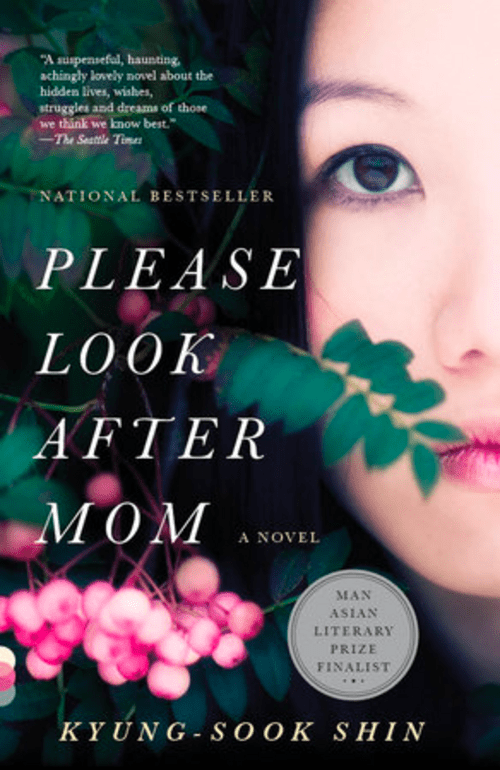
Book: Please Look After Mom by Kyung-Sook Shin, New York, ALFRED A. KNOPF, 2011, 288 pages, 17.9 x 2.2 x 20.2 cm, ISBN 10: 0307593916, $15.49
by Jasmine Khan
“To you, Mom was always Mom. It never occurred to you that she had once taken her first step or had once been three or twelve or twenty years old. Mom was Mom. She was born as Mom.”
Ever taken a moment to pause and reflect on all the sacrifices your mother has made for you? Ever thought that your mother too, had once been a young girl with her own dreams and ambitions in life just like you? Do you really know and understand your mother as much as you think you do? ‘Please Look After Mom’ is a poignant, reflective, and introspective novel by Kyung-sook Shin; that will make you ask these questions to yourself. The story revolves around the sudden disappearance of an elderly Korean woman, Park So-nyo, who gets left behind at the crowded subway station upon her arrival in Seoul, and thus, begins the family’s search for their missing mother. Divided into four different sections, we get to know each family member’s relationship with the mother, including Park So-nyo’s husband, as they all find themselves in utter guilt and regret once the realizations dawn upon them how little they all know about her and how neglected she had been by everyone at different stages in her life.
Shin debuted with Winter’s Fable in 1985, after she graduated from the Seoul Institute of Arts as a creative major. Having won notable awards and accolades, she is known as the first woman who bagged the ‘The Man Asian Literary Prize’ in 2011 for Please Look After Mom; translated to English by Kim Chi-young. This book, having sold more than a million copies within the first ten months of its release has also been adapted into stage play and musical. The author has done an excellent job of characterising each family member along with significant secondary characters who further add depth to a rather simple story. A story that resonates with mothers all around the world at several points in their lives evoking several emotions at once. Each character’s memories and flashbacks add layers to what would otherwise be just another story about a missing person.
The theme of guilt runs throughout, as each character struggles with their own sense of responsibility when they realise their neglect that led to the Mom’s missing. Chi-hon, the eldest daughter carries a heavy burden of guilt for not being able to understand her mother’s sacrifices and taking her for granted. She regrets not spending more time with her and feels responsible for her disappearance as the author claims, “Either a mother and daughter know each other very well, or they are strangers” (p.17). On the other hand, Hyong-chol, the only son in the family, feels guilty for not being able to protect his mother, as he was too focused on his own life and failed to appreciate her unconditional love and care. The father carries the guilt for neglecting his wife and her sacrifices. He is haunted by the realisation that he neither fully appreciated her presence until she was gone; nor was loyal to her, as he regrettably admits to his daughter, “There’s always the right time to say something.… I lived my life without talking to your mom. Or I missed the chance, or I assumed she would know” (p.130). These characters’ guilt reflects their deep remorse for not acknowledging So-nyo’s importance in their life and can only hope and pray for her to be safe and sound wherever she is, while they are on a lookout for her. On the contrary, So-nyo’s exact whereabouts remain unknown for a significant portion of the story, the revelation of which from her perspective gives readers a glimpse of the depth of her devotion and unconditional love towards her husband and children that kept the family together. However, it also reveals her own world of unexpressed desires and dreams. The mother’s perspective is filled with unspoken regrets and a sense of invisibility, and her reflections on the choices she made and paths not taken reveal a sense of loss and unfulfilled potential; yet it somewhat brings a sense of closure to the reader, but not in a way you might think. The ending of the story leaves room for reflection and contemplation.
This heart-warming and emotional novel takes the readers on a journey of self-discovery, emotional turmoil, heartbreak, and the realisations of every mother’s selflessness, love, dreams, hopes, and sacrifices. Please Look After Mom is beautifully written as it explores the complex themes and pressing issues related to family dynamics, identity, fidelity, patriarchy, as much as it is about maternal love, parent-child relationship, significance of education and career, differences between urban and rural life. An instance from the book highlights how the mother has placed value on education, mobility, and freedom, despite herself being uneducated and illiterate, as she says to her daughter, “You have to work hard in school so you can move into a better world” (p.18). With a similar conviction she confronts her husband as well, “We don’t have anything, so how is that girl going to survive in this world if we don’t send her to school?” (p.37). The novel in its own way, highlights how a mother’s unconditional love for her children and husband often goes unnoticed and neglected, until her absence is felt.
Another significant theme in this novel is cultural identity. The story majorly takes place in South Korea, where traditional gender roles are still prevalent as women are expected to always put their families first, sacrificing their own desires and dreams. This theme is illustrated in Mom’s story where she gives up her own aspirations and opportunities for her family’s sake, “Only after Mom went missing did you realize that her stories were piled inside you, in endless stacks. Mom’s everyday life used to go on in a repeating loop, without a break” (p.179). As the story progresses, the younger daughter’s life is presented in the novel, which is strikingly and ironically like Mom’s own life. She returns from abroad with her children to readjust in Korea and becomes confined to the outskirts of the city while taking upon the traditional duties of a mother, all the more becoming Mom’s very own reflection. Despite the gift of mobility, more freedom and better education that was accessible to the youngest daughter, she ended up somehow betraying those opportunities, adding to Mom’s painful observation of her own daughter’s fate being similar to her.
Shin’s writing is incredibly introspective and poetic as she uses imagery to bring settings to life. A unique aspect of this novel is its multi-perspective narrative style and unique structure where each character carries their own voice, that ranges from first person to second person, as well as in third person. This can come across as confusing at first for some, but then the flow eases the reader into the writing style of the author, and gradually as one reads and delves further into the story, the realisation will dawn upon why it has been structured that way. The tone might come across as harsh as if it is directive and accusative. However, once this feeling sinks in, only then it becomes more poignant as to how this story allows us to connect intimately with each character. I found this novel a gripping and compelling read because its uniqueness lies in its ability to weave together multiple perspectives that allowed me to reflect upon the inherent value of cherishing and appreciating our loved ones while they are still present in our lives as well as experience the complex waves of emotions, surrounding the profound presence of my mother in my life at every step. At its core, Please Look After Mom is a tribute to motherhood and maternal sacrifices, but it is more about realising how a mother’s heart is filled with unwavering and unconditional love told from the exquisite perspective of a daughter, a son, a husband, and a mother.
Jasmine is currently at a managerial position for a Dubai-based company. She has several articles published under her name and has offered her editorial inputs for various culture, lifestyle, media, entertainment, and news-based platforms.
 TheDaak review
Leave a comment