
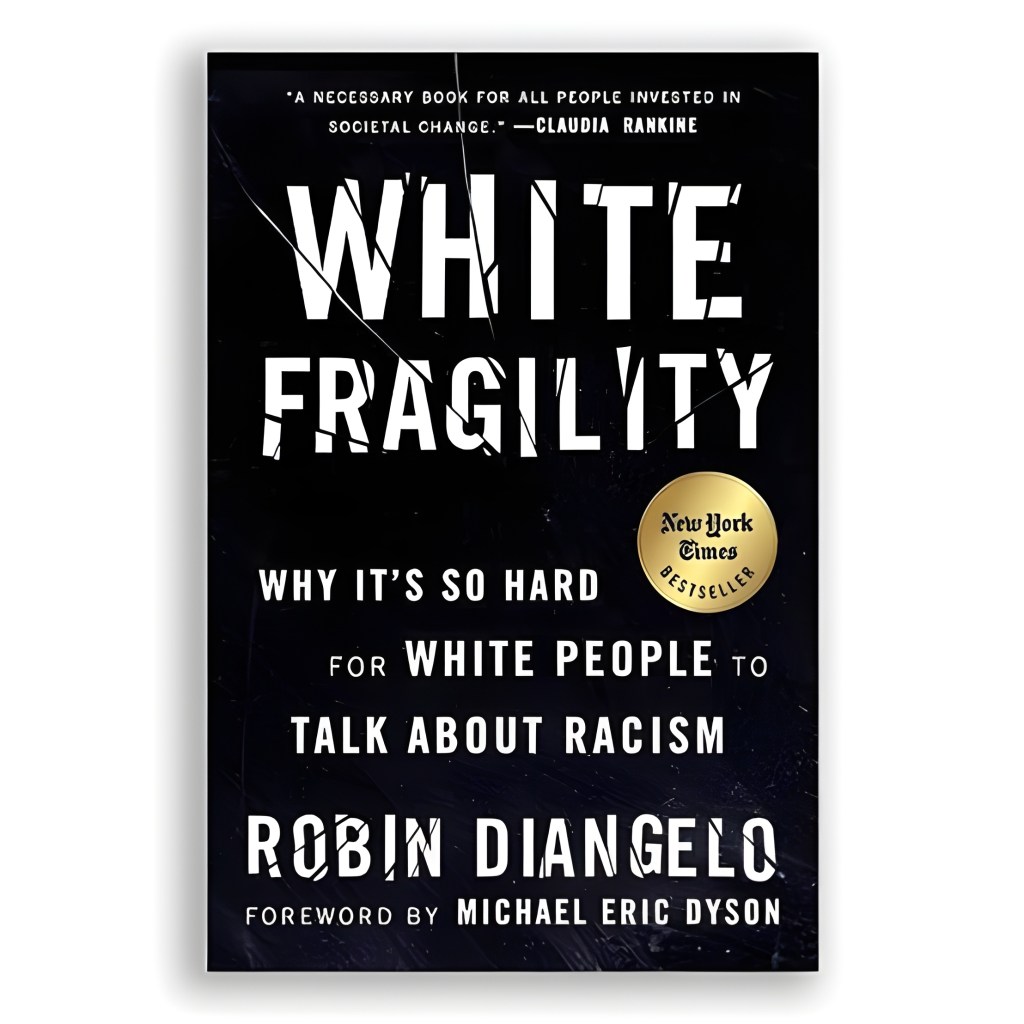
White Fragility: Why It’s So Hard for White People to Talk About Racism (EPUB) by Robin DiAngelo, Boston, Beacon Press, 2020, 192 pages, $24.95, ISBN 9780807047408
In light of polarised public opinion around issues of race and racial discrimination in the American context, sociologist and diversity consultant Robin DiAngelo, in her book White Fragility—Why It’s So Hard for White People to Talk About Racism, employs a sociological lens to deconstruct why conversations around racism and acknowledging internalised racist bias is challenging for white people. Written primarily for “white progressives” (loc. 205) this book adopts a socio-historical and psychological lens to structurally situate race in American history. It also explains socialisation into white supremacy and rationalises the contemporary defensiveness of white people in conversations which implicate them in racism or even merely suggest that “being white has meaning” (loc. 161). DiAngelo herself is a ‘white’ anti-racism consultant. However, recognising that she might be seen as another white individual centering the narrative towards themselves, she clarifies that it is in refusing to instrumentalise her privilege to drive reformative discourse that she or any individual in a position of power fails.
Right from the dehumanising slave trade to the segregationism enforced by the Jim Crow laws to the surreptitious systemic disadvantage marginalising racial minorities in the twenty-first century, American society has historically been. It continues to be plagued by the pernicious force of racism. However, despite copious empirical evidence revealing structural racial bias across institutions and its detrimental consequences on the life chances of disadvantaged races, the fact that their worldview is racially conditioned is a suggestion frequently denied by white people. Attempts at flagging bias in their outlook often provoke responses aimed at proving innocence, such as references to – their friendship with people of colour, their support for an African American political leader or their belief in equality of all. In this book DiAngelo deconstructs this discomfort, ascribing culpability for the persistence of racism to the operation of the eponymous phenomenon – ‘white fragility’. Having first explained the concept of white fragility in a paper by the same name in 2011, DiAngelo goes on to develop the same in-depth in this book.
Divided into fifteen chapters, the book is broadly structured as such— it begins by outlining the historical trajectory of racism in the USA, going on to explain how racism as a concept has evolved in the American context with time and with the changing notion of political correctness. This forms the premise for delving into how white fragility operates to insulate white people from conversations around racism and contributes to the sustenance of racism.
In chalking out the historical trajectory of the emergence of racism in the USA, DiAngelo employs what Wendy Bottero would call a structural framework to explain race-based social stratification — citing the pursuit of economic profitability as the motive, driving the founding fathers of the USA to commission race science. By scientifically grounding unequal treatment of blacks in their intrinsic, biological inferiority, these studies justified their exploitation, reconciling America’s founding ideals of freedom and equality with its “reality of genocide, enslavement and colonisation” (loc. 344). Thus, she underscores the social construction of race and its impacts.
Explaining socialisation, DiAngelo clarifies that no one is insulated from the influence of social forces that mould our understanding of what different gender, racial and economic identities mean and teach us to perceive certain group memberships as being better than others. Popular cultural narratives, the content of academic curriculums and a lack of “cross-racial relationships” (loc. 586) present whiteness as the default. Insofar as their racial makeup is concerned, whites are therefore always comfortable, their sense of belongingness almost perpetually robust. Given constant socialisation into a culture, that on the one hand, views black identity as deviant and inferior and, on the other, idealises principles of individualism, meritocracy and objectivity, the whites perceive their world-view as universal, believing privileged life chances to be the outcome of merit and effort, independent of the influence of one’s group identity and the position that group holds in the society. DiAngelo’s explication reveals an interesting irony —how socialisation into an individualist culture leads to the denial of socialisation itself. However, an exploration of how perceptions of members of the black community are socially conditioned is absent from the text. For instance, have blacks also internalised white supremacist beliefs? If so, how and why? I believe an exploration of this dimension would have added to the depth of the analysis of the text. Moreover, the author’s generalisation of the white experience in broad strokes fails to take into account variations evident in works such as sociologist Jay MacLeod’s Ain’t No Making It (2018). MacLeod’s (2018) research in a low-income American neighbourhood revealed that the achievement ideology tying success to merit and hard work was internalised by the poor Black students and not their white peers, who had rejected it.
DiAngelo’s central argument, that of maintenance of “racial status quo” (loc. 190) by the white fragility equation, grounds itself in an explanation of how racism in practice has come to acquire different forms over time, adapting to changing conceptions of what is politically correct. The author notes how racism went from its overt form, largely manifesting as explicit oppression and violence against blacks until the mid-twentieth century, to its aversive, symbolic nature at present. Racism in its present form — while maintaining similar racial outcomes of generational disadvantage and inequality for blacks — is coded and hence, difficult to call out. DiAngelo notes that this is what Eduardo Bonilla Silva called “colour-blind racism” (loc. 693). This conceptual category of aversive racism, which can also be situated in the context of caste and gender, explains subtle, indirect discrimination in attitudes of members of a dominant group towards those of a subordinate one. The basic operating principle in contexts of identity-based power asymmetry is arguably identical.
For DiAngelo, the Civil Rights movement and the Act of 1964 were watershed moments. Post this movement, while racism was pushed to the domain of subconscious belief owing to a dissonance between overt endorsement of racial prejudice and people’s explicit ideals of equality and fairness, popular understanding of what racism meant remained outdated. White people’s narrow conception of racism as deliberate acts of “discrimination committed by immoral individuals” (loc. 244) situates it within a “good-bad binary” (loc. 1126), making any suggestion of racially biased behaviour on their part an attack on a white individual’s self-identity as a “good” person. The prevalent belief is that “only bad people are racist” (loc. 1920).
Anthropologist Pierre Bourdieu theorises people’s “familiar ways of perceiving, interpreting and responding to social cues” (loc. 1550) as constituents of their habitus. Using Bourdieu’s concept, DiAngelo writes that subjection to even a minimal degree of “racial stress” (loc. 161), resulting from calling out racially biased behaviour of a white individual for instance, creates an unacceptable disequilibrium to the latter’s habitus, leading them to resort to defensiveness, argumentation or denial as coping mechanisms to restore equilibrium — this is white ‘fragility’ in operation, a concept which, unlike its name, has the strong implication of truncating attempts to talk about racism, thereby sustaining the status quo.
At the end of what can primarily be called an explanatory rather than a prescriptive text targeted at a white readership, DiAngelo briefly recommends acknowledgement of internalised bias and embracement of antiracist assumptions as effective correctives against white fragility. Viewed as a book meant to awaken her white readers to their complicity at an individual level, her resolution appears practical. Within the broader discourse on critical race theory, however the proposal of an exclusively individualistic solution to what the author herself identifies as a deeply systemic problem is inadequate.
DiAngelo mentions, albeit in passing, the global pervasiveness of white supremacy owing to forces of colonisation. However, her engagement with the white fragility framework remains limited to the USA. Moreover, her repeated use of the phrase ‘people of colour’ is misplaced, as she speaks solely of the white-black dynamic; she doesn’t engage with racism faced by other minority racial groups such as Asians. Employing the white fragility framework outside the American context and in relationship with other marginalised races would have made for a far more nuanced analysis, as would its location at the intersections of race and other identities such as gender and class.
Overall, what makes White Fragility an important addition to the literature on critical race theory is its accessibility. It is a jargon-free, crisp read, suitable as a point of departure for readers unfamiliar with available scholarship on race. This text is likely to provoke some introspection, a necessary step towards reforming an oppressive status quo.
References
- Gaertner, Samuel L. and John F. Dovidio. “Aversive Racism.” Advances in Experimental Social Psychological 36 (2004): 1–52. https://doi.org/10.1016/S0065-2601(04)36001-6
- MacLeod, Jay. “Teenagers in Clarendon Heights: The Hallway Hangers and The Brothers.” In Ain’t No Making It, 25-50. New York: Taylor & Francis, 2018. https://doi.org/10.1201/9780429495458
Namrata has recently completed her Masters in Political Science from Jawaharlal Nehru University. She is an incoming graduate student at the Department of Management, London School of Economics and Political Science.


Leave a Reply