
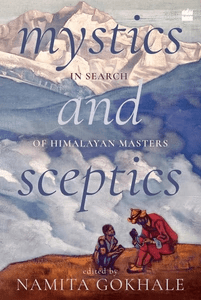
Mystics and Sceptics: In Search of Himalayan Masters edited by Namita Gokhale, Harper Collins India, 2023, 336 pages, 23 x 15.3 x 2.9 cm, ISBN: 9356295727, Rs. 699
“Is it we who invent the stories and thus inform the land,
or does the land invent the stories, thus inventing us?”
Paula Gunn Allen
(Kaul, 2018, p. 83)
The relationship between space and the social sciences has been a dynamic one, with the fluctuating importance of space as a factor in human agency from time to time. Initially, as Chetan Singh points out in his work Himalayan Histories, geographers and historians cooperated in research that showed how “humans and their natural surroundings were seen as interacting and influencing each other in bringing about long-term social and natural transformation.” (Singh, 2019, p.1) Gradually, however, with the increasing capability of humans to control nature and improve their material conditions, an anthropocentric attitude emerged. According to Singh, “territories and regions came to be regarded even more explicitly as the physical background or theatrical stages upon which historical actions are performed.” (Singh, 2019, p.2)
The book Mystics and Sceptics: In Search of Himalayan Masters, which has been edited by Namita Gokhale, challenges this reductionist view of seeing nature as a mere receptacle in the study of human consciousness and actions. Simon Schama, in his work Landscape and Memory, remarked that-
“For although we are accustomed to separate nature and human perception into two realms, they are, in fact, indivisible. Before it can ever be a repose for the senses, landscape is the work of the mind. Its scenery is built up as much from the strata of memory as from layers of rock.” (Schama, 1995, p.6-7)
Diana Eck, in her book India: A Sacred Geography, explains how India’s rivers, mountains, hills and coastlands are imbued with the stories of Gods and heroes. Likewise, she also shows how every myth or legend is connected to a certain place. The geographical features are revered as representations of the divine. Eck, therefore, uses the term ‘Sacred Geography’ in order to refer to this ‘imagined but lived landscape’- one that may focus on a particular temple, hill or river but sets it in a wider frame. It is a landscape as the features are connected and linked to a wider whole of epic cosmology and pilgrimage networks. For example, we have the 51 Shakti Peethas, which connect the different abodes of the Devi throughout the country into a single narrative frame. This is achieved, as Eck terms it, through the ‘grammar of sanctification’- involving the description of acts which either led to the manifestation of the divine at a particular spot or its attachment therein- thus sanctifying the site. (Eck, 2012)
Thus, we see in Diana Eck’s work how the footsteps of the pilgrim create a landscape based on myth, memory and association that shape human perception of nature. This was, therefore, an act of map-making which lent a certain meaning to the geography it was concerned with, which, in turn, shaped human actions of pilgrimage and trade across such networks. Therefore, humans and nature have a reciprocal relationship in the making of this sacred landscape. (Eck, 2012)
In a similar manner, this book shows us how the sacred landscape of the Himalayas has been created by human beings and is imbued with a power of divine meaning, which has, in turn, given meaning to and influenced human actions in the region. This gives us a new understanding of regions which are no longer defined through objective attributes, rather, are seen as outcomes of a “dynamic relationship existing between an area and the social processes and ideologies that give it meaning.” (Singh, 2019, p.3) This relationship of regions with humans influenced how David Knight saw the nature and metamorphosis of territories- “In a sense, territory is not, it becomes; for territory itself is passive, and it is human beliefs and actions that give territory meaning.” (Singh, 2019, p.3)
Given their topography and immense cultural diversity, the Himalayas are one of the best sites where one can study the interaction between nature and humans. It has often been argued, in the context of Mountain Studies, that mountainous physiography has a preponderant impact on human beings and, therefore, creates societies that perceive themselves distinctly from plain based societies. Moreover, it has also been argued that the presence of such similar ecological conditions across mountain-based societies would generate similar social responses (Singh, 2019). Irrespective of the veracity of the claim that mountain societies across the world are largely similar, the intensely close relationship that humans maintain and negotiate with nature while living in the mountains is a fact. Given this context, the Himalayas deserve to be brought into any discussion on the relationship between humans and nature.
Therefore, the book is a valuable contribution to the study of the interface between nature and human lives or actions. It is a collection of 25 essays on the spiritual experiences, or the lack thereof, that different individuals have had in their interaction with the Himalayas. The contributions come from a diverse range of individuals- spiritual beings, diplomats, journalists, travellers, and many others. The perspective of the believer and the sceptic, the initiated and the disillusioned- all find their place in this volume.
The individual experiences of several monks or spiritual renunciates are covered in these essays. For example, Andrew Quintman and W.Y. Evan Wentz talk about one of the greatest spiritual masters in the history of Tibetan Buddhism- Milarepa. They show how even the mundane geographical features of the Himalayas, like lakes, glaciers, mountain peaks and valleys, came to be imbued with meaning through Milarepa’s spiritual experiences and how these features continue to play an important role in the life of the Himalayan communities to this day. Navtej Sarna, in a similar fashion, tries to show how a Sikh sacred geography was formed by retracing the journey of the Sikh Gurus like Guru Nanak and Guru Gobind Singh through the Himalayas. We get an understanding of how famous sites like Manikaran and Paonta Sahib emerged. Holly Gayley and Ranjit Hoskote question the patriarchal dominance in narratives of spirituality by highlighting how women like Yeshe Tsogyal, Khandro Tare Lhamo and Lalleshwari/Lal Ded led their lives and impacted the communities in whose midst they lived. In Lhamo’s case, we get an interesting glimpse of how spiritual experience gave certain women leadership roles within Himalayan communities.
Coming to more recent times, we have Makarand Paranjape’s essay which describes the importance of the Himalayas to the spiritual experiences of Swami Vivekananda, who returned repeatedly to the Himalayan pilgrimages and its natural features as a source for his inspiration and vigour. Paramhansa Yogananda fondly reminisces about his escape to the Himalayas as a school kid. Sujata Prasad describes the journey of the polyglot and polymath Rahul Sankrityayan, who, despite being a sceptic, made painstaking efforts to travel across the Himalayas, particularly in Tibet, to retrieve and disseminate texts belonging to both the Hindu and Buddhist traditions of South Asia. The transcript of the interview that Rajiv Mehrotra conducted with the 14th Dalai Lama gives us an understanding of Tibetan Buddhism.
Besides such accounts, we have essays which talk about the contributor’s individual spiritual experience of some ritual, event, place or even interaction with a person. The volume’s editor, Namita Gokhale, fondly writes about being spiritually transformed through her interaction with Neem Karoli Baba and Siddhi Maa and the location of their Ashrams amidst the Himalayas which seems to have added to the experience. Ramola Butalia talks about the Siddha tradition, Madhu Tandon talks about “letting go” after her disillusionment with a spiritual figure, and Alka Pande talks about the Shakti Peethas like Naini Devi and Jwalamukhi which have moulded her personality.
Four essays particularly stand out for their association of spirituality with the Himalayas and how Himalayan people themselves (and not outsiders) react to such an imagery. For example, Western observers like Alexandra David Neel have illustrated Vajrayana Buddhist practices like ritual possession. In Alexandra David Neel’s own words-
“Shrouded in the moving fogs, a fantastic army of trees, draped in livid green moss, seems to keep watch along the narrow tracks, warning or threatening the traveller with enigmatic gestures. From the low valleys buried under the exuberant jungle to the mountain summits covered with eternal snow, the whole country is bathed in occult influences. In such a setting it is fitting that sorcery should hold sway.” (Gokhale, 2023, p. 98-99)
These words not only bring out the close connection between the geography and climate of a place with the society and culture of the people living there, which was discernible to the observers’ eye, but also allow a glimpse into the typical Western fascination with the idea of a spiritual hermitage or ‘Shangri-La’ in the heights of the Himalayas, offering solace from the anxieties and dislocations of a post-industrialized West. The same attitude is evident in two essays of Rene von Nebesky-Wojkowitz, which again focuses on the theme of ritual possession and how the Himalayan landscape plays a role in it.
One of the most interesting essays, which stands out from the others in the volume, is the one by Vaibhav Kaul. Kaul portrays how the landscape of the Thanggu Valley in Sikkim- dotted with glaciers, moraines, lakes, and rivers- is imbued with a sacred meaning by the people who live there. Not only are these natural features worshipped as divine, some of them, like the mountains, are seen as guardians of the landscape and protectors of morality. Whenever any geophysical disasters such as flash floods or avalanches occur, the people of Thanggu Valley take it as a functioning of the law of Karma– divine punishment for human failings with regard to respecting the sanctity of the landscape or failing to abide by piety and righteousness. Vaibhav Kaul sees in such an attitude a different kind of environmental ethics, which can be effective when engaging with indigenous and marginalised communities to ensure the sustainability of their landscape.
Mystics and Sceptics, therefore, is a valuable contribution to the study of the interface between nature and human lives or actions. It particularly focuses on how human spirituality, in the case of South/ Central Asia, has been shaped by the Himalayas and how, in turn, humans have created the landscape of the Himalayas. The impact of this dual interaction on the actions and consciousness of the Himalayan communities has been well covered by the essays in this volume. Therefore, it is an essential read for those interested not just in religion and spirituality but also in the history of the Himalayas.
Bibliography
Eck, D. (2012). India: A Sacred Geography. Harmony Books.
Kaul, S. (2018). The Making of Early Kashmir: Landscape and Identity in the Rajatarangini. Oxford University Press.
Schama, S. (1995). Landscape and Memory. Random House.
Singh, C. (2019). Himalayan Histories: Economy, Polity and Religious Traditions. State University of New York Press.

I am Sukrit Banerjee from Kolkata, West Bengal, India. I am currently pursuing my PhD in Modern History from JNU, New Delhi. I plan to work on the process of colonial border making and frontier policy in the Eastern Himalayas, from 1772-1947. My hobbies include listening to music and reading books (both fiction and non fiction). I am trained in Indian Classical Music and in Painting. Apart from History, my interest lies in subjects like International Relations, Philosophy and Religion.
Email: banerjeesukrit@gmail.com



Leave a Reply