
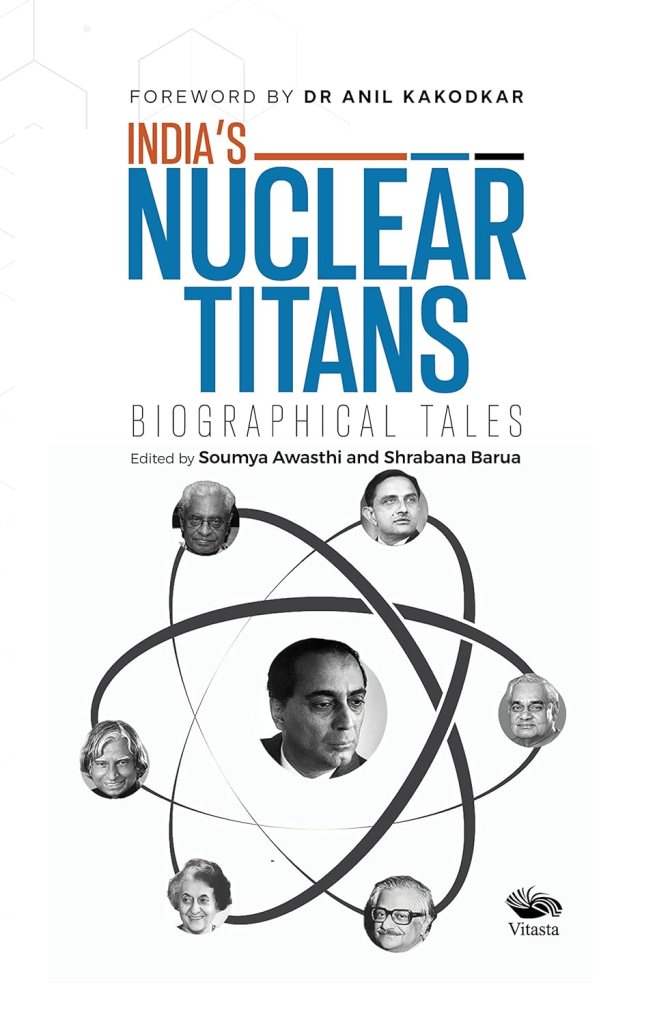
India’s Nuclear Titans: Biographical Tales by Soumya Awasthi and Shrabana Barua (eds.), New Delhi: Vitasta Publishing Pvt Ltd, 2023; pp.xlvii+327, ISBN: 9788196041373, ₹595 (Hardcover).
It has been twenty five years since India became an overt nuclear power. The nuclear tests conducted by India in 1998 marked a watershed moment in the country’s nuclear journey. It put an end to the ambiguities surrounding India’s nuclear program right from its origin. Since then India’s nuclear policy has travelled a long way in defying the global non-proliferation regime on the one hand and engaging in nuclear cooperation with the US for civilian purposes on the other. As Indians we do take pride in our country’s nuclear ‘exceptionalism’ but how many of us are aware of the sacrifices and contributions of the individuals who helped give shape and vision to India’s nuclear policy? The nuclear India we see today is the result of the toil and hard work of several individuals who contributed to India’s nuclear program in different capacities. In this regard, Soumya Awasthi and Shrabana Barua’s edited book titled India’s Nuclear Titans: Biographical Tales published recently celebrates the life and works of ten such personalities who envisioned, implemented, strategized and diplomatically guarded India’s nuclear ambitions since the early decades of independence.
The volume is certainly not the first of its kind as India’s nuclear history has been well documented earlier in the works of authors like George Perkovich, Raj Chengappa, Robert Anderson, Amitabh Mattoo and many others. India’s Nuclear Titans is different from the earlier works in two ways, firstly, the book traces some of the recent developments in India’s nuclear policy which the earlier works were unable to cover. For instance, New Delhi’s quest to “catapult itself into the nuclear map of the world” (p. xiiii) by transforming its relationship with the US from one of engagement to that of cooperation has been well documented in the book. It has also underscored the fact that despite becoming a declared nuclear power, India has remained loyal to its commitment for a phased elimination of nuclear weapons from the world and also offered its assistance to the UN in this regard in 2008 (p. 307). These issues had neither been addressed in Perkovich’s India’s Nuclear Bomb: The Impact on Global Proliferation (1999) nor in Raj Chengappa’s Weapons of Peace: The Secret Story of India’s Quest to be a Nuclear Power (2000) as the timeline of both these works were confined to the year 1998 when India became openly nuclear. Secondly and most importantly the book brings forth a new way of reading the nuclear history of India through the lives of the people who not only toiled in making India a nuclear power but also developed its nuclear strategy. The book does not limit its focus to scientists and politicians alone, it goes a step further to shed light on the role played by nuclear strategists as well as diplomats. This is a remarkable departure from the earlier works on India’s nuclear history that mostly discussed the contributions of either the nuclear scientists or the politicians. The book is a collage of the life stories of ten characters, a peep into which will help the readers gain a holistic understanding of India’s nuclear history which is rather complicated and debated.
The book has been divided into four sections- the first section includes four chapters that deal with the eminent scientists of India- Homi J. Bhabha, Vikram Sarabhai, Raja Ramanna and APJ Abdul Kalam. The common factor binding all these scientists was their zeal to harness the benefits of scientific and technological progress and channel it towards the development of the nation. The relentless efforts of these scientists to establish an indigenous nuclear program were unparalleled. For example, in Chapter one gets to learn about the pivotal role played by Homi J. Bhabha in establishing the Tata Institute of Fundamental Research (TIFR) in 1945 and the Atomic Energy Commission (AEC) of India in 1948. Needless to say, these institutions went a long way in shaping India’s nuclear destiny. Both Bhabha and Jawaharlal Nehru were in favour of using nuclear energy for peaceful purposes but at the same time, they also kept the option of building a nuclear bomb open (p.309).
After the untimely demise of Bhabha in an airplane crash, India’s nuclear program was ably guided by one of his bright disciples- Vikram Sarabhai. Even though Sarabhai’s greatest achievements are alluded to India’s space program yet one cannot turn a blind eye to his contributions in the field of nuclear science and technology. The second chapter depicts how Sarabhai led both the AEC and DAE at a critical juncture and filled in the void created due to Bhabha’s death. However, Sarabhai’s pacifist worldview meant that he was not much in favour of building a nuclear bomb and in that sense his position was a departure from his predecessor (p.43).
We mostly remember Bhabha and Sarabhai as the pioneers of India’s nuclear program but that leads us to ignore the valuable contributions of another prominent scientist named Raja Ramanna who also harboured a great love for music. This book does justice to Ramanna by dedicating a separate chapter that sheds light on his numerous feats as a nuclear scientist. The third chapter of the book points out how Ramanna wanted India to become self-sufficient at the nuclear level. It was due to his efforts that the CIRUS reactor was brought to India. Ramanna also headed the Study of Nuclear Explosions for Peaceful Purposes (SNEPP) project which was ordered by Prime Minister Lal Bahadur Shastri.
If Bhabha, Sarabhai and Ramanna had laid the basic foundations of India’s nuclear program, it was Dr. APJ Abdul Kalam who had steered it to higher levels. The fourth chapter celebrates the life and works of the former President of India- APJ Abdul Kalam. In this chapter author Rajaram Nagappa provides us a glimpse of Kalam’s pursuits in making India self-reliant when it came to the manufacturing of delivery systems/vehicles that would carry and deliver strategic weapons on specific targets located deep within enemy territory. In the 1980s Kalam headed the Integrated Guided Missiles Development Program (IGMDP) at the Defence Research and Development Organization (DRDO). Today India possesses surface to air missiles and Inter Continental Ballistic Missiles (ICBMs) of varied ranges like Prithvi and Agni but the brain that oversaw the making of these capabilities was none other than the ‘missile man of India’- APJ Abdul Kalam. He had the foresight to make India’s strategic deterrence more credible and strong.
The second section of the book succinctly depicts how two of India’s most decisive Prime Ministers- Indira Gandhi and Atal Vihari Vajpayee showed exemplary courage and determination in ordering the nuclear tests of 1974 and 1998 respectively. Chapter 5 and 6 sum up the political life of Gandhi and Vajpayee and also focuses on the role played by them in nuclear decision making. Decisions on sensitive matters like the nuclear policy of a country are not taken in vacuum, both internal and external variables combine to influence them. This fact has been well acknowledged in these two chapters where the authors Sitikanta Misra and Yasemin Develi (pp. 119-151, 172-178) draw our attention to how the interplay of multiple factors like domestic political pressure, discriminatory nuclear regime (NPT and CTBT), and external threats from China and Pakistan determined the decisions of the two political leaders to conduct nuclear tests. For example, Indira’s decision to conduct the PNE (Peaceful Nuclear Explosion) in 1974 was not only influenced by the Chinese threat and Beijing’s collusion with Pakistan but also by domestic political considerations as the Congress party’s support base saw a sharp decline in many parts of the country coupled with the increasing popularity of Indira’s political rivals like JP Narayan and Morarji Desai (p. 133).
The major contribution of the book lies in the third section which accounts for the contribution of three nuclear strategists in moulding the government’s nuclear policy from time to time. They are K. Subhramanyam, Jasjit Singh and C. Raja Mohan. As members of the National Security Advisory Board (NSAB), K. Subhramanyam who was hailed as ‘India’s Kissinger’ (p.183), the fighter pilot turned strategist Jasjit Singh and the IR scholar with a nuclear physics background C. Raja Mohan were the main architects of India’s Draft Nuclear Doctrine in 1999, whereby the nation adopted the No First-Use nuclear policy and in the process projected itself as a responsible nuclear power.
Through their narratives, these strategic analysts also helped in convincing the Western capitals that India’s possession of nuclear weapons served the sole purpose of deterring its nuclear-armed neighbours from coercion or blackmail. Another common factor between the three strategists is their dedication towards educating the young scholars on matters related to national security and they also built institutions like the Institute of Defence Studies and Analyses (IDSA) and Center for Air Power Studies (CAPS) to this end. The only prism through which these strategic thinkers viewed the world was national interest. This fact is attested to Subhramanyam and Raja Mohan’s changing stance towards the USA in the post Cold War period and how both of them lobbied in favour of the 2005 Indo-US Nuclear deal.
The fourth and final section of the book caters to one of the finest and seasoned diplomats of India- Arundhati Ghose. Vijaylaxmi Yadav enlightens the readers on how Ghose representing India in the diplomatic forums did an outstanding job to protect India’s security interests. Out of her several achievements in the field of diplomacy, the one that stands apart is the way in which she negotiated India’s stance on the CTBT treaty. She was resolute in not accepting the arbitrary terms of the treaty which allowed the Nuclear Weapons States (NWS) to carry out tests by using modes other than explosive testing. Besides nuclear diplomacy, she also suggested the government to forge stable relations in the West Asia North Africa (WANA) region where the strategic landscape keeps on evolving.
India’s Nuclear Titans therefore presents before its readers a bunch of facts about the lives of those individuals who in varied ways influenced the making of the self-reliant and confident India that we see today. Interesting anecdotes like Raja Ramanna’s love for music, Jasjit Singh’s obsession with his red turban, punctuality of K. Subhramanyam or for that matter the chain smoking habit of Arundhati Ghose, make the book an exciting read. Also the main focus of the book i.e. the hard work, dedication and sincerity of all these personalities is itself an inspiration to the readers.
As is the case with writing biographical tales, the book has ended up being a tad more on the informative side rather than being analytical. A separate chapter could have been added on the pioneering role played by Jawaharlal Nehru in laying down the foundations of India’s nuclear program. Moreover, some of the scientific jargon used in the book makes it difficult for a layman to understand them. Notwithstanding these minor deficiencies, the editors and the contributors deserve appreciation for being able to compile the stories of ten Indian stalwarts in one volume. No doubt that it leaves the readers wanting more. It is an academic book not only for students of security but it does give a vivid picture to anyone who is interested in knowing the nuclear history of India.

Dhritiman Mukherjee is presently pursuing Ph.D. at the Department of Political Science, Presidency University Kolkata. His research interests include Nuclear deterrence, India-Pakistan Relations and Theories of International Relations.


Leave a Reply